
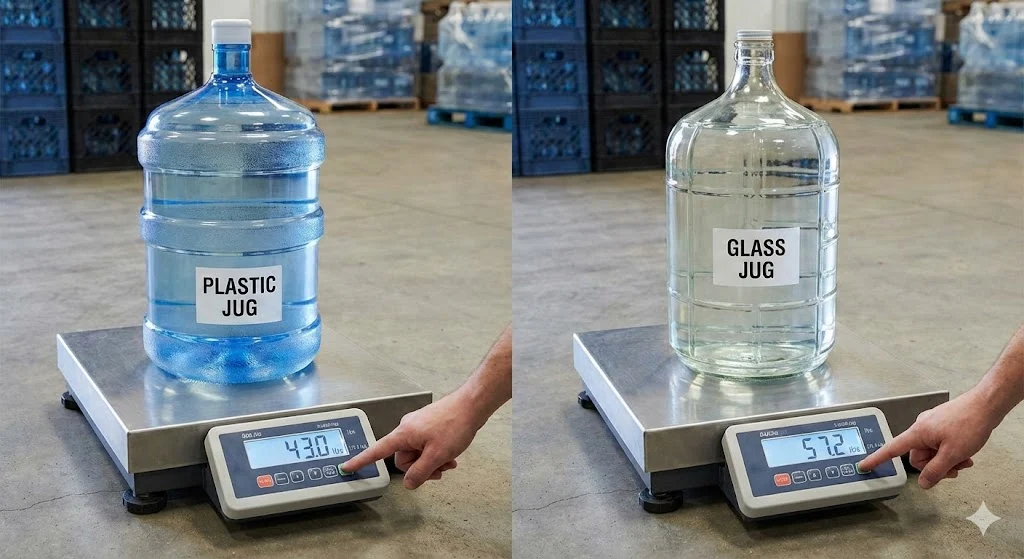
If you have ever carried a 5-gallon water jug, you know it feels heavy — especially when full. A standard 5 gallons of water weighs about 41.7 pounds (18.9 kg), but that is just the water. Add the jug itself and the real carrying weight climbs higher, with glass containers weighing far more than plastic. This guide gives you exact weights, conversions for every common size, and the science behind why water is so heavy.
How Much Does 5 Gallons of Water Weigh?
Water weighs approximately 8.34 pounds per gallon at room temperature (about 70°F / 21°C). The math is simple:
- 8.34 lbs × 5 gallons = 41.7 lbs (water only)
- 41.7 lbs ÷ 2.20462 ≈ 18.9 kg
That figure is for U.S. gallons, which is what nearly all American water jugs and dispensers use. A UK (imperial) gallon is larger, so 5 imperial gallons of water weighs about 50 lbs (22.7 kg) — worth knowing if you are reading specs from outside the U.S.
Water-Only vs Full Jug Weight
There is a meaningful difference between the weight of the water alone and the total weight you actually lift, which includes the container:
| Type | Weight (lbs) | Weight (kg) |
|---|---|---|
| Water only (5 gallons) | 41.7 lbs | 18.9 kg |
| Plastic jug (full) | 42–44 lbs | 19–20 kg |
| Glass carboy (full) | 50–55+ lbs | 23–25+ kg |
Why Does Water Weigh So Much?
Water has a density very close to 1 gram per cubic centimeter (1 g/ml), which is why volume-to-weight conversions for water are so clean. A single gallon contains about 3.785 liters, and each liter weighs almost exactly 1 kilogram. Multiply that across 5 gallons and you are carrying nearly 19 kilograms — roughly the weight of a medium-sized dog or a loaded carry-on suitcase. That density is also why a leaking or overfilled container can feel deceptively heavy.
Water Weight by Volume (Quick Conversion Guide)
| Volume | Weight (lbs) | Weight (kg) |
|---|---|---|
| 1 gallon | 8.34 lbs | 3.78 kg |
| 2.5 gallons | 20.9 lbs | 9.5 kg |
| 3 gallons | 25.0 lbs | 11.3 kg |
| 5 gallons | 41.7 lbs | 18.9 kg |
| 10 gallons | 83.4 lbs | 37.8 kg |
| 55 gallons (drum) | 458.7 lbs | 208 kg |
Need a size that isn’t in the table — or want the answer in liters, cups, or fluid ounces? Our free Water Weight Converter instantly converts any water volume to pounds and kilograms (and back), with temperature-aware density for extra precision.
Does Temperature or Water Type Change the Weight?
Slightly, yes. Water is densest at about 39°F (4°C), so very cold water weighs marginally more than warm water — but the difference across normal household temperatures is under 1%, too small to matter when you are lifting a jug. Water type matters a little more:
- Salt water is denser, weighing about 8.5–8.6 lbs per gallon, so 5 gallons of seawater is closer to 43 lbs.
- Distilled or purified water sits right at the standard 8.34 lbs per gallon.
- Ice is actually lighter by volume than liquid water, which is why ice floats — a frozen 5-gallon block weighs the same as the water it came from but takes up slightly more space.
Plastic vs Glass Jug Weight Differences
The container is where carrying weight really diverges:
- Plastic 5-gallon jugs weigh roughly 1–2 lbs (0.45–0.9 kg) empty
- Glass carboys can weigh 10–15 lbs (4.5–6.8 kg) empty
So a full glass jug can hit 55 lbs — comparable to lifting a heavy kettlebell. If you change the jug on a dispenser regularly and find it a strain, a hand pump or a jug stand can save your back. For storage planning, see how long you can safely keep water in our guide on storing drinking water safely.
Real-World Examples: What Does 41.7 lbs Feel Like?
To put the weight in perspective, a full 5-gallon jug weighs about the same as a 3-year-old child, a standard car tire and rim, or two gallons of paint plus a toolbox. That is why water-delivery services and dispensers are built around this size — it is the practical limit of what most adults can comfortably lift to chest height. Going up to a 7-gallon container pushes you past 58 lbs of water alone, which is why 5 gallons remains the sweet spot for home and office use.
FAQs
Is a 5 gallon water jug hard to lift?
Yes, a full jug weighs 42–55 lbs depending on the container, which can be challenging to carry or lift onto a dispenser. Using a hand pump or jug stand avoids repeated heavy lifting.
How much does 5 gallons of water weigh in pounds?
About 41.7 pounds of water only, or 42–44 lbs in a typical plastic jug.
How much does 5 gallons of water weigh in kilograms?
About 18.9 kilograms of water only, or roughly 19–20 kg in a full plastic jug.
Does temperature change water weight?
Very slightly — colder water is denser and weighs marginally more, but the difference across normal temperatures is under 1% and not noticeable in everyday use.
Does salt water weigh more than fresh water?
Yes. Salt water is denser at about 8.5–8.6 lbs per gallon, so 5 gallons of seawater weighs roughly 43 lbs versus 41.7 lbs for fresh water.
Why are 5 gallon jugs so common?
They balance capacity and portability — 5 gallons is about the heaviest size most adults can lift comfortably, making it ideal for dispensers and delivery.
How do I convert other water volumes to weight?
Multiply gallons by 8.34 for pounds, or liters by 1 for kilograms. For any other unit — cups, fl oz, imperial gallons — use our free Water Weight Converter, which handles all conversions instantly.
The Bottom Line
5 gallons of water weighs about 41.7 lbs (18.9 kg), and a full jug runs 42–44 lbs in plastic or up to 55 lbs in glass. Water’s near-perfect 1 g/ml density makes the math easy, and temperature or water type shift the number only slightly. Knowing the real carrying weight helps you plan safe lifting, storage, and transport — and for any other volume, the Water Weight Converter does the math for you.
![How Many Water Bottles Is a Gallon? [Quick Conversions & Tips]](https://completewaterguide.com/wp-content/uploads/2025/09/5-768x416.webp)