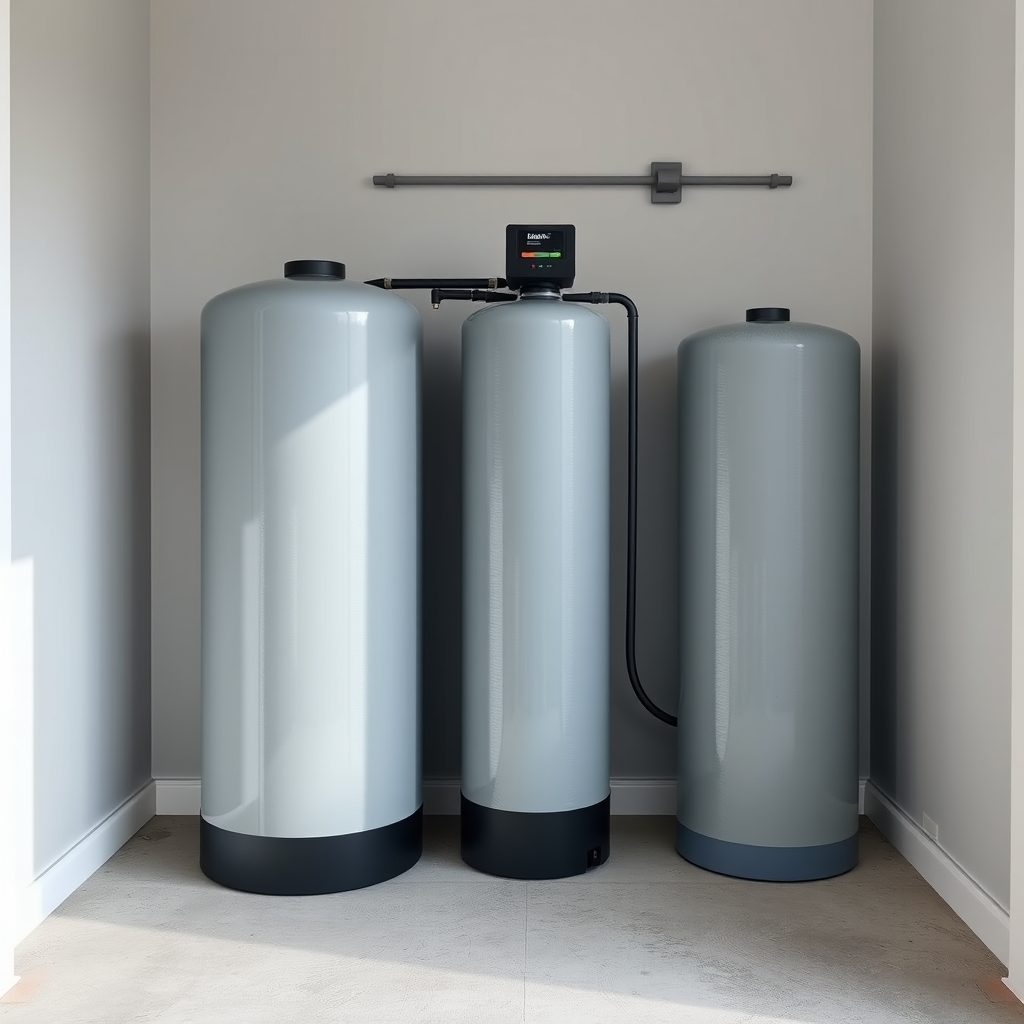
- “Salt-free softener” is a contradiction, but it is not illegal. The industry’s own trade association says a device that cannot get water below 1 grain per gallon may not be called a softener. That is a convention with no legal force, and no US regulator has ruled on the term.
- The gap between salt-free technologies is enormous. One independent study measured template-assisted crystallisation at over 88 percent scale reduction and electromagnetic devices at about 50 percent. Treating “salt-free” as one category hides that.
- A softener adds sodium in proportion to your hardness. About 7.9 mg/L for every grain per gallon removed, which passes the EPA’s 20 mg/L advisory level above roughly 2.5 grains.
Why does this confusion exist at all?
Because there is no legal definition of any of these words, and the one clear definition that exists comes from the industry itself.
The Water Quality Association’s Soft Water Task Force set the only bright line we could find:
Any water conditioning device that does not reduce the hardness of the feed water to less than 1.0 gpg cannot be called a softener and the water it produces cannot be called soft water.
That is precise, and it is exactly the distinction most buyers are missing. But it is a trade-body convention, not law.
We looked for a regulator that had acted on this and found none. No Federal Trade Commission case on the term. No National Advertising Division decision. No state statute defining “water conditioner”. A salt-free device can be marketed as a softener in the United States today, and many are.
So the word on the box will not tell you what the box does. The mechanism will.
What does each one actually do?
| Device | Mechanism | Removes hardness? | What it is for |
|---|---|---|---|
| Water softener | Cation exchange, regenerated with brine | Yes | Scale, soap scum, laundry, appliance life |
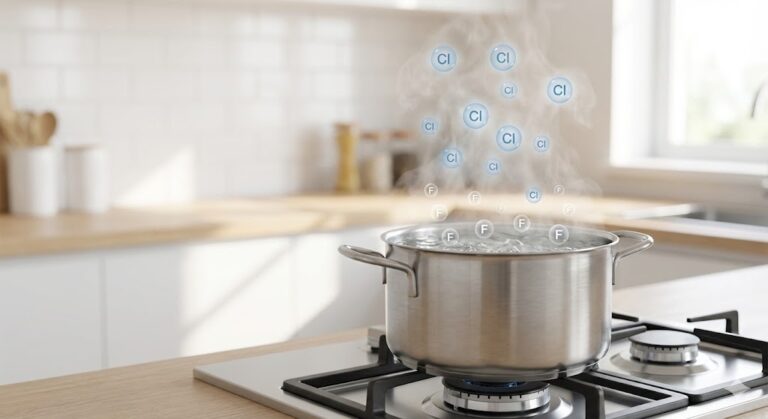
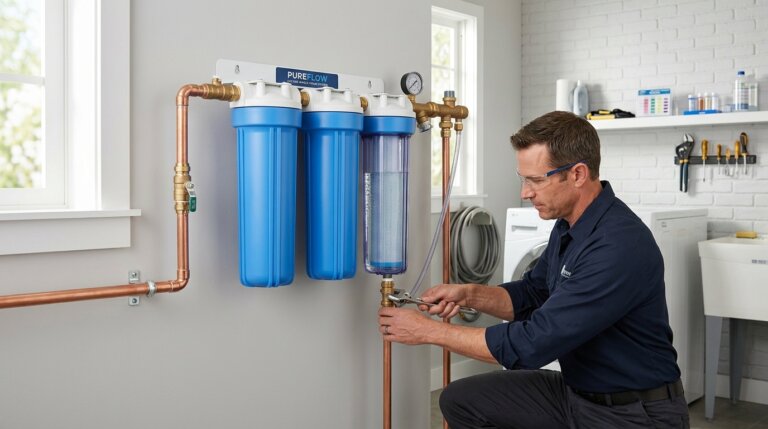
| Water filter | Carbon, membrane or media | No | Chlorine, lead, cysts, PFAS, taste |
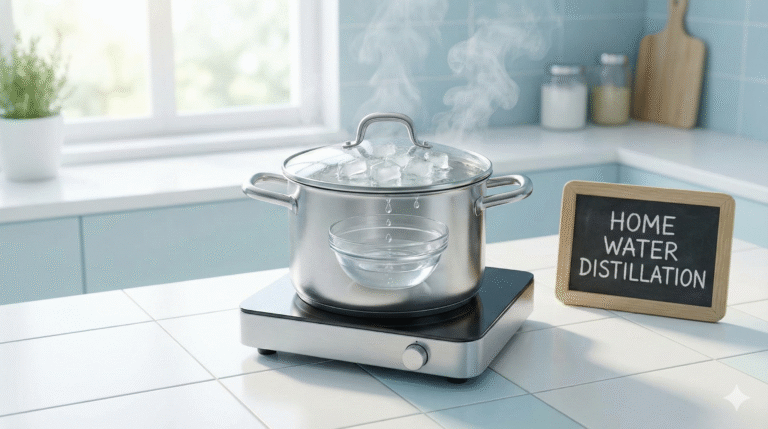
| Conditioner / descaler (TAC) | Template-assisted crystallisation | No | Scale prevention only |
| Magnetic / electronic descaler | Applied field, no media | No | Scale prevention, weakly evidenced |
Read the third column. Only one of these four makes your water soft.
The others are not inferior softeners. They are different products that happen to be sold in the same aisle, and two of them are aimed at a problem the filter does not address while ignoring the problem the filter solves.
How does a real softener work, and what does it put in your water?
Ion exchange resin holds sodium ions. Hard water passes through, calcium and magnesium stick to the resin, and sodium is released in their place. When the resin fills up, a brine flush strips the hardness off and reloads it with sodium.
The trade is fixed by chemistry: two sodium ions leave for every calcium ion captured. Working through the stoichiometry, that comes to about 7.9 mg of sodium per litre for every grain per gallon of hardness removed.
| Your hardness | Sodium added | At 2 litres a day |
|---|---|---|
| 5 gpg | ~39 mg/L | ~79 mg/day |
| 10 gpg | ~79 mg/L | ~157 mg/day |
| 20 gpg | ~157 mg/L | ~315 mg/day |
The EPA’s 2003 drinking water advisory sets a guidance level of 20 mg/L of sodium, and is explicit about who it is for:
developed for those individuals restricted to a total sodium intake of 500 mg/day and should not be extrapolated to the entire population
That matters in both directions. Softened water passes 20 mg/L above roughly 2.5 grains per gallon, which is most softened households. But the advisory is not a health limit for the general population, and sodium has no enforceable maximum in US drinking water.
For anyone genuinely on a 500 mg/day restriction, the numbers above are a real fraction of the daily budget. The EPA also notes, citing a 1977 National Academy of Sciences finding, that domestic softeners can raise sodium above 300 mg/L in some cases.
Do salt-free conditioners work?
One type does, well. Another type mostly does not. Collapsing them into “salt-free” is the single most misleading thing in this category.
The useful evidence here is a study by Fox, Wiest, Thomure and Lee for the WateReuse Research Foundation, carried out by Arizona State University with HDR Engineering. It was funded by municipalities, including the cities of Phoenix and Scottsdale, Santa Clara Valley Water District and Los Angeles County Sanitation Districts. These are organisations with an interest in reducing brine discharge, not in selling equipment.
| Technology | Scale reduction measured |
|---|---|
| Template-assisted crystallisation (TAC) | Over 88%, and over 90% |
| Electromagnetic | About 50% |
| Electrically induced precipitation | About 50% |
| Ion exchange (a real softener) | Effective, as expected |
Across all devices tested the range ran from 46 to 99 percent. TAC sat at the top of it. Magnetic and electronic devices sat in the middle, at roughly half the scale prevention.
For magnetic devices specifically, other independent work is harsher. A 1996 Lawrence Livermore National Laboratory evaluation concluded plainly:
No beneficial effect was found when using the magnetic device.
And a 2020 review in npj Clean Water, which has been cited well over a hundred times, put the state of the field this way:
the scientific basis for its purported effectiveness is not clear in the available literature, especially lack of quantitative assessment
So the honest summary is: TAC has real, independently measured performance. Magnetic and electronic descalers have a weak and contested evidence base, and at least one careful study found nothing at all.
Do the minerals stay in the water?
Yes. This follows directly from how conditioning works, and it is the cleanest way to understand why a conditioner is not a softener.
TAC works by converting dissolved calcium into microscopic suspended crystals. Those crystals are far less likely to bond to pipe walls and heating elements, which is why scale drops. But nothing leaves the water. The calcium is still there, in a different physical form.
Which means a conditioner does not soften water by any definition, including the trade association’s own. Your hardness test will read the same afterwards. You will not get the soap lather, the softer laundry, or the reduced detergent use that a real softener delivers, because those depend on the minerals being gone rather than rearranged.
One honest caveat: we could not find a primary study that measured calcium and magnesium before and after TAC treatment directly. The claim above follows from the mechanism as the researchers describe it. Vendor sites assert it too, but we are not treating those as evidence.
What does a softener not remove?
Almost everything you might actually be worried about in your drinking water.
The Wisconsin Department of Health Services publishes a table of which certified device types handle which contaminants. In the water softener column, only manganese is checked.
Not checked: arsenic, cadmium, chromium, copper, fluoride, lead, nitrate, PFAS, volatile organic compounds, zinc.
The Minnesota Department of Health states it directly on its PFAS guidance: water softeners do not remove PFAS.
Softeners are also not certified for bacteria or for chlorine. Chlorine is a carbon filter job under NSF/ANSI 53. Nitrate and arsenic are reverse osmosis jobs under NSF/ANSI 58.
To be fair to softeners, “removes nothing but hardness” would be slightly too strong. Minnesota notes that softeners may partially remove iron, manganese, copper and radium, and NSF/ANSI 44, the residential softener standard, includes optional claims for barium and radium 226/228 reduction. But the standard’s core scope is hardness reduction, capacity, rinse effectiveness and brine system accuracy. It is a softening standard, not a contaminant standard.
Is hard water actually bad for you?
No, and the World Health Organization is unusually direct about it.
There are insufficient data to suggest either minimum or maximum concentrations of minerals at this time, and so no guideline values are proposed.
Hardness is framed by the WHO as an aesthetic, economic and operational issue. Scale in your kettle, shortened appliance life, more detergent, spots on glassware. Not a health risk.
On the frequently repeated claim that hard water protects against heart disease, the WHO is careful, and so are we:
Although there is some evidence from epidemiological studies for a protective effect of magnesium or hardness on cardiovascular mortality, the evidence is being debated and does not prove causality.
There is one health-adjacent point that cuts the other way, and it is worth knowing before you soften. Soft water that has not been stabilised is corrosive, and the WHO notes it can leach lead, copper, cadmium and zinc from plumbing. In a house with older pipes or lead solder, softening is not a neutral act.
Are salt-based softeners restricted anywhere?
In California, in specific circumstances, and the story is narrower than it is usually told.
California Health and Safety Code section 116786 allows a local agency to prohibit the installation of residential softeners that discharge to the sewer, but only after making findings about discharge compliance and completing an independent salinity study. Those ordinances are prospective: they can stop new installations, and they cannot force removal of an existing unit.
One place went further. Senate Bill 475 created a narrow exception applying to Santa Clarita alone, permitting compelled removal subject to voter approval. In November 2008, Measure S passed with about 64 percent, requiring removal of salt-based self-regenerating softeners with 75 percent compensation. The driver was chloride levels in the Santa Clara River.
We checked Texas, because restrictions there are widely referenced. There is no Texas ban. Health and Safety Code section 366.013 explicitly permits softeners on on-site sewage systems, provided the unit uses demand-initiated regeneration. That is the opposite of a prohibition.
What does each option cost?
From the same municipal study, on a ten-year life-cycle basis. These are 2012 dollars, so treat the ranking as durable and the absolute figures as dated.
| Technology | Annual running cost | Capital | 10-year total |
|---|---|---|---|
| Magnetic | $11 | $760 | $855 |
| TAC | $27 | $1,098 | $1,326 |
| Ion exchange softener | $168 | $2,048 | $3,478 |
| Electrically induced precipitation | $194 | $2,375 | $4,151 |
| Capacitive deionisation | $102 | $4,000 | $4,873 |
A real softener costs roughly two and a half times what a TAC system costs over ten years, and the running cost gap is the larger part of it: salt, and the water used for regeneration. Two of the TAC units in the study had no annual running cost at all.
That gap is the honest case for TAC. If your only problem is scale, TAC delivers most of the scale prevention for a fraction of the lifetime cost and no brine discharge. What it does not deliver is soft water.
So which one do you need?
- Test your water first. Hardness in grains per gallon, and a contaminant panel if you have any reason for concern. Everything below depends on those two numbers.
- If your problem is scale only, and you do not care about soap lather or laundry feel, TAC is the strong value option. Avoid magnetic and electronic devices; the evidence is weak.
- If you want genuinely soft water, only ion exchange delivers it. Nothing else gets below 1 grain per gallon.
- If your problem is a contaminant, neither a softener nor a conditioner is relevant. You need a filter certified for that specific claim.
- If you have both, you need both devices. This is the case most often mis-sold as one.
- Check your sodium exposure if it matters medically. Multiply your hardness in grains by 7.9 to get mg/L added, and consider an unsoftened drinking tap.
- Check local rules before installing in California, where some agencies restrict new softener installations that discharge to sewer.
Frequently asked questions
What is the difference between a water softener and a water filter?
They solve unrelated problems. A softener removes calcium and magnesium by ion exchange, addressing scale and soap performance. A filter removes contaminants such as chlorine, lead, cysts or PFAS. A softener does not remove those contaminants, and a filter does not soften water.
Is a salt-free water softener really a softener?
No. The Water Quality Association’s own task force states that a device which cannot reduce hardness below 1 grain per gallon cannot be called a softener. Salt-free devices remove no hardness at all. However, this is a trade convention rather than law, and no US regulator has ruled on the term.
Do salt-free water conditioners work?
It depends entirely on the type. In independent municipal testing, template-assisted crystallisation reduced scale by over 88 percent. Electromagnetic and electrically induced precipitation devices managed about 50 percent in the same study. A 1996 Lawrence Livermore evaluation found no beneficial effect from a magnetic device.
Does a water conditioner remove hardness minerals?
No. Template-assisted crystallisation converts dissolved calcium into suspended microscopic crystals that are less likely to stick as scale, but nothing is removed. Your hardness test reads the same afterwards, and you will not get the soap lather or laundry benefits of real softening.
How much sodium does a water softener add?
About 7.9 mg per litre for every grain per gallon of hardness removed, which follows from the ion exchange chemistry. At 10 grains that is roughly 79 mg/L, or about 157 mg a day at two litres. The EPA’s guidance level is 20 mg/L, aimed at people restricted to 500 mg of sodium daily.
Is softened water safe to drink?
For most people, yes. Sodium has no enforceable limit in US drinking water, and the EPA’s 20 mg/L advisory is explicitly aimed at those on a 500 mg/day restriction rather than the general population. If you are on a sodium-restricted diet, keep an unsoftened tap or regenerate with potassium chloride, and speak to your doctor.
Does a water softener remove PFAS or lead?
No to both. Wisconsin’s Department of Health Services certified-device table checks softeners for manganese only, not for lead, PFAS, arsenic, nitrate, fluoride or VOCs. Minnesota’s health department states directly that softeners do not remove PFAS.
Is hard water bad for your health?
The World Health Organization proposes no guideline values for hardness and treats it as an aesthetic and operational issue rather than a health one. It notes some epidemiological evidence for a protective cardiovascular effect but states the evidence is debated and does not prove causality.
What is the difference between a water conditioner and a descaler?
In practice the terms are used interchangeably and neither is defined by any regulator. Both describe devices that reduce scale formation without removing hardness. What matters is the underlying technology, since template-assisted crystallisation and magnetic devices perform very differently.
Are water softeners banned in California?
Not statewide. California law lets a local agency prohibit new installations of sewer-discharging residential softeners after specific findings and a salinity study, and those ordinances cannot compel removal of existing units. Santa Clarita is the exception, where a 2008 ballot measure required removal of salt-based self-regenerating softeners.
Are water softeners banned in Texas?
No. Texas Health and Safety Code section 366.013 permits water softeners on on-site sewage systems provided the unit uses a demand-initiated regeneration device. This is a condition on how they operate, not a prohibition.
Is a water softener or a conditioner cheaper?
A conditioner, substantially. In one municipal study’s ten-year life-cycle costing, template-assisted crystallisation came to about $1,326 against $3,478 for ion exchange, with most of the gap in running costs for salt and regeneration water. Those are 2012 figures, so treat the ranking rather than the amounts as current.
Related reading
- NSF/ANSI 42 vs 53 vs 58 vs 401: what each certification covers
- What a water filter actually costs per gallon
- How to test water quality at home
- Well water testing cost by state (2026)
Sources
- Fox, P., Wiest, L., Thomure, T., & Lee, K. Evaluation of Alternatives to Domestic Ion Exchange Water Softeners. WateReuse Research Foundation Project 08-06, Arizona State University and HDR Engineering, funded by the cities of Phoenix and Scottsdale, Santa Clara Valley Water District and Los Angeles County Sanitation Districts.
- US EPA, Drinking Water Advisory: Consumer Acceptability Advice and Health Effects Analysis on Sodium, February 2003.
- World Health Organization, Hardness in Drinking-water, background document for guideline development, 2011 revision.
- Wisconsin Department of Health Services, publication P-03494 (November 2024), certified home water treatment device table.
- Minnesota Department of Health guidance on water softeners, sodium and PFAS.
- Krauter, P., et al. (1996). Evaluation of a magnetic device for scale prevention. Lawrence Livermore National Laboratory, UCRL-ID-125551.
- Lin, L., Jiang, W., Xu, X., & Xu, P. (2020). A critical review of the application of electromagnetic fields for scaling control in water systems. npj Clean Water, 3.
- NSF/ANSI 44, Residential Cation Exchange Water Softeners, scope as described by NSF. The standard text itself is paywalled.
- Water Quality Association Soft Water Task Force definition, as reported in Water Conditioning & Purification trade press, 2007.
- California Health and Safety Code sections 116786 and 116787; Senate Bill 475 (2005-06); City of Santa Clarita Measure S, November 2008. Texas Health and Safety Code section 366.013.