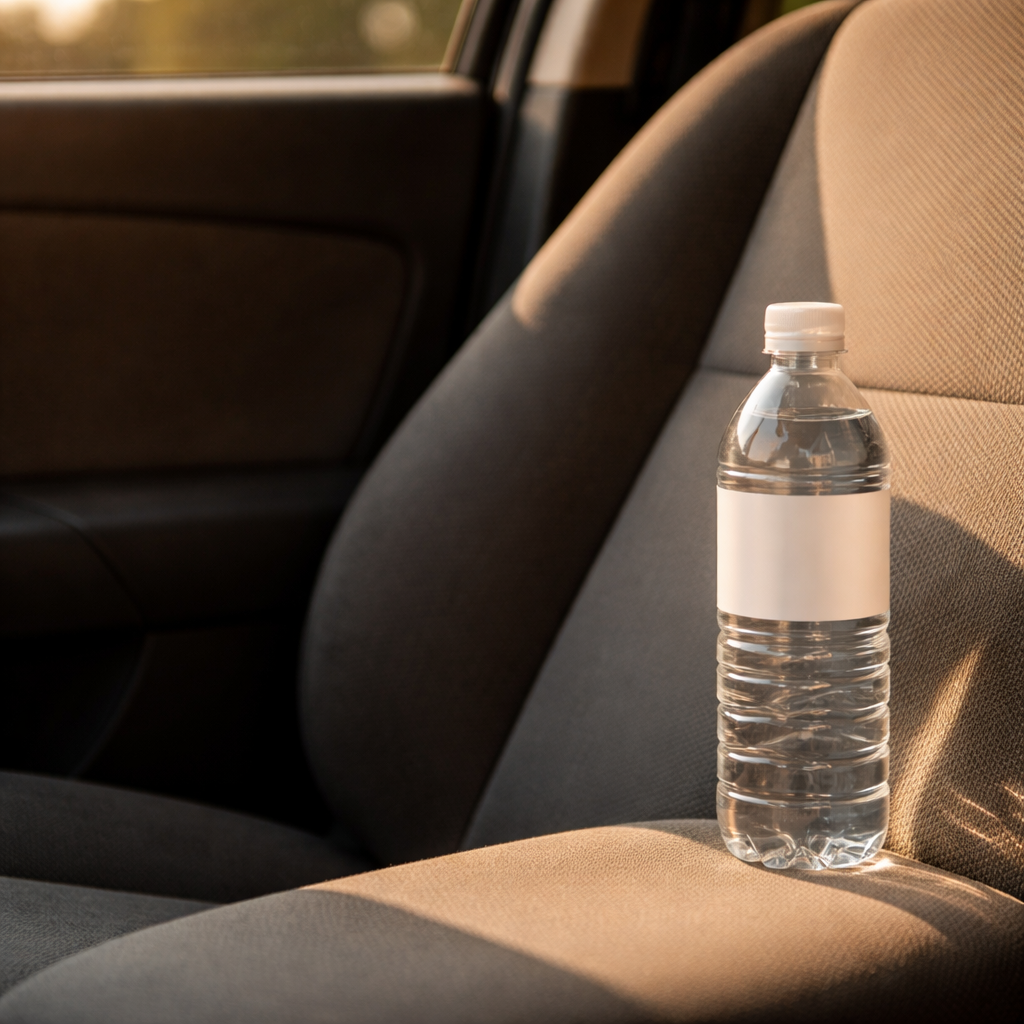
Almost everything written about this topic gets the risk ranking backwards. The chemical danger is the one that goes viral and it is negligible at real car temperatures. The bacterial risk is real, measured, large, and almost nobody covers it.
How hot does a car actually get?
Hotter than most people guess, but it plateaus rather than climbing forever, which matters a lot for the multi-day question.
A study published in Pediatrics in 2005 measured a dark car with a grey interior across 16 cloud-free days:
- Temperature rose about 3.2F every five minutes
- 80 percent of the total rise happened in the first 30 minutes
- Average total increase was 41F, peaking at about 60 minutes and then holding
- Even at a mild 72F outside, the interior reached 117F
- Cracking the windows 1.5 inches made no difference to the final temperature
A 2018 study in Temperature measured surfaces separately in Arizona heat, and the difference between surfaces is the useful part:
| Surface | Parked in sun | Parked in shade |
|---|---|---|
| Cabin air | 116F | 100F |
| Dashboard | 157F | 118F |
| Steering wheel | 127F | 107F |
| Seats | 123F | 105F |
So a bottle on the dashboard is in a far worse position than one in the footwell or trunk. And water inside a bottle lags the air temperature because water holds heat slowly. Cabin air at 116F does not mean the water reached 116F.
Does the plastic leach chemicals into the water?
A little, and nowhere near enough to matter in this scenario. Here is the actual number.
The chemical in question is antimony, which is used as a catalyst in making PET, the plastic in over 90 percent of single-use water bottles. The EPA limit is 6 parts per billion.
The definitive study is Westerhoff and colleagues, published in Water Research in 2008. At room temperature they measured antimony at 0.195 ppb, which is about 30 times below the legal limit, and it barely moved after three months. Then they heated bottles and calculated how long it would take to actually cross 6 ppb:
| Water temperature | Days to reach the EPA limit |
|---|---|
| 60C / 140F | 176 days |
| 65C / 149F | 38 days |
| 70C / 158F | 12 days |
| 75C / 167F | 4.7 days |
| 80C / 176F | 2.3 days |
Only the bottom two rows get anywhere near a weekend. But there is a physical problem with those rows: PET starts deforming around 74 to 80C. If your bottles are still bottle-shaped, the water never held 80C. And it would need to hold it continuously, not peak there for an hour before cooling overnight.
Two other studies land in the same place. A 2018 paper in Environmental Science and Pollution Research did the obvious experiment, storing PET bottles in a car trunk for four weeks of Chinese summer, and concluded the health risk was acceptable under normal storage conditions. A 2014 study found that at 40C, realistic for most cars, antimony stayed under the limit for the full eight weeks.
The University of Florida study that gets cited as proof of danger actually found that at a deliberate worst case of 70C for four weeks, only 1 of 16 brands exceeded EPA limits. That is a weak result being reported as a strong one.
What about BPA?
BPA is not in your disposable water bottle. This warning is aimed at the wrong plastic.
Single-use water bottles are PET, recycling code 1. PET is made from terephthalic acid and ethylene glycol. BPA is not one of its ingredients. BPA belongs to polycarbonate, recycling code 7, which is what older hard reusable sports bottles, five-gallon jugs and pre-2012 baby bottles were made from.
So if you are worried about BPA leaching from the case of water in your trunk, the chemical is not there to leach. One honest caveat: the Florida study did detect some BPA in PET bottles, most likely from cap or liner components rather than the bottle body, so “zero BPA” is slightly too strong. “PET is not made with BPA” is the accurate statement.
Can a water bottle in a hot car start a fire?
The physics is real and it has scorched upholstery. It has never been confirmed to cause an actual car fire.
The originating case is from Idaho Power in July 2017. A technician noticed smoke in his truck at lunch. Sunlight refracting through a water bottle on the seat had started burning the fabric, leaving two small burn marks. When they recreated it, the focused spot measured 213F.
A fire department in Oklahoma ran its own demonstration, burning a hole through paper and measuring 250F at the focal point. Their fire marshal was clear about the conditions required:
- The bottle must be clear, with clear liquid, and full or nearly full. He noted that empty or partly filled, it probably would not work.
- It needs direct unobstructed sunlight at the right angle
- The focal point must land on dark flammable material
- It must hold steady long enough, and the sun keeps moving
His own framing was a perfect storm of circumstances. And here is the number that settles it: vinyl ignites around 455F. The measured focal temperatures of 213 to 250F are well short of that. Fire departments report no known cases of a vehicle fire actually caused this way.
Accurate version: a water bottle can focus enough sunlight to scorch a seat, and that has genuinely happened. It has not been shown to start a car fire.
Can a water bottle explode in a hot car?
Still water, no. Carbonated drinks, yes.
Water is effectively incompressible and does not expand meaningfully at car temperatures. Its vapour pressure at 60C is only about 0.2 atmospheres, and it reaches equilibrium rather than building indefinitely. A sealed bottle of still water simply has no mechanism to build dangerous pressure, and the PET would soften and deform long before anything else happened.
Soda, beer and sparkling water are a different story. Dissolved CO2 comes out of solution as temperature rises, and pressure can reach five to six times atmospheric. Cans can fail around 120F, which car interiors exceed routinely in summer. If something in your car is going to burst, it is the sparkling water, not the still.
The risk almost nobody writes about
If you drank from the bottle before leaving it in the car, throw it out. This is the finding that actually matters and it has nothing to do with plastic.
A 2021 study in Dentistry Journal had 12 people drink about 50ml directly from bottles, then stored the bottles for 24 hours at 37C, roughly body temperature and well within summer car range:
| Sample | Immediately after drinking | After 24 hours at 37C |
|---|---|---|
| Remaining liquid | 0.8 x 10⁴ CFU/ml | 2.5 x 10⁶ CFU/ml |
That is roughly a 100-fold increase in 24 hours. The organisms were oral flora, mostly Streptococcus, which rose from 60 percent of the population to 96.5 percent. The authors concluded that remaining beverage should be discarded or refrigerated after drinking directly from the bottle.
Two useful nuances. Plain water is nutrient-poor, so growth is more limited than in juice or soda, where a sugary drink supported roughly five times the bacterial increase of carbonated water. And an unopened bottle has none of this problem at all, because nothing introduced the bacteria.
Compare the two risks honestly. Antimony at realistic car temperatures does not measurably approach its legal limit. Bacteria in a sipped-from bottle multiply a hundredfold in a day. The plastic is not the problem. What came out of your mouth is.
What about microplastics?
Measured, real, and of unknown health significance. We are not going to pretend otherwise.
A 2026 study in Water Research tested eight US bottled water brands under conditions deliberately simulating vehicle storage: 60C, mechanical shaking, and 15 days of temperature cycling. Heat combined with shaking produced the largest effect, a roughly 9-fold increase in nanoparticle release, with particles identified from both the bottle body and the cap.
So a case of water rolling around a hot car does shed measurably more plastic particles than one sitting cool and still. What that means for your health is genuinely unknown. There is no established dose-response relationship, no regulatory limit for microplastics in drinking water, and no demonstrated clinical outcome at these exposures. This is the part of the topic most likely to change as evidence accumulates.
So is the case of water in my trunk safe?
Yes. Drink it.
- Sealed bottles have no bacterial issue. Nothing was introduced.
- Two days is nowhere near the antimony threshold. The study’s own figures are 176 days at 60C and 38 days at 65C. Your car cools every night.
- The starting point is 30 times below the legal limit. There is an enormous margin.
- BPA is not in PET. Not a factor.
- It will not explode and it will not start a fire sitting in a case in a footwell or trunk.
The three things genuinely worth doing:
That is the 100-fold bacterial finding. It applies whether the bottle is plastic, glass or steel.
Heat degrades PET’s taste barrier. Off-taste is a real quality change and a legitimate reason to discard, even though it is not a toxicity signal.
Two days is fine. A case living in a hot trunk all summer is the scenario the studies actually flag.
157F on the dash versus 116F cabin air. Footwell or trunk is meaningfully cooler, and out of focused sunlight.
Myths worth retiring
| The claim | What is actually true |
|---|---|
| Hot bottles release dioxins and cause cancer | False. A Johns Hopkins researcher put it plainly: there are no dioxins in plastics. Dioxins require combustion above roughly 700F. The chain email behind this claim has circulated since 2004 and Johns Hopkins publicly disavowed it. |
| Freezing bottles releases chemicals | False. Cold slows diffusion. Freezing works against chemical release, not for it. |
| Your disposable bottle leaches BPA in heat | Wrong plastic. PET, code 1, is not made with BPA. That is a polycarbonate, code 7, issue. |
| Water bottles explode in hot cars | False for still water. True for carbonated drinks, where cans can fail near 120F. |
| A water bottle will set your car on fire | Overstated. Scorching is documented at 213 to 250F. Vinyl ignites near 455F. No confirmed vehicle fires. |
| One hot day makes bottled water toxic | False. Room-temperature antimony is 30 times below the limit and needs 176 days at 60C to reach it. |
| Bottled water expires and becomes unsafe | False. The FDA has determined there is no shelf-life limit and does not require an expiration date. Printed dates indicate quality, not safety. |
| Cracking the windows keeps it cool enough | False. The 2005 Pediatrics study found cracking windows 1.5 inches produced an identical final temperature. |
| Antimony from bottles causes cancer | Unsupported at these levels. The EPA lists raised cholesterol and lowered blood sugar as the effects of chronic exceedance, not cancer. |
What the official bodies say
The FDA has determined bottled water has no shelf-life limit and requires no expiration date, but advises storing it in a cool place out of direct sunlight, noting that prolonged heat and sunlight can affect taste and odour.
The International Bottled Water Association calls the hot-car danger claim untrue, and says antimony is often not even detected in migration testing under realistic protocols. Worth knowing they are an industry trade body rather than an independent regulator, and their own storage advice, keep it cool and out of sunlight, sits in mild tension with a blanket “untrue”.
Both overstate in opposite directions. Leaching is real and measurable. It does not reach regulatory limits under real conditions. Both of those things are true at once.
Frequently asked questions
Is it safe to drink water left in a hot car?
If the bottle was sealed, yes. Antimony needs roughly 176 days at 60C to reach the EPA limit of 6 ppb, and room-temperature levels start about 30 times below it. If you already drank from the bottle, throw it out, because bacteria from your mouth multiply roughly 100-fold in 24 hours at car temperatures.
I left water in my car for two days in summer. Is it still good?
Yes, if it was sealed. Two days is far short of the exposure needed for antimony to become an issue, and a study that stored PET bottles in a car trunk for four full weeks concluded the risk was acceptable. If it tastes or smells of plastic, discard it on quality grounds rather than safety.
Can a water bottle in a car start a fire?
It can scorch upholstery and that has been documented, with focused sunlight measuring 213 to 250F in two separate demonstrations. But vinyl needs around 455F to ignite and fire departments report no confirmed vehicle fires from this. It requires a full clear bottle, direct sun, and a dark flammable target all aligned.
Can water bottles explode in a hot car?
Still water will not. Water is incompressible and its vapour pressure reaches equilibrium rather than building. Carbonated drinks genuinely can, because dissolved CO2 escapes as temperature rises and cans can fail around 120F, which car interiors exceed routinely.
Does BPA leach from water bottles in heat?
Single-use water bottles are PET, recycling code 1, which is not made with BPA. BPA is associated with polycarbonate, code 7, used in older hard reusable bottles and five-gallon jugs. Warnings about BPA in disposable bottles are aimed at the wrong plastic.
How hot does the inside of a car get?
Cabin air reaches about 116F parked in the sun in extreme heat, and even a 72F day can produce a 117F interior. Eighty percent of the rise happens in the first 30 minutes and it plateaus at around an hour. The dashboard is far hotter at about 157F, so bottle placement matters.
Should I throw away a water bottle I drank from and left in the car?
Yes. A study measured bacteria in the remaining liquid rising from 0.8 x 10⁴ to 2.5 x 10⁶ CFU per millilitre after 24 hours at body temperature, roughly a hundredfold increase, almost all of it oral bacteria. This is the one genuine risk in the whole topic and it is about saliva, not plastic.
Do hot cars make bottled water release microplastics?
Measurably, yes. A 2026 study simulating vehicle storage with heat plus shaking found roughly a 9-fold increase in nanoparticle release. Whether that matters for health is unknown, as there is no established dose-response and no regulatory limit for microplastics in drinking water.
Does bottled water expire?
No. The FDA has determined bottled water has no shelf-life limit and does not require an expiration date. Printed best-by dates reflect quality and stock rotation. Taste and odour can degrade with prolonged heat or sunlight, which is a quality issue rather than a safety one.
Is it worse to leave bottles on the dashboard?
Yes, meaningfully. The dashboard measured 157F in the sun against 116F for cabin air, and it is also where focused sunlight through a bottle is most likely to hit something. Footwell or trunk is cooler and out of direct sun.
Do plastic water bottles cause cancer?
The evidence does not support this at real exposure levels. The EPA lists raised cholesterol and lowered blood sugar as the effects of chronically exceeding the antimony limit, not cancer. Harvard’s cancer FactFinder rates the plastic-bottle cancer claim as definitely or most likely not true, and the dioxin version of the claim is a debunked hoax.
Is a reusable steel bottle better in a hot car?
For chemical leaching, yes, because there is no plastic in contact with the water. It makes no difference at all to the bacterial risk, which comes from your mouth rather than the container. A steel bottle you drank from and left warm for a day has the same problem as a plastic one.
Related reading
- Plastic water bottles and heat: the full science
- Is BPA-free plastic really safe?
- Is it safe to drink from plastic bottles daily?
- Does water expire?
- Best insulated water bottles
- Top 10 safest bottled water brands
Sources
- Westerhoff P, Prapaipong P, Shock E, Hillaireau A. Antimony leaching from PET plastic used for bottled drinking water. Water Research 2008;42(3):551-556.
- McLaren C, Null J, Quinn J. Heat stress from enclosed vehicles. Pediatrics 2005;116(1):e109-e112.
- Vanos J, Middel A, Poletti MN, Selover N. Evaluating the impact of solar radiation on vehicle interior surfaces. Temperature 2018.
- Wakui et al. Bacterial contamination of beverages after drinking directly from bottles. Dentistry Journal 2021;9(6):58.
- Qiao F, Lei K, Li Z, et al. Antimony migration from PET bottles under vehicle storage conditions. Environmental Science and Pollution Research 2018;25(2):1388-1393.
- Molaee Aghaee et al. Effect of storage time and temperature on antimony release from PET bottles. Journal of Environmental Health Science and Engineering 2014.
- Ma L et al. University of Florida study on PET bottles at elevated temperature. Environmental Pollution 2014.
- US EPA National Primary Drinking Water Regulations, antimony maximum contaminant level 0.006 mg/L.
- WHO Guidelines for Drinking-water Quality, antimony fact sheet.
- FDA guidance on bottled water shelf life and storage.
- Idaho Power incident report, July 2017; Midwest City Fire Department demonstration.