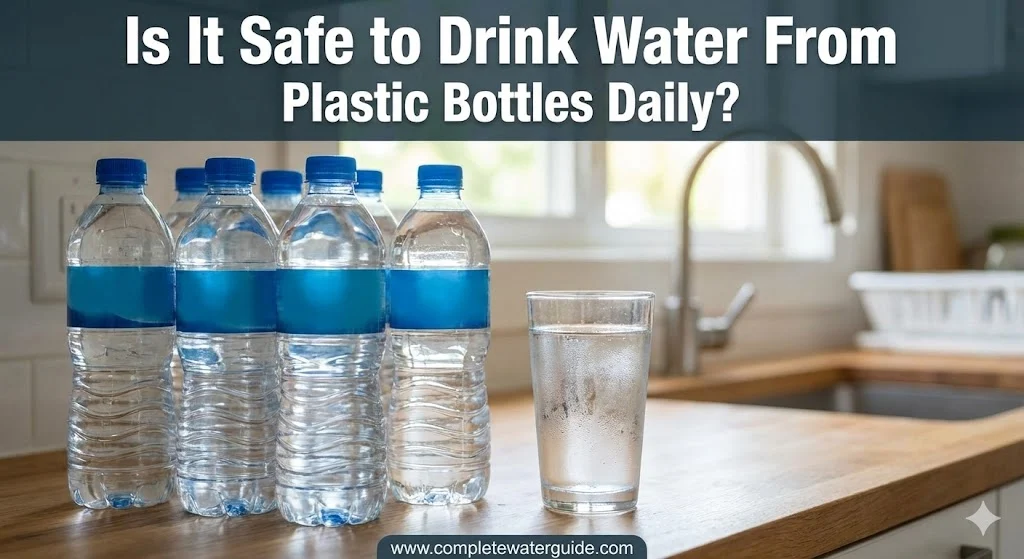
Is it safe to drink water from plastic bottles daily? For most people, the known risks are low, but it is not risk-free, and the open question is microplastics. The U.S. Food and Drug Administration’s position is that “BPA is safe at the current levels occurring in foods.” The newer concern is tiny plastic particles: a 2024 Columbia University study in PNAS estimated about 240,000 plastic particles per liter of bottled water, roughly 90% of them nanoplastics. What those particles do in the body is not yet known.
Below is what the research actually shows about BPA, “BPA-free” plastic and microplastics, the conditions that make plastic bottles worse, and the simple ways to cut your exposure if you drink bottled water every day.
What is in a plastic water bottle?
Most single-use water bottles are made of PET (polyethylene terephthalate), marked with the number 1 in the recycling triangle. BPA is associated with a different plastic, polycarbonate, which was used for hard reusable bottles and some 5-gallon water cooler jugs. Our guide to cleaning a 5-gallon water jug covers polycarbonate jugs specifically.
Is BPA in plastic bottles dangerous?
The FDA’s current conclusion “is that BPA is safe at the current levels occurring in foods,” based on its most recent safety review. It also says it “will update its assessment of BPA” as new research comes in, and it runs an ongoing long-term study with the National Toxicology Program.
In 2012, the FDA stopped allowing BPA-based polycarbonate in baby bottles and sippy cups. The agency notes that this followed an industry petition because manufacturers had already stopped using it, not a new safety finding.
Are “BPA-free” bottles safe?
“BPA-free” means just that: no BPA. It does not mean no chemicals at all. Some BPA-free plastics use other bisphenols, such as BPS, that have been studied less than BPA. For single-use water bottles, the label matters less, because PET was never a BPA plastic in the first place. For reusable bottles, the simplest way to avoid the question entirely is stainless steel or glass.
How much microplastic is in bottled water?
More than earlier studies suggested. Researchers at Columbia University used a new imaging method, stimulated Raman scattering microscopy, to count particles down to the nanometer scale. They estimated “about 2.4 ± 1.3 × 10⁵ particles per liter of bottled water, about 90% of which are nanoplastics,” which they called “orders of magnitude more” than earlier microplastic counts.
The study measured how many particles there are, not what harm they do. The authors note that nanoplastics are a concern because their small size makes them easier to enter the body, but health effects in people have not been established. Our article on bottled water microplastics by brand looks at which brands have been tested.
What makes plastic bottles worse?
- Heat. Leaving bottles in a hot car or in the sun increases what can move from the plastic into the water. Our guide on plastic water bottles and heat covers the temperatures that matter.
- Reusing single-use bottles many times. Thin PET bottles scratch, crack and are hard to clean, which is more a hygiene problem than a chemical one.
- Long storage. Bottled water does not spoil, but storing it for long periods in warm places is worth avoiding.
How to drink water daily with less plastic
- Use a reusable bottle made of stainless steel or glass for everyday water.
- Filter tap water instead of buying bottles, if your tap water is safe. Our guide on whether tap water is safe to drink shows how to check.
- Keep bottled water cool and out of the sun if you do buy it.
- Do not reuse single-use bottles for weeks; recycle them.
- Clean reusable bottles properly. Our guide on how to clean a stainless steel water bottle covers lids and straws, where most grime hides.
Frequently asked questions
Is it bad to drink bottled water every day?
Not according to current FDA guidance on BPA, which says it is safe at current food levels. Bottled water does contain micro and nanoplastics, and their health effects are not yet known, so cutting back is a reasonable precaution rather than an urgent one.
Do plastic water bottles contain BPA?
Single-use water bottles are usually PET (#1), which is not a BPA plastic. BPA is linked to polycarbonate, used in some hard reusable bottles and older water cooler jugs.
How many microplastics are in a bottle of water?
A 2024 PNAS study estimated about 240,000 particles per liter of bottled water, about 90% of them nanoplastics. A standard 500 mL bottle would hold about half that.
Is it safe to reuse plastic water bottles?
Occasionally, if you wash them. Thin single-use bottles scratch and are hard to clean, so a reusable stainless steel or glass bottle is better for daily use.
Is a hot car bad for plastic water bottles?
Heat increases what can move from plastic into water, so it is best avoided. A bottle left in a hot car once is unlikely to be harmful, but do not make it a habit.
Are BPA-free bottles completely safe?
They contain no BPA, but some use other bisphenols that have been studied less. Stainless steel or glass avoids the question.
Sources
- U.S. Food and Drug Administration, Bisphenol A (BPA): Use in Food Contact Application.
- Qian N, Gao X, Lang X, et al. Rapid single-particle chemical imaging of nanoplastics by SRS microscopy. Proceedings of the National Academy of Sciences, 2024.