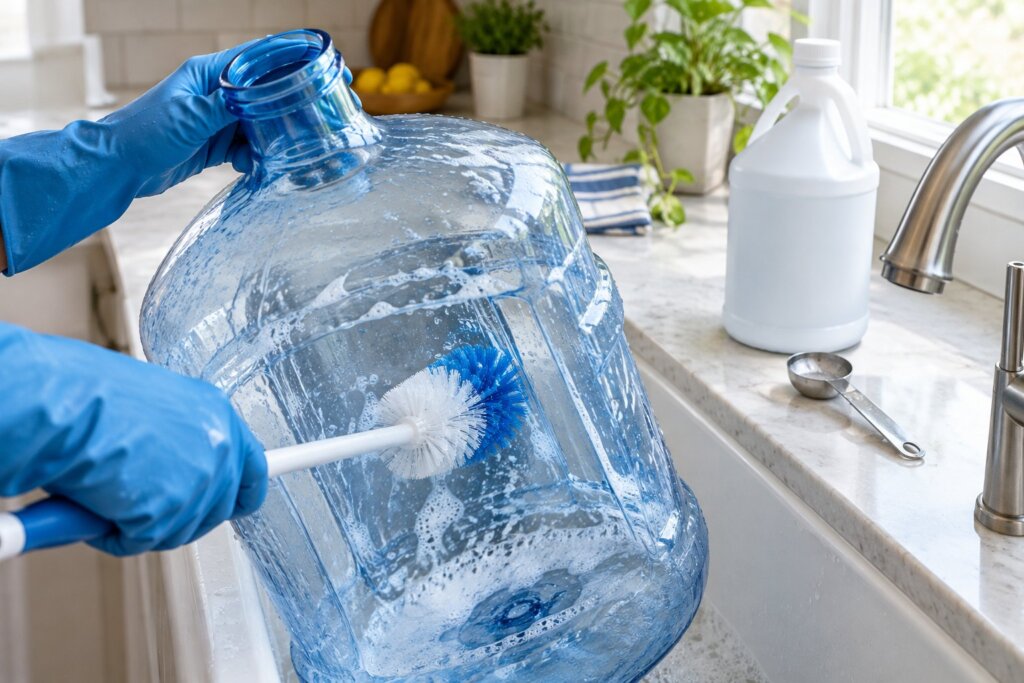
Here is how to clean a 5 gallon water jug the way the CDC says to clean any drinking water container: wash it with dish soap, rinse it, shake a mix of 1 teaspoon of unscented bleach in 1 quart of water around the inside, wait at least 30 seconds, pour it out and let the jug air-dry. That is the whole method. The parts people get wrong are the neck and cap, the drying, and where the jug sits afterward.
We built this guide from the CDC and FEMA’s Ready.gov water storage pages, Utah State University Extension, California’s rules for refill water stations and a 5 gallon bottle maker’s own care advice. Where they disagree, we say so.
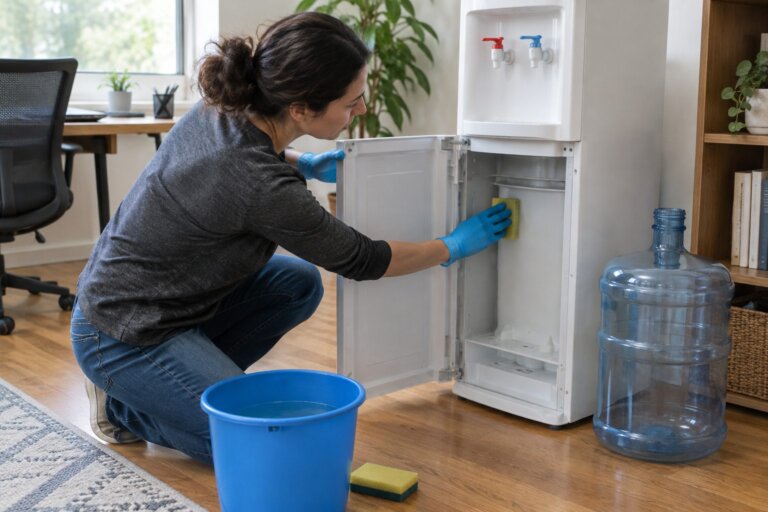
How to clean a 5 gallon water jug, step by step
- Empty the jug and take off the cap.
- Pour in a few inches of warm water and a squirt of dish soap. Scrub the inside with a long bottle brush, then scrub the neck threads and the inside of the cap.
- Rinse until no suds come out.
- Mix 1 teaspoon of unscented liquid household bleach into 1 quart (4 cups) of water. The CDC says to use bleach that contains 5% to 9% sodium hypochlorite.
- Pour the mix into the jug, put the cap on tightly and shake it well, turning the jug so the solution reaches the shoulder and the neck.
- Wait at least 30 seconds, then pour the solution out. Dip the cap in it too.
- Let the empty jug air-dry, neck down on a rack, before you refill it.
Steps 4 to 7 come straight from the CDC’s emergency water supply page. It says to “wash the storage container with soap and rinse completely with water,” then sanitize it by “mixing 1 teaspoon of unscented liquid household chlorine bleach in 1 quart (4 cups) of water,” then “cover the container tightly and shake it well,” “wait at least 30 seconds” and “let the empty container air-dry before use.” FEMA’s Ready.gov page uses the same ratio.
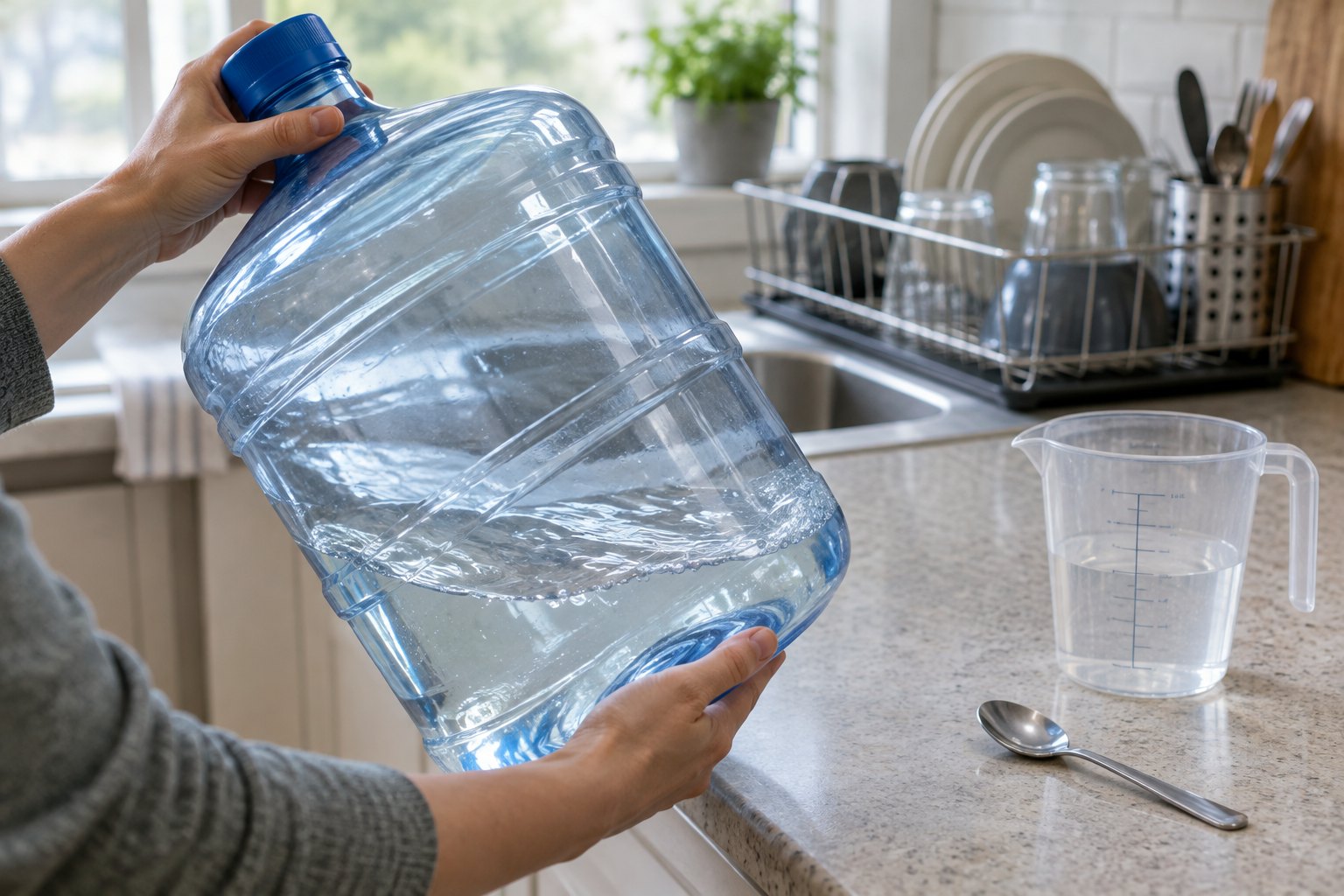
What is the best way to clean a 5 gallon water jug?
Soap first, then bleach, then air. The CDC lists the soap wash before the bleach, and we would never skip it. A quick bleach slosh does not scrub off the slick film you can feel inside a jug that has been refilled for months. The brush does that.
The sources do not agree on the bleach strength. CDC and Ready.gov say 1 teaspoon per quart, which works out to 4 teaspoons per gallon. Utah State University Extension says to sanitize the “container and lid with one tablespoon bleach per gallon of water,” which is 3 teaspoons. They are close, and we use the CDC number. USU also warns that bleach older than 4 months “should not be used as a water purifying agent,” so we keep a fresh bottle for this job too.
The CDC method does not include a rinse after the bleach. You pour the solution out and let the jug dry. If a faint bleach smell bothers you, a quick rinse with the same tap water you plan to store is our fix.
What is a good cleaning solution for 5 gallon water jugs?
- Dish soap and warm water: for the scrub. This removes the film and anything stuck to the walls.
- Unscented household bleach: for sanitizing, at the CDC ratio above. Scented bleach leaves a smell behind, and the CDC asks for unscented.
- Vinegar or baking soda: for odors. Reliance, which makes water containers, says to “rinse the inside with either baking soda and water or vinegar and water” and adds, “Do not use baking soda and vinegar at the same time.” We treat these as deodorizers, not as a replacement for the bleach step.
Never mix bleach and vinegar. The Skokie, Illinois fire department lists “Bleach + Vinegar = Chlorine gas.” If you use vinegar for a smell, rinse it out completely before the bleach step, or do them on different days.
Do not reuse a container that held something toxic. The CDC says, “Do not use containers that were previously used to hold liquid or solid toxic chemicals, such as bleach or pesticides.” USU Extension also warns against juice and milk jugs, which “may contain proteins and sugars from the previous foods.”
How long can water sit in a 5 gallon jug?
Six months for water you stored yourself. The CDC says to “replace water every six months,” and Ready.gov says, “Water that has not been commercially bottled should be replaced every six months.” USU Extension gives the same number to “avoid a possible stale taste.” For sealed jugs from a store or a delivery company, the CDC says to follow the expiration date on the label. Our guide on whether water expires explains what that date means.
Where the jug sits matters as much as the calendar. The CDC says to keep containers at a cool temperature (50°F to 70°F) and “away from direct sunlight.” USU Extension adds a tip we had not seen elsewhere: “avoid storing plastic containers directly on concrete or dirt since they will absorb odors.” We set our backup jugs on a wood shelf or a pallet in a dark closet.
Our own rule for a jug on a water cooler is shorter. Once it is open, we finish it within a few weeks. The six-month limit is for sealed, sanitized backup jugs.
How do you get algae out of a 5 gallon water jug?
Dump the water, then clean it hard. Algae needs light, and a clear jug lets light in. Texas A&M’s rainwater program says a clear tank “allows for sun to penetrate the material and increase the chances of algal growth,” and that is just as true for a jug sitting by a window.
We have not found an official method for algae in jugs, so this is what we do: pour the water out (we do not drink it), scrub with soap and the long brush until no green comes off on the bristles, rinse, then do the full CDC bleach step. If green staining is still there after two rounds, or slime comes back within a few weeks, we retire the jug. A refill jug is cheap. Then we move the new one out of the light, or cover it. If your cooler’s reservoir is green too, see our guide on how to clean a water cooler.
Can you use hot water or a dishwasher on a 5 gallon jug?
We would not. Turn the jug over and check the recycling code first. University of Illinois Extension says code 1, PET, “is commonly found in disposable food and drink containers, such as water and soda bottles,” code 2 is HDPE, and code 7 is “a catch-all for other plastics” that includes polycarbonate and BPA.
- PET (code 1): Petainer, which makes 5 gallon PET cooler bottles, says one customer’s switch from polycarbonate to PET “addressed BPA concerns, improved washability and leak resistance.” A bottle patent notes PET has limits above about 70°C (160°F). That is a patent, not a safety test, but it is enough for us to keep boiling water out.
- Polycarbonate (code 7): a University of Cincinnati study found that after polycarbonate bottles were exposed to boiling water, BPA “was released 55 times more rapidly than before.” That study used sports bottles, not 5 gallon jugs. The FDA’s position is that “BPA is safe at the current levels occurring in foods.”
No jug maker we checked says its 5 gallon bottles are dishwasher-safe, and a 5 gallon jug does not fit most dishwashers anyway. Warm tap water, soap and a brush do the job. For a deeper look at the plastics question, see our guides on whether BPA-free bottles are really safe and plastic vs steel water storage.
What we would buy for this job
- 28 inch bendable bottle brush, 2 pack: long enough to reach the bottom and shoulder of a 5 gallon jug. It needs a neck opening over 1.77 inches, so check yours.
- Homebrewers Outpost carboy drying rack: holds a big bottle neck-down so it drains and air-dries, the last step of the CDC method. Check the neck fit against the listing.
As an Amazon Associate, Complete Water Guide earns from qualifying purchases. Prices change, so check the listing.
Will a refill station clean my jug for me?
Usually not, and in California it is not supposed to. The California Department of Public Health says refill station operators “should not clean and/or sanitize their customers’ containers on their premises. It is the customer’s responsibility to bring clean containers.” So if you own the jug and refill it yourself, cleaning it is your job, every time.
Exchange and delivery jugs are different. The company owns those and must sanitize them between customers. Washington State’s rule, for example, says bottles “in which water is sold for drinking purposes shall be sterilized before refilling.” If you are choosing between refilling your own jug and swapping through a service, our Primo water cost breakdown compares the prices.
Jugs do wear out. Petainer says its PET bottle can survive “~25 trips” and recommends “thorough cleaning every six weeks” for bottles in service. A home jug sees less handling than a delivery bottle, but scratches, cloudiness and a smell that will not wash out are our signs to replace one. And when you lift a full one back onto the cooler, check our guide on how much a 5 gallon water jug weighs first.
Frequently asked questions
How much bleach do I use to clean a 5 gallon water jug?
The CDC says 1 teaspoon of unscented household bleach in 1 quart (4 cups) of water, shaken inside the closed container, then poured out after at least 30 seconds. Utah State University Extension uses 1 tablespoon per gallon, which is slightly weaker.
Can I clean a 5 gallon water jug with vinegar?
Yes, for odors. Reliance, a water container maker, says to rinse with vinegar and water or baking soda and water, but not both at once. We still sanitize with bleach afterward, after rinsing the vinegar out completely, because bleach and vinegar together make chlorine gas.
Do you rinse bleach out of a water jug?
The CDC method does not include a rinse. You pour the solution out and let the jug air-dry. A quick rinse with clean tap water is fine if a bleach smell remains.
How often should I clean a 5 gallon water jug?
Before every refill if you own the jug. Petainer, a 5 gallon bottle maker, recommends thorough cleaning every six weeks for bottles in service, and stored water should be replaced every six months, according to the CDC.
Why does my 5 gallon water jug smell?
Usually old water, a film inside, or storage in the wrong place. Utah State University Extension says plastic containers stored on concrete or dirt absorb odors. Scrub, sanitize, and store the jug on a shelf away from sunlight.
Can I put a 5 gallon water jug in the dishwasher?
We would not. No jug maker we checked lists 5 gallon jugs as dishwasher-safe, and hot water is a concern for both PET and polycarbonate jugs. Use warm water, dish soap and a long bottle brush.
Sources
- CDC, How to Create and Store an Emergency Water Supply.
- Ready.gov (FEMA), Water.
- Utah State University Extension, Storing Water for an Emergency, and USU Extension water storage tips.
- California Department of Public Health, Water FAQs for retail water facilities and vending machines.
- Washington Administrative Code 246-203-060.
- University of Illinois Extension, Understanding Recycling Resin Identification Codes, September 2025.
- Petainer, 5 gallon PET water cooler bottle product page.
- University of Cincinnati, Hot Liquids Release Potentially Harmful Chemicals in Polycarbonate Plastic Bottles, January 2008.
- U.S. FDA, Bisphenol A (BPA): Use in Food Contact Application.
- Reliance Outdoors, water container care and use.
- Texas A&M AgriLife, Rainwater Harvesting: Color and Aesthetics.
- Village of Skokie Fire Department, Dangers of Mixing Household Chemical Cleaners.