 Water filter pitcher and countertop filtration unit side by side on a kitchen counter” width=”1200″ height=”800″ loading=”lazy” decoding=”async” style=”width:100%;height:auto;border-radius:12px;” />
PFAS Filter Types Compared
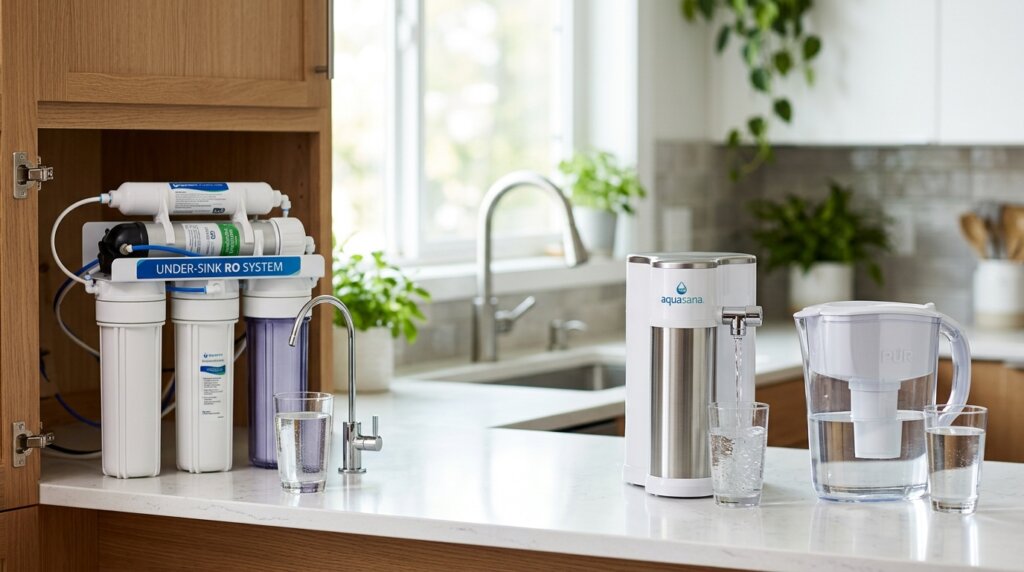
| Type | Price | PFAS removal | Install | Best For |
|---|---|---|---|---|
| Pitcher | $30–$90 | Up to ~99% (certified models) | None | Renters, budget, small households |
| Countertop RO | $300–$450 | 94–99% | None — sits on counter | Renters wanting RO-level purity |
| Under-Sink RO | $200–$500 | 94–99% | Plumbing (DIY or pro) | Homeowners — best value and flow |
The Only Number That Matters: NSF Certification
Before comparing formats, understand the certification, because “filters PFAS” on a box means nothing without it:
- NSF/ANSI 53 — covers health-related contaminant reduction in carbon and similar filters. A pitcher certified to 53 for PFOA/PFOS has been independently verified.
- NSF/ANSI 58 — the reverse osmosis standard. This is what under-sink and countertop RO units should carry.
- NSF/ANSI 42 — aesthetic only, covering taste, odor and chlorine. This does not cover PFAS. Many budget filters carry 42 and nothing else.
Check the manufacturer’s certification listing rather than the packaging claim. A filter certified only to 42 will improve taste and do nothing measurable for forever chemicals. Our guide to the best water filters that actually remove PFAS covers what each certification verifies.
Pitcher: Cheapest & No Install
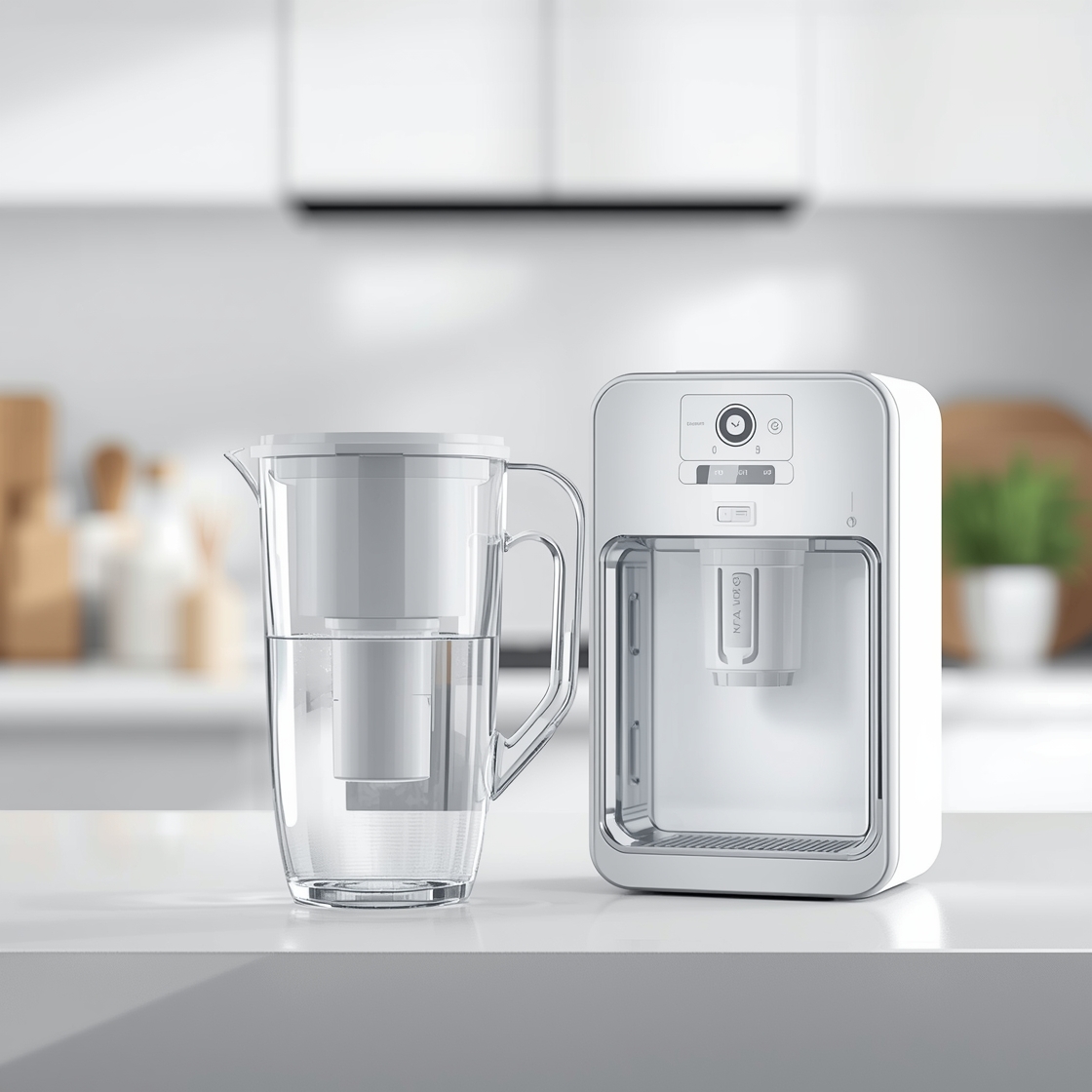
A certified PFAS pitcher is the lowest-cost route to removing forever chemicals from drinking water. No plumbing, works anywhere, and ideal for renters and small households.
The numbers: $30–90 upfront, replacement filters typically $15–50 every 2–6 months depending on the model and household use. Capacity is usually 6–12 cups per fill, and flow is slow — a full pitcher takes several minutes to filter.
The trade-offs: smaller capacity means frequent refills, and filter life is short compared to RO membranes. For a household drinking several litres a day, the refill cycle becomes a chore. But for one or two people who mainly want clean drinking water, it works.
See our tested picks: Best Water Filter Pitchers — Brita vs Pur vs ZeroWater vs Clearly Filtered.
Countertop RO: No Install, RO-Level Purity
A countertop reverse-osmosis unit gives you near-complete PFAS removal without touching your plumbing — it sits on the counter and you pour water in.
The numbers: $300–450 upfront, removing 94–99% of PFAS along with most other dissolved contaminants. Filter and membrane replacements typically run $50–100 annually. Most units hold roughly 0.75–1 gallon of filtered water at a time.
The trade-offs: it costs several times a pitcher and occupies meaningful counter space. It also wastes some water in the RO process. But for renters who want genuine reverse-osmosis purity without drilling into cabinets, it is the only format that delivers it.
Compare RO systems: Best Reverse Osmosis Systems for Home.
Under-Sink RO: Best Long-Term Value
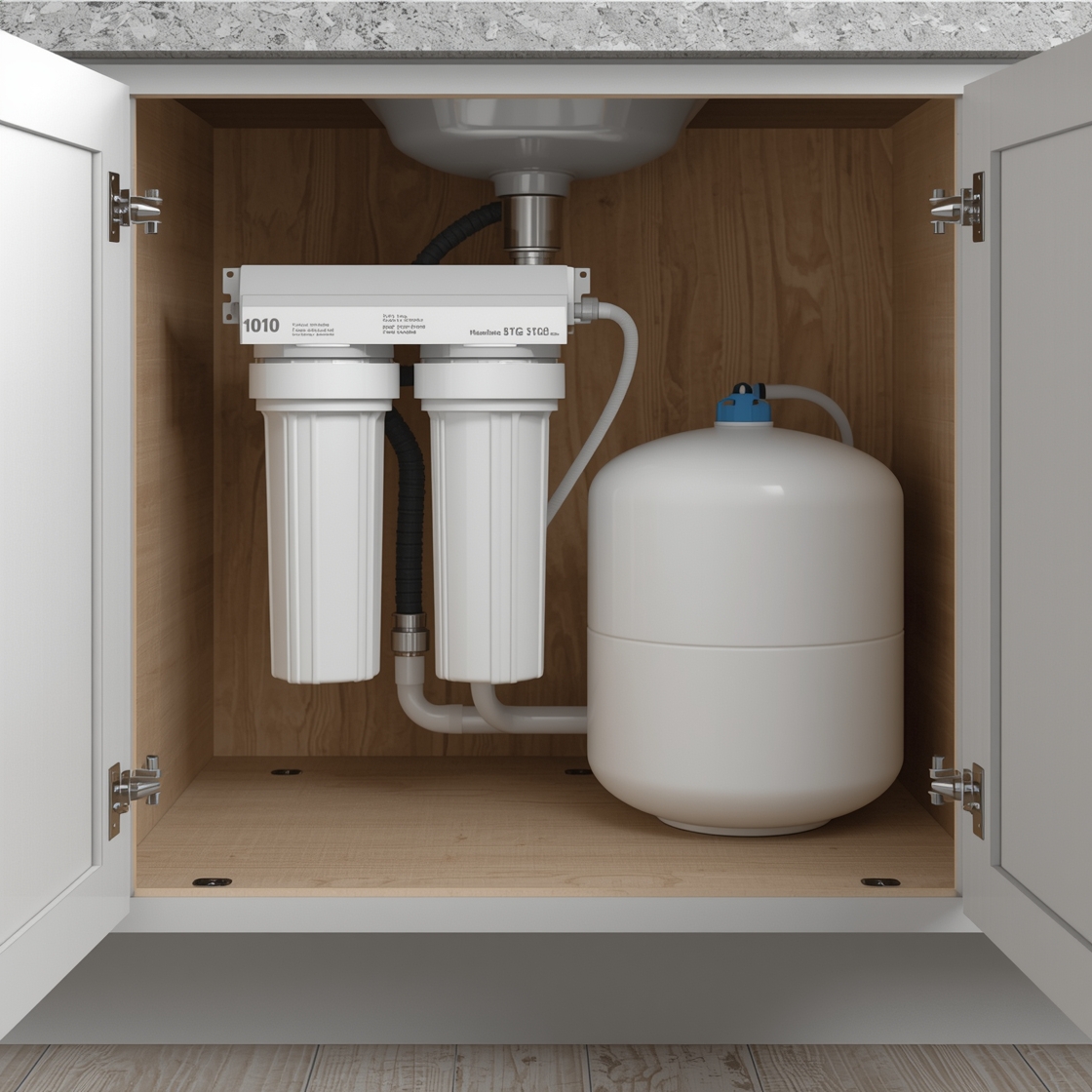
An under-sink reverse-osmosis system is the standard for PFAS removal at the drinking tap — 94–99% removal, high daily capacity, and the lowest cost per gallon over time.
The numbers: $200–500 upfront, producing roughly 50–800 gallons per day depending on the unit. Filter replacements typically run $50–120 annually. Cost per litre works out to roughly $0.05, against $1.50–4.00 for bottled water — the difference pays back the system within months for a regular household.
The trade-offs: it requires a one-time plumbing install. Many units are genuinely DIY-friendly with basic tools, but it is real work, and renters generally cannot do it. It also occupies cabinet space and, like all RO, produces some wastewater.
See our tested picks: Best Under-Sink Water Filters for PFAS.
Cost Over Three Years
Upfront price is misleading. Here is roughly what each format costs a two-person household over three years, including replacement filters:
| Format | Upfront | Filters (3 yrs) | 3-year total |
|---|---|---|---|
| Pitcher | $30–90 | ~$150–300 | $180–390 |
| Countertop RO | $300–450 | ~$150–300 | $450–750 |
| Under-Sink RO | $200–500 | ~$150–360 | $350–860 |
| Bottled water | — | — | $1,600–4,400 |
The pitcher stays cheapest overall, but delivers the least water per day. Every filtration format costs dramatically less than buying bottled — which is the comparison that actually matters if you are currently drinking bottled water because of PFAS concerns.
Quick Decision Guide
- Renting + tight budget? → Certified PFAS pitcher. Cheapest route to verified removal.
- Renting but want RO purity? → Countertop RO. No install, genuine reverse osmosis.
- Own your home? → Under-sink RO. Best value, highest capacity, ~$0.05 per litre.
- Concerned about showers too? → Add a whole-house carbon system on top of a drinking-water filter.
- Just want better taste? → A basic NSF 42 filter is fine, but it will not remove PFAS.
Whichever you choose, verify the product is certified to NSF/ANSI 53 or 58 for PFAS — that is the number that actually guarantees removal.
Frequently Asked Questions
What kind of filter removes PFAS best?
Reverse osmosis removes PFAS most thoroughly at 94–99%, available as under-sink or countertop units. Certified carbon pitchers also remove PFAS effectively but with lower capacity and shorter filter life. Look for NSF/ANSI 53 or 58 certification.
Is a pitcher enough to remove PFAS?
Yes, if it is certified for PFAS specifically. It is the cheapest option at $30–90 and fine for drinking water, though flow and capacity are limited compared to RO systems. Verify NSF/ANSI 53 certification rather than trusting box claims.
Do I need under-sink or countertop RO?
Choose under-sink if you own your home and want the best flow and long-term value at roughly $0.05 per litre. Choose countertop if you rent or cannot install plumbing but still want reverse-osmosis purity.
Does a whole-house filter remove PFAS?
Some do, but for guaranteed PFAS removal at the drinking tap, pair a whole-house system with an under-sink RO unit. Whole-house filtration is better suited to chlorine, sediment, taste, and shower water.
What does NSF 53 vs NSF 58 mean?
NSF/ANSI 53 covers health-related contaminant reduction in carbon and similar filters, and is what a PFAS-certified pitcher should carry. NSF/ANSI 58 is the reverse osmosis standard for under-sink and countertop units. NSF/ANSI 42 covers only taste and odor and does not verify PFAS removal.
How much does PFAS filtration actually cost per litre?
An under-sink RO system works out to roughly $0.05 per litre including filter replacements, against $1.50–4.00 for bottled water. Over three years, every filtration format costs a fraction of buying bottled.
Do RO systems remove minerals along with PFAS?
Yes. Reverse osmosis strips dissolved minerals along with contaminants, which is why RO water tastes neutral. Some people add mineral drops back, and some systems include a remineralisation stage.
Can I install an under-sink RO system myself?
Many units are designed to be DIY-friendly with basic tools and take an afternoon. It involves connecting to the cold water line, mounting the unit, and often drilling for a dedicated faucet. If you are uncomfortable with plumbing, professional installation typically costs $150–300.
Related Reading
- Best Water Filters That Actually Remove PFAS — certification explained, all formats
- Best Water Filter Pitchers — Tested Picks
- Best Reverse Osmosis Systems for Home
- Best Under-Sink Water Filters for PFAS
- Best Whole-House Water Filter Systems
- Bottled Water Brands & PFAS Ranked
- Sparkling Water Without PFAS — All 12 Tested Brands
References & Sources
- EPA — PFAS National Primary Drinking Water Regulation (April 2024), 4 ppt limit for PFOA and PFOS
- NSF/ANSI 53 and NSF/ANSI 58 — certification standards for contaminant reduction and reverse osmosis
- Manufacturer performance data sheets for pitcher, countertop and under-sink systems
The Bottom Line
Pick the format before the brand. Renters and budget buyers should start with a certified PFAS pitcher at $30–90; renters wanting maximum purity go countertop RO at $300–450; homeowners get the best value from under-sink RO, which works out to roughly $0.05 per litre against $1.50–4.00 for bottled. All three remove PFAS effectively — just verify NSF/ANSI 53 or 58 certification and match the format to your home. A filter certified only to NSF 42 will improve the taste and do nothing for forever chemicals.