Quick Answer: Bottled Water PFAS Rankings
- Cleanest Still Waters Tested: Icelandic Glacial (non-detect, brand verified), Essentia (0.2 ppt), Evian (~0.3 ppt), Dasani (~0.4 ppt), and Fiji (~0.5 ppt). Purified waters using reverse osmosis consistently test lowest. See our full guide to the safest bottled water brands.
- Cleanest Sparkling Waters Tested: Gerolsteiner (non-detect under EPA 1633), Liquid Death (non-detect), and San Pellegrino (0.31–0.81 ppt). Read the detailed breakdown in our guide to healthiest sparkling waters for daily drinking.
- Most Improved: Topo Chico cut its PFAS by more than half, falling from 9.76 ppt down to 1.41 ppt following filtration upgrades.
- The Regulatory Reality: The EPA regulates tap water at 4.0 ppt, but the FDA sets zero mandatory PFAS limits for bottled water.
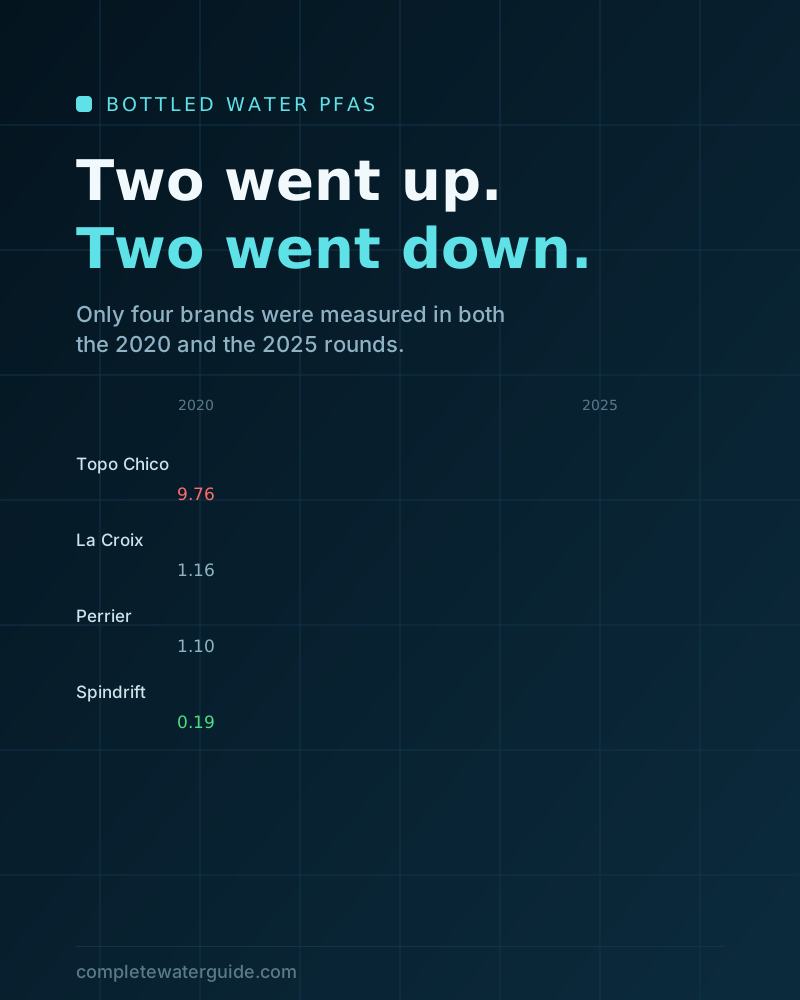
To evaluate bottled water PFAS levels accurately in 2026, you have to look beyond marketing claims. There is no single universal ranking of bottled water brands by PFAS, because there is no single test. There are three separate datasets, they were taken five years apart, they used different methods, and where they overlap they disagree. Four brands appear in both of the two main brand tests. Two went up. Two went down.
That is the honest state of the evidence in 2026, and it is why every “every brand ranked” list rests on a foundation that does not hold. The three sources are Consumer Reports, the US Food and Drug Administration, and a joint round by Mamavation and Environmental Health News. This page reads all three rather than any one of them. What follows is each dataset on its own terms, what each can and cannot tell you, and the regulatory question that matters more than any individual figure.
The three datasets, and what each one covers
| Source | When | What was tested | Method |
|---|---|---|---|
| Consumer Reports | September 2020 | 47 bottled waters, 12 of them carbonated | 30 PFAS compounds |
| FDA | Collected 2023–2024, published April 2025 | 197 bottled waters, retail shelf samples | 18 PFAS compounds |
| Mamavation with Environmental Health News | 2 September 2025 | 15 sparkling waters and seltzers | EPA Method 1633, 40 PFAS analytes |
Only the 2025 round used EPA Method 1633, the standardised method, and only it screened 40 compounds. It is the newest and the most thorough. It is also the smallest, and it covered sparkling water only.
The 2020 Consumer Reports figures are the ones quoted everywhere for five years. They remain the widest cross-brand look at still water. They are also, at this point, six years old.
Where the two brand tests overlap, they disagree
Four brands were measured in both the 2020 and the 2025 rounds. This is the single most useful comparison available, and it is small.
| Brand | 2020, total PFAS | 2025, 6:2FTS | Direction |
|---|---|---|---|
| Topo Chico | 9.76 ppt | 1.408 ppt | Down sharply |
| La Croix | 1.16 ppt | 0.942 ppt | Down slightly |
| Perrier | 1.10 ppt | 1.064 ppt | Roughly flat |
| Spindrift | 0.19 ppt | 2.621 ppt | Up sharply |
Read those two columns as what they are: different measurements, not a before-and-after of the same thing. The 2020 column is total PFAS across 30 compounds. The 2025 column is one compound out of 40. They are not directly comparable, and anyone presenting them as a single trend line is doing arithmetic the data does not support.
What the comparison does establish is harder to argue with. Spindrift was the lowest result in 2020 and the highest single reading in 2025. Topo Chico was the highest in 2020 and mid-table in 2025. A brand’s position in one test does not predict its position in the next. That is the finding.
What the 2025 testing actually found
Nine of the fifteen products had detectable PFAS. Six did not.
| Product | 6:2FTS | Other compounds detected |
|---|---|---|
| San Pellegrino | 0.813 ppt | — |
| Nixie Strawberry Hibiscus | 0.838 ppt | PFHxA 1.092, PFHpA 0.233 |
| Waterloo Strawberry | 0.911 ppt | — |
| La Croix Lime | 0.942 ppt | — |
| Perrier | 1.064 ppt | PFBA 0.5, PFOA 0.253 |
| Topo Chico | 1.408 ppt | PFBA 1.398 |
| Spindrift Grapefruit | 2.621 ppt | — |
Two more, Sanzo Lychee and OLIPOP Strawberry Vanilla, showed PFBA below the reporting limit, meaning something was present but too little to put a number on.
The products that came back non-detect were Gerolsteiner, Liquid Death, Mineragua, poppi, The Mountain Valley, Zevia, Sparkling Ice, Philips Water Maker and SodaStream. That list matters because Waterloo and Liquid Death had no published independent PFAS data before this round. Waterloo now has a figure. Liquid Death came back clean.
The compound nobody regulates is in almost every detection
Look down the 6:2FTS column. It appears in every single one.
6:2 fluorotelomer sulfonate is not among the six compounds the EPA set limits for. Utilities are not required to test for it or report it. There is no maximum contaminant level to exceed, so a result of 2.621 ppt breaks no rule and triggers no obligation on anyone.
It is not inert. 6:2FTS is a precursor: biodegradation converts fluorotelomer compounds into perfluorocarboxylic acids, PFOA among them. PFOA is regulated, at 4.0 ppt. So the compound running through this whole category is one that can become the compound the EPA cares about, and it is measured by nobody who is required to act on it.
This is the gap the reassuring headline hides. When the FDA reported that none of its 197 samples exceeded EPA limits, that was true and it was narrow: it screened 18 compounds against limits that exist for six.
What the FDA survey did and did not establish
The FDA collected 197 domestic and imported bottled waters at retail between 2023 and 2024 and published the results in April 2025. Ten samples had detectable PFAS. None exceeded the EPA drinking water MCLs.
That is the largest bottled water sample anyone has tested, and it is genuinely reassuring on the narrow question it asked. Its limits are worth stating plainly. It screened 18 compounds, not 40. It did not name brands, so it cannot rank or clear any specific product. And an earlier FDA survey in 2016 detected no PFAS at all in bottled water, which says as much about improving detection limits as about changing water.
The regulation itself is now in question
Every safe-or-unsafe judgement in every article on this topic is measured against the EPA rule of April 2024. As of 2026 that rule is partly under proposed rollback.
| Compound | 2024 limit | Status in 2026 |
|---|---|---|
| PFOA | 4.0 ppt | Kept; compliance may extend to 2031 |
| PFOS | 4.0 ppt | Kept; compliance may extend to 2031 |
| PFHxS | 10 ppt | Proposed for rescission |
| PFNA | 10 ppt | Proposed for rescission |
| HFPO-DA (GenX) | 10 ppt | Proposed for rescission |
| Hazard Index mixture | 1 (unitless) | Proposed for rescission |
In May 2026 the EPA proposed rescinding the drinking water regulations for PFHxS, PFNA, GenX and the Hazard Index mixture, while keeping PFOA and PFOS and offering water systems the option to request until 2031 to comply. These are proposals open for comment, not settled law, and the 2024 limits remain enforceable while the rulemaking runs.
None of it applies to bottled water in any case. Bottled water sits with the FDA, which has set no PFAS limit at all. The EPA numbers govern the water in your tap. Our page on what the sparkling water PFAS testing found covers that regulatory gap in more detail.
What this means for choosing a brand
The useful conclusions from all three datasets together are narrower than a ranked list, and more reliable than one.
Every figure published across six years of testing sits below 10 ppt, and most sit below 3. Against a 4.0 ppt threshold that applies to tap water, these are small numbers. The gaps between brands are smaller still, and they move between tests.
Batch, flavour and bottling location matter more than brand. Spindrift is the proof: 0.19 ppt and 2.621 ppt, same brand, different flavour, different year, different method. Both are probably accurate for the sample tested.
Nine products tested non-detect in the most thorough round run so far. If you want the shortest defensible answer, it is that list, with the caveat that it covers one sample of each and sparkling water only. For the still water side of the 2020 dataset, see which still brands tested cleanest.
The still water half of the same test
Everything above concerns carbonated water, because that is where the 2025 retesting concentrated. The 2020 Consumer Reports round also covered 35 noncarbonated brands, and that half is the one most people are actually shopping for.
Only two still waters exceeded 1 ppt in that round: Deer Park Natural Spring Water at 1.21 ppt and Tourmaline Spring Sacred Living Water at 4.64 ppt. Poland Spring’s sparkling line measured 1.66 ppt. The rest of the named still brands sat below 1 ppt.
| Brand | Total PFAS | Type |
|---|---|---|
| Icelandic Glacial | Non-detect, brand-verified | Spring, Iceland |
| Essentia | 0.2 ppt | Purified with added electrolytes |
| Evian | about 0.3 ppt | Natural spring, France |
| Dasani | about 0.4 ppt | Purified |
| Fiji | about 0.5 ppt | Artesian, Fiji |
| Aquafina | about 0.5 ppt | Purified |
| Mountain Valley | Clean record, no figure published | Spring, Arkansas |
| Nestlé Pure Life | about 1.0 ppt | Purified |
| Deer Park | about 1.2 ppt | Spring |
| Poland Spring | 1.66 ppt | Spring, Northeast US |
The pattern in that column is worth more than the order. Purified waters, the ones run through reverse osmosis or distillation before bottling, cluster at the bottom. Spring waters, which are bottled closer to how they come out of the ground, sit higher. Essentia at 0.2 ppt and Dasani at 0.4 are purified; Deer Park at 1.2 and Poland Spring at 1.66 are spring.
Our page on still bottled water brands ranked by PFAS goes through that side in full.
Which bottled water brands to avoid, and why that is the wrong question
Lists of brands to avoid are the most shared thing written about this subject and the least supported by it. The reason sits in the table further up this page: of the four brands measured in both 2020 and 2025, two moved down, one stayed flat, and one moved up by more than a factor of ten.
Spindrift is the case that breaks every avoid-list. It was the cleanest sparkling brand in 2020 at 0.19 ppt. In the 2025 round it returned the highest 6:2FTS reading of the fifteen products tested, at 2.621 ppt. Any list written from the first round put it at the top; any list written from the second put it at the bottom. Neither list was wrong when it was published.
Topo Chico ran the same course in the opposite direction, from 9.76 ppt down to 1.408. A brand-avoidance list from 2021 would still be telling you to skip it five years after the company changed its filtration.
So the honest version of “which brands to avoid” is this: no brand on any of these lists has been shown to be consistently high across rounds, and the compound that showed up in almost every 2025 detection, 6:2FTS, is not one the EPA regulates or requires anyone to test for. A brand with no published result is unmeasured, not clean.
Where to buy the brands named in these tests
The brands below are the ones these rounds actually measured, shown with the figure and the round it came from. As the page argues throughout, a single result is a snapshot rather than a ranking. As an Amazon Associate we earn from qualifying purchases; it never affects which figures appear here.
Essentia Purified Water
The lowest measured figure among the named still brands in the 2020 round. Purified rather than spring-sourced, which is the side of the split that tested lower.
San Pellegrino
The lowest 6:2FTS reading of the fifteen products in the 2025 round, with no other PFAS compounds detected alongside it.
Topo Chico Mineral Water
The clearest evidence on this page that a figure is a snapshot. Highest in 2020, mid-table in 2025, after the company changed its filtration.
Under-Sink PFAS Filter
Tap water is the side with an enforceable 4.0 ppt limit and a certification standard. Filtering at home sidesteps a bottled market where no PFAS limit applies at all.
What this page could not verify
Three things, stated rather than glossed over.
No dataset covers the whole market. Consumer Reports named only brands exceeding 1 ppt. The FDA named none. Mamavation tested 15 sparkling products. Large parts of the still water category have no independent published figure at all, and the absence of a number is not evidence of the absence of PFAS.
The 2020 and 2025 figures are not directly comparable, so this page does not merge them into one ranking. Total PFAS across 30 compounds and a single compound out of 40 are different measurements.
Every figure here is one sample at one point in time, with the single exception of Topo Chico, whose number moved after Coca-Cola changed its filtration. That is the only case where a change can be attributed to a cause.
The bottom line
There is no ranked list of bottled water brands by PFAS that survives contact with the evidence. There are three datasets that do not line up, four brands measured twice with two going up and two going down, and a regulatory framework currently being rewritten.
What holds: the measured levels are low against the standard that exists, the differences between brands are smaller than the differences between batches, and the compound found in nearly every detection, 6:2FTS, is the one nobody is required to test for or limit.
Frequently asked questions
Which bottled water brand has the least PFAS?
No dataset supports naming one. In the most thorough testing to date, September 2025 using EPA Method 1633 across 40 compounds, nine of 15 sparkling products came back non-detect: Gerolsteiner, Liquid Death, Mineragua, poppi, The Mountain Valley, Zevia, Sparkling Ice, Philips Water Maker and SodaStream. That is one sample of each, and it covers sparkling water only.
Which bottled water has the most PFAS?
It depends which test you read, which is the point. Topo Chico was highest in Consumer Reports 2020 testing at 9.76 ppt total PFAS. In the 2025 round the highest single reading was Spindrift Grapefruit at 2.621 ppt of 6:2FTS, while Topo Chico measured 1.408 ppt. Spindrift had been the lowest brand in 2020 at 0.19 ppt.
Does Waterloo sparkling water have PFAS?
Yes, in the one published test of it. Waterloo Strawberry measured 0.911 ppt of 6:2FTS in the September 2025 testing. Before that round Waterloo had no published independent PFAS figure, so any earlier article stating a Waterloo level was not working from measurement.
Does Liquid Death have PFAS?
It came back non-detect in the September 2025 testing, screened for 40 PFAS compounds under EPA Method 1633. That is one sample, and non-detect means below the reporting limit rather than confirmed zero.
Is there a legal PFAS limit for bottled water?
No. The EPA enforceable limits, 4.0 ppt for PFOA and PFOS and 10 ppt for PFHxS, PFNA and GenX, apply to public water systems, meaning tap water. Bottled water falls under the FDA, which has set no PFAS limit. In May 2026 the EPA proposed rescinding the PFHxS, PFNA, GenX and Hazard Index limits while keeping PFOA and PFOS.
What is 6:2FTS and why does it matter?
6:2 fluorotelomer sulfonate was detected in every one of the nine products that showed PFAS in the 2025 testing. It is not among the six compounds the EPA regulates, so no limit applies and utilities are not required to report it. It is also a precursor: biodegradation converts fluorotelomer compounds into perfluorocarboxylic acids including PFOA, which is regulated at 4.0 ppt.
Did the FDA find PFAS in bottled water?
In ten of 197 samples collected at retail between 2023 and 2024 and published in April 2025. None exceeded the EPA drinking water limits. The survey screened 18 PFAS compounds and did not identify brands, so it cannot be used to rank or clear any specific product.
Why do the different PFAS tests disagree?
They measured different things. Consumer Reports reported total PFAS across 30 compounds in 2020. The 2025 round reported individual compounds across 40 analytes using EPA Method 1633. Beyond method, PFAS levels vary by production batch, by flavour and by bottling location, so two samples of the same brand can differ legitimately.
Is filtered tap water lower in PFAS than bottled water?
It depends entirely on your tap water and your filter. A filter certified to NSF/ANSI 53 or 58 for PFOA and PFOS reduction addresses those two compounds specifically. Neither bottled nor filtered water can be assumed clean without a figure attached to it, and for bottled water most brands have no published figure at all.
Does Spindrift have forever chemicals?
Yes, in the most recent testing. Spindrift Grapefruit returned 2.621 ppt of 6:2FTS in the September 2025 round, the highest reading of the fifteen products tested. The same brand measured 0.19 ppt of total PFAS in 2020, the lowest figure in that round, so its two published results point in opposite directions. The 2025 round used EPA Method 1633 across 40 analytes, which looks for compounds the 2020 round did not cover.
Which bottled water brands are the cleanest?
No brand has been shown to be consistently cleanest across the three published rounds, which is the finding this page rests on. In the 2020 still-water results Essentia measured 0.2 ppt and Evian about 0.3; in the 2025 sparkling round San Pellegrino returned the lowest 6:2FTS at 0.813 ppt. Those come from different tests, different compound lists and different years, so they cannot be read as one ranking. A brand with no published result is unmeasured rather than clean.