La Croix and PFAS — The Short Version
Three numbers tell most of the La Croix PFAS story. 1.16 ppt — the total PFAS detected by Consumer Reports in 2020. 5 ppt — the bottled water industry’s voluntary safety limit per the International Bottled Water Association. 4 ppt — the EPA’s 2024 final Maximum Contaminant Level for PFOA and PFOS individually in public drinking water.
La Croix’s measured level sits comfortably below both the industry standard and the EPA’s new federal limit. It sits slightly above the most cautious scientific recommendations, including the Environmental Working Group’s 1 ppt total PFAS guideline.
That gap — between “below US regulatory limits” and “slightly above the strictest scientific recommendation” — is where the controversy lives. Both interpretations are defensible. Which one matters to you depends on how much you trust current US standards and how much PFAS exposure you’re already getting from other sources.
What Consumer Reports’ 2020 Testing Actually Found
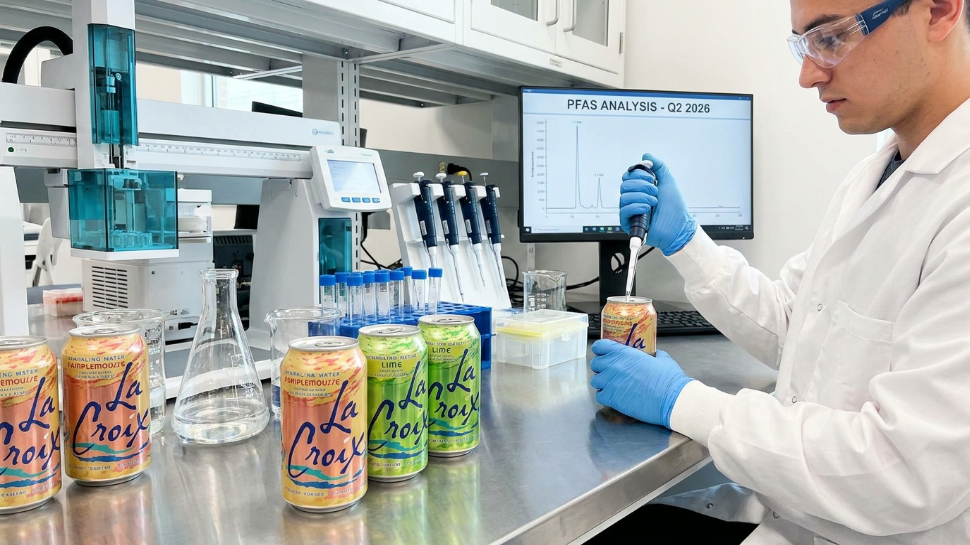
In September 2020, Consumer Reports published the results of an independent lab analysis testing 47 bottled water products — 35 still and 12 carbonated — for PFAS contamination and heavy metals. The carbonated water results were the ones that went viral.
Here’s what the lab found across the carbonated water brands tested, ordered from highest to lowest:
| Brand & Flavor | Total PFAS (ppt) | vs IBWA 5 ppt standard |
|---|---|---|
| Topo Chico Natural Mineral Water | 9.76 | ❌ Nearly 2x over |
| Polar Natural Seltzer Water | 6.41 | ❌ Over limit |
| Bubly Blackberry Sparkling Water | 2.24 | ✓ Below limit |
| Poland Spring Zesty Lime Sparkling | 1.66 | ✓ Below limit |
| Canada Dry Lemon Lime Sparkling | 1.24 | ✓ Below limit |
| La Croix Natural Sparkling Water | 1.16 | ✓ Below limit |
| Perrier Natural Sparkling Mineral Water | 1.10 | ✓ Below limit |
| Spindrift (2020 sample) | 0.19 | ✓ Below limit |
Several other brands tested non-detectable.
If you are choosing between the big three seltzer brands rather than researching PFAS specifically, see our Bubly vs LaCroix vs Spindrift comparison, or read the full LaCroix sparkling water review covering flavors, ingredients, and health claims.
Two of those brands now have their own full investigations: Perrier PFAS testing (1.10 ppt) — the lowest-tested of the brands that exceeded 1 ppt — and Poland Spring PFAS testing (1.66 ppt), which also faces an unresolved lawsuit over whether it is legally spring water at all. La Croix’s 1.16 ppt placed it in the lower middle of the pack — significantly cleaner than Topo Chico and Polar, slightly higher than Perrier and the still-water leaders like Spindrift.
The 2019 Lawsuit — Why La Croix’s Reputation Still Suffers
Before the Consumer Reports PFAS findings, La Croix had already weathered a separate controversy that’s still confused with the PFAS issue online. Understanding the difference matters because the two are completely unrelated.
In October 2018, attorney Beaumont Costales filed a class-action lawsuit in Cook County, Illinois, against National Beverage Corp, alleging that La Croix’s “natural” labeling was deceptive. The complaint named specific flavor compounds — limonene, linalool, linalool propionate, and ethyl butanoate — and made the inflammatory claim that linalool was “used in cockroach insecticide.”
The technical reality is more boring. All four named compounds occur naturally in citrus fruits, lavender, ginger, and sage. They can also be produced synthetically. The lawsuit’s lab couldn’t distinguish between the two sources.
The case was formally dismissed in February 2020, with a complete retraction signed by plaintiff Lenora Rice and her law firm. In the retraction, they admitted the laboratory that performed the original testing “could not, and did not, determine whether the ingredients were ‘synthetic'” and that the same compounds “can be derived naturally.” National Beverage’s independent retesting confirmed the flavor essences were 100% natural per supplier certifications.
Despite the formal dismissal six years ago, the original allegations still circulate online — often blended with the unrelated PFAS findings into one composite “La Croix is toxic” narrative that doesn’t match the actual evidence on either count.
What “1.16 Parts Per Trillion” Actually Means
One part per trillion is an extraordinarily small concentration. For scale, 1 ppt is equivalent to roughly one drop of water in 20 Olympic-sized swimming pools, or one second over approximately 32,000 years.
That doesn’t automatically make PFAS at 1 ppt harmless. The concern with PFAS isn’t acute toxicity — it’s bioaccumulation. PFAS don’t break down in the environment or the human body, so even small daily exposures can build up over decades. This is why different regulatory bodies have set different “safe” thresholds depending on their risk tolerance.
Here’s where the major regulatory benchmarks sit:
Most strict. EWG argues that any detectable PFAS represents an unnecessary health risk over a lifetime of exposure. La Croix’s 1.16 ppt slightly exceeds this advisory.
The federal Maximum Contaminant Level for the two most-studied PFAS compounds individually in public drinking water. La Croix’s total is well under this for any single compound.
The International Bottled Water Association sets a voluntary 5 ppt single-compound and 10 ppt total limit. La Croix is clearly compliant.
Several US states have set their own PFAS limits in this range. La Croix is far below all of them.
The previous federal advisory (combined PFOA + PFOS), in effect before April 2024. La Croix was well under this old standard too.
The picture is consistent: La Croix’s measured PFAS level falls below every binding regulatory limit in the US — and below most non-binding advisories — but slightly above the strictest scientific recommendation from EWG.
La Croix’s Official Response — and Why It Matters
National Beverage Corp, which manufactures La Croix, responded publicly to the 2020 Consumer Reports findings with a statement that the products are “subject to strict quality control and robust filtration systems” and that their samples “exceeded the most stringent PFAS requirements” in the US.
The company also disputed Consumer Reports’ testing methodology, arguing that the total PFAS calculations included compounds at trace amounts that might not represent real exposure risk. This is a defensible point technically — the way you aggregate “total PFAS” across many compounds is genuinely debated among scientists — but it doesn’t change the underlying measurements.
What matters more is independent verification. Mamavation’s 2025 retest of La Croix produced PFAS levels similar to Consumer Reports’ 2020 findings, suggesting the original numbers were reproducible across labs and time periods. When two independent investigators using different methodologies reach similar conclusions, the data has held up.
The EPA’s April 2024 Final Rule — The Real Goalpost
The most significant change in the PFAS regulatory landscape since the original La Croix testing happened in April 2024, when the EPA finalized the first-ever national legally enforceable drinking water standard for PFAS.
The new National Primary Drinking Water Regulation sets Maximum Contaminant Levels (MCLs) at:
- 4 parts per trillion — for PFOA individually
- 4 parts per trillion — for PFOS individually
- 10 ppt — for PFHxS, PFNA, and HFPO-DA (GenX) individually
- A combined Hazard Index limit for mixtures of four PFAS chemicals
Public water systems must complete initial monitoring by 2027 and implement treatment solutions by 2029 if levels exceed limits. Under section 410 of the Federal Food, Drug, and Cosmetic Act, the FDA is required to either establish parallel standards for bottled water or determine such regulation isn’t necessary.
Here’s the key implication for La Croix: even if you applied the strictest individual-compound EPA limit to La Croix’s total PFAS measurement, La Croix would still be below the federal threshold. The 1.16 ppt total represents multiple different PFAS compounds combined — no single compound in La Croix has been reported anywhere near the EPA’s 4 ppt single-compound MCL.
FDA’s April 2025 Bottled Water Investigation
The most recent and largest US bottled water PFAS dataset comes from the FDA. Between 2023 and 2024, the agency sampled 197 domestic and imported bottled water products, testing for 18 different PFAS compounds. Results were released in April 2025.
The findings:
- Only 10 of 197 samples contained any detectable PFAS
- Zero samples exceeded the EPA’s Maximum Contaminant Levels for drinking water
- Of the 10 detection samples: 4 PFAS compounds were detected at levels below EPA MCLs; 2 detected compounds had no MCLs established by EPA
- Most positive detections were either spring water or imported artisan water — not specifically named, but the pattern aligns with source-water contamination rather than processing introduction
This is the broadest independent test of US bottled water PFAS contamination available, and it tells a different story than the viral social media narrative. The viral version says “your bottled water is full of forever chemicals.” The data says: detectable PFAS exists in a minority of products, and none of those exceed federal safety limits.
How La Croix Compares to Competitors in 2026
The PFAS landscape across sparkling water brands has shifted since 2020. Some brands improved their filtration. Some new entrants have published their own testing. And some leaders quietly slipped backward.
| Brand | 2020 PFAS (ppt) | 2025 Retest (ppt) | Trend |
|---|---|---|---|
| La Croix | 1.16 | ~1.1 (similar) | Stable |
| Topo Chico | 9.76 | 3.9 (2021) | ↓ Improved significantly |
| Spindrift | 0.19 | 2.62 | ↑ Higher variance now |
| Perrier | 1.10 | Nestlé reports undetectable | ↓ Improved |
| Liquid Death | Not tested 2020 | Reports below limits | Limited public data |
| Waterloo | Not tested 2020 | Limited public data | — |
The Spindrift movement is notable — once positioned as the cleanest brand on PFAS, the 2025 retest found one flavor at 2.62 ppt, higher than La Croix. This may reflect a single batch, a different flavor formulation, or genuine production variance. It’s a reminder that no single brand is permanently “safe” or “unsafe” based on one test.
For a brand-by-brand comparison of the broader market, see our guide to the healthiest sparkling water for daily drinking.
Should You Stop Drinking La Croix? An Honest Verdict
This is where most PFAS articles either reassure too easily or panic too quickly. The honest answer requires distinguishing between three different reader scenarios.
You drink La Croix occasionally or moderately, and you trust the EPA’s 4 ppt MCL as a reasonable safety threshold. La Croix’s measured level is below every binding US regulatory limit and below the bottled water industry’s voluntary standard. Current evidence does not suggest meaningful harm at typical consumption.
You drink La Croix heavily (4+ cans daily) AND you also have high PFAS exposure from other sources (non-stick cookware, water-resistant clothing, contaminated tap water, food packaging). Cumulative exposure is what matters most with PFAS — single sources are rarely the issue, but stacked exposures add up.
You’re pregnant or planning pregnancy, you have a chronic kidney condition, you have a documented PFAS sensitivity, or you simply hold the strictest precautionary view that any detectable PFAS is too much. Filtered tap water with home carbonation is the most effective alternative.
For the median reader who drinks 1-3 cans of sparkling water a week, La Croix’s PFAS level is unlikely to be the biggest health concern in their day. Cooking on a Teflon pan or eating from fast-food wrappers typically contributes more PFAS exposure than a single can of La Croix.
How to Reduce Your PFAS Exposure
If you want to actively lower your PFAS load — whether or not you keep drinking La Croix — these are the highest-impact changes ranked by typical effectiveness:
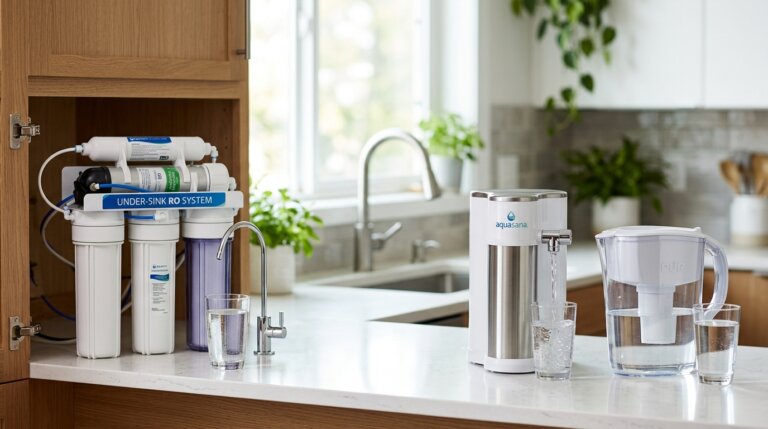
- Install a certified water filter at home. Look for filters certified to NSF/ANSI Standard 53 for PFOA/PFOS reduction, or a full reverse osmosis system. Many cheap pitchers don’t actually remove PFAS — certification matters.
- Replace non-stick cookware. Older Teflon and PFOA-coated pans are major PFAS sources. Switch to stainless steel, cast iron, or PFOA-free ceramic-coated cookware.
- Cut down on fast food wrappers. Fast food packaging — especially grease-resistant wrappers and microwave popcorn bags — historically contained PFAS for moisture resistance.
- Switch to filtered tap water for carbonation. A home soda maker (SodaStream, Aarke, Drinkmate) with filtered water input gives you sparkling water with controlled PFAS exposure.
- Avoid water-resistant fabrics where possible. Stain-resistant carpets, water-resistant outdoor gear, and dental floss with “glide” coatings are common PFAS sources.
- Filter your shower water. Skin absorption from PFAS-contaminated hot shower water can be significant, especially if your local tap water has known PFAS issues.
- Check your tap water’s PFAS report. Many municipalities now publish PFAS levels. The EWG Tap Water Database (ewg.org/tapwater) gives a free zip-code lookup.
For a deeper look at home water filtration options, our guide on best water filter pitchers covers what actually removes PFAS.
Frequently Asked Questions
Does La Croix contain PFAS?
Yes, but at low levels. Consumer Reports’ 2020 testing of La Croix Natural Sparkling Water detected 1.16 parts per trillion of total PFAS. This is above the Environmental Working Group’s recommended threshold of 1 ppt, but well below the International Bottled Water Association’s industry standard of 5 ppt for any single PFAS compound, and below the EPA’s 2024 maximum contaminant levels for drinking water.
Is 1.16 ppt of PFAS in La Croix dangerous?
Most regulatory bodies would say no at that level. The EPA’s 2024 final rule sets maximum contaminant levels at 4 ppt for PFOA and PFOS individually in drinking water — significantly higher than La Croix’s measured total. However, scientists who advocate for the strictest 1 ppt threshold (including the Environmental Working Group) would say La Croix slightly exceeds the precautionary limit. Whether 1.16 ppt is meaningfully harmful depends on your personal risk tolerance and how often you drink it.
What about the La Croix synthetic ingredients lawsuit?
That 2018 lawsuit was formally dismissed in February 2020 with the plaintiff issuing a complete retraction. The laboratory that performed the original testing admitted in writing and under oath that it could not determine whether the ingredients tested were synthetic or naturally derived. La Croix’s ingredients have been certified by their suppliers and independent labs as 100% natural since then. The controversy persists online despite the dismissal.
Which sparkling water has the most PFAS?
In Consumer Reports’ 2020 testing, Topo Chico Natural Mineral Water tested highest at 9.76 ppt total PFAS — nearly twice the IBWA industry threshold of 5 ppt. Polar Natural Seltzer Water tested at 6.41 ppt. Coca-Cola, which owns Topo Chico, later upgraded its filtration, and 2021 retests showed Topo Chico at 3.9 ppt — still detectable but significantly improved.
Which sparkling water has the least PFAS?
Spindrift tested at 0.19 ppt in Consumer Reports’ 2020 analysis — the lowest of all brands tested at that time. However, Mamavation’s 2025 retest found Spindrift at 2.62 ppt for one tested flavor, suggesting variance across production batches or flavors. San Pellegrino and Perrier have also been reported at undetectable levels in some independent tests. There is no single brand guaranteed to be PFAS-free across all batches.
Did the EPA set new PFAS limits?
Yes. In April 2024, the EPA finalized the first-ever national drinking water standard for PFAS — setting Maximum Contaminant Levels at 4 parts per trillion for PFOA and PFOS individually. The rule applies to municipal drinking water systems and gives utilities until 2029 to comply with treatment requirements. Bottled water producers are required to follow the same standard under FDA regulations once EPA sets a public water limit.
What did the FDA find when it tested bottled water?
In April 2025, the FDA released results from testing 197 domestic and imported bottled water samples for 18 different PFAS compounds. Only 10 of 197 samples contained any detectable PFAS, and none exceeded the EPA’s Maximum Contaminant Levels for drinking water. This is the largest independent dataset on US bottled water PFAS levels available and contradicts viral claims that bottled water broadly contains dangerous PFAS levels.
How can I reduce my PFAS exposure if I’m worried?
The most effective home treatments for PFAS removal are reverse osmosis systems and activated carbon filters certified to NSF/ANSI Standard 53 for PFOA/PFOS reduction. Switching to filtered tap water with a home carbonator (like SodaStream or Aarke) gives you sparkling water without bottled or canned packaging. PFAS exposure also comes from non-stick cookware, water-resistant fabrics, and food packaging — reducing exposure across these categories matters more than focusing on any single drink.
Should I stop drinking La Croix?
Most public health experts would say no, based on current data. La Croix’s measured PFAS level (1.16 ppt) is below the EPA’s 2024 drinking water limits and the bottled water industry standard. If you drink La Croix occasionally or daily, current evidence does not suggest meaningful harm. If you want absolute minimization of PFAS exposure, switching to filtered tap water with home carbonation is the most effective path.
Does La Croix’s parent company test for PFAS?
National Beverage Corp, which makes La Croix, has stated publicly that its products undergo strict quality control and robust filtration systems, and that their samples have tested below the most stringent PFAS requirements in the US. The company disputed Consumer Reports’ 2020 testing methodology. Independent retesting by Mamavation in 2025 produced results similar to Consumer Reports’ original findings, lending broader confidence to the published data.
Where do PFAS in sparkling water come from?
PFAS contamination in sparkling water comes from three main sources: the source water itself (PFAS are widespread in US groundwater due to industrial pollution and firefighting foam runoff), the carbonation process (some processes can introduce or fail to filter PFAS effectively), and packaging materials (some can linings and food-contact materials historically contained PFAS, though regulatory pressure is phasing this out).
Is sparkling water from a SodaStream PFAS-free?
Not automatically. If you use unfiltered tap water in a SodaStream, the resulting sparkling water will contain whatever PFAS are in your tap supply. To make truly PFAS-minimized sparkling water at home, use water that has first passed through a reverse osmosis system or an NSF/ANSI 53 certified carbon filter, then carbonate it.
Related Reading
- Healthiest Sparkling Water for Daily Drinking — 2026 Ranked
- Liquid Death Sparkling Water Review: All Flavors Explained
- Top Zero-Calorie Sparkling Waters
- Best Water Filter Pitchers That Remove PFAS
- Sparkling Water vs Seltzer vs Club Soda — Full Comparison
- Best Bottled Water Brands Reviewed
References & Sources
- Consumer Reports — Bottled Water PFAS Testing (2020)
- EPA — Final PFAS National Primary Drinking Water Regulation (April 2024)
- FDA — Bottled Water PFAS Testing Results (April 2025)
- Mamavation — Sparkling Water PFAS Retest (2025)
- Environmental Working Group — Tap Water Database
- National Beverage Corp — Lawsuit Dismissal & Retraction (February 2020 SEC Filing)
- International Bottled Water Association — Voluntary PFAS Standards
The Bottom Line
La Croix contains a small amount of PFAS — about 1.16 parts per trillion in Consumer Reports’ independent testing, confirmed again in 2025. That level is above the strictest precautionary recommendation from the Environmental Working Group, but well below every binding US regulatory limit, including the EPA’s new 2024 drinking water MCL and the bottled water industry’s voluntary standard. La Croix tested cleaner than Topo Chico, Polar, Bubly, Poland Spring, and Canada Dry — the headlines focused on it because of its popularity, not because it was the worst offender. The April 2025 FDA testing of 197 bottled waters found zero samples exceeding federal PFAS limits, contradicting the viral panic. If you want maximum PFAS minimization, the answer isn’t switching to a different bottled brand — it’s filtering your own tap water and carbonating it at home. If you drink La Croix moderately and your other PFAS exposure is reasonable (no non-stick cookware, no PFAS-contaminated tap water, no daily fast-food wrappers), the data does not support stopping. Drink it because you enjoy it. Don’t drink it because someone shared a 2020 headline without the 2025 context.