Carbonated Water Types Explained: Seltzer, Club Soda, Soda Water, Mineral and Sparkling
By Jessica Miller, Brand Reviews Lead · Reviewed by Emily Carter, Hydration & Nutrition Editor
Updated: · 6 min read
In our testing we compare labels can by can rather than trusting front-of-pack wording, because the same brand often sells both a plain seltzer and a mineral sparkling line under nearly identical packaging.
Quick Answer: “Sparkling water” is an umbrella term for any water containing dissolved carbon dioxide. It can mean naturally carbonated mineral water from a spring or plain filtered water with CO₂ added, and usage varies by region and brand. The narrower categories below — seltzer, club soda, soda water and mineral water — are all types of carbonated water that differ by where the bubbles come from and what minerals are present.
- Seltzer: Water + CO₂ only. 0 calories, 0 grams sugar, and typically 0 mg sodium per 12 oz can.
- Club soda / soda water: Carbonated water with added mineral salts, typically 50-75 mg sodium per 12 oz.
- Mineral water: Water from a protected spring carrying naturally occurring minerals; may be still or sparkling.
- Sparkling water: The broad category covering all of the above when carbonated. Read the ingredient list to see which one you actually have.
Labels can be confusing. One aisle says “sparkling,” another says “seltzer,” and a third says “club soda.” Below, we explain the naming, how to read the label, and which one to choose for daily hydration or mixing drinks. If you’re just getting started with bubbly water, skim our Sparkling Water hub for brand and flavor basics.
The One Definition That Clears Up Most Confusion
Much of the confusion online comes from sources that define sparkling water as “naturally carbonated” and treat anything artificially carbonated as a different drink. That distinction does not hold up at the shelf. Sparkling water describes the presence of carbonation, not its origin. Perrier and San Pellegrino are sparkling waters whose CO₂ is largely natural to the source; LaCroix and Bubly are sparkling waters whose CO₂ is injected. Both are correctly labeled sparkling water in the United States.
What actually varies between products is mineral content and added salts — and those are the things worth reading the label for.
What Each Term Usually Means
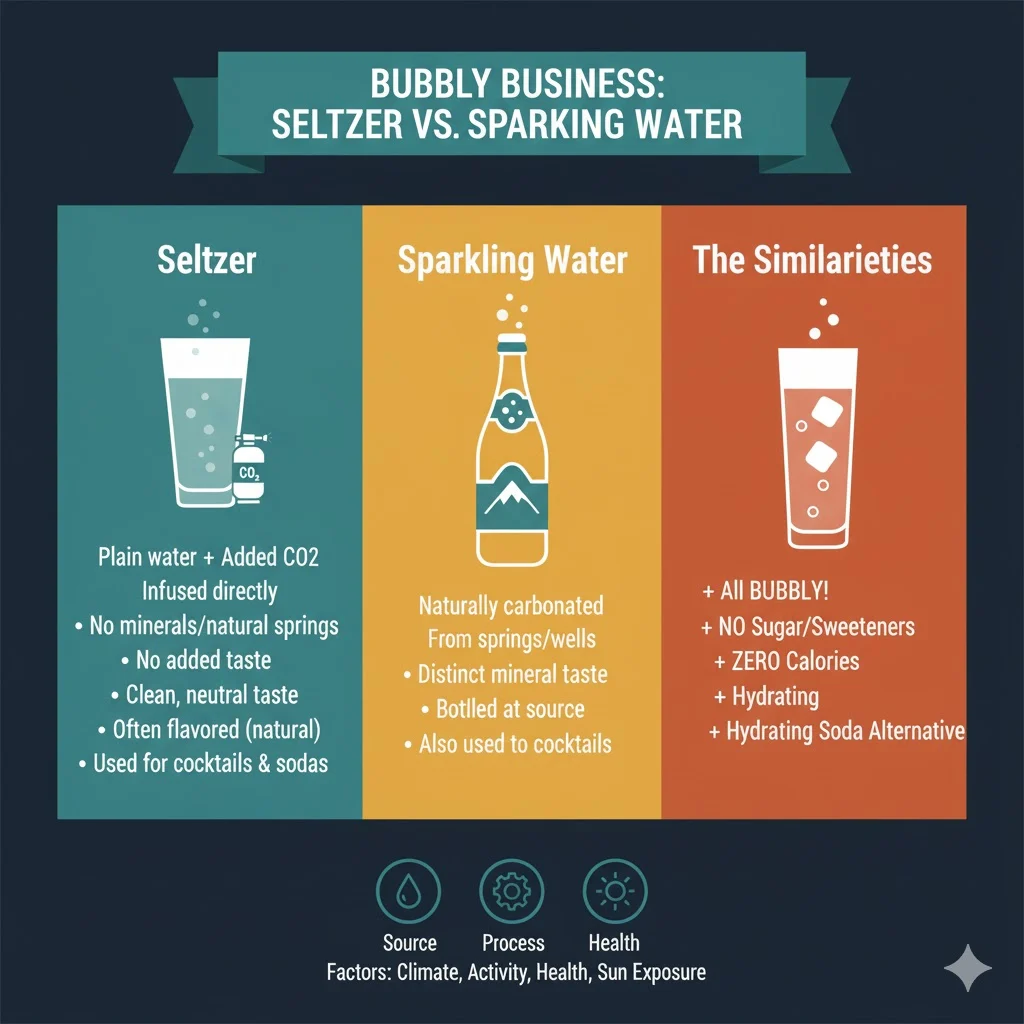
- Seltzer: Purified water + CO₂. Often available in unsweetened fruit flavors. Typically no minerals are added.
- Sparkling water: The umbrella term for carbonated water, whether the CO₂ is natural to the spring or added during bottling. It may or may not contain minerals. Read the ingredient list to see which.
- Club soda: Carbonated water with added mineral salts (e.g., sodium bicarbonate, potassium sulfate) that create a rounder, slightly saline taste. Typically 50-75 mg sodium per 12 oz versus 0 mg in most seltzers.
- Soda water: In U.S. usage, effectively the same product as club soda — carbonated water with added mineral salts. The two names are used interchangeably on most shelves.
- Mineral water: Spring water from a protected underground source carrying naturally occurring calcium, magnesium and bicarbonate. It may be still or sparkling, and its carbonation may be natural or boosted before bottling.
- Tonic water: Not a carbonated water at all. Contains quinine plus roughly 32 g sugar and 124 calories per 12 oz — the only product in this aisle that is not calorie-free. See Sparkling Water vs Tonic Water for the full comparison.
The Numbers That Actually Differ
Strip away the marketing and these products separate cleanly on three measurements:
- Dissolved minerals: Seltzer sits near 0-50 mg/L because it starts from purified water. San Pellegrino runs about 900 mg/L total dissolved solids, and Gerolsteiner exceeds 2,500 mg/L with roughly 348 mg/L calcium and 108 mg/L magnesium.
- Sodium: Most seltzers are 0 mg per can. Club soda runs 50-75 mg. At the extreme end, Vichy Catalan carries over 1,000 mg/L.
- Acidity: Plain carbonated water sits around pH 5-6, versus cola at roughly pH 2.5. Enamel demineralizes below pH 5.5, which is why citrus-flavored cans matter more than plain ones.
How to Read the Label (So You Get What You Want)
The name on the front can be marketing. The truth is on the ingredients and Nutrition Facts panel.
- Ingredients: “Carbonated water” = basic seltzer/sparkling. “Natural flavors” is common for unsweetened aromas. “Sodium bicarbonate/potassium sulfate” = more like club soda.
- Calories & sugar: Should be 0 for standard seltzer/sparkling. If you see calories or juice, it’s a flavored drink (still fine, but not “zero”).
- Sodium: Many seltzers are 0 mg; club soda often has more. If you drink several cans/day and track sodium, choose lower-sodium labels.
- Minerals: Natural mineral waters list calcium, magnesium, bicarbonate on brand sites or sometimes labels; taste can feel “harder” or more mineral.
Taste & Use Cases (When to Pick Which)
All of these hydrate, but minerals and flavoring change the experience. Match the can to the moment.
- Everyday sipping: Plain seltzer or plain sparkling water (low/zero sodium; clean taste).
- Food pairing: Mineral sparkling waters offer bigger bubbles and a distinct minerality that some people love with meals.
- Cocktails/mocktails: Club soda’s mineral salts make citrus and bitters pop.
- Cooking and baking: Soda water and seltzer add lightness to batters such as tempura and to doughs.
- Health angle: For the pros/cons of fizz and flavorings, see Is Sparkling Water Good for You?.
Health & Teeth: Quick Notes
Plain seltzer/sparkling is naturally 0 sugar, which is great. Acidity comes from carbonation and, more so, from citrusy flavors. For enamel-friendly habits—avoid all-day sipping, enjoy flavors with meals, and brush 30–60 minutes later—see our dentist-informed tips inside the hub.
Carbonation itself does not reduce hydration: carbonated water hydrates about as well as still water. Some people experience mild bloating from the bubbles. The claim that carbonated water weakens bones is not supported for carbonated water — that concern traces to cola-type soft drinks rather than to plain fizz. Mineral waters carrying bicarbonates may ease mild indigestion in some people.
At-a-Glance Comparison
| Feature | Seltzer | Sparkling Water | Club Soda / Soda Water | Mineral Water |
|---|---|---|---|---|
| Core definition | Water + CO₂ | Umbrella term: water + CO₂, natural or added | Carbonated water + added mineral salts | Spring water with natural minerals; still or sparkling |
| Carbonation source | Added | Natural or added | Added | Often natural; sometimes boosted |
| Typical sodium | Usually 0 mg | Varies with the source | Often 50-75 mg per 12 oz | Varies; some brands are high |
| Taste | Clean, crisp, neutral | Depends on mineral content | Slightly saline, rounder | Fuller, sometimes slightly salty |
| Best for | Daily hydration; clean taste | Everyday fizz; soda replacement | Cocktails/mocktails; cooking | Mineral intake; pairing with meals |
Cost and Environmental Notes
- Price: Seltzer typically runs $0.50–$1.00 per bottle in U.S. stores, while imported mineral sparkling waters run $1.00–$2.50, reflecting spring sourcing and shipping.
- Footprint: Domestically produced seltzer generally carries a lower carbon footprint than mineral water shipped internationally. Aluminum cans are easier to recycle than plastic bottles.
Popular Brands in the U.S.
- Mostly seltzer-style (added CO₂): LaCroix, Bubly, AHA, Spindrift, Waterloo
- Mineral sparkling: San Pellegrino, Perrier, Topo Chico, Gerolsteiner
Buyer Tips (Save Time in the Aisle)
- Zero sugar first: If calories matter, stick to “unsweetened” seltzer/sparkling.
- Check sodium: Choose low or zero sodium if you drink multiple cans per day.
- Want bold aroma? Look for unsweetened “flavored” lines—great for habit building. Start with the sparkling water hub to compare styles.
FAQs
Are sparkling water and seltzer the same?
- Nearly. Seltzer is specifically water + CO₂. Sparkling water is the broader umbrella term and may also refer to naturally carbonated mineral water. Every seltzer is a sparkling water; not every sparkling water is a seltzer.
Is soda water the same as sparkling water?
- Soda water is one type of sparkling water — specifically carbonated water with added mineral salts. In U.S. usage it is effectively interchangeable with club soda.
Is club soda the same as seltzer?
- No—club soda has added mineral salts (often more sodium). It’s popular as a mixer.
Is mineral water the same as sparkling water?
- No. Mineral water refers to source and mineral content; sparkling refers to carbonation. Some mineral waters are sparkling, and some sparkling waters are mineral waters, but neither term implies the other.
Which is better for daily hydration?
- Plain seltzer or plain sparkling water with low sodium are easy daily choices. Mineral versions are nice with meals.
Is tonic water a type of seltzer?
- No. Tonic water contains quinine and added sugar and is a soft drink rather than a carbonated water. See Sparkling Water vs Tonic Water.