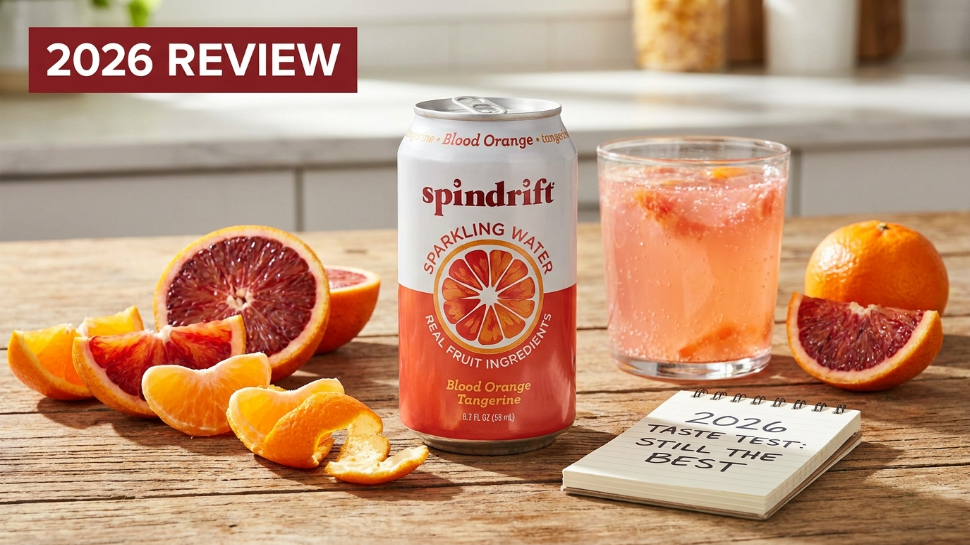
Is Spindrift Healthy? The Short Version
Yes, for most people, with two specific caveats worth knowing before you commit to it as a daily drink.
| The question | The answer |
|---|---|
| Calories per can | 3 to 17, depending on flavour. Lemon and Lime are 4. Grapefruit is the highest at 17. |
| Sugar | 0 to 3g, all natural fruit sugar. No added sugar, no cane sugar, no high-fructose corn syrup. |
| Artificial sweeteners | None. No aspartame, sucralose, acesulfame potassium or stevia. |
| Natural flavours | None. Real squeezed juice and purée instead, which is the brand’s whole point. |
| Caffeine | None, except Half Tea and Half Lemon at roughly 15 to 20mg. |
| PFAS | Mixed. 0.19 ppt in 2020 testing, 2.62 ppt in a 2025 retest of one flavour. Both below the 4 ppt federal limit. |
The two caveats. First, it is not a zero-calorie drink. If you are tracking calories to the gram, La Croix and Waterloo are at zero and Spindrift is not. Second, its PFAS position has weakened since 2020, so the “cleanest brand” claim you may have read no longer holds.
Put in context, though, the calorie objection is small. Spindrift’s highest-calorie flavour is 17 calories against 140 in a Coca-Cola and 165 in a glass of orange juice. Its 3g of natural sugar sits against the American Heart Association’s daily added-sugar limits of 25g for women and 36g for men, and Spindrift’s sugar is not added sugar at all.
The rest of this guide covers the ingredient labels flavour by flavour, the PFAS testing timeline in full, and how it compares against La Croix, Bubly, Waterloo and Liquid Death.
What Makes Spindrift Different (and Why It Matters)
Spindrift was founded in 2010 by Bill Creelman in Newton, Massachusetts, with a simple-sounding idea: make sparkling water with actual fruit instead of “natural flavor.” Sixteen years later, it’s still the only major American sparkling water brand following through on that promise at scale.
The distinction matters more than it sounds. The FDA defines “natural flavor” loosely — a natural flavor can be derived from plant or animal sources, but it can also be processed, distilled, fermented, or otherwise modified in ways most consumers wouldn’t expect. The end result might bear little resemblance to the actual fruit named on the label. La Croix’s Grapefruit, for example, contains “natural grapefruit flavor” — which the brand has defended in court as natural-origin, but which is not the same as actual grapefruit juice.
Spindrift skips the category entirely. Their Grapefruit flavor lists three ingredients: carbonated water, grapefruit juice, and a touch of citrus juices. Their Raspberry Lime lists carbonated water, raspberry purée, lime juice, and raspberry concentrate. Read any Spindrift label and you’ll find the same pattern — water plus identifiable fruit, often with citric acid to preserve freshness.
This transparency is the brand’s core value proposition. Whether it’s worth a 50-70% price premium over La Croix is what the rest of this guide will help you decide.
Ingredients Breakdown — Reading Behind the “Real Fruit” Claim
Let’s verify the real-fruit claim against actual product labels. Here’s the ingredient list for Spindrift’s most popular flavors:
| Flavor | Ingredients | Calories | Sugar |
|---|---|---|---|
| Lemon | Carbonated water, lemon juice | 4 | 0g |
| Lime | Carbonated water, lime juice | 4 | 0g |
| Grapefruit | Carbonated water, grapefruit juice, orange juice, lemon juice, hibiscus (for color) | 17 | 3g |
| Raspberry Lime | Carbonated water, raspberry purée, lime juice, raspberry concentrate | 5 | 1g |
| Pineapple | Carbonated water, pineapple juice, citric acid | 15 | 3g |
| Blackberry | Carbonated water, blackberry juice, lemon juice, blackberry purée | 3 | 1g |
| Blood Orange Tangerine | Carbonated water, blood orange juice, tangerine juice, citric acid | 10 | 2g |
| Half Tea & Half Lemon | Carbonated water, lemon juice, brewed black tea | 5 | 0g |
Three things stand out from these labels:
1. There are no added sugars. The 0-3g of sugar comes entirely from the fruit itself. Spindrift doesn’t add cane sugar, high-fructose corn syrup, agave, or honey.
2. There are no artificial sweeteners. No aspartame, sucralose, acesulfame potassium, saccharin, or stevia. The natural fruit sugars carry the sweetness.
3. There are no “natural flavors” hiding the real composition. Every ingredient is identifiable on sight — fruit name plus water.
The trade-off is that Spindrift contains real calories — small amounts, but more than the zero-calorie competitors. For most people, 3-17 calories per can is negligible; for someone tracking macros precisely or following a strict zero-calorie protocol, it’s a real consideration.
All Spindrift Flavors Explained — Best to Start With First
Below are Spindrift’s most popular sparkling water flavors, ordered by general consumer preference based on aggregated online reviews. Limited and seasonal flavors rotate in and out, so this list focuses on the consistent year-round lineup.
1. Raspberry Lime — The Universal Favorite
The flavor most reviewers recommend trying first. Real raspberry purée delivers actual berry taste (you’ll see the fruit sediment in the can), and lime juice keeps it bright without veering into syrup territory. At 5 calories and 1g of sugar, it’s an easy daily option. This is the flavor that converts La Croix skeptics into Spindrift loyalists.
2. Grapefruit — The Closest Thing to Fresh-Squeezed
The boldest flavor in the lineup and the one Spindrift built its reputation on. Real grapefruit juice plus touches of orange and lemon create what tastes like a less-sweet, slightly diluted version of fresh grapefruit juice. The 17 calories are the highest in the lineup — but unlike Bubly Grapefruit or La Croix Pamplemousse, you’re getting actual grapefruit, not a synthetic approximation.
3. Strawberry Lemonade — The Crowd-Pleaser
Tastes like a homemade lemonade stand. Real strawberry purée, lime juice, lemon juice, and natural strawberry extract create a layered, slightly sweet-tart drink. Kids tend to love this one. Around 11 calories and 2g of sugar — middle of the road on both counts.
4. Pineapple — The Tropical Standout
The first sparkling water made with real squeezed pineapple, and it shows. Where most pineapple sparkling waters taste like artificial candy, Spindrift tastes like an actual pineapple smoothie thinned with bubbles. At 15 calories and 3g sugar, it’s not the lightest, but the flavor authenticity is worth it for occasional indulgence.
5. Lemon — The Pure Workhorse
Two ingredients: carbonated water and real lemon juice. That’s it. The cleanest, lowest-calorie option in the lineup at 4 calories and 0g sugar. Perfect for mixed drinks, as a soda water substitute, or for anyone who finds the fruit-forward flavors too sweet.
6. Lime — Lemon’s Sister, Slightly Tangier
Same two-ingredient simplicity as Lemon, just with limes. Slightly more punch on the finish. 4 calories, 0g sugar. Works exceptionally well as a vodka or tequila mixer.
7. Blood Orange Tangerine — The Sophisticated Choice
Blood orange juice and tangerine juice deliver a distinct citrus profile that’s a step up from generic “orange sparkling water.” 10 calories, 2g sugar. Polarizing — people who like complex citrus love it; people wanting a clearer orange flavor sometimes find it muddled.
8. Orange Mango — The Smoothie-in-a-Can
Orange juice plus alphonso mango purée gives a creamy, tropical profile. Around 13-15 calories with 3g sugar. Heavier mouthfeel than most sparkling waters — almost feels like a thinned-out smoothie.
9. Pink Lemonade — The Surprise Hit
Sweet cherry, lime, and raspberry create what reviewers call “the first un-disappointing pink lemonade.” Unlike the powdered childhood version, this one tastes like an actual lemonade with berry undertones.
10. Blackberry — The Underrated Berry
Blackberry juice and purée plus lemon juice create a unique sweet-tart-slightly-bitter profile that’s hard to describe but easy to drink. Only 3 calories and 1g sugar — one of the lightest flavors despite being berry-heavy.
11. Cherry — Cleaner Than Expected
Cherry purée plus tart cherry juice avoids the medicinal cough-syrup trap that ruins most cherry sodas. Mid-pack on calories and sugar.
12. Half Tea & Half Lemon — The Sleeper Hit
Carbonated water, lemon juice, and brewed black tea — basically a sparkling Arnold Palmer. 5 calories, 0g sugar, but contains some natural caffeine from the tea (~15-20 mg per can). Reviewers compare it to AriZona iced tea minus the sugar bomb.
Calorie & Sugar Reality Check — Is It Actually a Problem?
The biggest knock against Spindrift is the calorie count. Critics argue that “real fruit” is just a euphemism for “more sugar.” Is that fair?
Let’s put the numbers in context.
| Drink (12 oz) | Calories | Sugar | Calorie context |
|---|---|---|---|
| Spindrift Grapefruit (highest) | 17 | 3g | = 1 baby carrot |
| Spindrift Raspberry Lime | 5 | 1g | = 1 piece of celery |
| Spindrift Lemon/Lime | 4 | 0g | = 1 piece of celery |
| La Croix (any) | 0 | 0g | — |
| Coca-Cola | 140 | 39g | = 1 medium banana |
| Orange Juice | 165 | 33g | = 1 slice of pizza |
Even Spindrift’s highest-calorie flavor (Grapefruit, 17 calories) is roughly 1/8th of a regular soda and 1/10th of orange juice. The “high-calorie sparkling water” framing only works if you compare Spindrift against zero-calorie competitors. Compared to anything else people typically drink, Spindrift is barely a calorie source.
The same applies to sugar. 3 grams of natural fruit sugar is roughly what you’d get from a small handful of grapes. The American Heart Association’s daily added sugar limit is 25g for women and 36g for men — Spindrift’s 0-3g of natural (not added) sugar is essentially a rounding error.
Spindrift vs Other Sparkling Water Brands
Where does Spindrift sit in the broader sparkling water market? Here’s how it stacks up on the metrics most readers care about:
| Brand | Sweetener | Calories | Sugar | Real Fruit? | Price Tier |
|---|---|---|---|---|---|
| Spindrift | None (natural fruit sugar) | 3-17 | 0-3g | ✅ Yes | Premium |
| La Croix | None | 0 | 0g | ❌ Natural flavors only | Standard |
| Waterloo | None | 0 | 0g | ❌ Natural flavors only | Standard |
| Bubly | None | 0 | 0g | ❌ Natural flavors only | Budget |
| Liquid Death (flavored) | Agave + Stevia | 10 | 2g | ❌ Natural flavors only | Premium |
| Topo Chico | None | 0 | 0g | ❌ Natural flavors only | Premium |
Where Spindrift wins: Ingredient transparency. It’s the only mainstream brand where every flavor ingredient is identifiable. For consumers who want to know exactly what they’re drinking, this matters.
Where competitors win: Cost and zero-calorie strictness. La Croix is cheaper. Bubly is cheaper still. Liquid Death has more aggressive flavors. Topo Chico has a glass-bottle option for premium occasions.
For a detailed look at the cleanest sparkling water options, see our guide to the healthiest sparkling water for daily drinking. We’ve also covered the full Liquid Death lineup and the La Croix PFAS investigation if you’re comparing across brands.
The Pulp Question — Is That Normal?
Open a can of Spindrift Raspberry Lime or Blackberry, pour it into a clear glass, and you’ll notice something that doesn’t happen with La Croix or Bubly: tiny bits of fruit sediment floating around or settled at the bottom.
This is real fruit pulp. Because Spindrift uses actual squeezed fruit and purées instead of flavor essences, the natural fiber, color compounds, and fruit solids end up in the final product. The amount varies by flavor — citrus flavors like Lemon and Lime show almost no visible pulp, while berry-forward flavors like Raspberry Lime, Blackberry, and Strawberry Lemonade show noticeable sediment.
Three things to know about Spindrift pulp:
- It’s safe to consume. It’s just fruit fiber and natural color compounds — the same stuff you’d consume eating the actual fruit.
- It’s a quality signal. Brands using flavor essences don’t have pulp because there’s no real fruit to leave residue. Pulp confirms the ingredient claim.
- You can mix it back in. A gentle invert of the can before opening, or pouring over ice, redistributes the sediment evenly.
For some drinkers, the pulp is the appeal — proof of authenticity. For others, the texture is off-putting and feels like the drink has “gone off.” Neither reaction is wrong.
The PFAS Situation — From Best in Class to Mixed Data
For a long time, Spindrift was held up as the gold standard for PFAS-free sparkling water. Then 2025 testing complicated that narrative.
Here’s the timeline:
2020 — Consumer Reports independent testing. Spindrift measured at 0.19 parts per trillion total PFAS — the lowest of all 12 carbonated water brands tested. For context, La Croix tested at 1.16 ppt; Topo Chico at 9.76 ppt. Spindrift’s score helped cement its premium, “clean” positioning.
2025 — Mamavation independent retest. When Mamavation and Environmental Health News retested 15 sparkling water products in September 2025 using EPA method 1633 across 40 PFAS compounds, Spindrift Grapefruit measured 2.62 ppt of 6:2FTS — significantly higher than its 2020 result and the highest single reading in that round of testing. The same retest found other brands had improved: Topo Chico dropped from 9.76 ppt to roughly 2.8 ppt after a filtration upgrade. Spindrift’s number went the other direction.
Two important caveats:
Both readings are below regulatory limits. Even the higher 2.62 ppt is below the EPA’s 2024 Maximum Contaminant Level of 4 ppt for PFOA and PFOS individually, and 6:2FTS is not currently regulated at all.
One flavor isn’t the whole brand. Mamavation tested a single Spindrift flavor in 2025. Different flavors may have different source-water origins or filtration profiles. Without comprehensive testing across the whole product line, it’s hard to say whether Spindrift overall has slipped or whether one flavor is an outlier. The same caution applies to every single-sample result in this category, including the non-detects.
Pros & Cons of Drinking Spindrift Daily
Pros
- Only major brand made with real squeezed fruit
- No natural flavors, no artificial sweeteners, no stevia
- Recognizable ingredients on every label
- Multiple flavors under 5 calories per can
- Authentic fruit taste — closer to fresh juice than soda
- No caffeine in core lineup (except Half Tea Half Lemon)
- US-made with family farm fruit sourcing
- Works as soda replacement and cocktail mixer
Cons
- 50-70% more expensive than La Croix per ounce
- Some flavors have 15-17 calories (notable for strict tracking)
- Visible fruit pulp can be off-putting to some drinkers
- PFAS levels increased in 2025 retest (still below limits)
- Smaller flavor variety than competitors like La Croix
- Not zero-sugar (0-3g natural sugar per can)
- Pulp settles — requires shaking or pouring over ice
Pricing & Where to Buy
Spindrift is available at Whole Foods, Trader Joe’s, Target, Walmart, most major grocery chains, and on Amazon. Approximate 2026 pricing:
- Single 12 oz can — $1.50 to $2.00 at convenience stores
- 8-pack (single flavor) — $5 to $7
- 20-pack variety pack — $14 to $18 (best per-can value)
- Costco bulk packs — typically the cheapest per-ounce option for regular drinkers
- Amazon Subscribe & Save — 5-15% discount on recurring orders
Our picks on Amazon (As an Amazon Associate we earn from qualifying purchases.)
4-Flavor Variety Pack (20-Pack)
Includes Raspberry Lime, Grapefruit, Orange Mango & Lemon — the two most-recommended flavors plus two more. Best per-can value and a low-risk way to find your favorite.
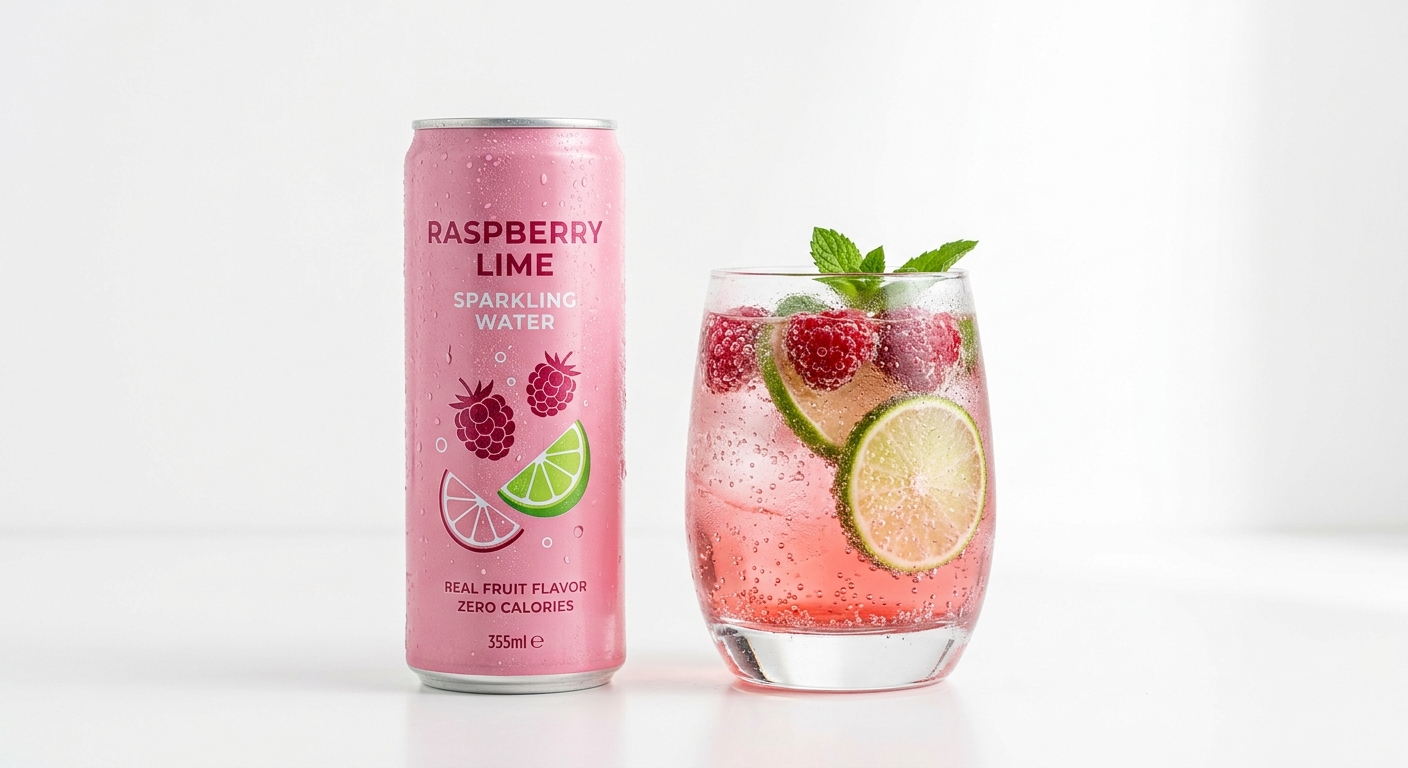
Raspberry Lime (8-Pack)
The universal favorite and best-seller — real raspberry purée and lime juice, just 5 calories and 1g natural sugar. The flavor that converts La Croix skeptics.
Who Should Drink Spindrift (and Who Shouldn’t)
Care about ingredient transparency. Find La Croix’s flavor “too subtle” or “barely there.” Want a soda replacement that actually tastes like fruit. Don’t mind paying more for cleaner ingredients. Use sparkling water as a cocktail mixer.
Are tracking calories or sugar strictly (choose Lemon, Lime, or Raspberry Lime). Are sensitive to fruit pulp texture. Are PFAS-conscious — current data shows Spindrift is no longer the cleanest option.
Want absolute zero calories and zero sugar — La Croix, Waterloo, or Bubly are better. Need to keep beverage spending low. Drink only plain water — filtered tap water at home is virtually free.
Are curious whether real fruit actually tastes different. Want to upgrade your default sparkling water. Have kids who reject “flavorless” sparkling waters. Are weaning yourself off soda gradually.
Frequently Asked Questions
Is Spindrift actually made with real fruit?
Yes. Spindrift is the only major American sparkling water brand that uses real squeezed fruit juice and purées instead of “natural flavors” or flavor essences. The ingredient label confirms this — every flavor lists actual fruit juice or purée as a primary ingredient, alongside carbonated water and occasionally citric acid for freshness.
How many calories are in Spindrift?
Spindrift calories range from 3 to 17 per 12 oz can, depending on the flavor. Lemon, Lime, and Grapefruit Variety Pack flavors are around 3-4 calories. Raspberry Lime is 5 calories. Pineapple is 15 calories. Grapefruit (single flavor) is 17 calories — the highest in the lineup. The calories come from the natural sugars in real fruit juice, not added sweeteners.
Does Spindrift have sugar?
Yes, but only naturally occurring sugars from real fruit. Spindrift contains 0-3 grams of sugar per can depending on the flavor. There are no added sugars, no artificial sweeteners, and no stevia. Grapefruit and Pineapple have the most natural sugar at 3 grams per can; Lemon and Lime have 0 grams.
Is Spindrift healthier than La Croix?
It depends on what you mean by healthier. La Croix has zero calories and zero sugar, while Spindrift has 3-17 calories and 0-3 grams of natural sugar. If you’re tracking calories strictly, La Croix wins. But Spindrift uses real fruit instead of “natural flavors” (which can be derived synthetically), so for ingredient transparency, Spindrift is the cleaner choice. Both are dramatically healthier than soda.
Why is there pulp at the bottom of my Spindrift?
That’s real fruit. Because Spindrift uses actual squeezed fruit juice and purées, you may see fruit sediment or pulp settle at the bottom of the can — especially in fruit-heavy flavors like Raspberry Lime, Strawberry Lemonade, and Blackberry. This is normal and a sign of authentic fruit content. Gently invert the can or pour over ice to redistribute it.
Does Spindrift contain PFAS?
Spindrift’s PFAS levels have shown variance across independent testing. Consumer Reports’ 2020 analysis measured 0.19 parts per trillion — the lowest of all brands tested at the time. However, Mamavation’s 2025 retest of the Grapefruit flavor measured 2.62 ppt of 6:2FTS — the highest single reading in that round. Both measurements are below the EPA’s 4 ppt limit for individual regulated compounds, but the gap illustrates that single-sample figures reflect one batch rather than a permanent property of a brand.
What’s the most popular Spindrift flavor?
Raspberry Lime is consistently Spindrift’s bestseller and the most universally praised flavor in online reviews. It uses real raspberry purée and real lime juice, delivers authentic fruit flavor without overwhelming sweetness, and works equally well chilled, over ice, or as a cocktail mixer. Grapefruit is a close second and the most commonly recommended starting flavor.
Can pregnant women drink Spindrift?
Spindrift is generally safe during pregnancy as it contains no caffeine, no artificial sweeteners, and only real fruit ingredients. However, if you’re monitoring sugar intake during pregnancy, choose the lower-sugar flavors (Lemon, Lime, Raspberry Lime) over higher-sugar options (Pineapple, Grapefruit). Always consult your healthcare provider about specific beverage choices while pregnant.
Does Spindrift have caffeine?
The standard sparkling water line contains no caffeine. The exception is Half Tea & Half Lemon, which contains brewed black tea and therefore some natural caffeine — approximately 15-20 mg per can, less than half a cup of coffee. All other Spindrift sparkling waters are 100% caffeine-free.
Is Spindrift good for weight loss?
Spindrift can support weight loss as a replacement for soda or juice, since it contains 3-17 calories per can versus 140-200 calories in regular soda. The natural sugars (0-3g per can) are minimal compared to soda’s 39-46g. For strict calorie minimization, choose Lemon, Lime, or Raspberry Lime flavors. For best results, treat Spindrift as a soda alternative rather than a water replacement.
How much does Spindrift cost?
Spindrift typically costs $5-7 for an 8-pack of 12 oz cans, or $14-18 for a 20-pack variety pack, depending on retailer. This is roughly 50-70% more expensive than La Croix per ounce, and similar in pricing to Liquid Death. Costco and Amazon Subscribe & Save offer the best per-can pricing for regular drinkers.
Where is Spindrift made?
Spindrift Beverage Co. is headquartered in Newton, Massachusetts. The company was founded in 2010 by Bill Creelman. Spindrift sources real fruit from family farms in the US and produces sparkling water in the United States. The brand emphasizes domestic sourcing and small-batch production methods compared to mass-market sparkling water competitors.
Related Reading
- Healthiest Sparkling Water for Daily Drinking — 2026 Ranked
- Liquid Death Sparkling Water Review: All Flavors Explained
- La Croix and PFAS — Independent Testing Investigation · Perrier PFAS Testing (1.10 ppt) — Full Investigation · Poland Spring PFAS Testing (1.66 ppt) — Full Investigation
- Top Zero-Calorie Sparkling Waters Ranked
- Sparkling Water vs Seltzer vs Club Soda — Full Comparison
- Best Bottled Water Brands Reviewed
References & Sources
- Spindrift — Official Product Information & Ingredient Labels
- Consumer Reports — Bottled Water PFAS Testing (2020)
- Mamavation & Environmental Health News — Sparkling Water PFAS Retest (2025)
- FDA — Natural Flavor Definition Guidelines (21 CFR 101.22)
- EPA — Final PFAS National Primary Drinking Water Regulation
- American Heart Association — Daily Added Sugar Guidelines
The Bottom Line
Spindrift is the only major sparkling water brand that delivers on the “made with real fruit” claim — and the ingredient labels back it up. The trade-off is real but small: 3-17 calories per can and 0-3 grams of natural sugar, compared to zero from La Croix or Bubly. For most drinkers that calorie difference is meaningless; for someone tracking strict zero-calorie hydration, it’s a reason to pick something else. Raspberry Lime is the universal first-flavor recommendation; Grapefruit is the boldest standout. The PFAS picture has shifted since 2020 — Spindrift is no longer demonstrably the cleanest on this metric — but it’s still within all current US safety limits. The premium price (50-70% more than La Croix per ounce) is harder to justify if you’re drinking sparkling water daily and don’t care about ingredient transparency. Buy Spindrift because you want to taste actual fruit, not because it’s measurably “healthier” than the competition. On that one metric — real ingredients you can identify on the label — nothing else in the mainstream market matches it.