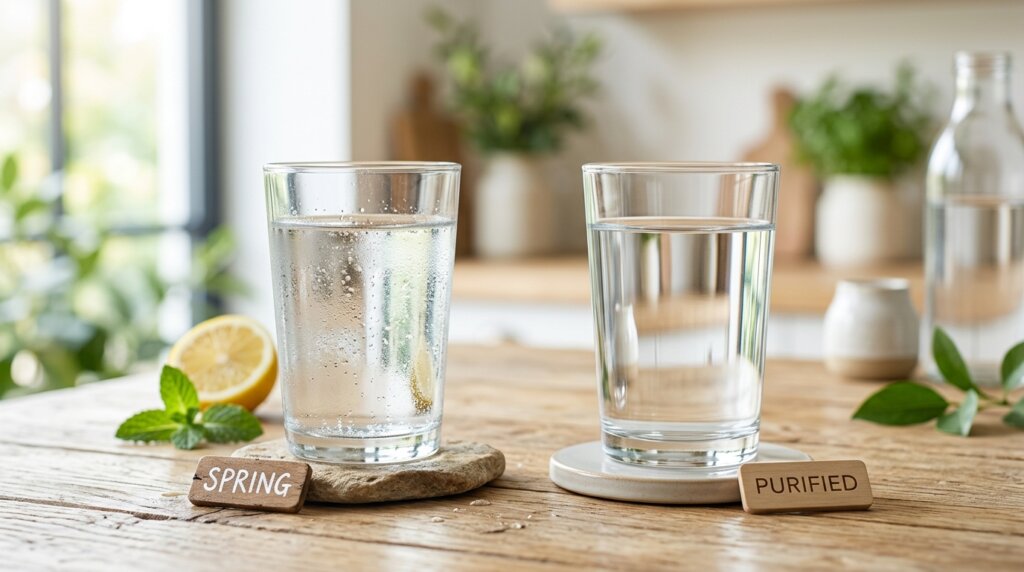
Quick answer: Spring water comes from an underground source and keeps its natural minerals, giving it a distinct taste. Purified water is any water processed to remove nearly all contaminants and minerals (via reverse osmosis, distillation, or deionization). The main difference: spring water retains minerals, purified water strips them out. Both are safe and hydrate equally — the choice is mostly about taste and what’s in your local tap.
Spring water and purified water sit side by side on every store shelf, and the labels can be genuinely confusing — especially since both are just “water.” The difference comes down to two things: where the water starts, and how much is done to it. Here’s a clear breakdown so you know exactly what you’re paying for.
What is spring water?
Spring water is collected from an underground source that flows naturally to the surface (a spring), or is pumped from a borehole tapping the same underground formation. By U.S. FDA definition, it must come from such a source. It’s typically filtered only lightly to remove sediment, so it keeps its naturally occurring minerals — calcium, magnesium, potassium, and others — which give each spring water its own subtle taste. Brands like Evian, Poland Spring, and Arrowhead are spring waters. Because the mineral content varies by source, no two spring waters taste exactly alike.
What is purified water?
Purified water is defined by how it’s treated, not where it comes from. It can start as tap water or even spring water, then goes through a purification process — reverse osmosis, distillation, or deionization — that removes almost all contaminants and dissolved minerals. To be labeled “purified” in the U.S., water must meet strict FDA purity standards (very low total dissolved solids). Dasani and Aquafina are well-known purified waters. Some brands add a small amount of minerals back afterward purely for taste.
The key differences at a glance
| Spring water | Purified water | |
|---|---|---|
| Source | A specific underground spring | Any source, defined by treatment |
| Minerals | Retained (natural) | Removed (unless added back) |
| Taste | Fuller, slightly mineral | Clean, neutral |
| Consistency | Varies by source | Very consistent |
| Examples | Evian, Poland Spring | Dasani, Aquafina |
Which is healthier?
For hydration, they’re equal — both are safe and effective, and your body absorbs water the same way regardless of label. Spring water provides trace minerals, but the amounts are small compared to what you get from food, so they’re a minor bonus rather than a real health advantage. Purified water removes those minerals along with any contaminants, which some people prefer. Neither is meaningfully “healthier” for most people. According to the CDC, both spring and purified bottled waters that meet FDA standards are safe to drink.
The PFAS difference nobody mentions
There is one measurable way these two categories genuinely differ, and it runs counter to what most people assume: purified water tends to test lower for PFAS than spring water.
The reason is straightforward. Spring water is bottled close to its natural state — so whatever PFAS exists in the aquifer travels into the bottle. Purified water goes through reverse osmosis or distillation, which strips out PFAS along with the minerals.
Consumer Reports’ independent lab testing showed exactly this pattern. Poland Spring, a spring water, tested at 1.66 ppt total PFAS. Dasani, a purified water, tested at 0.37 ppt — roughly a quarter of that. La Croix, also purified, came in at 1.16 ppt. Perrier, a natural mineral water, measured 1.10 ppt.
This is an uncomfortable irony for the premium spring water category: the “more natural” product is, on this specific measure, the less filtered one. If PFAS is a priority for you, purified water has the edge — and a home reverse osmosis system beats every bottled option, removing 94–99% of PFAS compounds. See our full ranking of bottled water brands by PFAS level for the complete data.
Which should you choose?
- Choose spring water if you like a fuller, mineral taste and want naturally occurring minerals.
- Choose purified water if you want the cleanest, most neutral taste, if your local tap water has quality issues you’re trying to avoid, or if minimizing PFAS is a priority.
- Skip bottled entirely if cost or plastic waste bothers you — a home filter can give you purified-quality water for a fraction of the price.
Learn more about purified water and how it compares in our mineral vs purified water guide.
The bottom line
Spring water keeps its natural minerals; purified water strips almost everything out. Both are safe and hydrate you equally, so the real choice comes down to taste preference and what’s in your tap. If you drink a lot of bottled water, a home reverse osmosis system can deliver purified-quality water at home for far less than buying bottles.
Frequently asked questions
What is the difference between spring water and purified water?
Spring water comes from an underground source and is bottled with its natural minerals intact, giving it a distinct taste. Purified water is any water (often tap or spring) processed to remove nearly all contaminants and minerals through methods like reverse osmosis or distillation. Spring water keeps minerals; purified water strips them out.
Which is healthier, spring or purified water?
Both are safe and hydrate equally. Spring water provides trace minerals like calcium and magnesium. Purified water removes those along with contaminants. Neither is meaningfully healthier for most people; it comes down to taste preference and what’s in your tap.
Is purified water the same as distilled water?
Not exactly. Distilled water is one type of purified water, made by boiling and condensing water to remove impurities. “Purified” is a broader label that also includes reverse osmosis and deionization. All distilled water is purified, but not all purified water is distilled.
Does purified water have minerals?
Very few. Purification removes nearly all dissolved minerals along with contaminants. Some brands add minerals back for taste after purifying. Spring water, by contrast, keeps its naturally occurring minerals.
Which tastes better?
It’s subjective. Many people find spring water tastes fuller or slightly sweet because of its minerals, while purified water tastes very clean and neutral. Try both and see which you prefer.
Does spring water or purified water have more PFAS?
Spring water tends to test higher. Because spring water is bottled close to its natural state, PFAS present in the aquifer ends up in the bottle. Purified water is treated with reverse osmosis or distillation, which removes most PFAS. In Consumer Reports’ testing, Poland Spring (a spring water) measured 1.66 ppt while Dasani (purified) measured 0.37 ppt.
Is spring or purified water better for babies?
For infant formula, purified or distilled water is often preferred because it has very low mineral and fluoride content. Spring water can be used but check the mineral and fluoride levels, and always follow your pediatrician’s guidance.
Reviewed by the Complete Water Guide team. This article is for general information and is not a substitute for professional water-quality or medical advice. We may earn a commission from some links on this page.