Not sure what is in your water? Use our free Water Quality Checker Tool, or jump straight to how to get your tap tested.
Disclosure: As an Amazon Associate we earn from qualifying purchases. If you buy through links on this page, we may earn a small commission at no extra cost to you — it never changes which products we recommend or the numbers we report.
⚡ Top 3 Quick Picks — certified specifically for lead, jump to full picks & prices ↓
Home Lead Test Kit
Know your number before you spend on a filter. Your utility may also test free.
Check Price
Brita Elite Filter
WQA certified for lead reduction specifically, not just for taste. No installation.
Check Price
Under-Sink RO System
NSF/ANSI 58 certified. Handles lead plus most other dissolved contaminants.
Check Price
Where Lead in Drinking Water Actually Comes From
This is the fact that reframes everything else on this page. Lead is almost never present in source water. Rivers, reservoirs and aquifers do not typically carry it. It enters after the water leaves the treatment plant, by corroding out of metal it touches on the way to your glass.
- Lead service lines. The pipe connecting the water main to your house. Millions of these remain in use across the US, and they are by far the largest single source.
- Lead solder. Used to join copper pipes until it was banned federally in 1986. Homes built before then are the highest-risk category.
- Brass fixtures and faucets. “Lead free” brass was legally allowed to contain up to 8 percent lead until 2014, when the definition was tightened to a 0.25 percent weighted average.
- Galvanized iron pipe downstream of a lead line. These absorb lead over decades and keep releasing it even after the lead line itself is gone.
Because the source is your plumbing rather than the utility’s water, two houses on the same street can produce completely different results. That is not a flaw in the testing. It is the nature of the contaminant.
What Lead Actually Does, by Age Group
Lead is a cumulative toxicant. It is stored in bone and released slowly over years, which is why exposure that ended in childhood can still register in adulthood.
| Group | Documented effects | Why they are at higher risk |
|---|---|---|
| Infants on formula | Developmental delay, reduced growth | Formula made with tap water can account for 40 to 60% of total lead exposure |
| Children under 6 | Reduced IQ, attention problems, learning and behavioural difficulties, slowed growth | Absorb a far greater fraction of ingested lead than adults, and brains are still developing |
| Pregnancy | Premature birth, reduced birth weight, increased miscarriage risk | Lead crosses the placenta, and stored maternal bone lead is mobilised |
| Adults | Increased blood pressure, cardiovascular disease, kidney damage, reduced fertility | Cumulative lifetime burden; effects often appear decades after exposure |
One point that is easy to miss and matters enormously: the neurological damage from childhood lead exposure is not reversible. There is no treatment that restores lost cognitive development. This is why every public health body treats prevention as the only meaningful strategy.
The Numbers: Action Level, Health Goal, and Why They Differ
Lead is regulated differently from almost every other drinking water contaminant, and the difference confuses a lot of people reading their annual water report.
| Figure | Value | What it actually means |
|---|---|---|
| MCLG (health goal) | 0 ppb | The level at which no known health risk exists. For lead, that is zero. It is a goal, not enforceable. |
| Action level (today) | 15 ppb | If more than 10% of sampled taps exceed this, the system must act. It is a trigger for the utility, not a safety limit for you. |
| Action level (from Nov 1, 2027) | 10 ppb | Lowered under the Lead and Copper Rule Improvements. The lead trigger level is removed entirely. |
| Copper action level | 1.3 ppm | Same 90th percentile mechanism, regulated alongside lead. |
| CDC blood lead reference value | 3.5 µg/dL | Identifies the most-exposed 2.5% of children. Not a threshold below which lead is safe. |
The most important thing to understand about the action level:
It is calculated as the 90th percentile of a system’s tap samples. That means up to 10 percent of tested homes can exceed it and the system still passes. If a utility samples 56 homes and 5 of them come back over 15 ppb, that is a pass — but those five households are drinking water above the action level every day. Your utility passing tells you about the system. It tells you nothing about your house.
What Changes in November 2027, and Why It Matters Now
The EPA finalised the Lead and Copper Rule Improvements on 30 October 2024. It took effect 30 December 2024, but the compliance date is 1 November 2027 — so most of what it changes is not yet operating. Here is what is coming.
| Change | Detail |
|---|---|
| Action level drops to 10 ppb | Down from 15. More systems will be pushed into corrosion control and public education. |
| Mandatory service line replacement | All lead and galvanized-requiring-replacement lines must be replaced within 10 years of the compliance date — a 2037 deadline for most systems, regardless of current lead levels. |
| Tougher tap sampling | Systems must take both a first-litre and a fifth-litre sample at homes with lead service lines, and use the higher of the two for the 90th percentile calculation. |
| Trigger level removed | The intermediate lead trigger level from the 2021 revisions is eliminated, simplifying compliance. |
| Inventories must be maintained | Initial inventories were due 16 October 2024. Systems must now keep updating them and publish replacement plans that prioritise vulnerable communities. |
| Deferral option | Systems facing more than 39 replacements per 1,000 connections annually can apply for a deferred deadline. |
The fifth-litre sampling change deserves particular attention. A first-litre draw captures water that sat in your faucet and interior plumbing. The fifth litre reaches back into the service line itself. Taking the higher of the two will surface lead that the current method systematically misses, which means some systems that pass comfortably today are likely to fail in 2027 without their water having changed at all.
Are You at Risk? The Honest Checklist
Risk is concentrated in identifiable housing, not spread evenly. Work through these in order.
- Home built before 1986? Lead solder was legal until then. This is the single strongest predictor.
- Home built before roughly 1950? Lead service lines were standard in much of the country. Highest risk tier.
- Fixtures installed before 2014? Brass could legally contain up to 8 percent lead before the current 0.25 percent rule.
- Unknown service line material? Millions of lines remain classified as unknown in utility inventories. Unknown is not the same as safe.
- Recent street or main work nearby? Physical disturbance of an old line can release accumulated scale for weeks afterwards.
- Change in your water’s taste, colour or supplier? A switch in source or corrosion control chemistry can destabilise protective scale.
If none of these apply — newer construction, documented copper or plastic service line, post-2014 fixtures — your lead risk is genuinely low, and we would not spend money on a lead-specific filter without a test result justifying it.
How to Actually Test Your Water for Lead
Testing is the step most people skip and the one that determines everything else. Here is the order that makes sense.
- Check your service line material first. Every water system was required to publish a service line inventory by 16 October 2024, and it must be publicly accessible. Look yours up before spending anything.
- Ask your utility for a free test. Many systems test residential taps on request at no charge, and some are required to. This is the highest-value free thing available to you.
- Take a first-draw sample correctly. Water must sit undisturbed in the pipes for at least 6 hours, then you collect the very first litre from a cold tap without running it first. Running the tap beforehand invalidates the result.
- Use a certified laboratory for anything decisive. Colour-change test strips are unreliable at the parts-per-billion levels that matter for lead. If a filter purchase or a service line replacement depends on the number, pay for a state-certified lab analysis.
- Retest after any plumbing or street work. A single clean result is a snapshot, not a permanent clearance.
How to Remove Lead From Drinking Water
Certification is everything here, because the standard a filter carries determines whether it does anything about lead at all.
| Method | Removes lead? | Notes |
|---|---|---|
| NSF/ANSI 53 certified filter | Yes | This is the standard for health-related contaminant reduction. Confirm the certification names lead specifically. |
| NSF/ANSI 58 reverse osmosis | Yes | Strongest reduction. Also handles arsenic, nitrate and dissolved solids. |
| Distillation | Yes | Effective but slow, energy-intensive and impractical for whole-household use. |
| NSF/ANSI 42 filter | No | Standard 42 covers aesthetic effects — chlorine taste, odour, particulates. It says nothing about lead. |
| Basic carbon pitcher | Usually no | Most budget pitchers are certified to Standard 42 only. Check the box, not the marketing. |
| Water softener | No | Softeners exchange calcium and magnesium. They do not target lead. |
| Boiling | No — makes it worse | Water evaporates, lead does not. Boiling concentrates it. |
| Letting water sit | No | Standing water in contact with lead plumbing gets worse, not better. |
Free habits that reduce exposure today
- Use cold water only for drinking, cooking and formula. Hot water dissolves lead far more readily, and hot water heaters accumulate sediment.
- Flush the tap for 30 seconds to two minutes after water has sat more than six hours. Use that water for plants or washing rather than pouring it away.
- Clean your faucet aerator every few months. Lead particles collect in the screen and release into the stream.
- Never mix formula with hot tap water. Use cold, filtered water and heat it separately.
Which Solution Fits Your Situation
Do: Test immediately, and filter in the meantime with an NSF/ANSI 53 lead-certified product. Formula water can be 40 to 60% of an infant’s total lead exposure — this is the highest-stakes case on the page.
Do: Look up your service line inventory record, then request utility testing. If the line is lead, ask about the replacement schedule and any cost-share programme.
Do: Test for lead solder risk. Service line is likely copper, but joints may be soldered with lead. A point-of-use filter is usually sufficient here.
Do: A certified pitcher or faucet filter. You cannot replace plumbing you do not own, and a pitcher costs a fraction of an under-sink install.
Do: Flush thoroughly, filter, and retest after a few weeks. Physical disturbance releases accumulated scale for a period afterwards.
Do: Test and filter regardless of home age. Lead crosses the placenta, and stored bone lead is mobilised during pregnancy even without new exposure.
Do: Probably nothing. Modern lead-free requirements and plastic or copper service lines make meaningful lead unlikely. Test once to confirm, then stop worrying.
Do: Community water systems are required to sample schools and licensed childcare facilities and provide outreach materials. Ask for the results.
Where to Buy: Lead-Certified Picks
These are the products behind the recommendations above, chosen for certification that names lead specifically rather than for marketing claims. Prices and availability update on Amazon.
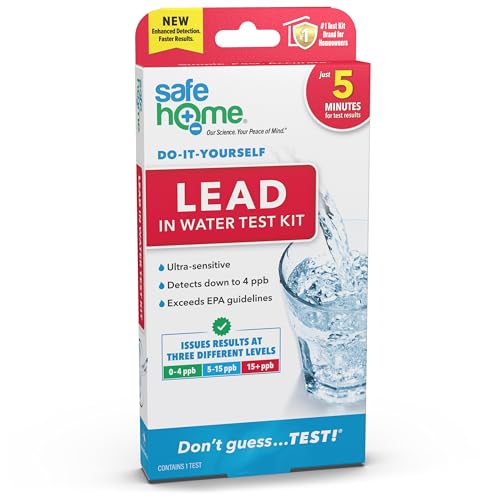
Safe Home® DIY Lead in Drinking Water Test Kit – Advanced Detection to 4 PPB – 5-Minute Test – 3 Levels of Test Results – EPA Lab Certified – Made in the USA – (1 Pack)
- #1 SELLING LEAD TEST KIT IN THE WORLD! Why? Safe Home’s kits are certified by independent laboratories such as Good Housekeeping, which supports the reliability and precision of testing. Plus, no messy test strips that can yield false positive or false negative results.
- PATENTED TECHNOLOGIES FOR LEAD DETECTION: This DIY kit offers three distinct levels of lead detection (0-4 PPB, 5-15 PPB, 15+ PPB) for tap and well water, providing a clear understanding of lead contamination in your water.
- EASY 5-MINUTE TESTING: The Safe Home test kit delivers quick and precise results in just 5 minutes, backed by our Certificate of Analysis (COA). Perfect for home testing, with clear and accurate outcomes every time.
- EXPERT CUSTOMER SUPPORT: With over 40 years of experience in lead testing, Safe Home provides expert assistance before, during, and after testing. Safe Home kits contain easy to follow trilingual instructions (EN/FR/ES).
- GLOBAL IMPACT: Safe Home donates a portion of every test kit sale to global clean water initiatives. Your purchase helps bring clean, safe water to communities in need around the world.
As an Amazon Associate we earn from qualifying purchases.
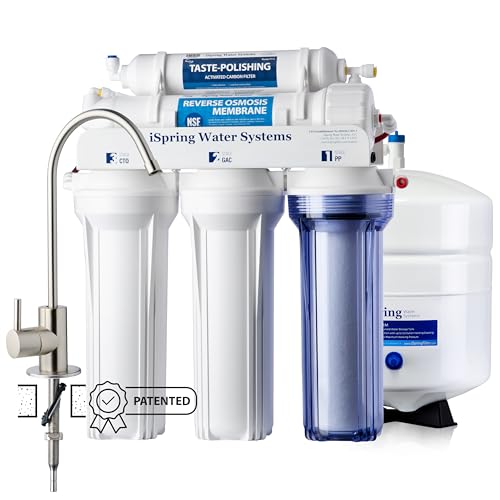
iSpring RCC7-BN NSF Certified, High Capacity Under Sink 5-Stage Reverse Osmosis Water Filter, RO Drinking System, 75 GPD Brushed Nickel Faucet, Patented Top-Mounted Faucet Design for Easy Installation
- EFFECTIVELY REDUCES CONTAMINANTS – The iSpring RO system delivers clean, pure, and great-tasting drinking water by removing up to 99% of over 1,000 harmful contaminants, including PFAS, chlorine, fluoride, lead (up to 98%), arsenic, asbestos, calcium, and sodium. It also reduces TDS by 80-90% and reduces hard water minerals that cause scale buildup.
- CERTIFIED TO NSF/ANSI 58 – Produced to strict American quality standards, this iSpring reverse osmosis system is NSF/ANSI 58 certified. For over 15 years, it has provided American families with unlimited, crisp, and refreshing water, superior to bottled water
- LOW MAINTENANCE & LEAK-FREE DESIGN – Engineered with premium components for long-term reliability and minimal upkeep. The transparent first-stage filter housing allows for quick inspections. This compact system fits under most kitchen sinks, requires no power source, and features a check valve to prevent backflow, ensuring safety and leak prevention. The AS-material filter housing offers impact resistance while making filter condition checks effortless.
- HIGH-QUALITY DESIGN & GREAT TASTE – Enjoy clean, safe, and fresh-tasting water with the iSpring under sink RO system. It includes a 100% lead-free designer faucet and food-grade tubing, ensuring crystal-clear ice cubes, fresher tea and coffee, better-tasting food, and healthier baby formula. The system’s advanced filtration reduces contaminants down to 0.0001 microns, while a fine GAC filter provides final polishing for exceptional water quality.
- 100% CUSTOMER SATISFACTION – The RCC7-BN is one of America’s highest-rated under sink reverse osmosis systems. It comes with a 1-year limited manufacturer warranty upon registration, lifetime personalized support from GA, USA, and premium-quality components to deliver bottled-quality drinking water for years to come—helping reduce plastic waste
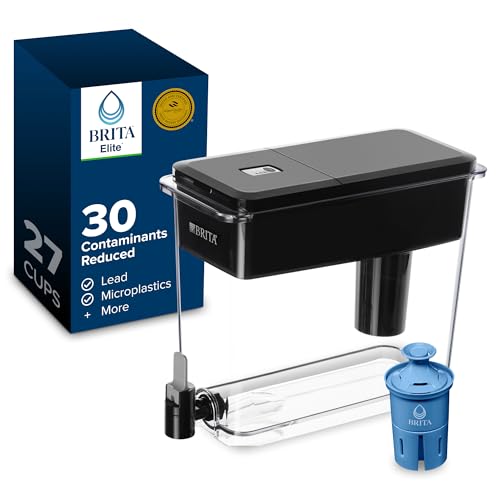
Brita XL 27 Cup Water Pitcher Dispenser, Includes 1 Elite Filter, Black
- REDUCES 99% OF LEAD + 30 CONTAMINANTS*: Brita Elite filter uses Advanced Carbon Core Technology to reduce 99% of lead and 30+ contaminants from your tap water, for long-lasting filtration
- LARGE 27-CUP CAPACITY, LASTS 6 MONTHS: This UltraMax water dispenser holds 27 cups and the Elite filter lasts 120 gallons or about 6 months — 4x longer than PUR** — meaning fewer replacement filters and more savings for your family
- BPA-FREE COUNTERTOP DESIGN: Made without BPA, the UltraMax filtered water dispenser features a convenient spigot for easy dispensing; fits on most countertops or in the fridge; space-efficient for large families
- REPLACE UP TO 900 PLASTIC BOTTLES: One Elite filter replaces up to 900 single-use 16.9 oz plastic bottles — that's 5,400 bottles replaced per year when you switch to the Brita Elite UltraMax dispenser
- WQA NSF/ANSI CERTIFIED: Brita Elite dispenser is certified by WQA to NSF/ANSI standards for lead, microplastics, chlorine, pharmaceuticals, pesticides and more. *See certifications. **Approximation based on 120-gallon filter life. Substances reduced may not be in all users' water
- SUSTAINABLE: By switching to Brita, you can save money and replace up to 1,800 single-use plastic water bottles a year
Lead Myths That Cost People Money
True
- Your home can exceed the action level while your utility passes
- Hot water leaches more lead than cold
- Filters must name lead in their certification to count
- Neurological damage in children is not reversible
- Utilities often test residential taps for free
- Partial line replacement can raise lead temporarily
False
- “Boiling makes it safe” — it concentrates lead
- “My water is clear, so it is fine” — lead is invisible and tasteless
- “Any filter removes lead” — Standard 42 filters do not
- “Bottled water is automatically safer” — it is less frequently tested
- “The action level is a safety limit” — the health goal is zero
- “A softener handles it” — softeners do not target lead
Frequently Asked Questions
What is a safe level of lead in drinking water?
There is none. The EPA sets the maximum contaminant level goal for lead at zero because no safe level of exposure has been identified, and the CDC states the same for blood lead levels in children. The 15 ppb action level is a regulatory trigger requiring the water system to take action, not a threshold below which lead is considered harmless.
Is the lead action level changing?
Yes. Under the Lead and Copper Rule Improvements finalised in October 2024, the action level drops from 15 ppb to 10 ppb on 1 November 2027. The intermediate trigger level is removed, and tap sampling becomes stricter. Until that compliance date, the 15 ppb action level remains in force.
Does boiling water remove lead?
No, and it makes the problem worse. Boiling evaporates water while the lead remains behind, so the concentration in what is left actually rises. Boiling is effective against bacteria and viruses, not against dissolved metals.
How do I know if I have a lead service line?
Every US water system was required to publish a service line inventory by 16 October 2024, and it must be publicly accessible — start there. You can also scratch an unpainted section of your incoming pipe: lead is dull grey, scratches to a shiny silver, and is not magnetic. Copper scratches to a penny colour, and galvanized steel holds a magnet.
Which water filters remove lead?
Filters certified to NSF/ANSI Standard 53 for lead reduction, and reverse osmosis systems certified to NSF/ANSI Standard 58. Standard 42 covers only aesthetic effects such as chlorine taste and does nothing for lead, which is what most inexpensive pitchers carry. Always confirm the certification names lead specifically rather than just citing the standard number.
My city says the water passed. Am I safe?
Not necessarily. Compliance is measured at the 90th percentile of sampled taps, meaning up to 10 percent of tested homes can exceed the action level while the system still passes. Lead comes from your service line and your own plumbing, so a citywide pass says very little about your individual tap.
Is lead in water safe for baby formula?
Formula-fed infants are the highest-risk group, because water made up as formula can account for 40 to 60 percent of their total lead exposure. Always use cold water, flush the tap first, and use a filter certified for lead if your home predates 1986 or your service line material is unknown. Never mix formula with hot tap water.
How much does a lead water test cost?
Often nothing. Many utilities test residential taps free on request, and this should be your first call. Certified laboratory analysis typically runs from around twenty to fifty dollars if you pay for it yourself. Colour-change strips are cheap but unreliable at the parts-per-billion levels that matter for lead.
Can you taste or see lead in water?
No. Lead is colourless, odourless and tasteless at every concentration relevant to health. Water that looks and tastes perfect can carry lead well above the action level, which is why testing is the only way to know.
Does a water softener remove lead?
No. Softeners work by ion exchange targeting the calcium and magnesium that cause hardness. They are not designed for lead and are not certified for it. If you have both hard water and a lead concern, you need a softener plus a lead-certified point-of-use filter.
Should I replace my lead service line myself?
The portion in the public right-of-way belongs to the utility and is scheduled for mandatory replacement. The portion on your property is usually yours. Many systems run cost-share programmes, so ask before paying full price. One warning: partial replacement, where only one side is done, can temporarily raise lead levels through galvanic corrosion, so full replacement is strongly preferred.
How long should I flush my tap?
Thirty seconds to two minutes after water has sat more than six hours, until it runs noticeably colder. If you have a lead service line the water needs to travel further, so err towards the longer end. Collect the flushed water for plants or cleaning rather than wasting it.
Is bottled water safer than tap water for lead?
Not automatically. Bottled water is regulated by the FDA rather than the EPA and is tested less frequently than a large municipal system. A certified point-of-use filter on your own tap is generally the more reliable and far cheaper answer. See our ranking of the safest bottled water brands for what independent testing has found.
When will all lead pipes be replaced?
Under the LCRI, most systems must complete replacement within 10 years of the 1 November 2027 compliance date, giving a 2037 target — and that applies regardless of current lead levels. Systems facing more than 39 replacements per 1,000 connections annually can seek a deferral. The American Water Works Association is challenging the rule in court on cost and feasibility grounds, so the timeline is not settled.
Water Quality Deep Dives
We have published dedicated guides on the questions that come up most often from this page:
- Is Tap Water Safe to Drink in Your City? — every city we have covered, compared side by side
- Best Water Testing Kits — what a home kit can and cannot tell you
- Best Reverse Osmosis Systems — the strongest lead reduction available at home
- Best Under-Sink Filters — what each NSF standard actually covers
- Is Phoenix Tap Water Safe? — a worked example of the 90th percentile problem in a real city
- Best Water for Baby Formula — the highest-stakes lead decision
- Does Boiling Remove Contaminants? — why it works for bacteria and not for metals
- Water Problems Troubleshooting — find your symptom, fix the cause
References & Sources
- Federal Register — National Primary Drinking Water Regulations for Lead and Copper: Improvements (LCRI)
- US EPA — Basic Information About Lead in Drinking Water
- US EPA — Lead and Copper Rule
- CDC — About Childhood Lead Poisoning Prevention
- CDC — Updated Blood Lead Reference Value
- US EPA — Lead and Copper Rule Implementation Tools
The Bottom Line
Lead is unusual among drinking water contaminants because it comes from your plumbing rather than your water source — which makes your utility’s citywide result close to meaningless for your household. The health goal is zero, the enforceable action level is 15 ppb today and 10 ppb from 1 November 2027, and that action level is a trigger for the system rather than a safety line for you. The single highest-value action available is free: look up your service line material in the inventory your utility was required to publish, then ask them to test your tap. If your home predates 1986, has an unknown service line, or has a formula-fed infant in it, do that this week. Then filter with something certified to NSF/ANSI 53 for lead specifically — not a Standard 42 pitcher, and definitely not a kettle, because boiling concentrates lead rather than removing it.