What Bubly Actually Is — And Who Makes It
Bubly is PepsiCo’s sparkling water brand, launched in February 2018 at the peak of the national sparkling water craze that La Croix had ignited earlier in the decade. PepsiCo recognized that La Croix — owned by the relatively small National Beverage Corp — had built a billion-dollar category essentially without competition from the major beverage conglomerates. Bubly was their answer.
The formula is standard for the category: purified water, carbonated with CO2, with natural flavors added for each variety. Zero calories, zero sugar, zero sweeteners, zero sodium. In this respect Bubly is nutritionally identical to La Croix and Waterloo — the differences come down to flavor selection, carbonation intensity, branding, and the PFAS data.
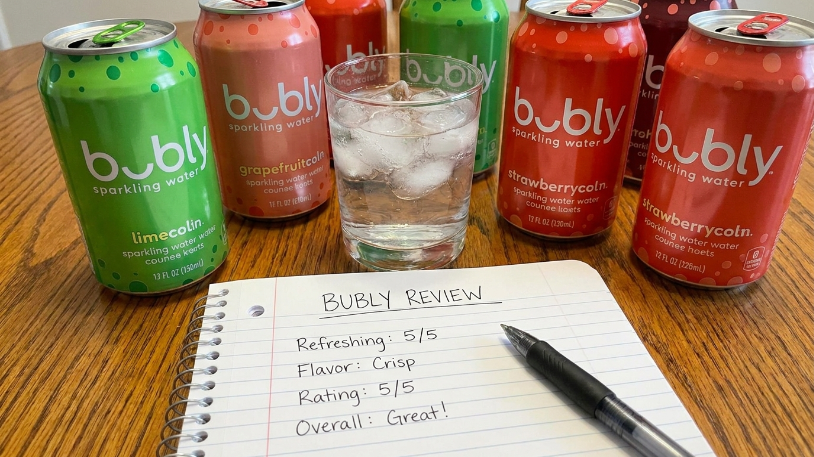
Bubly’s brand identity leans into personality in a way La Croix doesn’t. The cans feature cheerful phrases printed inside the pull tab (“hey you,” “oh hi,” “yay!”), bright color-coded designs for each flavor, and a playful visual tone designed to stand out in the sparkling water section of a refrigerator. Whether you find this charming or excessive depends entirely on your tolerance for personality-first branding. The water inside is the same regardless.
Since launch Bubly has expanded beyond the core sparkling water line into Bubly Burst (sparkling water with a splash of real juice, adding a small amount of calories and sugar) and Bubly Bounce (sparkling water with 35mg of caffeine). This review covers only the original Bubly Sparkling Water line — the zero-calorie, caffeine-free core product.
Ingredients — What’s Actually In the Can
Every Bubly flavor shares the same two-ingredient formula:
- Carbonated water — purified municipal water with CO2 dissolved under pressure
- Natural flavors — the specific flavor essence for each variety (mango, lime, strawberry, etc.)
That’s it. No sodium. No potassium. No added minerals. No sweeteners of any kind. No citric acid (which La Croix adds to some flavors for tartness). No juice (that’s Bubly Burst, not core Bubly). The result is one of the cleanest label profiles in the entire sparkling water category.
The “natural flavors” designation covers the flavor essences — these are derived from natural sources but processed into a concentrated form. As with La Croix and Waterloo, Bubly does not use actual fruit juice (that would add calories and sugar). Natural flavor essences are legal, FDA-regulated, and extremely common across the food and beverage industry. They are also, by their nature, less transparent than Spindrift’s real-juice approach — you don’t know exactly which processing went into deriving the flavor compound.
Bubly PFAS Data — What Testing Found
In Consumer Reports’ September 2020 independent testing of 12 carbonated water brands, Bubly Blackberry Sparkling Water measured at 2.24 parts per trillion total PFAS — the third-highest reading of the brands tested.
Here’s where 2.24 ppt sits in context:
| Brand | PFAS Level (ppt) | vs IBWA 5 ppt standard |
|---|---|---|
| Topo Chico (2020) | 9.76 | ❌ Nearly 2x over |
| Polar Natural Seltzer | 6.41 | ❌ Over limit |
| Bubly Blackberry | 2.24 | ✓ Below limit |
| Poland Spring Sparkling | 1.66 | ✓ Below limit |
| Canada Dry Sparkling | 1.24 | ✓ Below limit |
| La Croix Natural | 1.16 | ✓ Below limit |
| Perrier | 1.10 | ✓ Below limit |
| Spindrift (2020) | 0.19 | ✓ Lowest detected |
Three important caveats: Consumer Reports tested one flavor of Bubly (Blackberry) — other flavors may test differently. PFAS levels can vary across production batches. And the FDA’s April 2025 testing of 197 bottled water samples found zero samples exceeding the EPA’s 2024 drinking water limits, suggesting Bubly’s overall profile falls within regulatory safe range even if one flavor tested higher than some competitors.
For a detailed explanation of what these PFAS numbers mean for your health, see our La Croix PFAS investigation which covers the regulatory framework, the EPA’s 2024 MCL, and how to interpret the numbers.
All 18 Bubly Flavors Ranked — Best to Try First
Below is Bubly’s core flavor lineup ordered by general consumer preference, based on aggregated online reviews and retail sales data. Limited, seasonal, and Bubly Burst flavors are noted separately. All flavors in the core line: zero calories, zero sugar, zero sweeteners.
1. Mango — The Undisputed Best
Warm, tropical, and instantly recognizable as mango without veering into candy-artificial territory. Consistently Bubly’s top-selling flavor and the one most recommended for first-time Bubly drinkers. Works well as a standalone drink or over ice. Converts many La Croix drinkers who find La Croix’s mango (and most sparkling water mango flavors generally) too subtle.
2. Strawberry — The Surprising Winner
Most sparkling water strawberry flavors taste like strawberry-flavored medicine. Bubly Strawberry doesn’t. The natural flavor captures a fresh, bright strawberry quality that’s approachable without being cloying. The can’s pink-red design matches the general energy of the drink. Second-most reordered flavor behind Mango in consumer surveys.
3. Watermelon — The Summer Favorite
Light, melon-forward, and refreshing in a way that makes it almost exclusively a warm-weather drink for most people — but a very good one. The Watermelon flavor leans into sweetness more than most Bubly varieties without adding any actual sugar. Third-most purchased in seasonal rankings.
4. Blackberry — Bold and Complex
The one that Consumer Reports tested for PFAS. Beyond the data: Bubly Blackberry has a deep berry profile with slight tartness that sits closer to the real fruit than most sparkling water blackberry flavors manage. One of the few Bubly flavors where you’d notice if you switched brands.
5. Lime — The Everyday Workhorse
Clean, simple, and consistent. Bubly Lime has slightly less citrus punch than Topo Chico or La Croix Lime, reflecting the brand’s generally softer carbonation. If you mix sparkling water into cocktails, this is where Bubly falls a bit short — the lighter bubbles and subdued flavor mean it’s less assertive as a cocktail base. For drinking straight, it’s perfectly pleasant.
6. Grapefruit — Better Than Average
More faithful to actual grapefruit bitterness than most sparkling water grapefruit flavors. Not as bold as Spindrift’s (which uses real grapefruit juice) or as mineral-complex as Topo Chico’s, but above La Croix’s Pamplemousse in actual grapefruit character. A solid pick for citrus fans.
7. Cherry — Cleaner Than Expected
Cherry sparkling waters tend to split into cough-syrup territory or overly candy-sweet. Bubly Cherry avoids both, landing on a tart fresh cherry profile. Not universally loved — some reviewers still find it too medicinal — but better executed than most competitors’ cherry options.
8. Raspberry — Middle of the Pack
Softer and more subtle than Blackberry. Tart raspberry essence with light sweetness. Works well in the heat, less memorable than the tropical flavors. Good but not a standout in the lineup.
9. Apple — The Surprise Entry
An unusual flavor for a sparkling water and one Bubly pulls off reasonably well — a Fuji apple-adjacent crispness. More interesting than most competition’s attempts at apple. Not a daily drinker for most people but worth trying if you’re exploring the lineup.
10. Lemon — Simple and Clean
Bright lemon zest profile, slightly more forward than La Croix’s Limon. Works well as a daily drinker or cocktail base. Less personality than Mango or Strawberry, but consistent and reliable.
11. Peach — Subtle, Divisive
Sweet, soft peach profile. The flavor is present but quieter than the tropical options. Peach fans tend to love this; non-peach fans find it unmemorable. A flavor that shows the gap between those who love subtle sparkling water flavors and those who want something that announces itself.
12. Orange — Exactly What You’d Expect
Standard bright orange flavor. Pleasant but doesn’t do anything La Croix or Waterloo’s orange options don’t also do. If you specifically love orange-flavored sparkling water, Bubly’s is fine. If you’re choosing based on distinctiveness, go mango or strawberry.
Bubly vs La Croix — Honest Head-to-Head
This is the comparison most people actually want. Both are purified water plus natural flavors, both zero calorie, both zero sweetener. The differences:
| Factor | Bubly | La Croix |
|---|---|---|
| Owner | PepsiCo | National Beverage Corp |
| Founded | 2018 | 1981 |
| Carbonation | Lighter, softer | Slightly more assertive |
| Flavor variety | 18+ flavors | ~21 flavors |
| PFAS (2020 test) | 2.24 ppt (Blackberry) | 1.16 ppt (Natural) |
| Sodium | Near-zero | Near-zero |
| Calories | 0 | 0 |
| Sweeteners | None | None |
| Pricing | $5-8 per 12-pack | $5-9 per 12-pack |
| Brand personality | Fun, colorful, playful | Clean, minimal, serious |
The honest verdict: La Croix has a lower tested PFAS level and slightly stronger carbonation. Bubly wins on tropical and berry flavor execution, and many people prefer the softer carbonation for daily drinking. Neither is meaningfully healthier than the other — the 2.24 vs 1.16 ppt PFAS difference is both below regulatory limits and below most scientific concern thresholds. This comes down to flavor preference and carbonation preference more than health differences.
The Extended Bubly Family — What’s Different
Bubly has expanded beyond the core sparkling water line. Understanding the product family prevents confusion when you’re shopping:
Bubly Sparkling Water (core)The product reviewed here. Zero calories, zero sugar, zero sweeteners, zero caffeine. Just carbonated water plus natural flavors. Available in 18+ flavors.
Bubly BurstCarbonated water with a splash of real fruit juice added. Results in slightly more fruit-forward flavor at the cost of trace calories and a small amount of natural sugar. Different from core Bubly — check the label for “Burst.”
Bubly BounceContains 35mg of caffeine per can from natural sources. Zero sugar, zero calories, same sparkling water format. For buyers who want light caffeine without energy-drink levels. Important to distinguish from standard Bubly if you’re caffeine-sensitive.
Pros & Cons of Drinking Bubly
Pros
- Widest tropical and berry flavor selection of any major brand
- Zero calories, zero sugar, zero sweeteners — very clean label
- Generally comparable pricing to La Croix
- Excellent mango, strawberry, and watermelon execution
- Widely available at most US grocery chains, Target, Walmart
- PepsiCo distribution means consistent national availability
- Fun, personality-driven branding (if that matters to you)
Cons
- PFAS: Blackberry tested at 2.24 ppt — higher than La Croix’s 1.16 ppt
- Lighter carbonation than La Croix, Topo Chico, or Perrier
- Natural flavors (not real fruit like Spindrift)
- Softer bubbles make it a weaker cocktail mixer
- Some flavors (Orange, Peach) are generic vs competition
- Flavor quality is uneven across the lineup
Pricing & Where to Buy
Bubly is one of the most widely distributed sparkling water brands in the US — in every major grocery chain, Target, Walmart, Costco, Amazon, and most convenience stores. Pricing:
- 12-pack (12 oz cans) — $5-8
- 18-pack variety — $9-13
- Costco bulk (36-pack) — $18-24 — best per-can value
- Single can — $1.00-1.75
Who Should Drink Bubly
✅ Choose Bubly If You…Find La Croix’s flavor range too limited or too subtle. Love tropical flavors — Mango is genuinely excellent. Prefer softer carbonation for daily drinking. Want wide availability without hunting specialty stores.
⚠️ Be Aware If You…Are PFAS-conscious — Bubly Blackberry tested 2.24 ppt vs La Croix’s 1.16 ppt. Both are below regulatory limits, but La Croix tested lower. Other flavors may test differently.
❌ Skip It If You…Want aggressive carbonation for cocktail use — Topo Chico or Perrier are better. Want real fruit ingredients — Spindrift is the only mainstream option. Want the absolutely lowest PFAS level available.
🤔 Worth Trying If You…Are a La Croix drinker curious about different flavor profiles. Want to explore tropical sparkling waters. Have kids who find La Croix too bland — Bubly’s Mango and Strawberry are excellent entry points.
Frequently Asked Questions
Does Bubly contain PFAS?
Yes, at detectable levels. Consumer Reports’ 2020 testing of Bubly Blackberry Sparkling Water measured 2.24 parts per trillion total PFAS — higher than La Croix (1.16 ppt) and Perrier (1.10 ppt), but below Topo Chico and below the IBWA’s 5 ppt voluntary industry standard. The EPA’s 2024 MCL is 4 ppt for individual PFAS compounds, and both Bubly and La Croix are below that threshold.
Is Bubly the same as La Croix?
Nutritionally very similar — both zero-calorie, zero-sweetener sparkling waters with purified water and natural flavors. Bubly is owned by PepsiCo (launched 2018); La Croix by National Beverage Corp (1981). Bubly has slightly softer carbonation and different flavor strengths. La Croix tested lower for PFAS in 2020. Both are comparable in price.
What is the most popular Bubly flavor?
Mango is consistently Bubly’s best-selling and highest-rated flavor. Strawberry and Watermelon are close seconds. All three out-perform Bubly’s citrus options in consumer satisfaction ratings and are the most recommended starting points for new Bubly drinkers.
Who owns Bubly sparkling water?
PepsiCo, which launched Bubly in February 2018. Bubly became notable early for a marketing campaign involving Canadian singer Michael Bublé, whose name is nearly identical to the brand — a coincidence PepsiCo turned into a Super Bowl ad where Bublé “corrected” cans to read “mibubly.”
Does Bubly have sugar or sweeteners?
No. All core Bubly sparkling water flavors contain zero calories, zero sugar, and zero sweeteners of any kind. The only ingredients are carbonated water and natural flavors. Bubly Burst (a different product) adds real fruit juice, creating trace calories and natural sugar. Bubly Bounce adds caffeine. Check the can label to confirm which product you’re buying.
Bubly vs La Croix — which is better?
Depends on priorities. Bubly wins on tropical and berry flavor quality — Mango especially. La Croix has slightly stronger carbonation and tested lower for PFAS in 2020 (1.16 vs 2.24 ppt). Both are below regulatory limits. Price is comparable. If flavor variety matters most, Bubly. If carbonation strength or lowest available PFAS is the priority, La Croix.
How many Bubly flavors are there?
Over 18 as of 2026, up from the original 8 at 2018 launch. Core lineup includes Mango, Strawberry, Watermelon, Blackberry, Lime, Grapefruit, Cherry, Raspberry, Apple, Lemon, Peach, Orange, Pineapple, Cranberry, Blueberry Pomegranate, Passion Fruit, Concord Grape, and Coconut Pineapple. Regional availability varies.
Is Bubly healthier than soda?
Yes, dramatically. Zero calories and zero sugar versus 140-170 calories and 39-46g of sugar in a regular soda. No phosphoric acid, no high-fructose corn syrup, no artificial colors. The only dental consideration is mild carbonation acidity, which is roughly 100 times less damaging to tooth enamel than sodas or fruit juices.
Is Bubly good for weight loss?
As a soda replacement, yes — zero calories versus 140+ in regular soda is a significant reduction for soda drinkers who switch. As a plain water replacement, it’s calorie-neutral. There’s no evidence sparkling water directly aids weight loss, but replacing caloric beverages with Bubly is clearly beneficial for those reducing total calorie intake.
Does Bubly have caffeine?
Standard Bubly sparkling water contains no caffeine. Bubly Bounce — a separate product line — contains 35mg of caffeine per can from natural sources. Check the can: if it says “Bubly Bounce,” it has caffeine. Standard cans showing only the flavor name are completely caffeine-free.
What is the Michael Bublé and Bubly connection?
When PepsiCo launched Bubly in 2018, Canadian singer Michael Bublé noticed the name looked nearly identical to his own. PepsiCo turned the coincidence into a marketing campaign, culminating in a Super Bowl commercial where Bublé “corrected” Bubly cans to say “mibubly.” One of the most memorable sparkling water marketing moments of the era, it significantly boosted early brand awareness.
Where is Bubly manufactured?
Bubly is manufactured by PepsiCo at bottling facilities across the United States, using purified municipal water at each location — the same approach as La Croix and Waterloo. PFAS levels may vary depending on source water at each bottling location, which is why testing across flavors and production runs matters more than any single data point.
Related Reading
- Healthiest Sparkling Water for Daily Drinking — 2026 Ranked
- La Croix and PFAS — What Independent Testing Shows
- Liquid Death Sparkling Water Review
- Spindrift Sparkling Water Review: Real Fruit Explained
- Topo Chico Review: Minerals, PFAS, and Cocktail Use
- Sparkling Water vs Seltzer vs Club Soda — Differences Explained
References & Sources
- Consumer Reports — Bottled Water PFAS Testing (2020)
- EPA — Final PFAS National Primary Drinking Water Regulation (April 2024)
- Bubly — Official Product Information
- FDA — Natural Flavor Regulations (21 CFR 101.22)
The Bottom Line
Bubly earns its place as the second-biggest sparkling water brand in the US through one genuine advantage: it outperforms La Croix on tropical and berry flavors, particularly Mango, Strawberry, and Watermelon — the three flavors that made it a household name. The formula is clean (carbonated water plus natural flavors, nothing else), the pricing is competitive, and the availability is essentially universal. The trade-offs are real: softer carbonation that makes it a weaker cocktail base than Topo Chico or La Croix, and a higher tested PFAS level in the one flavor Consumer Reports measured (2.24 ppt Blackberry vs 1.16 ppt La Croix Natural — both below regulatory limits). If your top priority is flavor variety and specifically tropical flavors, Bubly is the best-positioned mainstream alternative to La Croix. If carbonation strength or the lowest tested PFAS level is your priority, La Croix serves you better. If you want real fruit instead of natural flavors, Spindrift is in a different category entirely. Bubly is a solid, honest sparkling water — not the best at everything, genuinely excellent at mango.