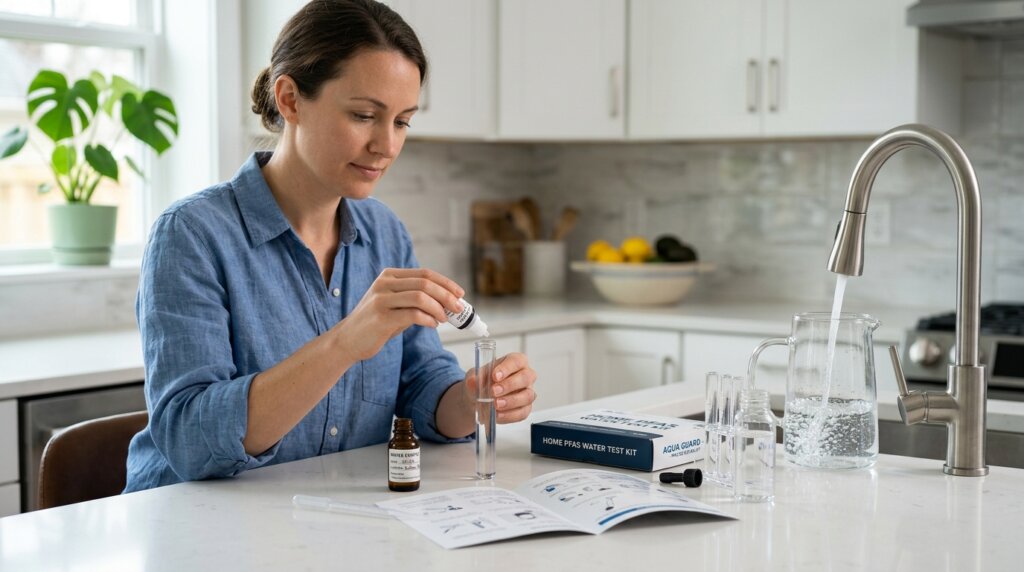
Quick answer: You cannot test for PFAS with a test strip or a home meter. The only reliable way to test your water for PFAS at home is to collect a sample yourself and mail it to a certified laboratory that uses EPA Method 537.1 or 533. Mail-in kits from providers like Cyclopure, Tap Score, or Culligan range from about $85 to $335, take 10–14 business days, and detect PFAS down to parts per trillion. Some states also offer free PFAS testing for private well owners.
To test water for PFAS at home, you collect a sample yourself and mail it to a certified laboratory — there is no accurate strip or meter that detects these “forever chemicals.” PFAS have been found in thousands of public water systems across the United States, they cannot be seen, smelled, or tasted, and they don’t break down naturally. This guide walks you through exactly how to test your water for PFAS at home, what it costs, and what to do with your results.
Can you test for PFAS at home with a strip or meter?
No. This is the single most important thing to understand before you spend any money. There is no dip strip, color-change kit, or countertop meter that can detect PFAS. The chemistry simply doesn’t allow it.
Standard home test strips check for things like chlorine, pH, hardness, nitrates, and a handful of metals. A TDS meter measures dissolved solids. None of these detect PFAS. That’s because PFAS are measured in parts per trillion (ppt) — roughly a thousand times more sensitive than the parts-per-billion levels most contaminants are measured at. According to the U.S. Environmental Protection Agency (EPA), the enforceable limit for PFOA and PFOS is just 4 ppt.
Detecting concentrations that low requires laboratory equipment called LC-MS/MS (liquid chromatography with tandem mass spectrometry), which costs hundreds of thousands of dollars and needs trained analysts to run. Any product claiming to detect PFAS with a $20 strip is not measuring at the sensitivity required. If you see one, skip it.
The real way to test: mail-in lab kits
A “home PFAS test” really means: you collect the sample at home, and a certified lab does the analysis. Here’s how the process works:
- Order a kit. The provider ships you sample bottles, gloves, instructions, chain-of-custody paperwork, and a prepaid return label.
- Collect your sample. Wash your hands, avoid contact with anything that might contain PFAS (food packaging, cosmetics, certain plastics), remove your faucet aerator if possible, and fill the bottles exactly as instructed. Contamination during collection is the #1 cause of inaccurate results.
- Mail it back. Drop the box in the mail with the prepaid label. No refrigeration is needed for most kits.
- Get your report. In about 10–14 business days you receive a detailed report listing each PFAS compound found, the total, and how it compares to EPA limits.
What a PFAS water test costs
Pricing varies by how many compounds the kit tests for. As of 2026, typical options include:
- Budget mail-in kits — around $85–$130. Cyclopure, for example, tests for 55 PFAS compounds at the lower end of this range.
- Detailed consumer kits — around $299–$335. Tap Score (SimpleWater) and SimpleLab test 14–30+ compounds with in-depth reporting and expert support.
- Direct certified-lab testing — $200–$500, depending on the compound panel, if you ship a sample to an accredited lab yourself using EPA Method 537.1 or 533.
Prices change; confirm current pricing with the provider before ordering.
Choosing a kit: Look for one that uses EPA Method 537.1 or 533, tests at least 14 PFAS compounds, and includes a prepaid return label.
Free PFAS testing options
Before you pay, check whether you qualify for free testing:
- Private well owners: Several states, including New York, Colorado, and New Hampshire, offer free PFAS testing programs. Contact your state’s Department of Health or environmental agency and ask for the private well program.
- City water customers: Under the EPA’s 2024 rule, public utilities are now required to test for PFAS. Check your utility’s annual Consumer Confidence Report (CCR) — it may already show PFAS results for your system.
- Health departments: Some local health departments provide kits or can point you to accredited labs.
City-water testing tells you about the system, but if you’re on a private well or want to know what’s coming out of your specific tap, a mail-in kit is still the most direct answer.
How to read your PFAS results
When your report comes back, focus on the EPA limits set in 2024:
- PFOA: 4 ppt
- PFOS: 4 ppt
- PFNA, PFHxS, GenX (HFPO-DA): 10 ppt
If your results say “non-detect” or “below detection limit” for all compounds, your water is likely fine for PFAS. If any result is above the EPA limit, don’t panic — PFAS health effects are long-term, not immediate — but you should act.
What to do if your water has PFAS
Boiling does not remove PFAS, and neither does a basic carbon pitcher on its own. The two treatment methods proven to reduce PFAS are:
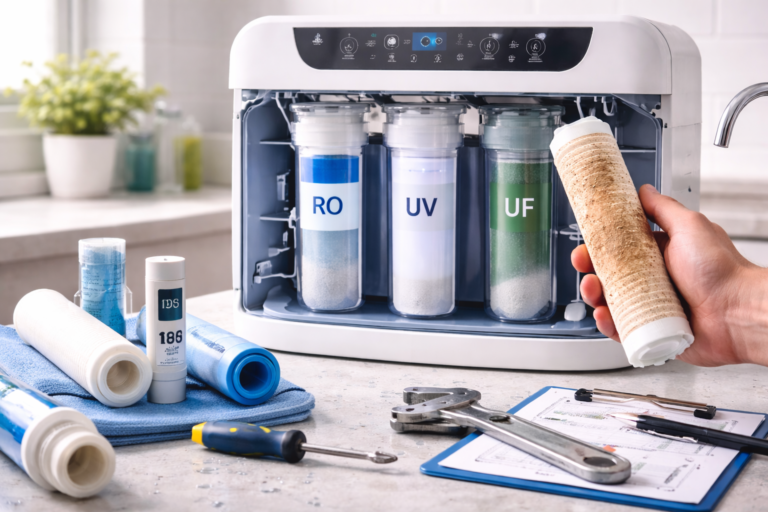
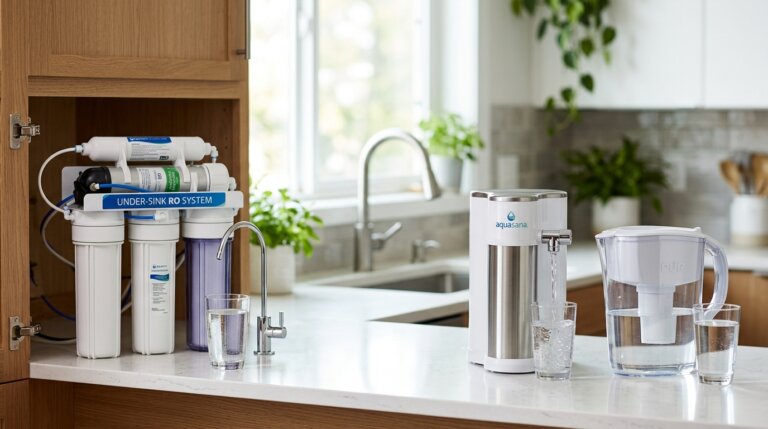
- Reverse osmosis (RO): An under-sink RO system can remove up to 99% of PFAS along with dozens of other contaminants. This is the most thorough point-of-use option.
- Activated carbon (GAC): High-quality granular activated carbon filters certified for PFAS reduction can bring levels below the EPA limit.
If you install a filter, re-test after about six months to confirm it’s working. Learn more in our guides on how PFAS affect your drinking water, the best water filters for PFAS, and reverse osmosis systems.
When should you test?
- When you move into a new home
- Annually, if you live in an area with known contamination (near a military base, airport, or industrial site)
- Six months after installing a PFAS filter, to verify it works
- Any time your water source changes
Frequently asked questions
Can I test for PFAS with a test strip?
No. Test strips and TDS meters cannot detect PFAS. PFAS are measured in parts per trillion, which requires laboratory LC-MS/MS equipment. Only a certified lab test using EPA Method 537.1 or 533 gives accurate results.
How much does it cost to test water for PFAS?
Mail-in kits generally cost between $85 and $335 depending on how many compounds are tested. Direct certified-lab testing can run $200–$500. Some states offer free testing for private well owners.
How long do PFAS test results take?
Most mail-in lab kits return results in about 10 to 14 business days after the lab receives your sample.
Does boiling water remove PFAS?
No. Boiling does not remove PFAS and can slightly concentrate them as water evaporates. Reverse osmosis and certified activated-carbon filters are the proven removal methods.
Is bottled water free of PFAS?
Not necessarily. Studies have detected PFAS in some bottled water brands, so switching to bottled water is not a guaranteed solution.
Reviewed by the Complete Water Guide team. This article is for general information and is not a substitute for professional water-quality or medical advice. We may earn a commission from some links on this page.