Choosing the right water purifier can be confusing with options like RO, UV, and UF systems available. Each technology works differently and is suitable for different water conditions. This guide compares RO vs UV vs UF water purifiers to help you choose the best option for your home.
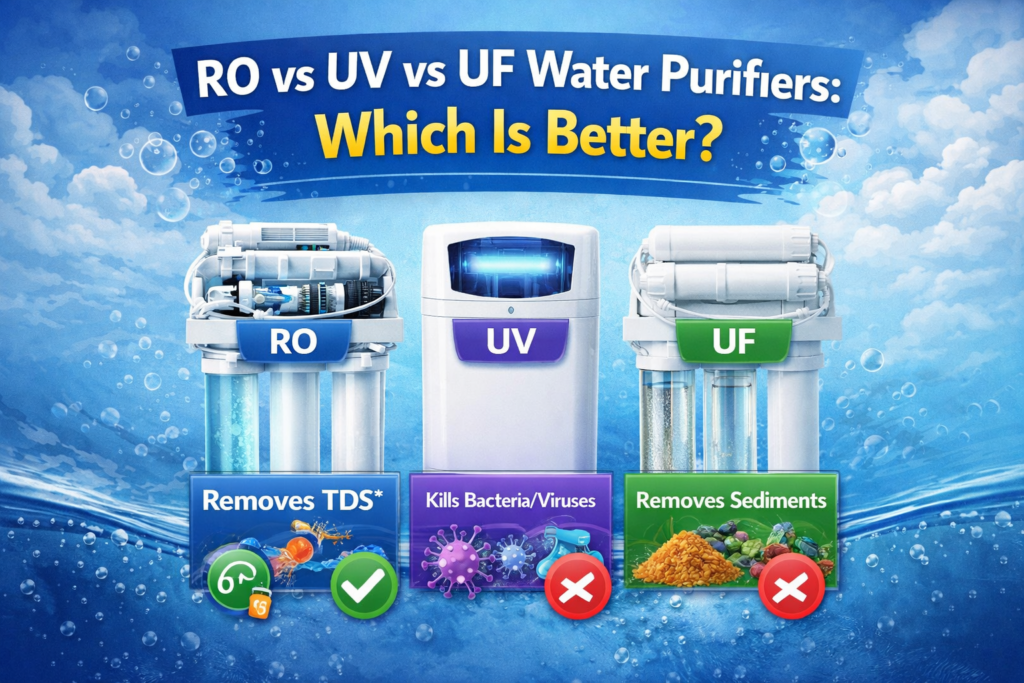
RO (Reverse Osmosis) removes dissolved salts and heavy metals, UV (Ultraviolet) kills bacteria and viruses, and UF (Ultrafiltration) removes suspended particles. The best option depends on your water quality—RO is best for high TDS water, UV for low TDS with microbes, and UF for basic filtration.
What Are RO, UV, and UF Water Purifiers?
RO, UV, and UF are different water purification technologies used to remove contaminants and make water safe for drinking. Each method targets specific types of impurities.
RO vs UV vs UF: Key Differences
| Feature | RO | UV | UF |
|---|---|---|---|
| Removes TDS | ✔ Yes | ✖ No | ✖ No |
| Kills Bacteria/Viruses | ✔ Yes | ✔ Yes | ✔ Partial |
| Removes Sediments | ✔ Yes | ✖ No | ✔ Yes |
| Electricity Required | ✔ Yes | ✔ Yes | ✖ No |
| Best For | High TDS water | Microbial contamination | Low TDS water |
How Each Purifier Works
RO (Reverse Osmosis)
RO uses a semi-permeable membrane to remove dissolved salts, heavy metals, and impurities. It is highly effective for hard water and high TDS levels.
UV (Ultraviolet)
UV purification uses ultraviolet light to kill bacteria and viruses without changing water composition.
UF (Ultrafiltration)
UF uses a membrane to remove suspended particles and some microorganisms. It does not remove dissolved salts.
Which Water Purifier Is Best for You?
- Choose RO: If your water has high TDS, heavy metals, or hardness
- Choose UV: If water is clear but may contain bacteria
- Choose UF: If water has low TDS and basic filtration is enough
Pros and Cons of Each System
| Type | Pros | Cons |
|---|---|---|
| RO | Removes TDS, heavy metals | Wastes water, needs electricity |
| UV | Kills microbes quickly | Does not remove TDS |
| UF | No electricity needed | Limited purification |
FAQs
Which is better RO or UV?
RO is better for high TDS water, while UV is better for killing bacteria in low TDS water.
Is UF better than RO?
UF is suitable for low TDS water, but RO provides more advanced purification.
Can I use RO + UV together?
Yes, many modern purifiers combine RO and UV for better purification.
Does RO remove healthy minerals?
Yes, RO removes most minerals, but many systems add them back using mineral cartridges.
Conclusion
RO, UV, and UF water purifiers each serve different purposes. Choosing the right one depends on your water quality. For best results, many households use a combination system to ensure safe and clean drinking water.