Is Aquafina good water? For safety and purity, yes in our view: Aquafina is city tap water that PepsiCo runs through filtration, UV disinfection, reverse osmosis and ozonation, and its published reports list the tested contaminants as not detected or far below limits. The trade-off is that the same process strips out nearly everything, so Aquafina has almost no minerals or electrolytes, and some people find the taste flat. It is a clean, plain water rather than a “healthy” one.
Below is where it comes from, what PepsiCo’s water quality reports show, how it compares on PFAS, and who should pick something else.
Is Aquafina tap water?
It starts as tap water. PepsiCo’s water quality report lists each bottling plant with its source, and they are city supplies: the City of Detroit Municipal Water, City of Phoenix Water Department, City of Riverside Public Utilities, Mesquite Municipal Supply in Texas and others. In 2007, after a campaign by the group Corporate Accountability International, PepsiCo agreed to spell out “Public Water Source” on Aquafina labels.
But it is not the same as what comes out of your faucet. The PepsiCo report lists the same treatment at every plant: “Filtration, Ultraviolet Disinfection, Reverse Osmosis, Ozonation.” Reverse osmosis pushes water through a membrane that removes most dissolved solids, which is why Aquafina is sold as purified water rather than spring water.
Is Aquafina good water to drink every day?
Yes, for most people. PepsiCo says its plants each run “on average 320 tests daily” and about 102,000 tests a year, and its sample analysis lists metals such as arsenic, lead and mercury, organic chemicals and coliform bacteria as not detected. We found no FDA recall of Aquafina in FDA’s enforcement database.
What you give up is minerals. Because reverse osmosis removes nearly everything, PepsiCo’s reports list total dissolved solids as not detected, and the Amazon listing calls it “sodium free.” So Aquafina adds no meaningful calcium, magnesium or electrolytes to your day. That is fine if you eat a normal diet; most of those minerals come from food anyway.
| Aquafina | Typical spring water | Typical tap water | |
|---|---|---|---|
| Source | City water | Underground spring | River, lake or wells |
| Main treatment | Filtration, UV, reverse osmosis, ozone | Varies by brand | Varies by city; always disinfected |
| Minerals | Almost none | Some, varies by source | Some, varies by city |
| Fluoride | Not detected | Usually low | Often added at about 0.7 mg/L |
| Cost | Cents to a dollar a bottle | Similar or more | Pennies per gallon |
Is Aquafina high quality water?
On purity, it is among the cleaner options. On PFAS, Consumer Reports’ 2020 bottled water tests put Aquafina in its group of still waters with PFAS under 1 part per trillion; CR did not publish an exact figure for it. FDA’s own survey of 197 bottled waters, released in April 2025, found ten with detectable PFAS and none above EPA’s tap water limits. Reverse osmosis is one of the treatments that removes PFAS well, which our guide to the best water filters for PFAS explains. Our page on whether Aquafina has PFAS has the brand’s detail.
Taste is the common complaint. With no minerals, purified water tastes plain, and some people call it flat. That is a preference, not a safety issue.
What we would buy for this job
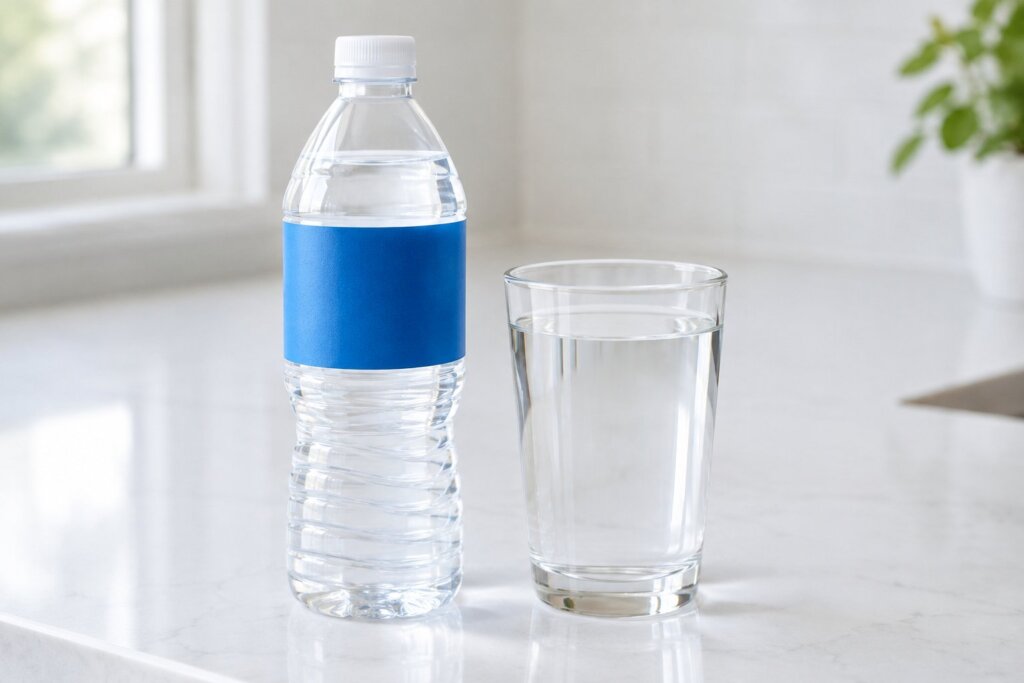
- Aquafina Purified Water, 16.9 oz, pack of 24: plain purified water with no added minerals, if that is the taste you like. Store the case out of heat and sun.
As an Amazon Associate, Complete Water Guide earns from qualifying purchases. Prices change, so check the listing.
Is Aquafina acidic?
It can read slightly acidic. Purified water has almost no minerals to buffer it, so carbon dioxide from the air can lower its pH a little. A 2015 study in the Journal of Dental Hygiene measured popular bottled waters in a lab and found 10 of 14 drinks tested were acidic (below pH 7), and most waters tested more acidic than their quality reports listed. Slightly acidic plain water is not a health concern in itself; our guide on whether alkaline water is good for you covers the pH debate.
Who should choose something else?
- Families relying on bottled water for children’s teeth. Aquafina’s report lists fluoride as not detected, while CDC recommends about 0.7 mg/L in community water. Ask your dentist.
- Athletes in long, sweaty sessions. It has no electrolytes. Our guide to electrolyte water brands compares options.
- Anyone who wants to avoid plastic. It comes in plastic bottles; our guide to microplastics in bottled water covers what studies found.
- Anyone paying for “purified” when their tap is already good. If your city water tastes fine, a reverse osmosis filter at home gives you much the same water for less; our purified water brands ranking compares Aquafina with other purified waters.
Is Aquafina better than Dasani?
They start the same way, as purified city water, but Dasani’s label adds minerals for taste, while Aquafina sells its water without them. If you like a plainer taste, Aquafina; if you like a slightly mineral taste, Dasani. Our ranking of the safest bottled water brands places both alongside spring and mineral waters.
Frequently asked questions
Is Aquafina good water?
It is very clean: PepsiCo treats city water with filtration, UV, reverse osmosis and ozone, and its reports list tested contaminants as not detected. It has almost no minerals, so it is plain rather than healthy.
Is Aquafina just tap water?
It starts as city tap water; in 2007 PepsiCo agreed to print “Public Water Source” on the label. It is then purified with reverse osmosis and other steps, so it is much lower in dissolved solids than most tap water.
Is Aquafina water healthy for you?
It is a safe way to stay hydrated. It does not add minerals or electrolytes, so it has no health benefit beyond hydration.
Does Aquafina have fluoride?
PepsiCo’s water quality report lists fluoride as not detected. CDC recommends 0.7 mg/L in community water for tooth decay prevention.
Has Aquafina been recalled?
We found no Aquafina recall in FDA’s food enforcement database when we checked in November 2026.
Does Aquafina have PFAS?
Consumer Reports’ 2020 tests placed Aquafina among still waters with under 1 part per trillion of PFAS, without giving an exact number. Reverse osmosis removes most PFAS.
Sources
- PepsiCo, Aquafina bottled water information and sample water quality analysis (date updated to website June 2019): testing frequency, results, bottler and source list, treatment process. PepsiCo also posts a 2025 report on its contact site.
- ABC News, July 2007: Aquafina to say it comes from the same source as tap water.
- U.S. FDA food enforcement database, searched November 3, 2026.
- Consumer Reports, What’s Really in Your Bottled Water?, September 24, 2020.
- U.S. FDA, FDA Shares Testing Results for PFAS in Bottled Water, April 14, 2025.
- Wright KF, Is Your Drinking Water Acidic? A Comparison of the Varied pH of Popular Bottled Waters, Journal of Dental Hygiene, 2015.
- CDC, community water fluoridation recommendation of 0.7 mg/L.