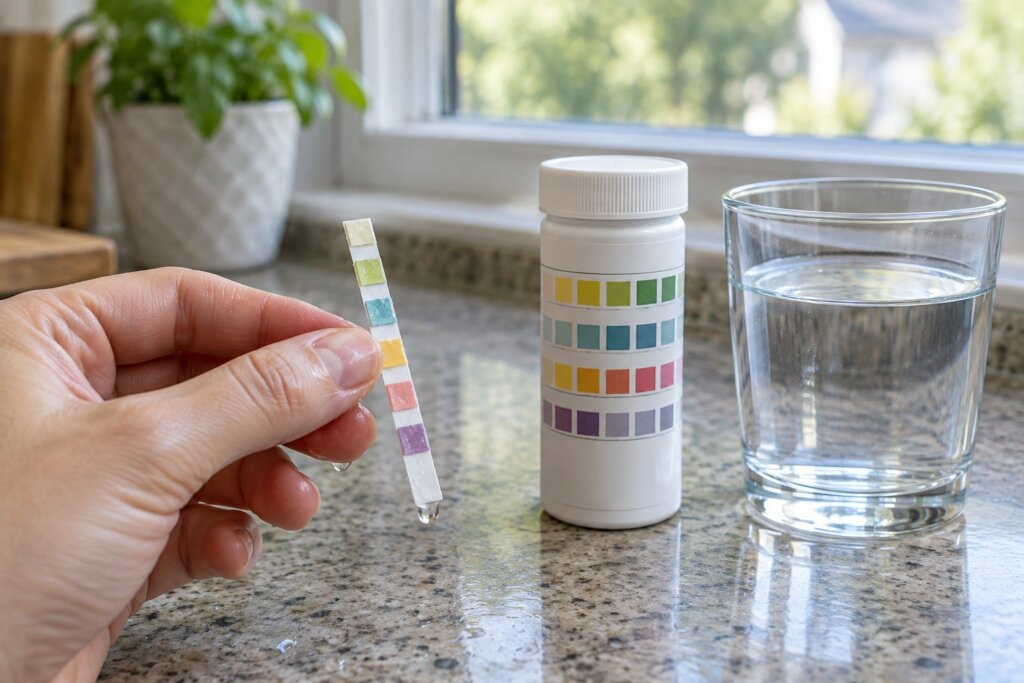
Here is how to read water test strips correctly: dip for exactly the time the instructions give, hold the strip level, and compare each pad to the chart at its own read time, because some pads must be read immediately and others only after 30 to 60 seconds. Timing and light matter as much as the strip itself. Then compare the numbers to EPA’s limits, and send anything worrying to a certified lab, because strips are a screening tool.
We read the instructions for LaMotte, PurTest, First Alert and SenSafe strips, EPA’s drinking water standards, Nebraska Extension’s hardness guide, a utility’s advice on home nitrate tests, and two published studies on how strips compare with labs. Here is the step-by-step, what each number means, and where strips fall short.
How to read water test strips, step by step
- Use a fresh sample. PurTest says, “Draw a fresh sample of water for each test.” Use a clean glass, not the tap stream.
- Do not touch the pads. PurTest says, “Test pads Do Not Touch,” and LaMotte says, “Keep wet fingers out of the vial.”
- Dip for the stated time. This varies by brand: LaMotte says to “immerse strip for 2 seconds”; PurTest’s hardness strip is dipped “for one second”; SenSafe’s iron strip is dipped “for 30 seconds with a back-and-forth motion.”
- Remove excess water the way the brand says. LaMotte says, “SHAKE ONCE TO REMOVE EXCESS WATER.” PurTest’s chlorine strip says the opposite: “DO NOT shake off excess water. Hold level for 2 seconds.”
- Hold the strip level so colors do not run from one pad into the next.
- Read each pad at its own time. See the table below.
- Compare in good light. The Safe Drinking Water Foundation says to “use a good source of light (natural light is best, so near a window if possible).”
- Close the bottle right away. LaMotte says, “Close vial tightly after removing strip.”
When should you read each pad on a water test strip?
This is the easiest step to get wrong. Different pads develop at different speeds, and some fade:
| Brand and strip | What the instructions say |
|---|---|
| LaMotte drinking water 6-way | “Immediately read Free Chlorine, Total Chlorine, Total Hardness and pH. Wait 30 seconds, then read: Nitrite > Nitrate.” |
| PurTest chlorine, copper, nitrate, nitrite | Read chlorine immediately, then copper, then nitrate and nitrite “after a total of 45 seconds has elapsed” |
| PurTest alkalinity, pH, hardness | “Hold test strip level and wait ten (10) seconds” |
| PurTest iron | “Wait 60 seconds and compare to color chart” |
| First Alert nitrate/nitrite | Read “after 1 minute”; “Colors are stable for 1 minute” |
| First Alert pH, hardness, chlorine | “Hold the strip level for 15 seconds” |
| SenSafe iron | Wait “15 seconds for the color to develop” |
Two warnings from the makers. PurTest says, “Chlorine test colors will fade within minutes, therefore reading the test immediately and as instructed is important.” And reading too late is as bad as too early: the Safe Drinking Water Foundation’s instructions for a 17-in-1 strip say to “read the test results carefully within 60 seconds.”
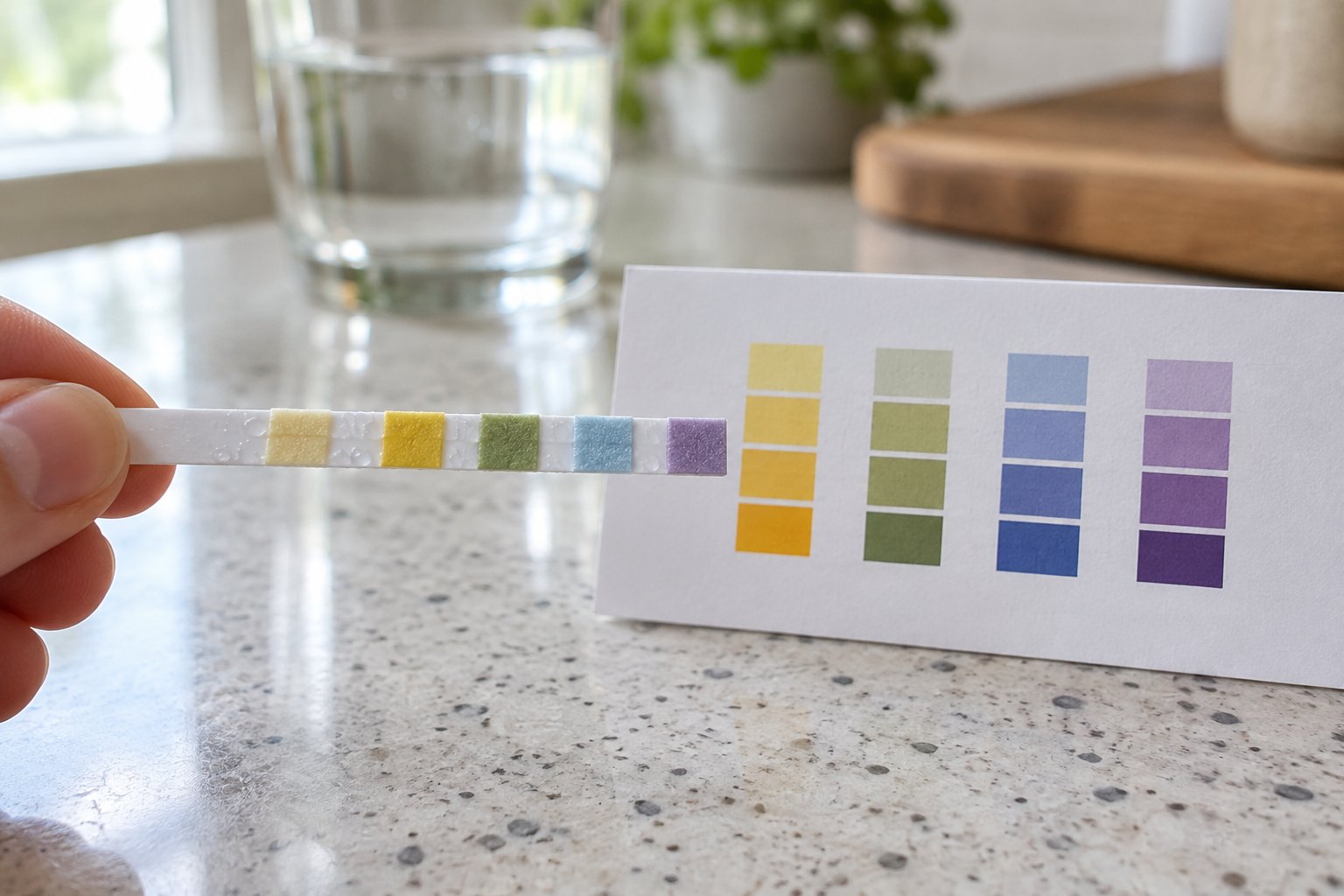
What do the numbers on a water test strip mean?
First, the units. Most strips read in ppm, which is the same as mg/L; SenSafe’s chlorine chart is labeled “ppm (mg/L).” Lead and metals strips read in ppb, the same as µg/L. Hardness is often printed in both ppm and grains per gallon (gpg); LaMotte’s chart shows “0 50 100 200 400” ppm alongside “(0) (3) (5.8) (11.7) (23)” gpg.
Then compare your reading with the benchmark for each test:
| Test | Benchmark | Source |
|---|---|---|
| Nitrate (as nitrogen) | 10 mg/L legal limit | EPA |
| Nitrite (as nitrogen) | 1 mg/L legal limit | EPA |
| Lead | Action level 0.015 mg/L (15 ppb); health goal zero | EPA |
| Copper | Action level 1.3 mg/L | EPA |
| Chlorine | 4.0 mg/L maximum | EPA |
| pH | 6.5 to 8.5 (guideline) | EPA secondary standard |
| Iron | 0.3 mg/L (guideline) | EPA secondary standard |
| Hardness | Soft under 17.1 mg/L (1 gpg); hard 120 to 180 mg/L (7 to 10.5 gpg); very hard over 180 | Nebraska Extension |
The nitrate number matters most for families with babies. EPA warns that “infants below the age of six months who drink water containing nitrate in excess of the MCL could become seriously ill.” Note that nitrate strips usually read “as NO3-N,” which is nitrogen, the same basis as EPA’s 10 mg/L. Hardness, on the other hand, is not a health issue; Nebraska Extension says, “Hard water is not a health risk but can be a nuisance.” Our guide to hard water vs soft water explains what to do with a hardness reading.
What if the color is between two blocks on the chart?
We found little official guidance on this. SenSafe says to “match with the closest color match.” TESPERT, which sells a 16-in-1 kit, says on its product listing: “If between two blocks, record the HIGHER value for safety.” We agree with that rule for anything health-related, such as nitrate or lead. PurTest adds one specific case: “If either the Nitrate or Nitrite test turn gray or light brown that test should be interpreted as 0 ppm.”
Are water test strips accurate?
Accurate enough to screen, not to decide. The evidence:
- Hardness: Nebraska Extension says dip strips “can provide a good estimate of hardness. Laboratory tests should be considered if more accurate measurements are needed.”
- Nitrate: a 2007 study comparing strips with a lab in 102 homes found “moderate precision overall,” and among samples with nitrate, “the laboratory assay indicated higher nitrate levels than the test strip for 81%.” The authors said strips “should be used with caution, preferably as a screening tool.” In other words, strips tended to read low.
- Arsenic: in EPA’s verification of one arsenic kit, “the rate of false negatives was 16% for the non-technical operator” at the 10 ppb limit. Our arsenic in water test guide covers this in detail.
Central Iowa Water Works sums it up: “Treat results as a screening tool, not a definitive measurement,” and “if a home test result raises concerns, we recommend confirming it through a certified laboratory before taking action.” EPA says to “only use laboratories that are certified to do drinking water testing.” Our guide on home test kits vs lab tests explains which results you can act on directly.
What we would buy for this job
- TESPERT 16-in-1 drinking water test strips: covers hardness, pH, chlorine, nitrate, nitrite, iron, copper and lead on one strip. Its own tips say to read within 30 to 45 seconds in daylight.
- Varify water hardness test strips: a simple single-test strip that reads 0 to 25 gpg, useful for checking a softener.
As an Amazon Associate, Complete Water Guide earns from qualifying purchases. Prices change, so check the listing.
Can a test strip detect lead in water?
Some can, but be careful. A 2021 study in Environmental Science and Technology found “most kits (12 of 16 brands) were not suitable for drinking water analysis,” and that strips which did detect dissolved lead “failed to detect particulate lead.” Some kits are designed around the 15 ppb action level; PurTest says its lead test “can detect dissolved lead at levels below the EPA Action Level of 15 parts per billion,” and takes 10 minutes.
Even then, First Alert says its kit “is a screening test and can not be used to certify water as safe or unsafe for drinking.” EPA says, “Because you cannot see, taste or smell lead in water, testing is the only way to know,” and the CDC notes that certified labs test for lead. With children in the house, we would always use a lab. Our guide to lead in drinking water covers testing and filters.
Do water test strips test for bacteria?
No. Dip strips test chemistry, not germs. Kits that include a bacteria test use a separate vial that you incubate; PurTest’s coliform test sits at room temperature “for 48 hours” and “is a screening test and cannot be used to certify water as safe or unsafe for drinking.” Penn State Extension says wells should be “tested for total coliform bacteria every year” by “a state-certified commercial water-testing laboratory.” EPA recommends testing private wells annually “for total coliform bacteria, nitrates, total dissolved solids, and pH levels.”
How should you store water test strips?
Dry, cool and sealed. LaMotte says, “Store in a cool, dry place,” and PurTest warns that “even moisture in the air can activate the test once removed from the protective packaging.” SenSafe says, “Do not store kit in direct sunlight or above 90°F/32°C,” and to use strips “within the allowed shelf life as marked on each container.” Central Iowa Water Works adds, “Heat, humidity, and age can reduce accuracy.” We keep strips out of the bathroom for that reason, and throw out a bottle that has passed its date.
Frequently asked questions
How long do you leave a water test strip in the water?
It depends on the brand: 1 to 2 seconds for most multi-pad strips such as LaMotte and PurTest, and up to 30 seconds with a back-and-forth motion for SenSafe’s iron strip. Always follow the instructions for your kit.
How long do you wait to read a water test strip?
Each pad has its own time. LaMotte reads chlorine, hardness and pH immediately and nitrate and nitrite after 30 seconds; PurTest reads iron after 60 seconds. Reading late can be as wrong as reading early, because some colors keep changing.
What does ppm mean on a water test strip?
Parts per million, the same as milligrams per liter (mg/L). Lead and metals strips usually use ppb, parts per billion, which is micrograms per liter.
Are water test strips accurate?
Good for screening, not for final answers. A study of nitrate strips found the lab read higher than the strip in 81% of samples with nitrate. Confirm anything near a health limit with a certified lab.
What should I do if a test strip shows high nitrate or lead?
Stop using the water for infant formula and drinking until a certified lab confirms the result. Central Iowa Water Works recommends lab confirmation before acting on a home test.
Can test strips go bad?
Yes. Heat, humidity and age reduce accuracy. Keep the bottle closed, store it cool and dry, and use strips before the date printed on the container.
Sources
- LaMotte, Insta-TEST Analytic Drinking Water 6 instructions.
- PurTest, Home Water Analysis Kit instructions.
- First Alert (BRK), WT1 Drinking Water Test Kit manual.
- Industrial Test Systems, SenSafe Iron, Free Chlorine and Water Metals Check product pages, and SenSafe arsenic kit booklet.
- Safe Drinking Water Foundation, How to Use the LAWNFUL Drinking Water Test.
- Central Iowa Water Works, home nitrate testing.
- U.S. EPA, National Primary Drinking Water Regulations, Secondary Drinking Water Standards, Protect Your Home’s Water, and Protect Your Family from Sources of Lead.
- University of Nebraska-Lincoln Extension, Drinking Water: Hard Water (Calcium and Magnesium), G1274.
- Searles Nielsen et al., Journal of Exposure Science and Environmental Epidemiology, 2007, nitrate test strips compared with laboratory analysis.
- Kriss et al., Environmental Science and Technology, 2021, evaluation of home lead test kits.
- U.S. EPA Environmental Technology Verification, ITS Quick arsenic test kit verification statement.
- Penn State Extension, Coliform Bacteria; CDC, Lead in Drinking Water.