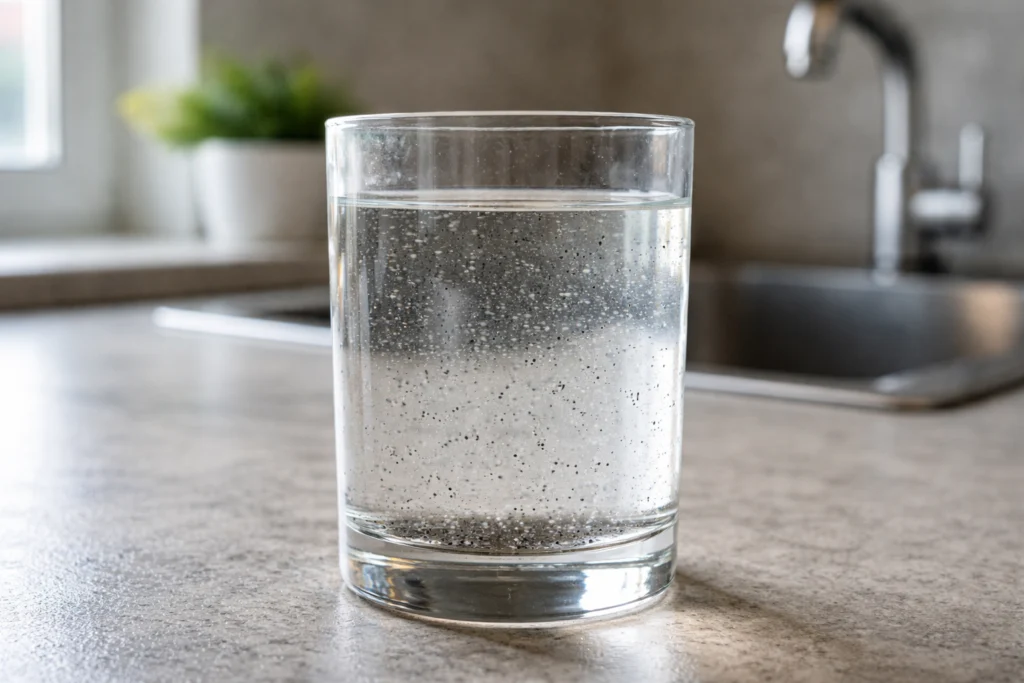
Black specks in water almost always come from one of three things: rubber breaking down somewhere in your plumbing, carbon dust from a water filter, or manganese. You can usually tell which in about 10 seconds. Pinch a speck between two fingers. If it smears and leaves a gray, pencil-like mark, it is rubber. If it stays gritty or crumbles, it is mineral. If you only see specks in filtered water, it is carbon.
We read what water utilities tell their own customers about this, the Water Quality Association’s manganese guidance and EPA’s standards, and put it into one checklist. Here is how to find your source and what each fix looks like.
The smear test: rubber or mineral?
This is the quickest way to narrow it down. Greenville Utilities Commission in North Carolina describes rubber specks this way: “The particles typically smear when you touch them and leave a pencil-like mark on your fingers.” A water industry handbook from the American Water Works Association, quoted by Stanford University’s utilities division, says rubber flakes “sometimes have a ‘greasy’ appearance and will frequently stick and smear on surfaces.”
Specks that do not smear point to minerals: manganese, iron or sediment knocked loose from pipes. Fine black powder that shows up only after a filter points to carbon.
Where do black specks in water come from?
Where and when you see them matters as much as what they feel like. Use this table:
| What you notice | Most likely source | What the source says |
|---|---|---|
| Specks smear, appear in hot water as it first gets hot | Rubber lining in the water heater flex connector | “The black particulate appears just as the water gets hot, then clears up” (AWWA handbook, via Stanford) |
| Greasy specks in hot water, water heater has an expansion tank | Rubber diaphragm inside the thermal expansion tank | “The tank is divided in two by a rubber diaphragm that degrades over time” (Greenville Utilities) |
| Specks in toilet tanks and around faucets, hot and cold | Gaskets, O-rings, flapper valves | “Plumbing gaskets and o-rings disintegrate over time and can collect in toilet tanks and around faucets” (Cambridge Water Department) |
| Fine black powder only in filtered water | Activated carbon from the filter | “It’s normal for carbon dust to appear in your first few fillings” (Brita) |
| Specks after a water main break or road work nearby | Iron and manganese loosened from pipe walls | Particles can “come loose from pipe walls after a large main break or major construction” (Cambridge) |
| Gritty specks plus black stains on fixtures or laundry | Manganese in the water itself | Manganese causes “black stains on tubs/showers, toilets, plumbing fixtures, and laundry” (Water Quality Association) |
Why does chloramine make rubber break down?
Many cities disinfect with chloramine, a mix of chlorine and ammonia, instead of plain chlorine. The Cambridge Water Department says “the use of chloramine as a disinfectant is known to cause rapid disintegration of some types of plumbing fixtures.” The AWWA handbook names the usual victims: “the rubber or elastomer linings on older stainless steel braided flex connections and rubber flapper valves in toilet tanks.”
Cambridge adds a useful rule of thumb. If O-rings and gaskets fall apart “within one to two years of installation,” contact the manufacturer and ask for parts that are resistant to chloramine. Your water utility can tell you whether it uses chloramine.
Why are there black specks in my hot water only?
If the specks appear only on the hot side, look at the water heater first, not the faucets. Two parts cause it:
- The flex connector. The braided hose that connects the water heater to your pipes can have a black rubber lining inside. The Town of Jupiter, Florida warned residents that some push-to-connect braided connectors with a black rubber-like lining “breakdown after 6 months to 2 years.”
- The thermal expansion tank. Greenville Utilities lists a “deteriorating membrane in the thermal expansion tank on the hot water heater” as one of the two typical sources of black, grease-like specks.
A quick check: run the hot tap and watch. The AWWA handbook says connector problems show up “just as the water gets hot, then clears up as the black particulate is displaced by the clean water from the water heater.” Our guide to water heater expansion tank installation shows where the tank sits and how it is connected.
Why are there black specks in my bath water?
Bath water is mostly hot water, so the same two water heater parts are the first suspects. Jupiter’s notice describes exactly this: pieces of rubber lining “end up in the bathtub, shower, washing machine, etc.” and “can also collect inside of faucet aerators.” It adds that the flecks “can smear when touched and leave greasy streaks in sinks, bathtubs or other fixtures.”
If you see specks in the tub but not at the kitchen sink, also check the tub’s own rubber parts, such as the diverter or cartridge seals. Unscrew a faucet aerator anywhere in the house: if it is full of black bits that smear, rubber is confirmed.
Are black specks in water dangerous?
It depends on the source, which is why the smear test comes first.
- Rubber: none of the utility notices we read list a health warning. They treat it as a plumbing repair: find the failing part and replace it.
- Carbon from a filter: Brita says carbon dust in the first few fillings is normal, and “seeing carbon particles in the pitcher after several weeks of use is normal with our older filters.”
- Manganese: this is the one to take seriously. The Water Quality Association says “studies suggest an association between exposure to manganese in drinking water and neurological issues in infants and children.” EPA set a lifetime health advisory of 0.3 mg/L and, according to WQA, “suggests 0.3 mg/L be used for both chronic and acute exposure for infants younger than 6 months old.”
Our rule: if the specks smear, fix the plumbing. If they are gritty, or you also see black stains, test the water before you mix baby formula with it.
Black specks in well water: check for manganese
Manganese is more common in wells. WQA says it “is more prevalent and found at higher concentrations in groundwater than in surface water.” EPA’s secondary standard for manganese is 0.05 mg/L, and EPA lists its effects as “black to brown color; black staining; bitter metallic taste.” For comparison, iron’s standard is 0.3 mg/L, and EPA describes iron as causing “reddish or orange staining.” Black usually means manganese; orange or brown usually means iron.
WQA’s advice is direct: “If you are experiencing black stains on your shower, toilet, plumbing fixtures, or laundry, it is likely you have manganese in your drinking water and it is recommended you have your water tested.” Use a certified lab; EPA keeps a lab certification contact list by state. Our guide to manganese in water covers treatment, and home test kits vs lab tests explains which result you can act on.
Black particles in filtered water: carbon dust
Carbon filters are made from activated carbon, and some of it washes out, especially from a new cartridge. Cambridge says “the small carbon particles of these filters are black and can pass through in your water.” Brita’s setup steps for its Elite filter say: “Discard your first three containers worth of filtered water.”
If a filter keeps shedding after that, replace it. Cambridge says: “If black particles are from your filter, you should replace the filter as recommended by the manufacturer.” Our list of signs a water filter needs replacing helps you check.
How do you get rid of black specks in water?
Match the fix to the source:
- Flush first. After a main break or nearby construction, Cambridge says “flushing the system and your taps will likely resolve the issue of black particles.” Run the cold taps until the water is clear.
- Clean the aerators. Unscrew each faucet aerator, rinse out the debris, and note which faucets had black bits. That map shows you where the source is.
- Replace rubber parts with chloramine-resistant ones. Stanford’s guidance says to replace the degraded part with “silicone based rubber, synthetic polymers, copper or nylon flex lines” and that “these products should say ‘chloramine resistant.'”
- Fix the water heater connection. Jupiter suggests “‘hard piping’ the hot water heater or other brands of flexible connectors with no liner or a different liner material.” A corrugated copper connector has no rubber lining to shed.
- Replace a failing expansion tank. Greenville Utilities says you “may need to replace the thermal expansion tank or the water hose with one that is resistant to chloramines.”
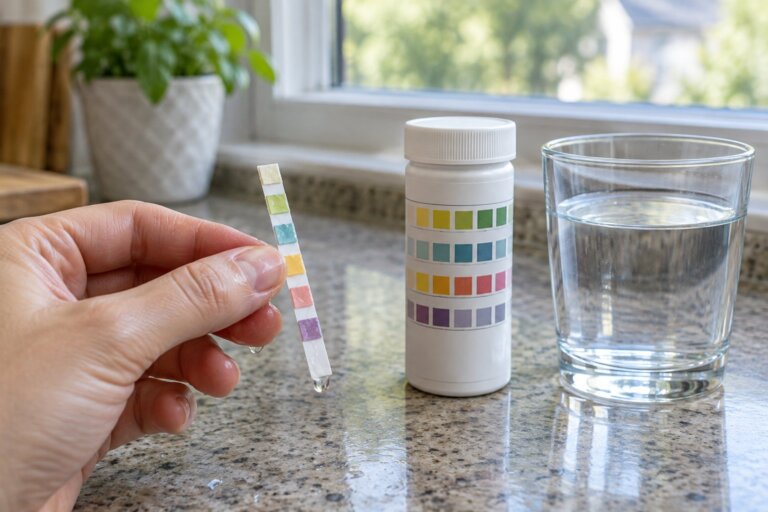
- Test and treat for manganese. If the specks are gritty and you have black staining, get a lab test before buying treatment.
What we would buy for this job
- EZ-Fluid 18 inch corrugated copper water heater connector, 3/4 inch FIP: a copper connector has no rubber lining to break down, which is the fix Stanford and Jupiter describe for hot-side specks. Check your fitting size before you order.
As an Amazon Associate, Complete Water Guide earns from qualifying purchases. Prices change, so check the listing.
If you are not comfortable working on a gas or electric water heater, this is a short job for a plumber. Our guide on how to flush a water heater covers the steps that come before any water heater work.
When should you call your water utility?
Call your utility if the specks appear at every tap in the house at once, especially after a main break, or if neighbors see them too. That points to the water main, not your plumbing. Cambridge says it is usually temporary and clears after the system is flushed. If the specks show up only at some taps, or only on the hot side, the cause is almost always inside your home.
Frequently asked questions
What are the black specks in my water that smear?
Almost always rubber. Greenville Utilities says rubber specks smear and leave a pencil-like mark on your fingers. The usual sources are the water heater flex connector, the expansion tank diaphragm, toilet flappers, gaskets and O-rings.
Why do I only get black specks in hot water?
The water heater’s rubber-lined flex connector or the diaphragm in its thermal expansion tank is breaking down. The AWWA handbook says connector specks appear just as the water turns hot and then clear.
Are black specks in water dangerous?
Rubber and carbon specks are a plumbing or filter issue. Manganese is the one with health relevance, especially for babies; EPA’s lifetime health advisory is 0.3 mg/L. If the specks are gritty or you see black stains, test your water.
Why are there black particles in my Brita water?
Carbon dust from the filter. Brita says it is normal in the first few fillings and tells you to discard the first three containers of filtered water from a new filter.
Can chloramine cause black specks in water?
Yes, indirectly. Chloramine breaks down some rubber parts in plumbing, and the broken-down rubber shows up as soft black flakes. The fix is chloramine-resistant replacement parts.
Do black specks mean I have manganese?
Only if they are gritty or you also see black staining on fixtures or laundry. Specks that smear are rubber. A certified lab test confirms manganese; EPA’s guideline is 0.05 mg/L for staining and taste.
Sources
- Cambridge Water Department, Drinking Water Quality FAQs.
- Stanford University Utilities Division, Gradual Chloramine Degradation of Rubber Components, quoting the CA-NV AWWA Handling Water Quality Complaints Handbook.
- Greenville Utilities Commission, What are those black grease-like specks in my water?
- Town of Jupiter, Florida, Flexible Water Heater Connectors with Black, Rubber Lining.
- Water Quality Association, Manganese FAQ.
- U.S. EPA, Secondary Drinking Water Standards.
- Brita, Pitcher FAQs.