An arsenic in water test is the only way to know if arsenic is in your water, because it has no color, taste or smell. EPA’s limit for public water is 10 parts per billion (0.010 mg/L), and its health goal is zero. Our recommendation is a lab test through a state-certified laboratory, which costs about $15 to $50 at public labs. Home kits exist, but EPA’s own verification found they miss arsenic at the 10 ppb limit more often than you would want.
We built this from EPA, CDC, USGS, the Minnesota, New Hampshire, Maine and Wisconsin state agencies, Wisconsin’s state lab price list, Penn State, University of Arizona and University of Georgia Extension. Here is who should test, how often, what it costs, how to read the result, and what to do if it is high.
Why should you test your water for arsenic?
Because you cannot tell any other way. The Minnesota Department of Health says, “You cannot taste, see, or smell arsenic in your water.” New Hampshire’s environmental agency says arsenic has no color, taste or odor even at high levels, and that “the only way to determine the arsenic level in your well water is by testing.”
The health concern is long-term drinking. EPA lists “skin damage or problems with circulatory systems, and may have increased risk of getting cancer.” New Hampshire lists an increased risk of “cancer of the skin, bladder, lung, kidney, nasal passages, liver or prostate, and non-cancerous effects such as diabetes, cardiovascular, immunological and neurological disorders.” It also notes that “washing and bathing do not pose a known risk to human health.” The concern is the water you drink and cook with.
If you are on city water, your utility already tests for arsenic under EPA’s rules. This article is mostly for private well owners, who are responsible for their own testing.
How common is arsenic in well water?
More common than most people expect, and it varies a lot by region:
| Where | What the source found |
|---|---|
| United States, domestic wells | About 2.1 million people use domestic wells with predicted arsenic above 10 µg/L, out of about 44.1 million on domestic wells (USGS, 2017) |
| U.S. wells sampled nationally | “About 7 percent” exceeded 10 µg/L; about 16 percent in the Southwest (USGS) |
| Minnesota | “About 10 percent” of private wells above 10 µg/L; arsenic detected in about 40 percent of new wells drilled since 2008 |
| New Hampshire | About a 25% probability of arsenic above 5 µg/L in private wells |
| Arizona | “About 1 in 5 water samples” above 10 ppb |
| Pennsylvania | “Nearly 8%” of groundwater samples at or above 10 ppb |
| Wisconsin | 3% of 14,699 recorded tests above 10 ppb |
USGS says detections “were more common and concentrations generally were higher in the west than in the east,” and names the glacial aquifer system of the northern U.S. as another area of concern. We would not rely on a neighbor’s result; test your own well.
How often should you test well water for arsenic?
- New Hampshire and Maine: every 3 to 5 years. Maine CDC says “well owners test their water every 3-5 years for arsenic.”
- Arizona: “Test at least every three years for arsenic, lead, and radon.”
- Wisconsin: “every well owner test for arsenic at least once. If arsenic is found, the well owner should test for it again annually.”
- Minnesota: test “at least one time beyond the initial well water test when the well is first constructed,” and if arsenic was found, consider retesting “about six months after construction.”
Our rule: test once now if you never have, then every 3 years, and every year if anything was found. If a result comes back high, test again before buying treatment. University of Georgia Extension says that above 10 ppb “you should re-test to confirm the result before obtaining a treatment system.”
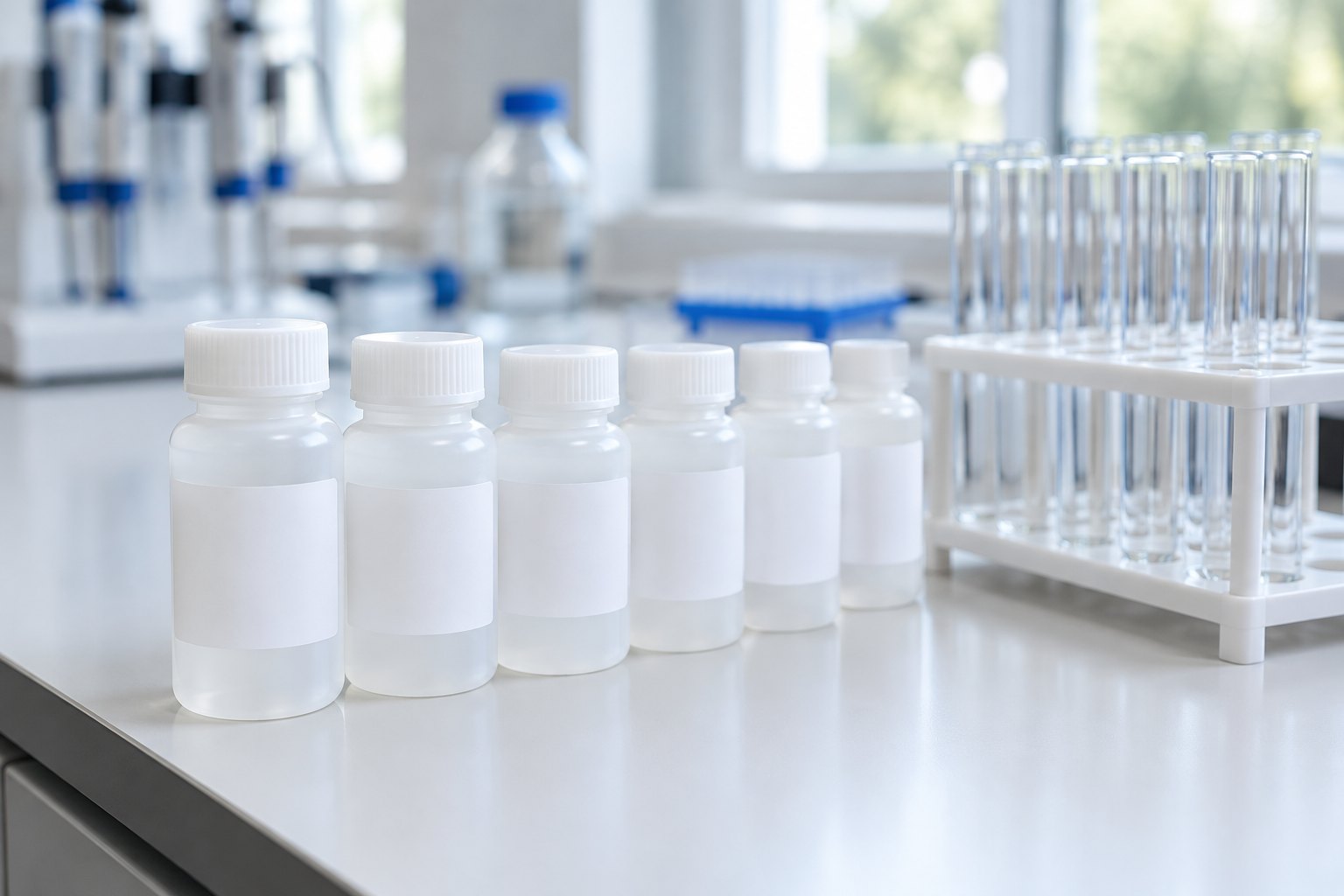
Arsenic in water test: lab or home kit?
A lab, for any result you plan to act on. Here is why.
EPA’s Environmental Technology Verification program tested one popular home kit, the ITS Quick. EPA describes it as giving “a semi-quantitative analysis,” read from a color chart in steps of 0, 5, 10, 20 ppb and up. At the 10 ppb limit, “the rate of false negatives was 16% for the non-technical operator and 5% for the technical operator.” On real drinking water samples, its “qualitative accuracy … was 57% for the non-technical operator and 52% for the technical operator.” EPA’s statement also says the verification does “not certify that a technology will always operate as verified.”
University of Arizona Extension reaches the same conclusion: home kits “estimate arsenic levels between a wide range of numbers and are therefore not as accurate,” and even verified kits “do not always detect arsenic accurately at or near the level of the 10 ppb arsenic standard.” Our view: a home kit can be a useful quick screen, especially for checking that a treatment system is still working, but a lab test decides whether you have a problem. Our guide on home test kits vs lab tests covers this for other contaminants too.
How much does an arsenic water test cost?
- Wisconsin State Laboratory of Hygiene (prices effective July 1, 2026): arsenic $38.00 with a 10 business day turnaround, $76.00 rush, a metals screen that includes arsenic $97.00, and arsenic speciation (arsenic III and V) $150.00.
- New Hampshire (2021 figures): “the state laboratory for example charges $15,” and arsenic III testing was $35.
- Arizona: “The cost for a single arsenic test in a laboratory may be as much as $50.”
Check your own state lab first; it is often the cheapest certified option. Our well water testing cost guide lists lab prices by state.
How do you take a water sample for an arsenic test?
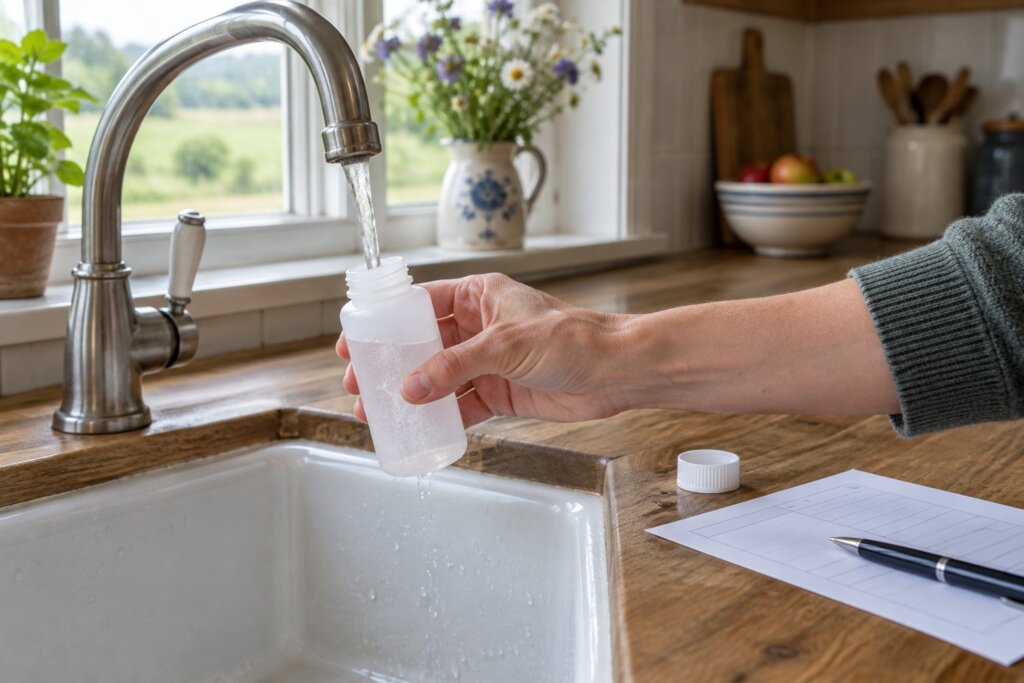
Use the lab’s bottle and follow its instructions exactly. New Hampshire says to “obtain water sample bottles by contacting an accredited laboratory.” Wisconsin DNR says, “The laboratory you work through will provide you with a water sampling kit,” and “it’s very important to make sure you follow their sampling directions.” Wisconsin’s state lab warns that samples not in its own bottles may be rejected.
Two more points matter. First, test the right water: to know what is in your well, sample untreated water, from a tap before any filter or softener. University of Arizona Extension says to “test untreated water before RO installation; test treated water after RO installation; and re-test treated water annually.” Second, the flushing steps in official procedures run the cold tap for two to five minutes until the temperature steadies, then reduce the flow to a pencil-width stream before filling the bottle. If your lab’s instructions differ, follow the lab.
What we would buy for this job
- Tap Score total arsenic water test kit (mail-in lab test): a certified-lab arsenic test by mail, if your state lab is not convenient. Compare its price with your state lab first.
- Tap Score Advanced home water test (lab, 116 analytes): arsenic plus lead, manganese, bacteria and more in one lab test, for a well that has never been fully tested.
As an Amazon Associate, Complete Water Guide earns from qualifying purchases. Prices change, so check the listing.
What do arsenic test results mean?
- Below 10 ppb: meets EPA’s limit for public water. Keep testing on schedule. New Hampshire sets a stricter state limit of 5 ppb for public systems.
- Above 5 ppb: New Hampshire recommends “a follow-up test for Arsenic-III be conducted before selecting a treatment system.”
- Above 10 ppb: retest to confirm, then choose treatment. Use bottled water for drinking and cooking in the meantime.
The arsenic III test matters because the two forms behave differently. New Hampshire explains: “As-III (Arsenite, H3AsO3) has no charge, while As-V (Arsenate…) is negatively charged and thus more easily removed.” Most treatment works far better on arsenic V.
How do you remove arsenic from well water?
The right system depends on which form of arsenic you have:
- Reverse osmosis: New Hampshire says “removal efficiency for As-III is only 60% compared to 95% removal for As-V.” RO systems certified to NSF/ANSI 58 for arsenic are tested on pentavalent arsenic (arsenic V), and their data sheets warn they “may not reduce other forms of arsenic.” See our best reverse osmosis systems and NSF/ANSI standards guides.
- Anion exchange: “removes the negative Arsenic-V ion only,” and New Hampshire says it “must be followed by a calcite neutralizer.”
- Adsorptive media: “media longevity is especially affected by the presence of As-III and pH greater than 7.5.”
- Oxidation first: if you have arsenic III, it can be converted to arsenic V before treatment. New Hampshire lists “chlorine, ozone, permanganate and solid manganese dioxide (pyrolusite) media” as effective, and “air, UV light, chlorine dioxide” as not effective.
Some things do not work. Minnesota says conventional water softeners and activated carbon filters alone will not remove arsenic. New Hampshire notes that “even pitchers certified for arsenic removal by the National Sanitation Foundation are required only to reduce arsenic from 50 ppb down to below 10 ppb.”
Whatever you install, test the treated water. University of Arizona reports one survey where “RO systems removed an average of 80% of the arsenic in treated water, leaving arsenic above the 10 ppb standard in one-third of the homes.” New Hampshire recommends “quarterly arsenic testing of the treated water for the first year of treatment, and semi-annually after that.” If you are not sure whether to handle this yourself, our guide on when to call a well water professional helps.
Does boiling water remove arsenic?
No, it makes it worse. The Minnesota Department of Health says, “Boiling the water will only concentrate the arsenic, due to evaporation of some of the water.” The CDC says, “Boiling will not remove chemicals from water.” University of Arizona lists “heating or boiling the water,” activated carbon filters and chlorine disinfection among the methods that do not remove arsenic.
Frequently asked questions
How do I test my well water for arsenic?
Order a sampling kit from a state-certified lab, take the sample from an untreated cold tap following the lab’s instructions, and send it back. Home kits can screen, but EPA’s verification of one kit found it missed arsenic at 10 ppb in 16% of tests by non-technical users.
How much does an arsenic water test cost?
About $15 to $50 for a single arsenic test at public labs. The Wisconsin State Laboratory of Hygiene charges $38 as of July 2026, and testing for arsenic III and V separately costs $150 there.
How often should I test my well for arsenic?
Every 3 to 5 years, according to New Hampshire and Maine, or every 3 years in Arizona’s advice. Wisconsin says to test at least once and then yearly if arsenic is found.
What level of arsenic in water is safe?
EPA’s legal limit for public water is 10 ppb (0.010 mg/L), and its health goal is zero. New Hampshire uses a stricter 5 ppb state limit for public systems.
Can you taste or smell arsenic in water?
No. The Minnesota Department of Health, Wisconsin DNR and Penn State Extension all say arsenic cannot be seen, tasted or smelled. Testing is the only way to know.
Does a water softener or Brita remove arsenic?
No. Minnesota says conventional softeners and activated carbon filters alone will not remove arsenic, and University of Arizona lists carbon filters such as Brita and Pur among methods that do not work.
Sources
- U.S. EPA, National Primary Drinking Water Regulations.
- U.S. EPA Environmental Technology Verification, verification statement for the ITS Quick arsenic test kit, 2002.
- CDC/ATSDR, ToxFAQs for arsenic; CDC, Chemicals That Can Contaminate Tap Water.
- USGS, Ayotte et al. 2017, arsenic in U.S. domestic wells, and Arsenic and Drinking Water.
- Minnesota Department of Health, Arsenic in Well Water.
- New Hampshire Department of Environmental Services, fact sheet DWGB-3-2 and private well lab guidance.
- Maine CDC, testing well water.
- Wisconsin DNR, Arsenic; Wisconsin DHS publication P-01830.
- Wisconsin State Laboratory of Hygiene, public environmental and water prices effective July 1, 2026.
- Penn State Extension, Arsenic in Private Drinking Water Supplies.
- University of Arizona Extension, AZ1650.
- University of Georgia Extension, Circular 996.