The PFAS Picture
Consumer Reports (2020) — Evian was not tested
The dataset behind nearly every published bottled water PFAS ranking is Consumer Reports’ 2020 analysis of 47 products across 30 PFAS compounds. Evian was not among them, alongside Fiji, Smartwater, Essentia and Mountain Valley.
This is why no widely-cited ppt figure exists for Evian. If you encounter one, check whether it traces back to an actual lab report.
Independent lab testing — PFAS covered
Evian has undergone independent contaminant testing outside the Consumer Reports programme. A Microbac Laboratories analysis, sampled 30 March 2026 and reported 8 April 2026, applied a broad methodology panel including EPA 200.7, EPA 200.8, EPA 300.0, EPA 524.2 and Agilent 8700 LDIR, with PFAS testing included.
What that testing established about Evian’s composition:
| Measure | Result | What it means |
|---|---|---|
| PFAS tested | Yes | Covered in the panel, unlike most untested brands |
| TDS | 326 ppm | Moderate mineralisation — light, clean character |
| pH | 8.3 | Mildly alkaline, typical of Alpine spring sources |
| Fluoride | 0 mg/L | None detected |
| Microplastics | High | The consistent flag across independent sources |
The pattern here is worth naming clearly: on PFAS, Evian is in reasonable shape and at least has been tested. On microplastics, it is repeatedly flagged. Those are two separate contamination questions and they deserve separate answers.
The Microplastics Problem
This is the substantive issue with Evian, and it has generated more legal activity than any PFAS question.
July 2024 — Plastic Pollution Coalition sues Danone
On 23 July 2024, the Plastic Pollution Coalition filed a complaint in DC Superior Court against Danone Waters of America, maker of Evian, under the District’s Consumer Protection Procedures Act. The allegation: an independent laboratory evaluation found both microplastics and bisphenol-A (BPA) in Evian products, which the complaint argues contradicts marketing describing the water as “natural,” “sustainable” and “healthy.”
The Coalition filed a structurally identical complaint against Fiji Water six months later, in January 2025 — the same argument applied to a different brand.
The wider wave of lawsuits
Evian is one of six brands targeted in a broader set of microplastics-related consumer actions, alongside Arrowhead, Crystal Geyser, Fiji, Ice Mountain and Poland Spring. The common argument begins with research on microplastic prevalence in bottled water, frequently citing a 2018 Orb Media and State University of New York at Fredonia study that found microplastic contamination in 93% of bottles tested across 11 brands in nine countries, with more than 1,000 particles per litre in half the brands.
The point that gets lost in brand-by-brand coverage: this is a packaging problem, not a source problem. Water bottled in plastic picks up plastic. Evian’s Alpine aquifer is not the variable.
What the Court Actually Ruled
In January 2025, US District Judge Thomas Durkin dismissed a separate class action brought by plaintiffs Michael Daly and Michael Dotson, who had sought over $5 million in damages arguing that Evian’s “natural” labelling was deceptive given microplastic content.
The reasoning matters more than the outcome. Judge Durkin held that:
- Under FDA regulation, “spring water” describes water originating from a natural spring — the term is legally tied to origin, not purity.
- The FDA uses “natural” to describe the source of the water rather than the absence of contaminants like microplastics.
- FDA regulations preempt state consumer fraud laws that might otherwise require additional disclosure about microplastic content.
Evian’s Actual Composition
Setting the contamination debate aside, Evian’s mineral profile is a genuine part of why people buy it:
- 326 ppm TDS — moderate mineralisation. Lighter than San Pellegrino (1,109 mg/L) and far lighter than Gerolsteiner (2,488 mg/L), heavier than a purified seltzer under 50 mg/L.
- pH 8.3 — mildly alkaline, which contributes to the smooth mouthfeel Evian is known for.
- Roughly 15 years of natural filtration through Alpine glacial sand before reaching the catchment.
- Legally protected catchment area — the surrounding land is restricted from agriculture and development, which is meaningful protection against the runoff that drives PFAS contamination.
- Zero fluoride detected in independent testing.
European natural mineral water regulation also requires the source to be officially recognised and the composition stable, and prohibits chemical treatment. That is a stricter framework than US bottled water, which the FDA regulates as a food product. Our mineral water ranking compares the full field.
So Should You Drink Evian?
Reasonable position. Evian has been independently tested, and a protected Alpine catchment with 15 years of filtration is genuine structural protection.
Flagged as high, and the subject of active litigation. This comes from the plastic bottle, not the spring — and applies to every plastic-bottled brand.
You are paying a premium for a genuinely protected source and a mineral profile. Whether that is worth it against filtered tap water at $0.05 per litre is a personal call.
Glass Alternatives and Verified Options
If microplastics are the concern, the fix is packaging rather than brand. As an Amazon Associate we earn from qualifying purchases; it never affects our rankings.
S.Pellegrino (Glass)
The only bottled water with both a published PFAS figure and a low one. Glass removes the microplastic variable entirely.
Acqua Panna (Glass)
Tuscan still spring water at 188 mg/L TDS with a soft, neutral character much like Evian’s — available in glass rather than plastic.
Evian Natural Spring Water
326 ppm TDS, pH 8.3, zero fluoride, from a legally protected Alpine catchment with roughly 15 years of glacial filtration.
Under-Sink RO System
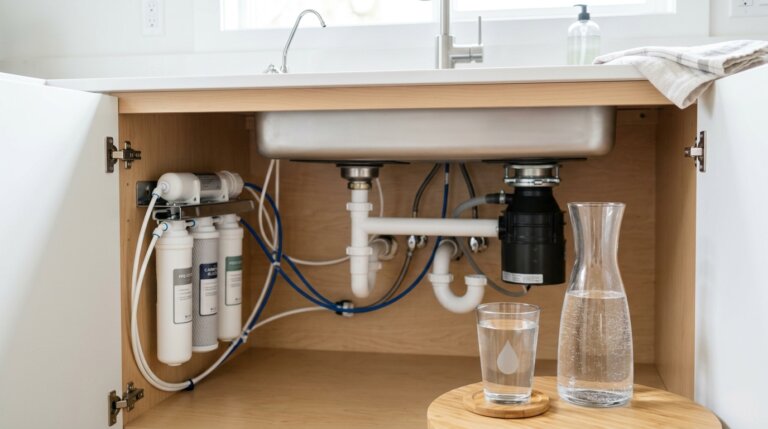
An NSF/ANSI 58 certified system removes 94-99% of PFAS at roughly $0.05 per litre — and eliminates the plastic bottle from the chain entirely.
Frequently Asked Questions
Does Evian have PFAS?
Evian was not included in Consumer Reports’ 2020 analysis, so it has no figure in the most-cited dataset. It has undergone independent lab testing that included PFAS in the panel, alongside a broad contaminant analysis. Its legally protected Alpine catchment provides genuine structural protection against the surface runoff that drives PFAS contamination.
Does Evian contain microplastics?
Independent testing rates Evian’s microplastic content as high, and a July 2024 Plastic Pollution Coalition lawsuit alleges that lab evaluation found microplastics and BPA in Evian products. This is a plastic packaging issue rather than a source issue — it affects every plastic-bottled brand.
What was the Evian lawsuit about, and who won?
Two separate actions. The Plastic Pollution Coalition filed a false advertising complaint against Danone in July 2024 over microplastics and BPA. Separately, a class action seeking over $5 million was dismissed in January 2025 when Judge Thomas Durkin ruled that under FDA rules, “natural spring water” describes the source rather than the absence of microplastics, and that federal regulation preempts state consumer fraud claims on this point.
Is Evian actually worth the price?
You are paying for a legally protected Alpine catchment, roughly 15 years of natural glacial filtration, a moderate mineral profile at 326 ppm TDS, and strict European mineral water regulation. Those are real. Whether they justify the premium over filtered tap water at roughly $0.05 per litre is a personal judgement.
What is Evian’s pH and TDS?
Independent testing puts Evian at pH 8.3 and 326 ppm total dissolved solids, with zero fluoride detected. That places it in the light-to-moderate mineralisation band — lighter than San Pellegrino at 1,109 mg/L and considerably lighter than Gerolsteiner at 2,488 mg/L.
Is Evian safer than Fiji?
Both face the same microplastics question and both have been the subject of near-identical Plastic Pollution Coalition complaints. Evian has more published independent contaminant data; FDA sampling of a Fiji-sourced sample showed PFOA and PFOS below quantification limits. Neither has a Consumer Reports PFAS figure.
Why are so many bottled water brands being sued over microplastics?
Six brands — Arrowhead, Crystal Geyser, Evian, Fiji, Ice Mountain and Poland Spring — face related consumer actions. The common argument cites research including a 2018 Orb Media and SUNY Fredonia study that found microplastic contamination in 93% of bottles tested across 11 brands, with over 1,000 particles per litre in half of them.
Does European regulation make Evian safer?
On source purity, the framework is stricter. European natural mineral water must come from an officially recognised protected source with stable composition and cannot be chemically treated. US bottled water is regulated by the FDA as a food product. This affects what goes into the bottle, not what the bottle itself contributes.
Related Reading
- Bottled Water Brands & PFAS — Every Major Brand Ranked
- Does Fiji Water Have PFAS? What Testing Shows
- Safest Bottled Water Brands — Ranked by Published Data
- Best Mineral Water to Drink — TDS and Minerals Compared
- Fiji vs Smartwater vs Evian — Which Is Best?
- Is It Safe to Drink from Plastic Bottles Daily?
- Best Water Filters That Actually Remove PFAS
References & Sources
- Microbac Laboratories — independent contaminant analysis, sampled 30 March 2026, reported 8 April 2026 (EPA 200.7, 200.8, 300.0, 524.2, Agilent 8700 LDIR)
- Plastic Pollution Coalition — complaint against Danone Waters of America, filed 23 July 2024, DC Superior Court
- US District Court — Daly and Dotson v. Danone, dismissed January 2025 (Judge Thomas Durkin)
- Consumer Reports — bottled water PFAS testing (2020), 47 products, 30 compounds
- EPA — PFAS National Primary Drinking Water Regulation (April 2024)
- Orb Media and State University of New York at Fredonia — microplastics in bottled water study (2018)
The Bottom Line
Evian splits cleanly into two different answers. On PFAS, it holds up reasonably well — it has been independently tested, its Alpine catchment is legally protected from agriculture and development, and European mineral water rules are stricter on source purity than US bottled water regulation. On microplastics, it is repeatedly flagged as high, and that has produced a Plastic Pollution Coalition lawsuit and a place among six brands facing related consumer actions. The January 2025 dismissal did not clear the water — it clarified that FDA labelling rules define “natural spring water” by origin rather than purity. If the source is what you are paying for, Evian delivers it. If the plastic bottle is what worries you, no amount of Alpine filtration solves that, and glass or home filtration will.