
A well water yellow color almost always comes from one of two things: tannins, which are natural stains from decaying plants, or iron. Less often, iron bacteria or manganese are involved. A simple bucket test from the Wisconsin Department of Natural Resources tells tannins and iron apart in a few minutes, and that matters because the fixes are completely different. Iron treatment does not deal with tannins, and the Minnesota Department of Health warns that tannins can even stop iron equipment from working.
We built this from Wisconsin DNR, the Minnesota and Washington state health departments, Penn State and NDSU Extension, University of Florida IFAS, Iowa DNR and EPA. Here is how to tell what is turning your water yellow, when to worry, and what each fix involves.
Well water yellow color: why is my well water yellow?
These are the usual causes, with how each one looks:
| Cause | What it looks like | Source |
|---|---|---|
| Tannins | “Tea coloring formed during the decomposition of vegetation”; yellow or brown right out of the faucet | NDSU Extension, Wisconsin DNR |
| Clear-water (ferrous) iron | “Water comes out of the faucet clear, but turns red or brown after standing” | Minnesota Dept. of Health |
| Red-water (ferric) iron | “Water is red or yellow when it first comes out of the tap” | Minnesota Dept. of Health |
| Organic iron (iron bound to tannins) | “Usually yellow or brown, but may be colorless”; more common in very shallow wells | Minnesota Dept. of Health |
| Iron bacteria | “Yellow, orange, red, or brown stains and colored water,” plus slime and an oily sheen | Minnesota Dept. of Health |
Location is a strong clue for tannins. Wisconsin DNR’s checklist asks, “Is your well shallow? Is your property located close to a swamp, bog, wetland, lake or river?” It also notes that “iron can sometimes be associated with tannins,” which is why some wells have both.
How to tell tannins from iron: the bucket test
This is the most useful thing in this article, and it costs nothing. Wisconsin DNR’s instructions:
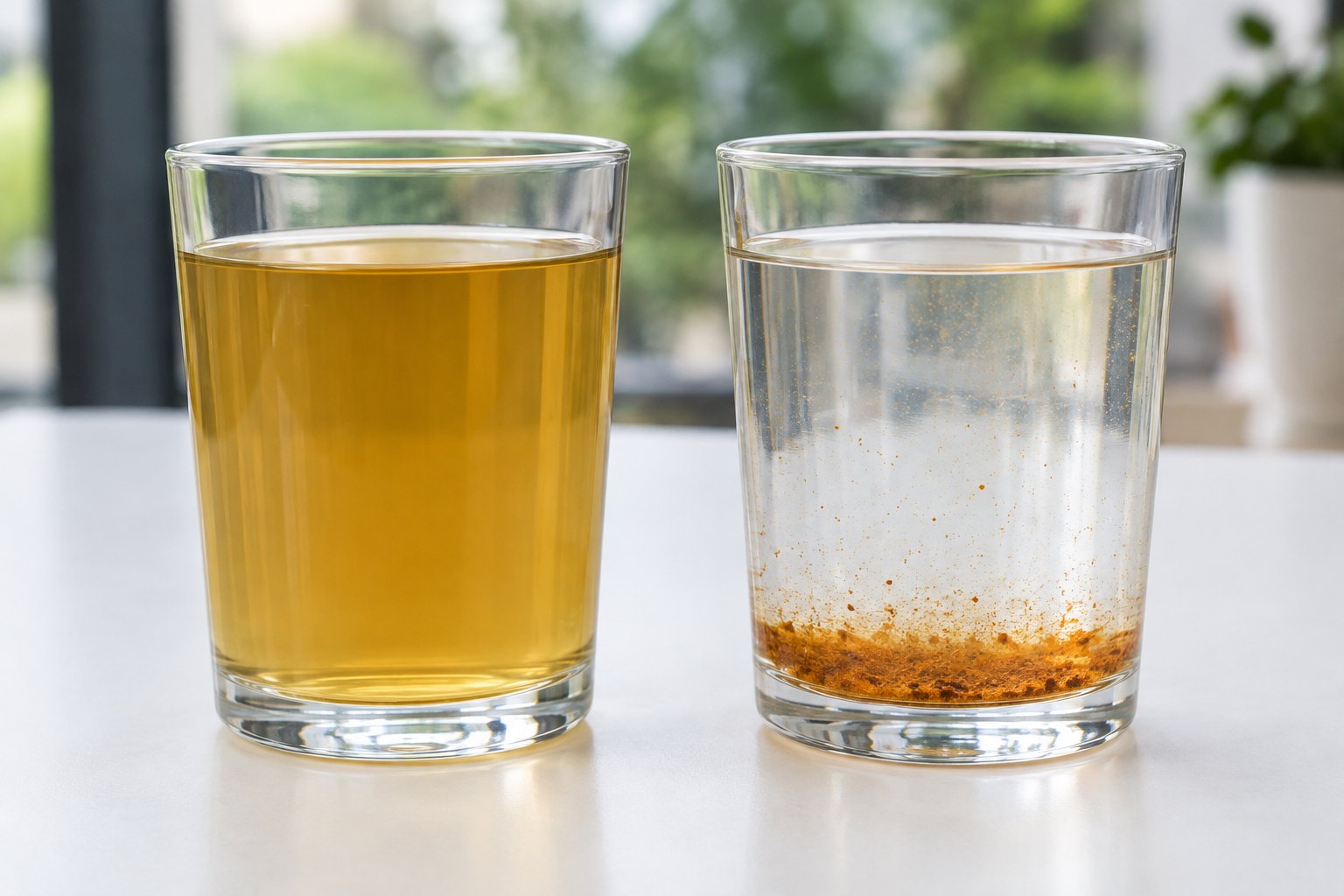
- “Slowly run water into a bucket without aerating the water. If the water is clear at first then changes color after sitting awhile, then the problem is likely iron.”
- “If the water is brown as it leaves the faucet, then tannins are the likely problem.”
Wisconsin DNR’s iron guide adds the glass version: with clear-water iron, “if allowed to stand in the presence of air, reddish brown particles will appear in the glass and eventually settle to the bottom.” Red-water iron looks rusty, red or yellow as soon as you pour it.
Our tip: use a white bucket or a clear glass against white paper, and check it again after an hour. Then confirm with a lab test, because tannins and iron often show up together, and the treatment depends on the numbers.
Is yellow well water safe to drink?
Usually it is a nuisance, not a health problem, but there are exceptions you should rule out:
- Tannins: Wisconsin DNR answers “No” in its health concern column for tannins.
- Iron: Wisconsin DNR says the 0.3 mg/L iron guideline “is based on taste and appearance rather than on any detrimental health effect.” The Minnesota Department of Health says, “Iron in water does not usually present a health risk,” but adds that “some harmful organisms require iron to grow,” so iron can make bacteria harder to get rid of.
- Iron bacteria: Minnesota says they “are not known to cause disease. However, they can create conditions where other disease-causing organisms may grow.”
- Manganese is the one to check. Penn State notes an EPA health advisory of 0.3 mg/L “due to concerns about various neurological health effects.” Minnesota says that if an infant drinks your tap water or formula made with it, a safe level is 100 micrograms per liter or less, and 300 for everyone over a year old. It warns infants “may develop learning and behavior problems if they drink water with too much manganese in it.” If there is a baby in the house, test for manganese before they drink the water. Our guide on the best water for baby formula covers what to use meanwhile.
Why did my well water suddenly turn yellow?
A sudden change is the one situation where we would stop drinking the water until it is tested. Washington’s Department of Health says, “If your water suddenly changes color–no matter what color it becomes–it could indicate a public health concern.” University of Florida IFAS says to test immediately if “your well has been flooded,” if “you replace or repair any part of your well system,” or if “you notice a change in your water, such as a change in taste, odor, or color.”
Iowa DNR is direct about floods: “Never consume water from a well if there is any chance the well has been impacted by flood waters.” It says to test for coliform bacteria and E. coli. The Minnesota Department of Health recommends testing for coliform bacteria “every year and any time the water changes in taste, odor, or appearance,” and notes that “drilling, repair, or service work can also introduce iron bacteria into a well or water system.”
Why is only my hot water yellow?
If the cold water is clear and only the hot water is yellow or rusty, the water heater is the likely source. A State Water Heaters technical bulletin lists “rusty, brown, black, or yellow water appearing in the hot water” as a symptom and says “the most common cause of ‘rusty’ water is a non-toxic iron reducing bacteria.” It adds that water heaters with iron bacteria “usually require new anode rods.” That is a manufacturer’s bulletin, not a health agency, so treat it as a strong lead rather than the final word. Our guides on rusty water from a water heater and the sulfur smell in hot water cover the anode and flushing fixes.
How do you fix yellow well water?
Test first, then match the treatment to the cause.
If it is tannins
NDSU Extension gives a simple rule: anion exchange when the pH is more than 6.0, and an activated carbon filter when the pH is less than 5.0. The Water Quality Association says tannins “can be removed by GAC” (granular activated carbon). The Minnesota Department of Health warns that “anion exchange may affect how corrosive your water is and can corrode your pipes; this may be a health concern if you have copper or lead pipes,” so check your pH and pipes before choosing it.
If it is iron
The amount decides the equipment. From Penn State and the Minnesota Department of Health:
- Under 2 mg/L: polyphosphate can keep dissolved iron in solution (Penn State).
- Up to about 5 mg/L: a water softener can work when the pH is above 6.7. Minnesota says “2 to 5 mg/L is a more common limit,” though some makers claim up to 10.
- 3 to 10 or 15 mg/L: a manganese greensand filter (Penn State and Minnesota).
- Over 10 mg/L: “oxidation followed by filtration,” with chlorine as the most common oxidant (Penn State), or aeration then filtration (Minnesota).
Our guides on how to remove iron from well water and iron bacteria go deeper.
If it is both
This is the tricky case. Minnesota warns that “organic iron and tannins can slow or prevent iron oxidation, so water softeners, aeration systems, and iron filters may not work well.” Wisconsin DNR’s advice for organic iron is “first step is to treat for organics.” In other words, treat the tannins first, then the iron. Minnesota adds that “distillation or reverse osmosis can remove any type of iron” for drinking water at a single tap. Our well water filtration system guide shows how to let a test result pick the system.
What we would buy for this job
- Tap Score tannins water test kit (mail-in lab test): a lab test for tannins, which Wisconsin DNR says to get before choosing treatment. You mail the sample back.
- Varify 17-in-1 water test kit with 2 bacteria tests: a quick home screen for iron, pH and hardness, plus bacteria tests. Use it to decide what to send to a certified lab, not instead of one.
As an Amazon Associate, Complete Water Guide earns from qualifying purchases. Prices change, so check the listing.
What should you test yellow well water for?
Wisconsin DNR says a complete test for iron problems “should include tests for iron concentration, iron bacteria, manganese, pH, alkalinity, and hardness,” and for yellow water, to “test your water for tannins” at a certified lab. Add coliform bacteria if the color changed suddenly or the well was flooded or repaired. Minnesota recommends an accredited laboratory, and University of Florida IFAS says private well owners should test “in a certified laboratory.” Our well water testing cost guide lists typical lab prices, and our guides on iron in well water and manganese in water explain the results.
Frequently asked questions
Is yellow well water safe to drink?
Usually yes if the cause is tannins or iron, which Wisconsin DNR and the Minnesota Department of Health treat as appearance problems. Test for manganese if an infant drinks the water, and test for coliform bacteria if the color changed suddenly.
How do I know if my well water has tannins?
Run water slowly into a bucket. Wisconsin DNR says that if the water is brown as it leaves the faucet, tannins are the likely cause; if it starts clear and changes color after sitting, it is likely iron. A certified lab can test for tannins directly.
Will a water softener fix yellow well water?
Only for some iron. Penn State says softeners suit dissolved iron under 5 mg/L when the pH is above 6.7. Softeners do not remove tannins, and Minnesota warns that tannins can stop softeners and iron filters from working well.
Why is my well water yellow after rain?
We did not find an official source that links tannins to rainfall. Treat any sudden change in color as a reason to test for coliform bacteria, as Washington’s Department of Health and University of Florida IFAS advise, especially if the well may have been flooded.
What removes tannins from well water?
Anion exchange when the pH is above 6.0, or an activated carbon filter when the pH is below 5.0, according to NDSU Extension. Check whether anion exchange could make your water more corrosive if you have copper or lead pipes.
Why is my well water yellow only in the hot water?
The water heater is the likely source. A State Water Heaters bulletin says iron bacteria are the most common cause of discolored hot water and that affected heaters usually need new anode rods.
Sources
- Wisconsin DNR, My Water Appears Yellow, and Iron in Drinking Water (DG035).
- Minnesota Department of Health, Iron in Well Water, Iron Bacteria in Well Water, Manganese in Drinking Water and Home Water Treatment.
- Penn State Extension, Iron and Manganese in Private Water Systems.
- NDSU Extension, What’s Wrong With My Water? Choosing the Right Test.
- Washington State Department of Health, publication 331-286.
- University of Florida IFAS, SS712.
- Iowa DNR, Floods and Water Wells.
- U.S. EPA, Secondary Drinking Water Standards: Guidance for Nuisance Chemicals.
- Florida Department of Health, well water odor and staining fact sheet.
- Water Quality Association, Granular Activated Carbon fact sheet.
- State Water Heaters, Technical Bulletin 21.