
A sulfur smell hot water problem, where the cold water smells fine, almost always starts inside your water heater, not in your well or your city supply. The rotten egg odor is hydrogen sulfide gas, and a water heater is a near-perfect place to make it. The good news: in our view this is one of the easier water problems to fix, and the fix usually costs less than a service call.
Below is how to confirm the water heater is the source, whether the smell is a health risk, and the fixes we would try in order, cheapest first.
Why does my hot water smell like sulfur?
Because four things are happening inside the tank at the same time. The installation manual for Lochinvar residential water heaters, from an A. O. Smith company, says the rotten egg smell “is derived from hydrogen sulfide gas dissolved in the water” and that four factors “must all be present for the odor to develop”:
- Sulfate in the supply water.
- Little or no dissolved oxygen in the water.
- Sulfate-reducing bacteria that have built up inside the water heater. The manual calls them “harmless” and “nontoxic to humans.”
- Excess active hydrogen in the tank, caused by the corrosion-protecting action of the anode rod.
That last factor is the one most people never hear about. Nearly every tank heater has an anode rod, a metal rod that corrodes on purpose so the steel tank does not. The Minnesota Department of Health says the anode “is usually made of magnesium metal, which can supply electrons that aid in the conversion of sulfate to hydrogen sulfide gas.” Warm water helps the bacteria grow, and the magnesium keeps the reaction going.
Our take: since all four conditions have to be present, you only need to break one of them. The anode rod is the easiest one to change, which is why we start there.
Sulfur smell hot water only: why does just the hot side smell?
Because the gas is being made in the heater, so only water that passed through the heater carries it. The Minnesota Department of Health gives a simple test: after you have been away from home for a few hours, smell the water from both the hot and cold taps and note which ones have the odor.
- Hot only: the water heater is the source. Keep reading.
- Hot and cold: the gas is in your well, groundwater or plumbing. That is a different fix, covered in our guide to why well water smells like rotten eggs.
- Only after a softener or filter: Penn State Extension notes that “in rare cases, adding water treatment equipment, like a water softener, may cause hydrogen sulfide production,” because the softener gives the bacteria a place to grow.
Penn State also says hydrogen sulfide problems are most common in wells drilled into acidic bedrock such as shale and sandstone, so well owners see this far more often than city customers. It can still happen on city water that carries sulfate.

Is it safe to use hot water if it smells like sulfur?
For washing and bathing, generally yes. Penn State Extension describes hydrogen sulfide in water as “an aesthetic concern,” and says the human nose “can detect it well before it causes health concerns,” picking it up at levels “well below 0.5 mg/L.” The Lochinvar manual and Penn State both say the sulfate-reducing bacteria themselves do not cause human health problems.
Two cautions we would not skip:
- Gas in enclosed spaces. The Minnesota Department of Health says that while sulfur bacteria are not harmful, “hydrogen sulfide gas in the air can be harmful at high levels.” A strong smell in a small, closed laundry room is a reason to ventilate.
- A smell in all the water, from a well. The same department says that “in rare instances, the gas may be from sewage or other pollution,” and recommends testing well water for coliform bacteria and nitrate to be safe. Our well water testing cost guide covers what that runs.
The smell also stains. Penn State notes hydrogen sulfide can leave yellow or black greasy stains on fixtures and corrode metal plumbing, so it is worth fixing even when nobody is drinking the hot water.
How do you fix sulfur smell in hot water?
Here is the order we would work in. Each step breaks one of the four conditions above.
1. Flush the tank and the hot lines
Start free. Soquel Creek Water District in California says the smell is most often noticed “when a water heater has not been used for a long time,” and that active use can reduce it. Its steps: open all faucets fully for 10 minutes to flush the pipes, then, if the odor stays, drain the heater through a garden hose on the drain valve. Our step-by-step guide on how to flush a water heater covers the valve and safety steps. If the smell returns within days, the cause is still inside the tank.
2. Replace the magnesium anode rod with an aluminum one
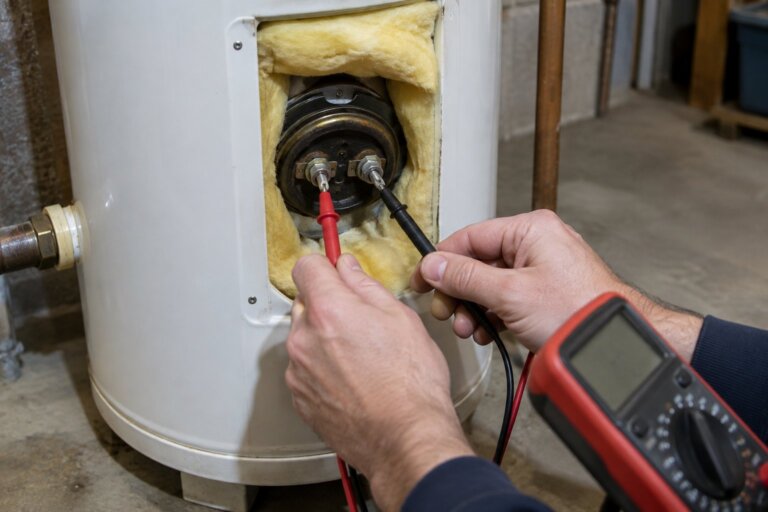
This is the fix we would bet on. Penn State Extension says “replacement of the magnesium rod with an aluminum rod should eliminate the rotten egg odor while maintaining corrosion protection for the heater.” The Minnesota Department of Health agrees that an aluminum anode “may provide corrosion protection without contributing to the production of hydrogen sulfide gas.” The anode is a 1/2 to 3/4 inch rod, 30 to 40 inches long, screwed into the top of the heater. Our water heater anode rod replacement guide walks through the swap.
A powered anode, a titanium rod that runs on a small electric current, is the other option sold for this problem. Its makers claim it stops the odor, but we have not found an independent test of that claim, so we treat it as a second choice if the aluminum rod does not work.
3. Chlorinate the tank
The Lochinvar manual pairs the anode swap with “chlorinating the water heater tank and all hot water lines.” Chlorine kills the sulfate-reducing bacteria. The Minnesota Department of Health warns that “if all bacteria are not destroyed by chlorination, the problem may return within a few weeks,” which is why we do it together with the anode change, not instead of it.
4. Heat the tank to 160°F for several hours (with care)
The Minnesota Department of Health says raising the water heater to 160°F (71°C) for several hours “will destroy the sulfur bacteria,” followed by flushing. It also warns this “can be dangerous”: confirm the relief valve works first (see our guide to a water heater relief valve leaking), keep everyone away from the taps, and turn the thermostat back down afterward to prevent scalding.
What not to do: pull the anode out
Some people remove the anode rod and leave the hole plugged. The smell often goes away, but the Lochinvar manual is blunt: “Do not remove the anode leaving the tank unprotected. By doing so, all warranty on the water heater tank is voided.” Penn State adds that removal “could cause increased corrosion and reduced life of the hot water heater.” We would never trade a smell for a tank that rusts through early.
What we would buy for this job
- 44 inch flexible aluminum-zinc anode rod kit, 3/4 inch NPT: the swap Penn State Extension describes. Segmented, so it fits under a low ceiling. Measure your old rod first.
- HertzEagle powered titanium anode rod, 40 to 89 gallon: the second option if an aluminum rod does not stop the smell. The odor claims are the maker’s own; it does not fit Bradford White.
- Corro-Protec anode rod socket kit, 1-1/16 and 1-3/16 inch: the 6-point sockets a tight factory anode usually needs.
As an Amazon Associate, Complete Water Guide earns from qualifying purchases. Prices change, so check the listing.
Should I call a plumber if my water smells like rotten eggs?
If you have never worked on a water heater, yes. The Minnesota Department of Health says: “Unless you are very familiar with water heater operation and maintenance, have a plumber or water system professional to do the work.” An anode rod often sits tight after years in the tank and needs a breaker bar, and the power or gas must be off and the tank depressurized first.
Fixr’s water heater repair guide, updated in August 2025, puts a professional anode rod replacement at about $125 to $300. That is a vendor estimate, so treat it as a range rather than a quote. If the smell persists after a new anode and chlorination, the Lochinvar manual says the next step is chlorination or aeration of the whole water supply, which is a job for a water treatment professional.
Why does my hot water smell after a vacation?
Because the water sat still and warm, so the gas built up. Soquel Creek Water District links the smell to heaters that have not been used for a long time. There is a second, more serious reason to run the water after a trip: the Lochinvar manual says hydrogen gas, which is “extremely flammable and explosive,” can build up in a hot water system that has not been used for about two weeks or more. It recommends opening the hot tap farthest from the heater for several minutes before running the dishwasher or washing machine, with no smoking or open flame nearby.
Frequently asked questions
What causes sulfur smell in hot water?
Hydrogen sulfide gas made inside the water heater. It forms when sulfate in the water, low oxygen, sulfate-reducing bacteria and hydrogen from the magnesium anode rod all come together, according to the Lochinvar water heater manual.
Is sulfur smell in hot water dangerous?
Usually not at the levels that cause the smell. Penn State Extension calls it an aesthetic problem and says the nose detects it below 0.5 mg/L, well before health concerns. Ventilate if the odor is strong in a small, closed room.
How do I get rid of the rotten egg smell in my water heater?
Flush the tank first. If the smell returns, replace the magnesium anode with an aluminum one and chlorinate the tank and hot lines. Penn State Extension says an aluminum rod should eliminate the odor while still protecting the tank.
Can I just remove the anode rod?
We would not. The Lochinvar manual says removing the anode and leaving the tank unprotected voids all warranty on the tank, and Penn State warns it shortens the heater’s life.
Why does my new water heater smell like sulfur?
New heaters usually ship with a magnesium anode, and the same reaction can start within weeks if your water carries sulfate and the bacteria are present. The fix is the same: an aluminum anode plus chlorination.
Does a water softener cause sulfur smell?
It can, rarely. Penn State Extension says a softener may give sulfur-reducing bacteria a favorable place to grow. If the smell appears only after the softener, ask the installer or manufacturer for disinfection instructions, as the Minnesota Department of Health advises.
Sources
- Lochinvar (an A. O. Smith company), Residential Gas Water Heater Installation and Operation Manual, 2017: smelly water, anode, warranty, hydrogen gas.
- Minnesota Department of Health, Hydrogen Sulfide and Sulfur Bacteria in Well Water.
- Penn State Extension, Hydrogen Sulfide (Rotten Egg Odor) in Water Wells.
- Soquel Creek Water District, How to Get Rid of Odor in Water.
- Fixr, Water Heater Repair Cost, updated August 29, 2025. Vendor estimates.