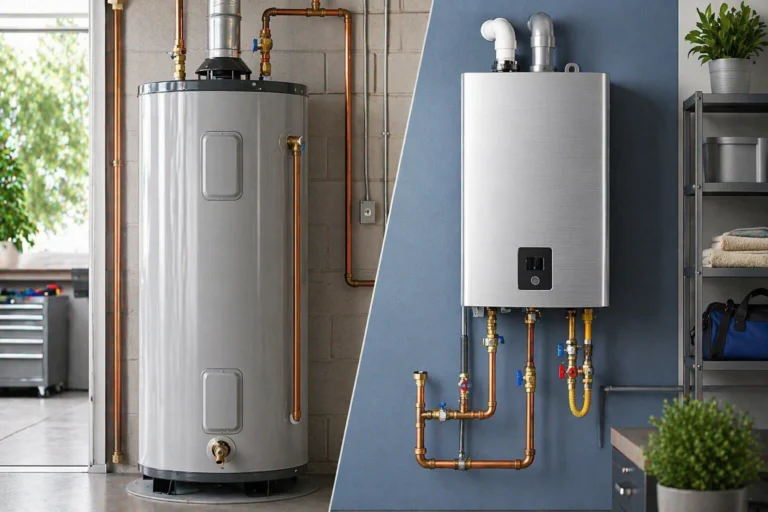
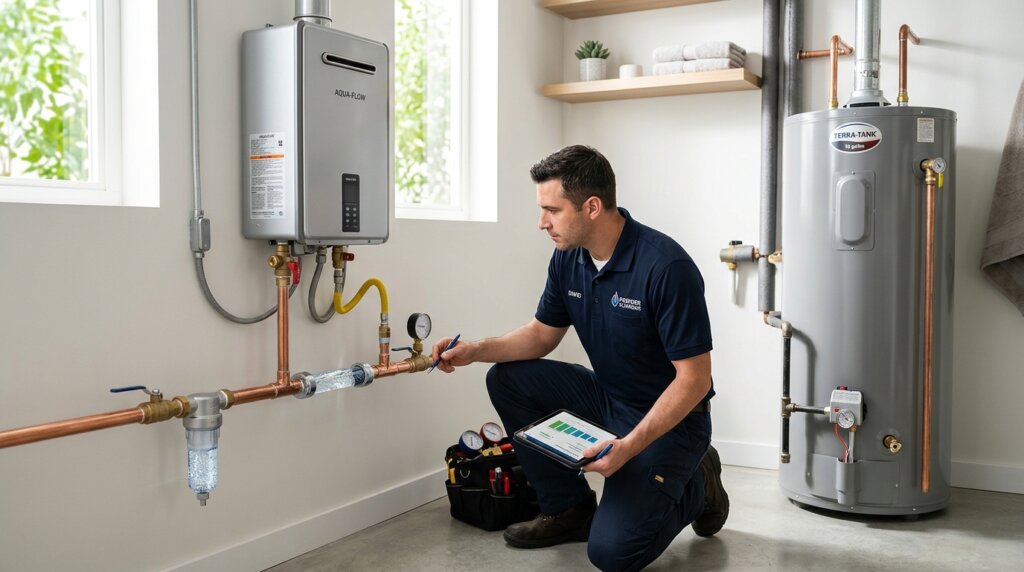
Quick answer: A tankless water heater costs more upfront ($1,400–$5,600 installed vs $600–$3,100 for a tank) but is 24–34% more energy-efficient and lasts 20+ years versus 8–15 for a tank. Over 20 years, a gas tankless typically costs $12,000–$18,000 total versus $14,800–$20,800 for a tank once you count two replacement cycles — a $2,000–$5,000 lifetime saving. Tank heaters are cheaper upfront and better for large simultaneous demand; tankless saves space, energy, and money long-term.
When your water heater needs replacing, the big question is tankless or traditional tank. The answer comes down to cost — but not just the price on day one. This guide runs the actual 2026 numbers, from upfront install to the 20-year total, so you can make the decision that saves money rather than the one that just looks cheaper today.
Upfront cost: tank wins
There’s no contest on day-one price. A traditional tank is far cheaper to buy and install.
| System | Unit price | Installed (2026) |
|---|---|---|
| Tank (40–50 gal) | $400–$900 | $600–$3,100 |
| Gas tankless | $1,000–$2,500 | $2,500–$5,600 |
| Electric tankless | $500–$1,500 | $1,400–$4,500 |
The gap is real, and it matters if your budget is tight or your current unit just died. The reason tankless costs more to install: the units are pricier, the work takes more expertise, and retrofitting from a tank often needs infrastructure upgrades — a gas line upsize ($500–$1,500) because tankless burners need 150,000–200,000 BTU vs 30,000–40,000 for a tank, new venting, or an electrical panel upgrade ($1,000–$2,000) for electric models.
Running cost and efficiency: tankless wins
Tankless heaters only heat water on demand, so they don’t waste energy keeping a tank hot 24/7 (that waste is called “standby loss” and accounts for 10–20% of a tank’s water-heating cost). According to the U.S. Department of Energy, tankless units are 24–34% more energy-efficient for homes using modest amounts of hot water (up to ~41 gallons/day), and still 8–14% more efficient for heavy users (80+ gallons/day).
In real dollars, a gas tankless typically saves a family of four about $95–$200 a year, or roughly $1,800–$4,000 over the unit’s life. Electric tankless saves less ($50–$100/year). The savings are real but gradual — you won’t notice them month to month.
Lifespan changes everything
This is the single biggest factor in total cost of ownership. A tank heater lasts 8–15 years (most plumbers plan replacement by year 10, sooner in hard-water areas). A well-maintained tankless lasts 20+ years — some early-2000s units are still running. Over a 20-year horizon, you’ll likely buy and install a tank twice before a tankless needs its first replacement. That second tank install is another $1,200–$2,200.
The 20-year math
Put it all together — upfront + energy + replacements + maintenance — and here’s how a gas system compares over two decades:
| Time horizon | Which is cheaper |
|---|---|
| Day one | Tank, by a wide margin |
| 10 years | Close; tank still slightly cheaper |
| 15–20 years | Tankless, decisively |
Over a full 20 years, a gas tankless typically totals $12,000–$18,000, while a gas tank totals $14,800–$20,800 once you count two replacement cycles, higher energy bills, and maintenance — a lifetime saving of roughly $2,000–$5,000. The catch is the payback period: because of the high upfront cost, tankless takes 10–15 years to break even on energy savings alone. If you’ll move sooner, the tank’s lower upfront cost may win.
Rule of thumb: choose tankless if you’ll stay long-term and want lower bills plus endless hot water; choose a tank if you want the lowest upfront cost or have very high simultaneous hot-water demand.
Don’t forget rebates and tax credits
Incentives can meaningfully close the upfront gap. In 2026, the federal Energy Efficient Home Improvement Credit offers up to $600 for a qualifying high-efficiency gas tankless (UEF 0.95+), claimed on IRS Form 5695 — it applies to equipment cost, not labor. Many state and utility programs add $100–$1,000 on top. Combined, a $3,500 gas tankless install can drop to $2,500 or less. Always verify current models at energystar.gov before buying.
Gas vs electric tankless
- Gas tankless: Higher flow rate (better for whole-house and multiple fixtures), bigger energy savings, but pricier install (gas line + venting). Best for larger homes.
- Electric tankless: Cheaper unit and simpler install, no venting, but limited flow rate and may need a panel upgrade. Best for smaller homes, additions, or point-of-use.
Which suits your household?
- Small-to-medium homes, modest use: Tankless shines — best efficiency gains and payback.
- Large families, many fixtures at once: A high-capacity tank, or a properly sized (or multiple) tankless unit, to avoid running short — a single tankless can hit its flow-rate limit.
- Tight budget now: Tank heater.
- Small space / flood worry: Tankless (wall-mounted, no 50-gallon tank to burst).
- Cold climate: Factor in that very cold incoming water reduces tankless flow rate — size up accordingly.
The bottom line
If you plan to stay in your home 10+ years, a tankless water heater usually wins on total cost — lower bills, double the lifespan, plus rebates — despite the higher upfront price. If you’re on a tight budget, might move soon, or have very high simultaneous demand, a quality tank heater is the smarter, cheaper-today choice. Run your own numbers using the ranges above, and don’t forget to check 2026 tax credits and utility rebates before you buy.
Having water heater trouble? See our guides on smelly hot water and other whole-house water topics, and if you have hard water, learn how it shortens appliance life.
Frequently asked questions
Is a tankless water heater cheaper than a tank?
Not upfront. Tankless units cost more to buy and install ($1,400–$5,600 vs $600–$3,100 for a tank), but they’re more energy-efficient and last 20+ years vs 8–15. Over a full 20 years, tankless typically saves $2,000–$5,000 once you count two tank replacement cycles — but the payback takes 10–15 years.
How much does a tankless water heater cost to install?
A gas tankless typically costs $2,500–$5,600 installed; electric runs $1,400–$4,500. Cost depends on whether your home needs a gas line upsize ($500–$1,500), new venting, or an electrical panel upgrade ($1,000–$2,000). Federal and utility incentives can lower the net cost.
Do tankless water heaters save money?
Yes, gradually. They’re 24–34% more energy-efficient for modest hot-water use, saving a family of four about $95–$200 a year on gas. But high upfront and install costs mean the savings take 10–15 years to pay back.
How long do tankless vs tank water heaters last?
Tankless units typically last 20+ years; conventional tank heaters last about 8–15. The longer lifespan is the single biggest reason tankless can be cheaper over the long run despite the higher purchase price.
Which is better for a large family?
A large family with high simultaneous hot-water demand needs either a high-capacity tank or a properly sized (or multiple) tankless unit. Tank heaters handle big simultaneous draws well; a single undersized tankless can struggle if many fixtures run at once.
Are there tax credits for tankless water heaters in 2026?
Yes. The federal Energy Efficient Home Improvement Credit offers up to $600 for a qualifying high-efficiency gas tankless (UEF 0.95+), claimed on IRS Form 5695 for equipment cost. Many state and utility rebates add $100–$1,000 more. Verify current qualifying models at energystar.gov.
Reviewed by the Complete Water Guide team. This article is for general information and is not a substitute for professional water-quality or medical advice. We may earn a commission from some links on this page.