Water heater anode rod replacement is due once the rod is substantially worn, and the owner’s manual for Lochinvar residential gas water heaters says to inspect it six months after the heater goes into service, then at least once a year. A plumber typically charges about $200 to $300 for the job, while a do-it-yourself swap runs $30 to $90, including a rod that costs $20 to $50.
That small part decides how long the tank lasts. Here is how to tell when yours is done, which replacement to buy and how the swap works.
What does a water heater anode rod do?
The anode rod is a sacrificial metal rod that corrodes so the steel tank does not. The Lochinvar manual describes it as a rod “that helps reduce corrosion and premature failure (leaks) in the tank.”
The same manual calls it “a consumable item” and states that anode rods “are not covered under warranty.” The tank warranty, on the other hand, depends on the rod being there: “Do not remove the anode leaving the tank unprotected. By doing so, all warranty on the water heater tank is voided.”
Put simply, once the rod is used up, the water starts working on the tank itself. A tank that leaks from its body has to be replaced, which the Department of Energy prices at $1,578 installed for a typical gas model and $1,855 for electric, in 2022 dollars. Our guide to water heater replacement cost breaks that bill down.
How often should you replace the anode rod?
Replace it when an inspection shows it is substantially worn, not on a fixed calendar. The Lochinvar manual sets the inspection schedule: “Inspect the anode rod after the first six months of operation or when you drain and flush the tank… Thereafter, inspect the anode rod annually or more frequently if needed.”
Water softeners speed things up. The manual says: “If you use a water softener, your anode rod will deplete faster than normal. Inspect the anode rod more frequently, replacing the anode rod as needed.” If your home has one, our page on hard water vs soft water explains why softened water behaves differently in a tank.
You will often read that an anode rod lasts three to five years. Bob Vila’s guide repeats that range, but it does not appear in the manufacturer manual we reviewed, which ties replacement to what you see on the rod. Water chemistry varies too much for one number to fit every house, so check yours rather than trusting a calendar.
How do you know the anode rod is worn out?
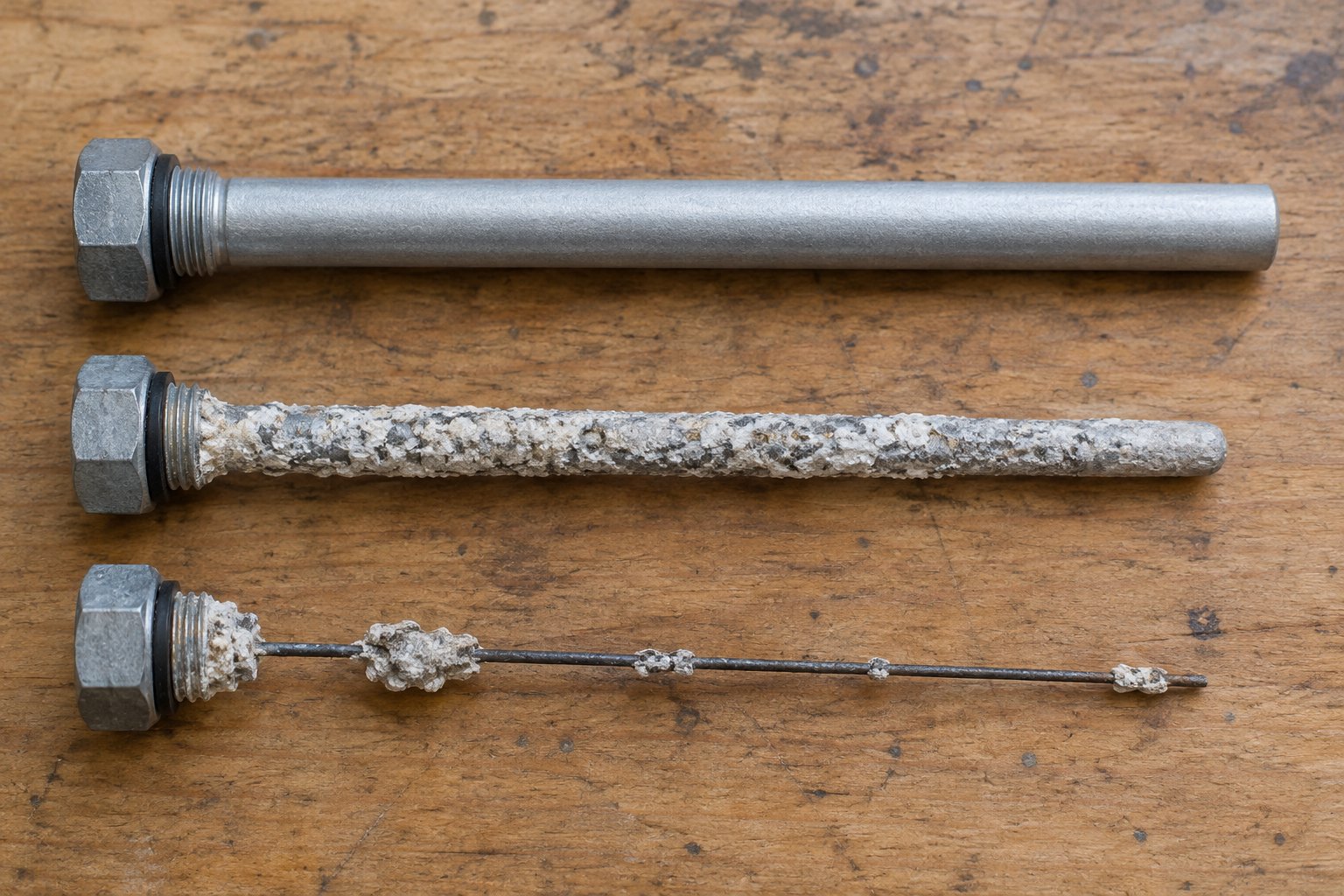
Pull it and look. A new rod is a smooth, even cylinder. A worn rod is pitted and thin, and a fully depleted one has eaten down to its steel core wire. The Lochinvar manual shows all three stages side by side and says to replace the rod “if it is substantially worn out or depleted.”
Some commercial A. O. Smith documentation gives a harder cutoff: replace the rod once its diameter is under 3/8 inch, or when much of the support wire is showing. That is a useful rule for a home rod too, since a new magnesium rod such as Rheem’s SP11524C measures 0.840 inch across.
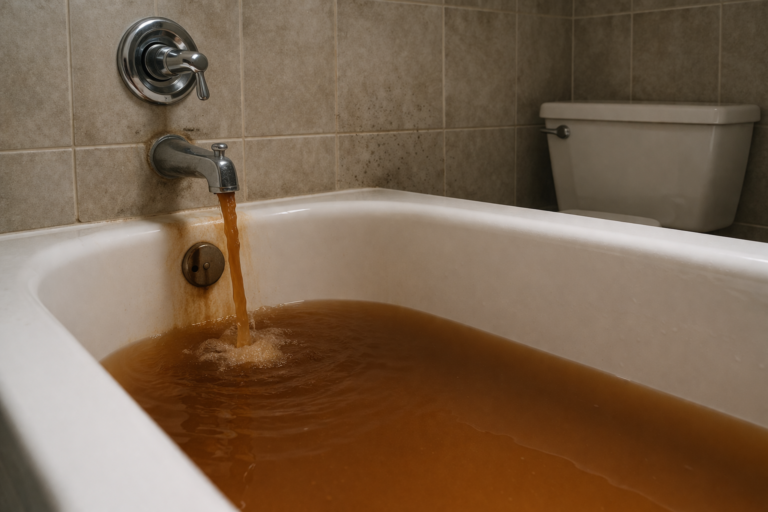
Indirect signs point the same way. Rusty hot water can mean the rod is gone and the tank is corroding, which we cover in why a water heater produces rusty water. A rotten egg smell in hot water is also linked to the anode, as explained below.
Which anode rod should you buy?
Buy the type and length your heater’s manual or rating plate lists, then pick the metal for your water. Most home rods share the same fitting: Rheem’s SP11524C, for example, has a 1-1/16 inch hex head and a 3/4 inch NPT thread at a length of 44-3/16 inches.
| Rod type | Best for | Watch out for |
|---|---|---|
| Magnesium | Most homes. Bob Vila calls it the better protector of the tank. | Wears faster in very soft or low-pH water. |
| Aluminum or aluminum-zinc | Homes with a sulfur or rotten egg smell. Zinc content can reduce the odor. | Protects the tank less actively than magnesium. |
| Flexible (segmented) | Tight ceilings where a solid 44-inch rod cannot come straight out. | Confirm the hex size before you buy, since listings do not always state it. |
| Powered (impressed current) | Persistent odor problems where a passive rod has not helped. | Runs on electricity rather than wearing away, so check the maker’s sizing for your tank. |
Length matters. One buyer of the 44-inch Rheem rod reported it was too long for their tank, so measure the old rod before ordering.
Parts and tools for this job
- Water Connection magnesium anode rod, 44 inch, hex head, 3/4 inch NPT: a solid magnesium rod in the standard thread size. Measure your old rod before ordering.
- Ozek segmented aluminum-zinc anode rod, 44 inch: a flexible rod for tanks with little clearance overhead. The listing says it does not fit Bradford White heaters.
- Corro-Protec anode rod socket kit, 1-1/16 and 1-3/16 inch: 6-point sockets on a 1/2 inch drive, with PTFE tape.
As an Amazon Associate, Complete Water Guide earns from qualifying purchases. Prices change, so check the listing.
How do you replace a water heater anode rod?
The job takes a 1-1/16 inch socket, a breaker bar, thread sealant and a garden hose. Work through these steps, and follow your own model’s manual where it differs.
- Shut off the energy. Turn off the breaker for an electric heater, or set a gas heater’s control to off.
- Close the cold water inlet valve at the top of the heater.
- Relieve pressure by opening a nearby hot water faucet.
- Drain some water. Connect a hose to the drain valve and run it to a drain. You only need the level below the top of the tank, not a full drain.
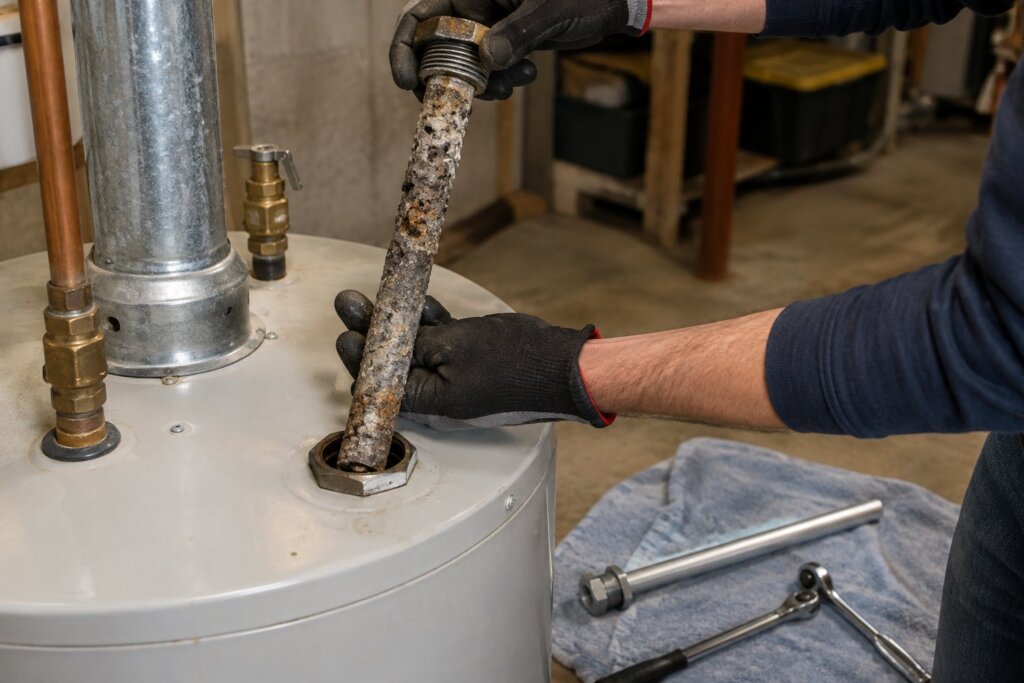
- Break the rod loose. The hex head sits on top of the tank, sometimes under a plastic cap or insulation. Fit the 1-1/16 inch socket and turn counterclockwise. Factory rods are tight, so brace the tank so it does not twist.
- Inspect and install. Compare the old rod with the stages above. Wrap the new rod’s threads with sealant, thread it in by hand, then tighten.
- Refill before restarting. Close the drain valve, open the cold inlet, and let the hot faucet run until water flows steadily without air. Then restore power or gas.
While the tank is partly drained, it is a good moment to flush sediment. The full method is in our guide on how to flush a water heater, and the Lochinvar manual recommends draining and flushing every six months.
One safety note from the same manual: hydrogen gas can build up in a hot water system that has not been used for two weeks or more, and it is “extremely flammable and explosive.” If the heater has sat unused, run the hot water at a sink for a few minutes before working on it, with no flame or spark nearby.
Can the anode rod cause a rotten egg smell?
Yes. The Lochinvar manual says “the most common complaint associated with the anode rod is one of a ‘rotten egg smell’ in the hot water,” caused by hydrogen sulfide gas. It lists four conditions that must all be present:
- sulfate in the supply water,
- little or no dissolved oxygen in the water,
- sulfate-reducing bacteria in the heater, which the manual calls “nontoxic to humans,”
- excess active hydrogen in the tank, produced by the anode’s protective action.
The manual’s fix is to replace the anode “with one of less active material, and then chlorinating the water heater tank and all hot water lines.” If the smell is in your cold water as well, the cause is the water supply, not the heater. Our guide to why well water smells like rotten eggs covers that case.
Pulling the anode out to stop the smell is the one fix to avoid. It voids the tank warranty, as quoted above, and leaves the steel unprotected.
How much does anode rod replacement cost?
Expect $30 to $90 to do it yourself and about $200 to $300 for a plumber, based on Bob Vila’s guide, last updated in December 2022. No regulator publishes these prices, so treat them as vendor estimates.
| Item | Typical cost |
|---|---|
| Anode rod alone | $20 to $50 |
| DIY total, with socket and sealant | $30 to $90 |
| Plumber, parts and labor | $200 to $300 (Bob Vila); $125 to $300 (Fixr, Aug 2025) |
| New tank water heater, installed (DOE, 2022 dollars) | $1,578 gas, $1,855 electric |
The gap between the last two rows is the reason to check the rod. A $50 part and an hour of work is the cheapest maintenance a tank gets.
Frequently asked questions
How often should I check my water heater anode rod?
Check it six months after the heater is installed, then at least once a year, per the Lochinvar residential gas manual. Check more often if you have a water softener, because the rod wears faster.
What size socket removes a water heater anode rod?
Most residential anode rods use a 1-1/16 inch hex head. Rheem’s SP11524C magnesium rod, for example, lists a 1-1/16 inch hex and a 3/4 inch NPT thread.
Can I remove the anode rod to stop a rotten egg smell?
No. The manual warns that removing the anode and leaving the tank unprotected voids the tank warranty. Replace it with a less active rod, such as aluminum-zinc, and chlorinate the tank instead.
Is an anode rod covered by the water heater warranty?
No. The Lochinvar manual lists anode rods as a consumable item that is not covered under warranty, even though the tank warranty requires one to be installed.
Magnesium or aluminum anode rod: which is better?
Magnesium protects the tank more actively and suits most homes. Aluminum or aluminum-zinc rods are the usual choice where hot water smells of sulfur.
How much does it cost to replace an anode rod?
About $200 to $300 with a plumber and $30 to $90 if you do it yourself, according to Bob Vila’s estimates. The rod alone costs about $20 to $50.
Sources
- Lochinvar (an A. O. Smith company), Residential Gas Water Heater Installation and Operation Manual, 2017: anode rod inspection, smelly water, draining and flushing, hydrogen gas warning.
- A. O. Smith commercial electric water heater maintenance guidance, as summarized by MaintainX (anode replacement below 3/8 inch diameter).
- Rheem SP11524C magnesium anode rod specifications, SupplyHouse listing.
- U.S. Department of Energy, Consumer Water Heaters final rule, Federal Register, May 6, 2024 (installed cost estimates).
- Bob Vila, Anode Rod Replacement, updated December 30, 2022. Vendor-style estimates.
- Fixr, Water Heater Repair Cost, updated August 29, 2025. Vendor estimates.