For a water heater element replacement, turn off the breaker, confirm the power is off with a tester, drain the tank, unscrew the old element with an element wrench or a 1-1/2 inch deep well socket, and install a new one with the same voltage and wattage as the heater’s data plate. A. O. Smith’s support guide says a good element reads between 5 and 25 ohms, and its one hard rule is to fill the tank completely before power goes back on.
A plumber charges $200 to $750 for the job, according to Fixr’s water heater repair guide. The part is the cheap piece. Here is how to tell whether yours has failed and how the swap works.
How do you know a water heater element is bad?
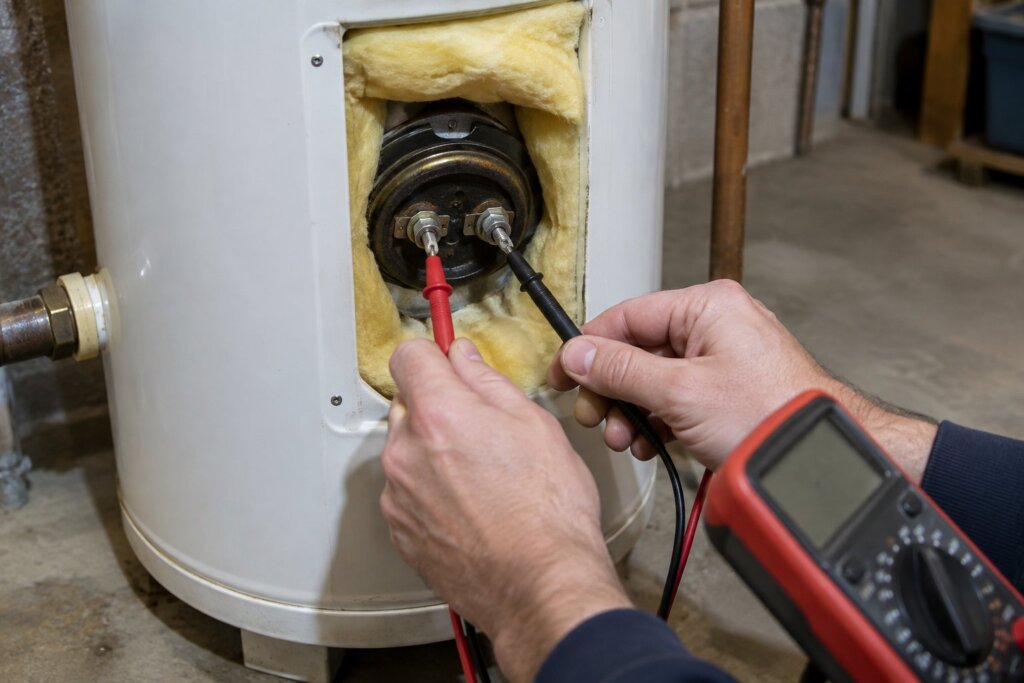
Test it with a multimeter. A. O. Smith’s guide says to measure “the resistance between the two screw terminals on the heating element,” and that “a good element will have a resistance ranging between 5 and 25 Ohms.” A reading outside that range means the element needs replacing.
Symptoms send you to the test in the first place. Lukewarm water, hot water that runs out much sooner than it used to, or no hot water at all on an electric heater all point at an element or thermostat. Our guide on a water heater that is not heating sorts out which part to suspect first, and the water heater troubleshooting guide covers the rest.
What resistance should a water heater element read?
A healthy element reads close to the value set by its own voltage and wattage, which you can work out with Ohm’s law: resistance equals voltage squared divided by wattage. A. O. Smith’s 5 to 25 ohm range covers every common size. The table below gives the expected reading for each one.
| Element rating | Expected resistance |
|---|---|
| 240 V, 3,500 W | about 16.5 ohms |
| 240 V, 4,500 W | about 12.8 ohms |
| 240 V, 5,500 W | about 10.5 ohms |
| 120 V, 1,500 W | about 9.6 ohms |
| 120 V, 2,000 W | about 7.2 ohms |
We calculated these from the rating, so a reading a few tenths off is normal, because resistance rises slightly as metal warms. A reading of zero, or no reading at all because the circuit is open, means the element has failed. The wattage and voltage are printed on the heater’s data plate and stamped on the element itself. As a cross-check, one 4,500-watt, 240-volt element sold on Amazon by DROMIX lists its cold resistance as 12.80 ohms, the same figure the formula gives.
Why did my water heater element burn out?
On a new heater, the usual cause is turning the power on too soon. A. O. Smith states that “on a new water heater, a burned out upper heating element is almost always caused by turning the power on before the tank was completely full of water (dry fire).”
An element that is not covered by water has nothing to carry its heat away, so it overheats quickly. The same mistake is easy to repeat after a repair, which is why the refill step below matters more than any other.
On older heaters, look at sediment. Minerals settle at the bottom of the tank, where the lower element sits, and A. O. Smith notes sediment can even clog the drain valve. Flushing the tank as the manufacturer directs slows that down, and our guide on how to flush a water heater walks through it.
How do you replace a water heater element?
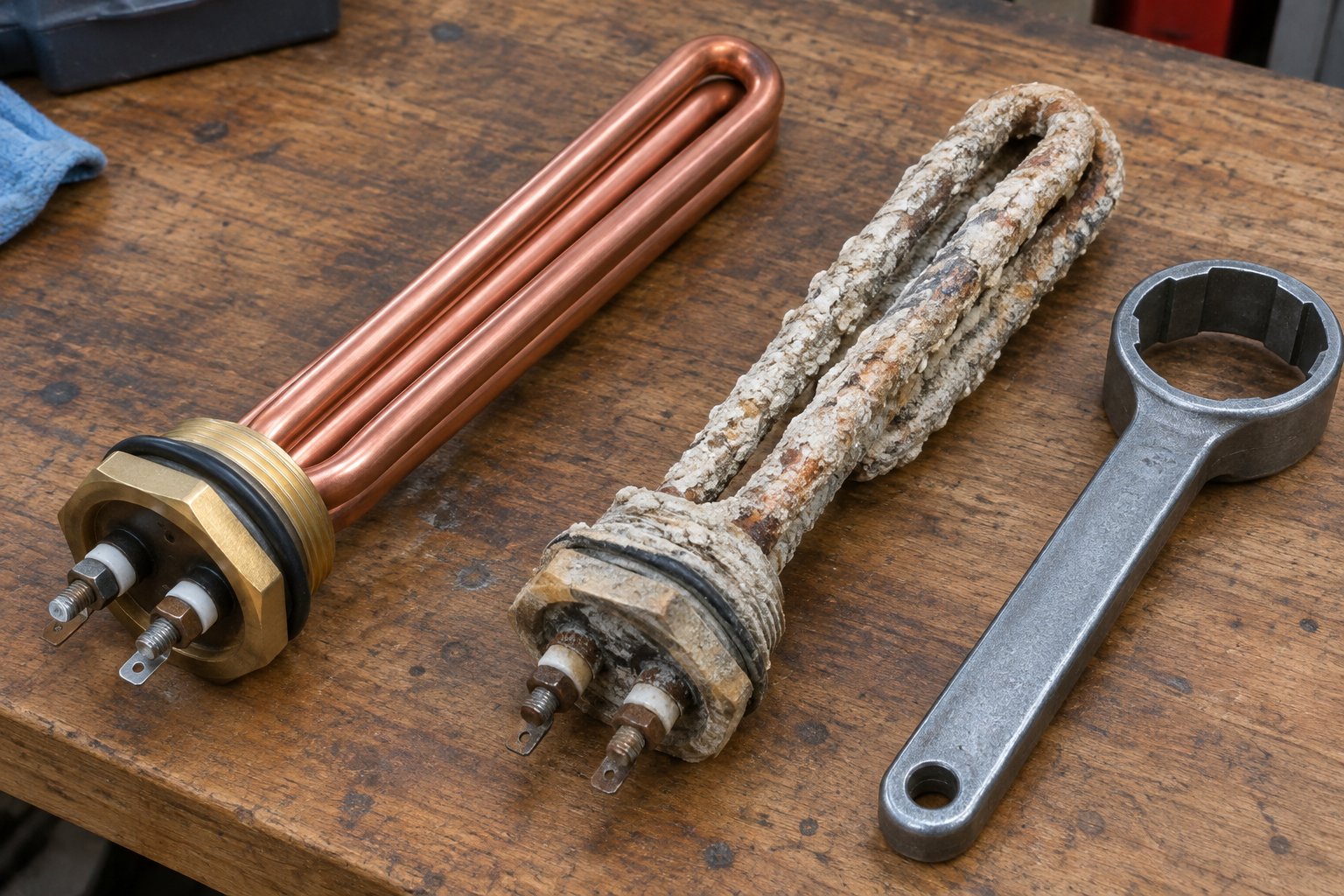
These steps follow A. O. Smith’s guide to replacing the lower heating element. The upper element works the same way.
- Turn off the power “at the circuit breaker (or remove fuses).”
- Prove it is off. Open the junction box on top of the heater and “check for power with a non-contact circuit tester,” then confirm with a volt meter. A. O. Smith warns that “working on an energized circuit can result in severe injury or death from electrical shock.”
- Cool the water. Run a hot faucet until the water runs cool, to cut the scald risk while draining.
- Shut off the cold water valve that supplies the heater.
- Drain the tank. Attach a garden hose to the drain valve, run it to a drain or outside, and open the valve. Opening a hot faucet speeds draining.
- Expose the element. Remove the element cover, fold back the insulation and remove the plastic protector.
- Disconnect and test. Remove the two power wires and measure resistance across the screw terminals.
- Unscrew the old element with an element wrench or a 1-1/2 inch deep well socket.
- Match the part. Check the new element against the heater’s data plate “for voltage and wattage information.”
- Prepare the opening. Clean the threads in the tank opening with a rag, fit the gasket on the new element and put a drop of hand dish soap on the gasket so it does not tear as you tighten.
- Install and reconnect. Tighten the element, then refit the power wires and make sure every connection is tight.
- Refill before any power. Close the drain valve, open the cold supply, and run a hot faucet until water flows full stream. A. O. Smith says to let it run “full stream for THREE MINUTES to get all of the air out of the tank.”
- Check for leaks at the new element. If it seeps, tighten it until the leak stops. If it will not stop, drain the tank again and inspect the gasket for damage.
- Close up and restore power. Refit the protector, insulation and cover, then turn the breaker on. A. O. Smith notes “it may take two hours for the tank to heat up.”
If the tank will not drain, sediment may be blocking the drain valve. That is a sign to call a technician rather than force the valve.
Parts and tools for this job
- Camco 4500 W, 240 V screw-in element, low watt density: only if your data plate says 4500 W at 240 V. Match the plate, not the old part.
- 1-1/2 inch water heater element socket, 1/2 inch drive: the deep 6-point socket screw-in elements take.
- AstroAI digital multimeter: for the resistance test before you buy anything.
As an Amazon Associate, Complete Water Guide earns from qualifying purchases. Prices change, so check the listing.
Should you replace the element or the whole water heater?
Replace the element if the tank is sound. An element is a replaceable part, and a new tank costs far more: the Department of Energy puts a typical electric tank water heater at $1,855 installed, in 2022 dollars, against Fixr’s $200 to $750 for a plumber to replace an element.
Replace the heater when the tank itself leaks or it is near the end of its life. The DOE estimates storage water heaters last about 15 years on average. Our repair vs replace guide and our breakdown of water heater replacement cost help with that call.
How much does water heater element replacement cost?
A plumber charges $200 to $750 including labor, based on Fixr’s water heater repair cost guide, updated August 29, 2025. Fixr lists plumber rates at $50 to $150 an hour, with a service call fee of about $50 that is often waived if you hire them for the repair, and $100 to $200 extra for an urgent or emergency job. These are vendor estimates, not regulated prices.
Doing it yourself costs the element, a gasket if it does not come with one, and an element wrench if you do not own a 1-1/2 inch deep socket.
Frequently asked questions
What size socket removes a water heater element?
A 1-1/2 inch deep well socket or a water heater element wrench, according to A. O. Smith’s support guide.
What should a water heater element read on a multimeter?
Between 5 and 25 ohms, per A. O. Smith. A 240-volt, 4,500-watt element should read about 12.8 ohms, worked out from its rating with Ohm’s law.
Do I have to drain the water heater to replace an element?
Yes. A. O. Smith’s steps drain the tank completely before the element comes out, and refill it completely before the power goes back on.
What happens if you turn on a water heater before it is full?
The element dry fires and burns out. A. O. Smith says this is almost always the cause of a burned-out upper element on a new water heater.
Can I use a higher wattage element?
Use the voltage and wattage on the heater’s data plate. A. O. Smith’s steps say to confirm the new element matches that plate before installing it.
How long does a water heater take to heat after replacing an element?
A. O. Smith says it may take about two hours for the tank to heat up after the power is restored.
Sources
- A. O. Smith, Replace the Lower Heating Element and heating element resistance check, aosmithatlowes.com support guides.
- U.S. Department of Energy, Consumer Water Heaters final rule, Federal Register, May 6, 2024 (installed cost and average lifetime).
- Fixr, Water Heater Repair Cost, updated August 29, 2025. Vendor estimates.
- Expected resistance values calculated by Complete Water Guide from element ratings (R = V² / W). DROMIX 4500 W 240 V element listing on Amazon (cold resistance 12.80 ohms).