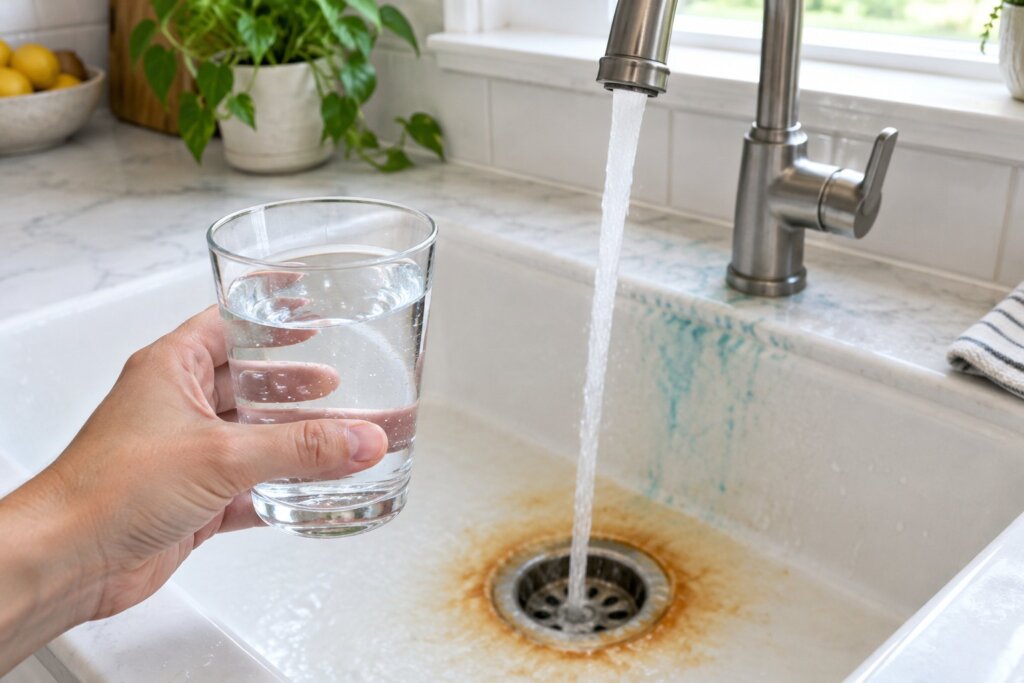
If you are asking “why does my water taste metallic,” the answer is almost always one of four metals: iron, manganese, copper or zinc. EPA lists a metallic taste as a sign of each one. The fifth usual cause is acidic water, which tastes metallic because it dissolves metal out of your pipes. The stains in your sink usually tell you which one you have, and a lab test confirms it.
One warning before anything else: the metal that matters most for health, lead, has no taste at all. A metallic taste does not mean lead, and no metallic taste does not mean no lead. We explain below why the taste is still a good reason to test for it.
Why does my water taste metallic? The five usual causes
EPA sets “secondary” levels for substances that affect taste, color and staining. Here is what it says for the ones that taste metallic:
| Cause | EPA secondary level | What EPA says it does |
|---|---|---|
| Iron | 0.3 mg/L | “rusty color; sediment; metallic taste; reddish or orange staining” |
| Manganese | 0.05 mg/L | “black to brown color; black staining; bitter metallic taste” |
| Copper | 1.0 mg/L | “metallic taste; blue-green staining” |
| Zinc | 5 mg/L | “metallic taste” |
| Low pH (acidic water) | Below 6.5 | “bitter metallic taste; corrosion” |
These are guidelines, not limits. EPA says plainly, “EPA does not enforce these ‘secondary maximum contaminant levels’ (SMCLs).” They are set where people start to notice the taste or the stains.
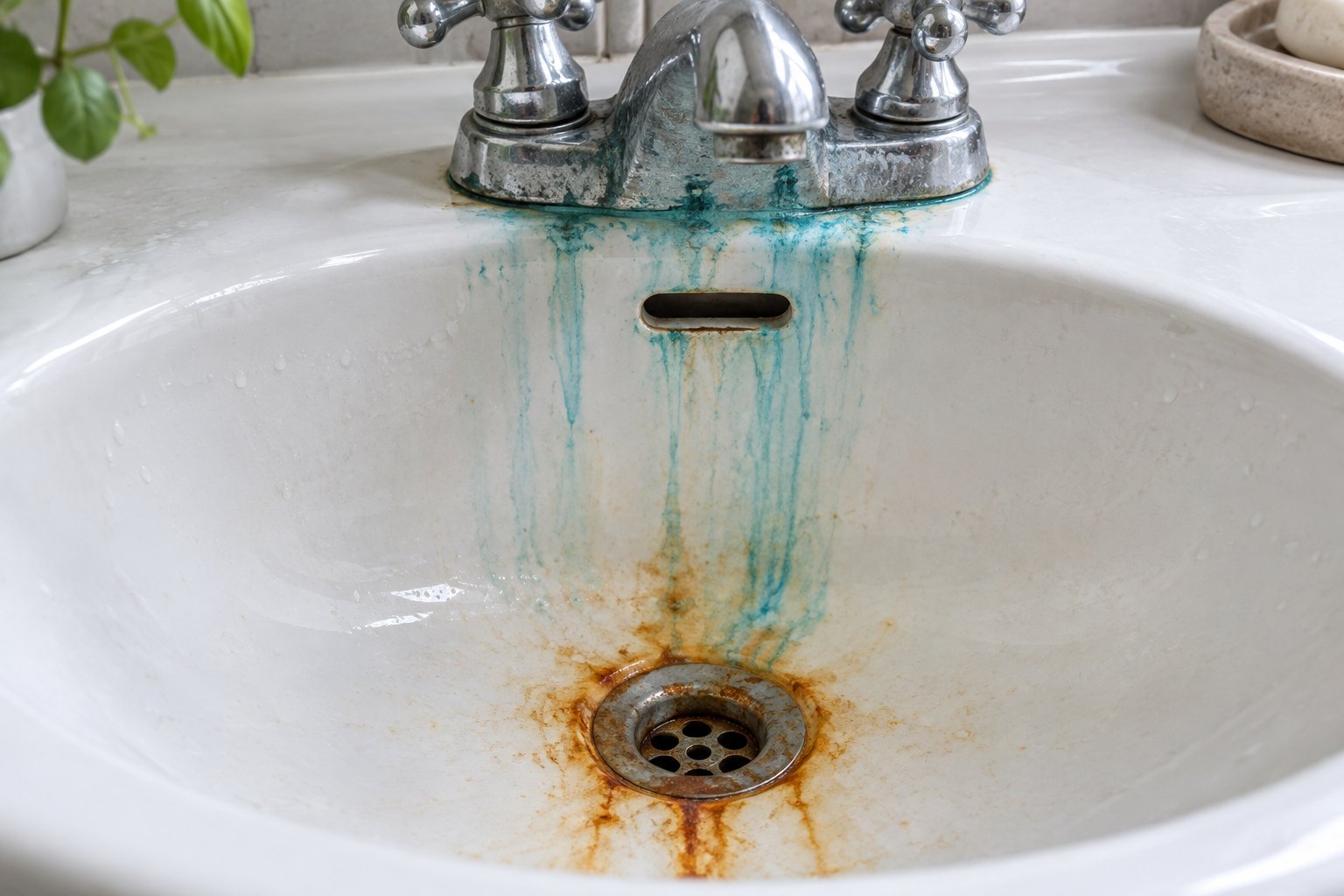
Our shortcut is to look at the sink before you buy a test. Orange or brown stains point to iron. Black stains point to manganese. Blue-green stains point to copper, which usually means acidic water is eating copper pipes. No stains at all and a taste that comes and goes points to water sitting in the pipes, or to something other than the water.
Is it safe to drink water that tastes metallic?
It depends which metal, which is why we would test rather than guess.
- Iron and manganese at taste levels: EPA treats these as nuisance levels, set for taste and staining. Penn State Extension says, “Both impart a strong metallic taste to the water and both cause staining.”
- Copper: the CDC’s toxic substances agency (ATSDR) says, “Ingesting a high amount of copper, usually in drinking water, can cause vomiting, nausea, abdominal pain, and/or diarrhea,” and that too much every day over time “can lead to severe illness, such as kidney and liver damage.” It also says, “If your water is metallic or bitter in taste or smell and/or is green-blue in color, this may be a sign that there is too much copper in your drinking water.” The Minnesota Department of Health adds that copper “does not usually cause illness in most healthy people.” EPA’s action level for public water systems is 1.3 mg/L.
- Lead: the CDC says, “Lead cannot be seen, tasted, or smelled in drinking water.”
Here is why a copper taste is a reason to test for lead too. Penn State says, “Corrosive water can also dissolve lead from solders joining copper pipes.” The same acidic water that puts copper in your glass can pick up lead on the way. If your water tastes metallic and leaves blue-green stains, we would test for lead, copper and pH together. Our guide to lead in drinking water covers what the results mean.
Why does my water taste metallic all of a sudden?
Three common reasons, in the order we would check them:
1. The water sat in the pipes
If the taste is worst first thing in the morning or after a trip, this is the likely cause. Penn State says, “Copper and lead concentrations are usually highest in the first water out of the tap.” The Minnesota Department of Health says to “let the water run for at least 30-60 seconds before using it for drinking or cooking” if the water “has not been turned on in over six hours.” Medford Water, a utility in Oregon, says to run it “30 seconds to 2 minutes (until you feel the temperature drop).” The CDC adds to drink and cook only with water that comes out of the tap cold.
2. New copper plumbing
New pipes taste more. The Minnesota Department of Health says, “Plumbing systems with copper parts less than three years old usually have not had time to build up this protective coating.” ATSDR says high copper “is more likely to occur in new or recently renovated buildings/homes using copper plumbing.”
3. It is you, not the water
A metallic taste in the mouth is a common symptom on its own. The NHS lists causes including gum disease, “taking certain medicines, like metronidazole or zopiclone,” cancer treatments, colds and sinus infections, indigestion and “being pregnant.” The U.S. National Institute on Deafness and Other Communication Disorders calls this dysgeusia, when “a foul, salty, rancid, or metallic taste sensation persists in the mouth.”
Our quick test: drink a glass of bottled water. If that tastes metallic too, the problem is probably not your tap. The NHS says to see a doctor if “you have a metallic taste that does not go away” or “the metallic taste has no obvious cause.”
Why does my well water taste metallic?
If you are on a well and the taste comes with orange or black stains, iron or manganese is the likely cause. Penn State says, “Natural sources of iron and manganese are more common in deeper wells,” and that dissolved iron and manganese “are most common in groundwater with a pH less than 7.0.” The Minnesota Department of Health says iron “may give water a metallic taste and affect how food and beverages taste,” and leaves “yellow, red, or brown stains on dishes, laundry, and plumbing fixtures.” Penn State says manganese “often results in a dense black stain.”
The fix depends on how much you have and in what form, which only a test tells you. Our guides on iron in well water and manganese in water go through the treatment options.
Can acidic water make your water taste metallic?
This is the cause behind most copper tastes. The Connecticut Department of Public Health says, “Water with a pH value less than 7 indicates acidity and tends to be corrosive,” and that “acidic water (low pH) can leach metals (e.g.; lead, copper, zinc, etc.) from plumbing systems.” It lists the signs: “bluish-green stains on copper plumbing fixtures, reddish stains on galvanized iron plumbing.” The Minnesota Department of Health adds that “pinhole leaks, pitting in your pipes, or blue green stains on plumbing fixtures may be signs that you have corrosive water.”
Penn State says “water that is soft and acidic (pH < 7.0) tends to be more corrosive” and lists three fixes: “Acid neutralizing filter, soda-ash injection or replace metal plumbing with National Sanitation Foundation (NSF) approved plastic components.” Connecticut describes the neutralizing filter as one “containing calcite (marble chips) or ground limestone (calcium carbonate) or magnesia (magnesium oxide) to raise the pH,” and adds a step people miss: “test your water for hardness after installation of a neutralizing filter.” Those filters add minerals, so your water can get harder.
Can old galvanized pipes make water taste metallic?
Older homes with galvanized steel pipes can get a metallic taste from zinc. ATSDR says zinc gets into water that “flows through pipes that have been coated with zinc to resist rust,” and that EPA recommends no more than 5 mg/L “because of taste.” Washington’s Department of Health puts it simply: “Metallic taste: Iron or copper, may leach into the water from the pipes. Less common metals, such as zinc and manganese, could also be a problem.” It also notes that galvanized iron, steel or cast iron pipes “can cause rusty water.”
How do you get rid of the metallic taste in water?
- Flush first. Run the cold tap until the water feels colder, about 30 seconds to 2 minutes, before drinking. If the taste goes away, water sitting in the pipes was the cause.
- Read the stains. Orange or brown means iron, black means manganese, blue-green means copper and probably acidic water.
- Test at a certified lab. EPA says to test right away if “you notice a change in your water quality (i.e. odor, color, taste)” and to “only use laboratories that are certified to do drinking water testing.” For stains, EPA suggests testing for “Iron, copper, manganese,” and for lead plumbing, “pH, lead, copper.” Connecticut warns that “home test kits may not provide accurate results.” Our well water testing cost guide lists lab prices, and home test kits vs lab tests explains when strips are enough.
- Fix the cause. Iron and manganese need treatment sized to your test result. Acidic water needs a neutralizer or soda-ash feed. On city water, call your utility first: the corrosion control is its job, and EPA says utilities must “control corrosion” when copper is above the action level. For a stopgap at the tap, see which pitcher filters remove copper.
If the taste is more chemical, earthy or salty than metallic, start with our broader guide on why your water tastes funny.
What we would buy for this job
- TESPERT 16-in-1 drinking water test strips: a quick first screen for iron, copper, lead, pH and hardness while you wait on a lab. Connecticut warns home kits may not be accurate, so confirm anything that shows up with a certified lab.
As an Amazon Associate, Complete Water Guide earns from qualifying purchases. Prices change, so check the listing.
Frequently asked questions
Is metallic tasting water bad for you?
Not always. Iron and manganese at taste levels are mostly a nuisance, but copper can upset your stomach at high levels, and the acidic water that brings copper can also pick up lead, which has no taste. Test for lead, copper and pH to know.
Why does my water taste metallic in the morning?
Because it sat in the pipes overnight. Penn State says copper and lead are usually highest in the first water out of the tap. Run the cold tap for 30 seconds to 2 minutes, until it feels colder, before drinking.
Can you taste lead in water?
No. The CDC says lead cannot be seen, tasted or smelled in drinking water. The only way to know is a lab test.
What do blue-green stains in my sink mean?
Usually copper dissolved by corrosive, acidic water. The Connecticut Department of Public Health lists bluish-green stains on copper fixtures as a sign of low pH. Test pH, copper and lead.
How do I fix metallic tasting well water?
Test it first for iron, manganese, copper and pH at a certified lab. Iron and manganese need treatment sized to the result. Acidic water is fixed with a neutralizing filter or soda-ash injection, according to Penn State Extension.
Why does everything I drink taste metallic?
Then it is probably you, not the water. The NHS lists gum disease, some medicines, colds and sinus infections, indigestion and pregnancy as causes, and says to see a doctor if it does not go away.
Sources
- U.S. EPA, Secondary Drinking Water Standards: Guidance for Nuisance Chemicals.
- U.S. EPA, Lead and Copper Rule; Protect Your Home’s Water (private wells).
- CDC, Lead in Drinking Water.
- ATSDR, ToxFAQs: Copper, and ToxFAQs: Zinc.
- Penn State Extension, Iron and Manganese in Private Water Systems, Corrosive Water Problems, and Common Drinking Water Problems and Solutions.
- Minnesota Department of Health, Copper in Drinking Water and Iron in Well Water.
- Connecticut Department of Public Health, Publication No. 18, pH/Acidity of Private Drinking Water Wells.
- Washington State Department of Health, publication 331-286.
- Medford Water, What Can I Do to Improve My Water Quality.
- NHS, Metallic taste.
- NIH, National Institute on Deafness and Other Communication Disorders, Taste Disorders.