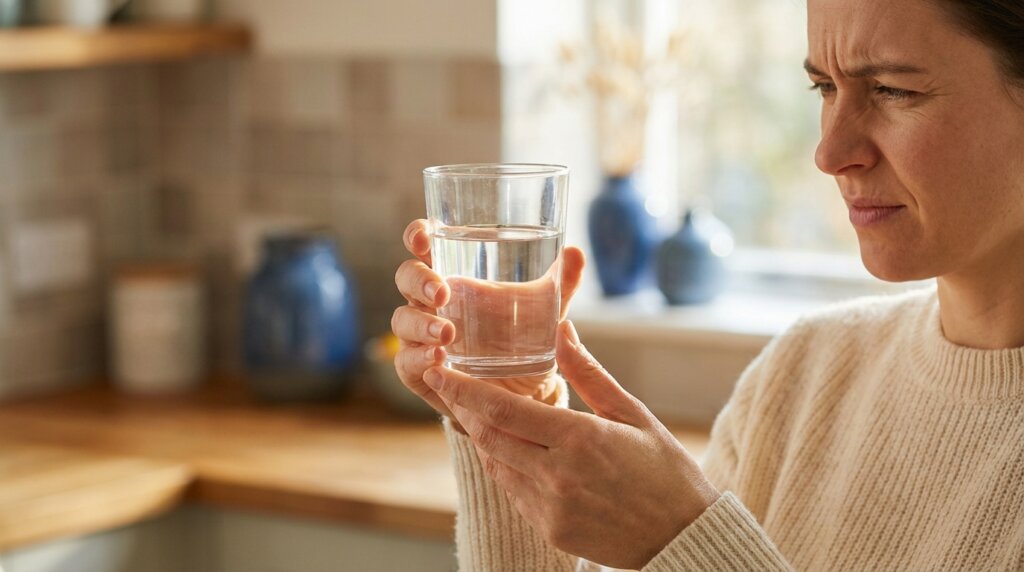
Quick Taste Diagnosis: What Your Water Tastes Like = What’s Causing It
Match your specific taste below to jump straight to the cause and fix. If you have multiple symptoms, start with the strongest taste.
| If Your Water Tastes Like… | The Likely Cause | Risk Level |
|---|---|---|
| Pool water / bleach | Chlorine disinfection | 🟢 Low |
| Rotten eggs | Hydrogen sulfide / sulfur bacteria | 🟡 Medium |
| Coins / blood / iron | Iron, copper, or lead in pipes | 🟠 Medium-High |
| Dirt / mud / mold | Algae compounds (geosmin, MIB) | 🟢 Low |
| Salty / brackish | Water softener or salt intrusion | 🟡 Medium |
| Plastic / chemical | New pipes or expired filter | 🟡 Medium |
| Bitter / dry mouth | High TDS or magnesium sulfate | 🟢 Low |
| Sweet / soapy | High calcium or pipe corrosion | 🟡 Medium |
The 8 Reasons Your Water Tastes Funny (And How to Fix Each)
1. Chlorine Taste (Pool / Bleach Smell)
What it is: Municipal water utilities add chlorine or chloramine to kill bacteria and viruses. Levels typically range from 0.2–4 ppm — safe by EPA standards but noticeable past 1 ppm.
Why it spikes: Utilities increase chlorine in spring/summer (algae growth) and after main repairs. If your water suddenly tastes “more chlorine-y,” it’s probably seasonal.
Quick fix:
- Fill a pitcher and refrigerate uncovered for 1 hour — chlorine evaporates naturally
- Use a carbon filter pitcher (Brita, Pur, ZeroWater all remove chlorine effectively)
- Add a slice of lemon — the citric acid neutralizes chlorine taste
Risk: 🟢 Low. Chlorine is safe at municipal levels but the taste is unpleasant.
2. Sulfur Taste (Rotten Egg Smell)
What it is: Hydrogen sulfide (H₂S) gas, produced by sulfate-reducing bacteria. The smell is so strong you can detect it at 0.5 ppm.
Where it comes from:
- Hot water only? Your water heater‘s anode rod is reacting with sulfates. Replace the magnesium rod with an aluminum or zinc one.
- Cold water too? Sulfur bacteria in your well or supply line. Shock-chlorinate the well or install a sulfur-removal filter.
Risk: 🟡 Medium. Not directly toxic, but indicates bacterial growth that should be addressed.
3. Metallic Taste (Coins / Blood / Iron)
What it is: Iron, copper, manganese, or — most concerning — lead leaching from pipes.
How to tell which metal:
- Reddish-brown stains in sink: Iron (harmless but ugly — install an iron filter)
- Blue-green stains: Copper from pipes (usually safe, but check if levels exceed 1.3 ppm)
- No staining, just taste: Could be lead. Order a lead test immediately if your home was built before 1986.
Risk: 🟠 Medium-High (depending on metal).
4. Earthy / Musty Taste (Dirt or Mold)
What it is: Geosmin and 2-MIB — organic compounds released by blue-green algae and certain bacteria in reservoirs and lakes. The human nose can detect these at 5 parts per trillion, which is why they taste so strong.
Why it spikes: Late summer when reservoir temperatures peak and algae bloom.
Quick fix:
- Activated carbon filters remove geosmin/MIB completely
- The water itself is safe — utilities monitor and treat it, but the taste compounds slip through
Risk: 🟢 Low. Aesthetic issue, not a health one.
5. Salty / Brackish Taste
What it is: High sodium, chloride, or sulfate levels. The most common causes:
- Water softener malfunction: Softener is regenerating too aggressively, dumping sodium into the line
- Coastal areas: Saltwater intrusion into the aquifer (common in Florida, Texas coast)
- Road salt seepage: Winter road salting contaminating shallow wells
Quick fix: Check the unsoftened cold tap (usually outdoors) — if that tastes normal, your softener is the issue. If both taste salty, you need a reverse osmosis system.
Risk: 🟡 Medium. People with high blood pressure should avoid high-sodium water.
6. Plastic or Chemical Taste
What it is: Usually from PEX/PVC pipe leaching, expired refrigerator filters, plastic water bottles left in sun, or new plumbing curing.
Where it comes from:
- New construction or remodel? PEX pipes leach a plastic taste for 3–6 months. Run water daily.
- Fridge water tastes plastic? Replace your fridge filter — they should be changed every 6 months.
- Only bottled water? Don’t store plastic bottles in hot cars. Switch to glass or stainless.
Risk: 🟡 Medium. Some leached compounds (BPA, phthalates) are endocrine disruptors.
7. Bitter Taste (Dry Mouth Feeling)
What it is: High Total Dissolved Solids (TDS) over 500 ppm, magnesium sulfate (Epsom-salt taste), or copper corrosion.
How to tell:
- Buy a TDS meter ($10 on Amazon) and test. Under 300 ppm = ideal. 300–500 ppm = noticeable. 500+ ppm = bitter.
- If TDS is normal but bitterness persists, copper from old pipes is likely
Quick fix: A reverse osmosis system reduces TDS by 95–99%. For copper, replace the affected pipes or install a whole-house filter.
Risk: 🟢 Low for TDS. 🟡 Medium for sustained copper exposure.
8. Sweet or Soapy Taste
What it is: Often high calcium content or alkali residue from corroded pipes/water softener. Less commonly, bacteria-produced compounds.
Quick fix:
- Test water hardness — over 180 ppm calcium often tastes sweet
- Flush hot water heater (sediment buildup can cause this)
- If sudden, contact your utility — could indicate a treatment issue
Risk: 🟡 Medium. Sudden sweet taste can rarely indicate antifreeze contamination — if you suspect this, stop drinking and call your utility immediately.
Best Fix Based on Your Water Source
The right solution depends on where your water comes from. Here’s the most likely cause + fix by source:
Most likely cause: Chlorine or seasonal algae compounds. Fix: Carbon filter pitcher (Brita Elite or Pur Plus) solves 80% of cases.
Most likely cause: Lead, copper, or iron from aging pipes. Fix: Order a lead test ($30) immediately, then install an NSF 53 certified filter.
Most likely cause: Sulfur, iron, or bacteria. Fix: Whole-house filtration system + annual well shock-chlorination.
Most likely cause: Stagnant water in pipes, expired building filters. Fix: Run cold tap 2 minutes before using + countertop filter.
Most likely cause: Salt intrusion or chloride. Fix: Reverse osmosis system — only RO removes salt effectively.
Most likely cause: Plastic tank leaching, biofilm in lines. Fix: Sanitize tank with bleach solution + use inline RV carbon filter.
Most likely cause: PEX pipe off-gassing. Fix: Run cold water 5+ min daily for 3 months — taste fades naturally.
Most likely cause: Sulfur bacteria or nitrates from agriculture. Fix: Annual well test + sediment + carbon filter combo.
How to Test Your Water (3 Methods)
If your taste issue persists after a basic carbon filter, get your water tested. Here are your options ranked by accuracy and cost:
- Free utility report (start here): Every U.S. water utility publishes an annual Consumer Confidence Report (CCR). Search “[your city] CCR water report” — shows all tested contaminants.
- At-home test kit ($25–$40): Brands like Watersafe or Health Metric test for 10–14 contaminants. Good for quick screening.
- Certified lab test ($100–$300): Most accurate. Send sample to a state-certified lab for full analysis. Recommended for well water owners every 1–2 years.
Should You Filter Your Water? Pros & Cons
Pros
- Removes chlorine taste & odor instantly
- Filters out lead, copper, and most heavy metals
- Cheaper than bottled water long-term
- Reduces plastic waste
- Improves coffee, tea, and ice cube quality
Cons
- Filter replacement adds ongoing cost
- Standard pitchers don’t remove sulfur or salt
- RO systems remove healthy minerals too
- Won’t fix issues caused by your water heater
- Some need professional installation
Frequently Asked Questions
Why does my tap water suddenly taste different?
Sudden taste changes usually mean a recent shift in your water supply — seasonal disinfection (chlorine spike), pipe corrosion, or biofilm growth in stagnant lines. Run cold tap water for 2 minutes and re-taste. If it persists, contact your local water utility.
Is funny tasting water safe to drink?
Sometimes, but not always. Chlorine and earthy tastes are usually safe but unpleasant. Metallic, sulfur, or chemical tastes can signal lead, bacteria, or contamination. When in doubt, switch to filtered or bottled water and order a home water test.
Why does my water taste like chlorine?
Municipal water utilities add chlorine to disinfect the water supply. Chlorine taste is usually safe but unpleasant. Fill a pitcher and refrigerate uncovered for 1 hour to dissipate it, or use a carbon filter pitcher like Brita or Pur.
Why does my water smell like rotten eggs?
A rotten egg smell is hydrogen sulfide gas, usually from sulfate-reducing bacteria in your water heater or well water. If only hot water smells, flush the water heater. If cold water smells too, install a sulfur-removal filter or shock-chlorinate your well.
Why does my water taste metallic?
Metallic taste usually comes from iron, copper, or lead in your pipes. Iron and copper are unpleasant but not dangerous in small amounts. Lead is toxic, especially in homes built before 1986. Order a lead test kit if your home has old plumbing.
Why does my water taste like dirt?
An earthy or musty taste comes from geosmin and MIB compounds released by algae and bacteria in reservoirs. The water is usually safe but tastes terrible. A carbon filter removes both compounds completely within minutes.
Why does my water taste salty?
Salty taste means high sodium or chloride levels — often from a water softener overloading the line, road salt seepage, or coastal aquifer intrusion. Test the unsoftened tap (usually outdoors) and compare. If softener is the cause, recheck its settings.
Why does my water taste bitter?
Bitter taste usually means high Total Dissolved Solids (TDS) over 500 ppm, copper from corroding pipes, or magnesium sulfate (Epsom-like). Test TDS with a meter. Above 500 ppm, switch to filtered water or install a reverse osmosis system.
Why does my water taste like plastic?
Plastic taste usually comes from new PEX or PVC pipes leaching, plastic water bottles left in heat, or a fridge filter that needs replacement. Run cold water for 5 minutes daily for new pipes. For bottles, switch to glass or stainless steel.
Does boiling water remove bad taste?
Boiling removes chlorine and kills bacteria, but it concentrates lead, iron, fluoride, and salts. If your water tastes metallic or salty, boiling makes it worse. For taste issues, use a carbon filter pitcher instead.
How do I get my water tested?
Order an at-home water test kit ($25–$40 on Amazon), or send a sample to a state-certified lab ($100–$300 for a comprehensive test). Most utilities also publish an annual Consumer Confidence Report with tested contaminants for free.
Will a Brita filter fix bad-tasting water?
Yes, for chlorine, earthy, and mild metallic tastes. Brita uses activated carbon, which removes the most common taste-causing compounds. For sulfur, bitter (high TDS), or strong metallic tastes, you need a stronger filter like ZeroWater or Clearly Filtered.
Related Reading
- Best Water Filter Pitchers 2026: Brita vs Pur vs ZeroWater
- Which Sparkling Water Is Healthiest for Daily Drinking?
- 10 Health Benefits of Drinking Water Daily
- Is It Safe to Drink Water From Plastic Bottles Daily?
References & Sources
- EPA — National Primary Drinking Water Regulations
- CDC — Hydrogen Sulfide in Well Water
- EWG Tap Water Database — Find Your Local Contaminants
- EPA — Lead in Drinking Water
- CDC — Private Well Water Safety
The Bottom Line
If your water tastes funny, the cause is almost always one of 8 things — and most are easy, cheap fixes. Start by identifying the specific taste using the diagnostic table above, then match it to your water source for the right solution. Chlorine, earthy, and most metallic tastes are aesthetic issues that a $35 carbon filter pitcher solves instantly. Sulfur, salty, or strong metallic tastes deserve a water test before you spend on equipment. And if your home was built before 1986, get a lead test today — that’s one taste you don’t want to ignore.
![What Is Tonic Water? [Ingredients, Uses & Health Facts]](https://completewaterguide.com/wp-content/uploads/2025/09/3-768x416.webp)