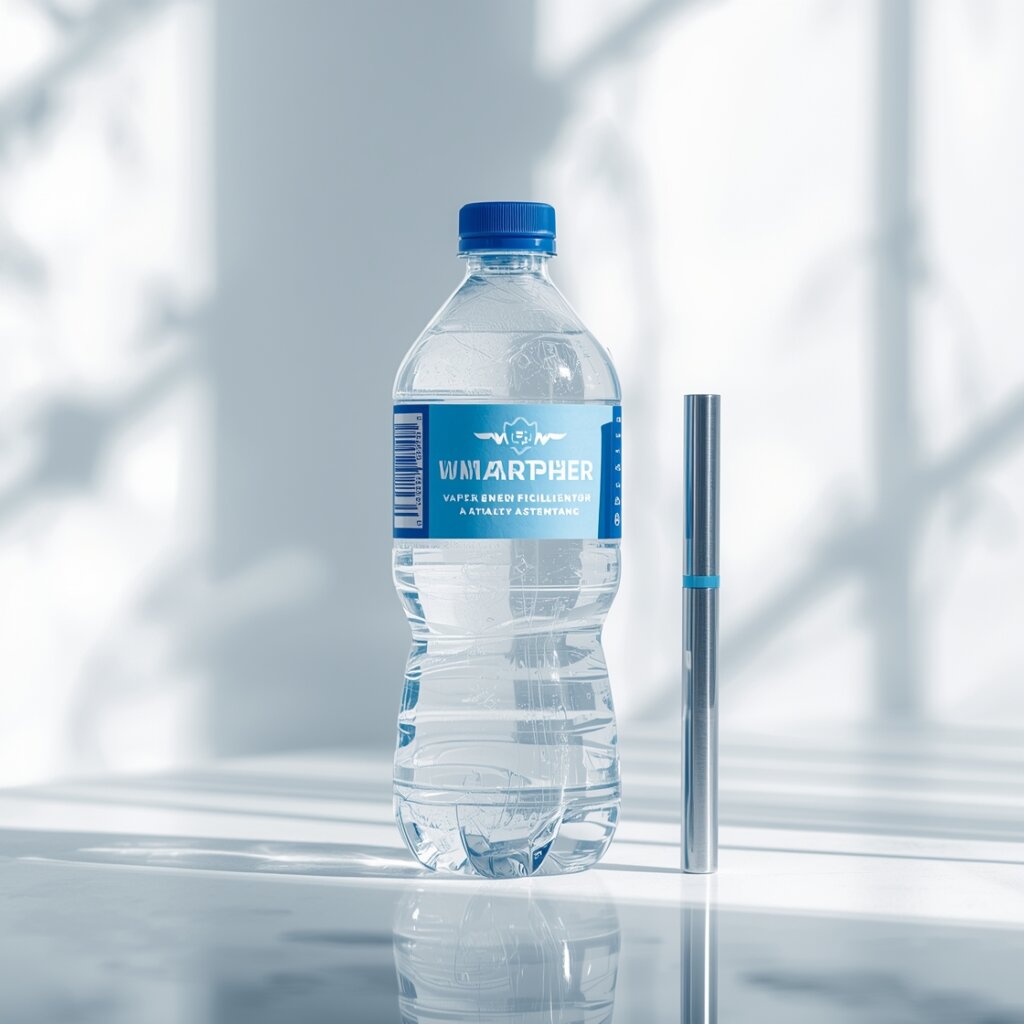
Why There Is No Smartwater PFAS Number
Consumer Reports tested 47 bottled waters in 2020 across 30 PFAS compounds. That study is where essentially every published bottled water PFAS figure originates. Smartwater was not included — nor were Fiji, Evian, Mountain Valley or Icelandic Glacial.
No comparable independent study has been published since covering the brands that were missed. So any article giving you a specific ppt figure for Smartwater is either citing something that does not exist or extrapolating without saying so.
But “no data” means something quite different for a distilled water than for a spring water, and that distinction is the substance of this guide.
How Vapor Distillation Removes PFAS
The mechanism is straightforward physical chemistry, and it is why distillation is considered one of the most complete purification methods available.
Water boils at 100°C. PFAS compounds do not. They are large, stable synthetic molecules with far higher boiling points — that same stability is precisely why they are called “forever chemicals” and why they resist breaking down in the environment.
So when water is boiled and the vapor is collected separately:
- Water molecules evaporate and travel to the condenser.
- PFAS, heavy metals, dissolved salts and most other contaminants stay behind in the residue.
- The condensed vapor is close to pure H₂O.
- Smartwater then adds calcium chloride, magnesium chloride and potassium bicarbonate back for taste.
This is the same principle behind reverse osmosis, which independent testing of NSF/ANSI 58 certified systems consistently shows achieving 94-99% PFAS reduction. Distillation is generally regarded as at least as thorough.
Smartwater vs Tested Brands
Placing the inference alongside the actual data:
| Brand | Treatment | PFAS (ppt) | Basis |
|---|---|---|---|
| Spindrift | Purified | 0.19 | Tested |
| Essentia | Reverse osmosis | 0.2 | Tested |
| San Pellegrino | Natural mineral | 0.31 | Tested |
| Dasani Sparkling | Reverse osmosis | 0.37 | Tested |
| Perrier | Natural mineral | 1.10 | Tested |
| Poland Spring | Spring | 1.66 | Tested |
| Smartwater | Vapor distilled | No data | Process inference only |
Notice where the tested purified waters land. Essentia, which uses reverse osmosis, measured 0.2 ppt. Dasani’s RO sparkling product came in at 0.37 ppt. Those are the closest available data points to what a distilled product would likely show, and they support the inference rather than merely permitting it.
The Question Distillation Does Not Answer
Smartwater is sold exclusively in plastic, and that raises the issue that distillation has no bearing on: microplastics enter after purification, from the bottle itself.
This is a category-wide problem rather than a Smartwater-specific one. A 2018 Orb Media and State University of New York at Fredonia study found microplastic contamination in 93% of bottles tested across 11 brands in nine countries, with more than 1,000 particles per litre in half the brands. Six major brands — Arrowhead, Crystal Geyser, Evian, Fiji, Ice Mountain and Poland Spring — face consumer lawsuits over microplastics in “natural” water.
Regulatory attention is now catching up. In April 2026, the EPA added microplastics to its Contaminant Candidate List for the first time, alongside pharmaceuticals — a formal step toward potential future regulation. Notably, some experts have cautioned that current analytical methods struggle to detect the smallest particles reliably, so early monitoring data may be difficult to interpret.
The practical implication: a perfectly distilled water in a plastic bottle solves the PFAS question and leaves the plastic one open.
What Smartwater Actually Is
- Source: Municipal water, not a named spring. The brand does not market a source story, which is unusually honest for the category.
- Treatment: Vapor distillation — evaporation and condensation, removing essentially all dissolved solids.
- Added back: Calcium chloride, magnesium chloride and potassium bicarbonate, for taste rather than nutrition. The amounts are small.
- Mineral content: Very low. Distilled water starts at effectively zero TDS, and the electrolyte addition is minimal — nothing like the 326 mg/L of Evian or 1,109 mg/L of San Pellegrino.
- Packaging: Plastic only.
If you are drinking Smartwater expecting mineral benefits, you are drinking the wrong product — see our mineral water ranking for brands that actually deliver them. If you are drinking it for purity, the process supports you.
Should You Drink Smartwater?
Among the strongest positions of any untested brand. Vapor distillation removes PFAS by physical mechanism, and tested RO products landed among the lowest measured.
Unaddressed. Plastic packaging, no brand-specific data, and a category-wide issue the EPA only began formally tracking in April 2026.
Effectively none. The added electrolytes are for taste. This is purified water, and it is not pretending otherwise.
Options With Verified Data or Glass
If you want a published figure rather than a process inference, or want to remove the plastic variable. As an Amazon Associate we earn from qualifying purchases; it never affects our rankings.
S.Pellegrino (Glass)
A published PFAS figure and a low one, in glass. Solves both the verification gap and the packaging question at once.
Essentia Ionized Water
The closest comparable product with an actual published figure. Three-stage RO purification to under 10 ppm TDS, 0.2 ppt PFAS.
Smartwater Vapor Distilled
Vapor distillation removes PFAS, heavy metals and dissolved solids by physical mechanism, with electrolytes added back for a clean, neutral taste.
Under-Sink RO System
NSF/ANSI 58 certified systems achieve 94-99% PFAS reduction — the same principle as distillation, at roughly $0.05 per litre with no bottle involved.
Frequently Asked Questions
Does Smartwater have PFAS?
No published independent test result exists — Smartwater was not included in Consumer Reports’ 2020 analysis. However, it is vapor distilled, and PFAS compounds do not evaporate at water’s boiling point, so they are left behind during distillation. This is a strong process-based basis for expecting very low levels, though not a verified measurement.
Does distillation remove PFAS?
Yes, very effectively. Distillation evaporates water and collects the vapor separately. PFAS are large, stable molecules with far higher boiling points than water, so they remain in the residue rather than travelling with the vapor. Reverse osmosis works on a comparable principle and certified systems achieve 94-99% PFAS reduction.
Is Smartwater actually purified or just marketing?
It is genuinely purified. Smartwater starts with municipal water and vapor distills it, which removes essentially all dissolved solids including PFAS, heavy metals and salts. Calcium chloride, magnesium chloride and potassium bicarbonate are then added back for taste. The electrolyte claim is about flavour, not nutrition.
Why do purified waters test lower for PFAS than spring waters?
Spring water is bottled close to its natural state, so whatever the aquifer contains carries into the bottle. Purified water goes through reverse osmosis or distillation, which strips contaminants out before bottling. In Consumer Reports’ data, purified waters generally tested lower than spring and mineral waters.
Does Smartwater contain microplastics?
No brand-specific data has been published. Smartwater is sold in plastic, and microplastics enter from the packaging after purification rather than from the water source, so distillation does not address this. A 2018 study found microplastic contamination in 93% of bottled water tested across 11 brands.
Does Smartwater have minerals?
Very few. Distillation removes essentially all dissolved minerals, and the electrolytes added back — calcium chloride, magnesium chloride, potassium bicarbonate — are present in small amounts for taste. If you want meaningful mineral content, a natural mineral water like Gerolsteiner at 2,488 mg/L TDS is a different product entirely.
Is Smartwater better than Fiji or Evian for PFAS?
On process reasoning, likely yes. Smartwater is distilled, which removes PFAS by physical mechanism. Fiji and Evian are spring and artesian waters bottled close to natural state. That said, FDA sampling of a Fiji-sourced product showed PFOA and PFOS below quantification limits, so the practical gap may be small.
Which purified water has an actual tested PFAS figure?
Essentia, at 0.2 ppt from independent testing, is the closest comparable product with a published number. It uses three-stage purification ending in reverse osmosis rather than distillation, but the principle and the expected result are similar.
Related Reading
- Bottled Water Brands & PFAS — Every Major Brand Ranked
- Does Essentia Water Have PFAS? Tested at 0.2 ppt
- Does Fiji Water Have PFAS?
- Does Evian Have PFAS? Testing & Lawsuits
- Safest Bottled Water Brands — Ranked by Published Data
- Mineral vs Purified Water — Full Comparison
- Best Reverse Osmosis Systems for Home
References & Sources
- Consumer Reports — bottled water PFAS testing (2020), 47 products, 30 compounds
- EPA — PFAS National Primary Drinking Water Regulation (April 2024); Contaminant Candidate List addition of microplastics (April 2026)
- FDA — bottled water PFAS survey (April 2025), 197 products
- NSF/ANSI 58 — reverse osmosis certification standard; independent testing showing 94-99% PFAS reduction
- Orb Media and State University of New York at Fredonia — microplastics in bottled water study (2018)
The Bottom Line
Smartwater sits in an unusual position: no published PFAS figure, but the strongest process-based case of any untested brand. Vapor distillation removes PFAS because those compounds do not evaporate at water’s boiling point — they are physically left behind. The closest available data points support it, with Essentia’s RO-purified water testing at 0.2 ppt and Dasani’s at 0.37 ppt, among the lowest measured. That is inference rather than verification, and it is worth being clear about the difference. What distillation does not touch is the plastic bottle, and microplastics enter after purification. If PFAS is your concern, Smartwater’s process is genuinely reassuring. If plastic is, glass-bottled brands remove that variable — and an RO system at home removes both for roughly $0.05 per litre.