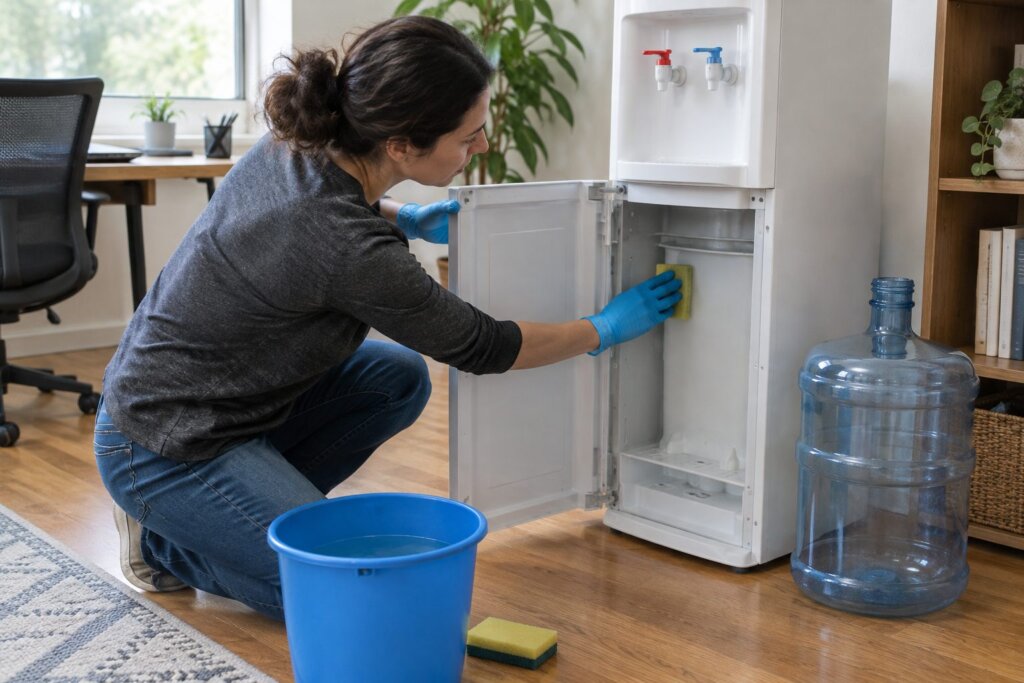
Here is how to clean a water cooler properly: drain it, sanitize the cold reservoir with a weak bleach solution for 3 to 5 minutes, rinse it three times, and descale it with vinegar or citric acid every few months. Most people only wipe the outside and the drip tray, and the inside is where the problem lives. A 2025 review of studies on water dispensers found that bacteria build up as a biofilm inside the unit itself, and that water from coolers often carried more bacteria than the tap water feeding them.
We follow two published procedures: a national laboratory’s facilities instructions for bleach sanitizing, and a cooler maker’s own descaling routine. Both are below, step by step.
How to clean a water cooler, step by step
Our short version, for a standard cooler with hot and cold taps:
- Unplug the cooler, remove the bottle and drain both taps into a bucket. Empty the drip tray.
- Plug the hot tank inlet if your model has one, so no bleach gets into the hot tank.
- Mix 1/2 teaspoon of plain household bleach into 1 gallon of water.
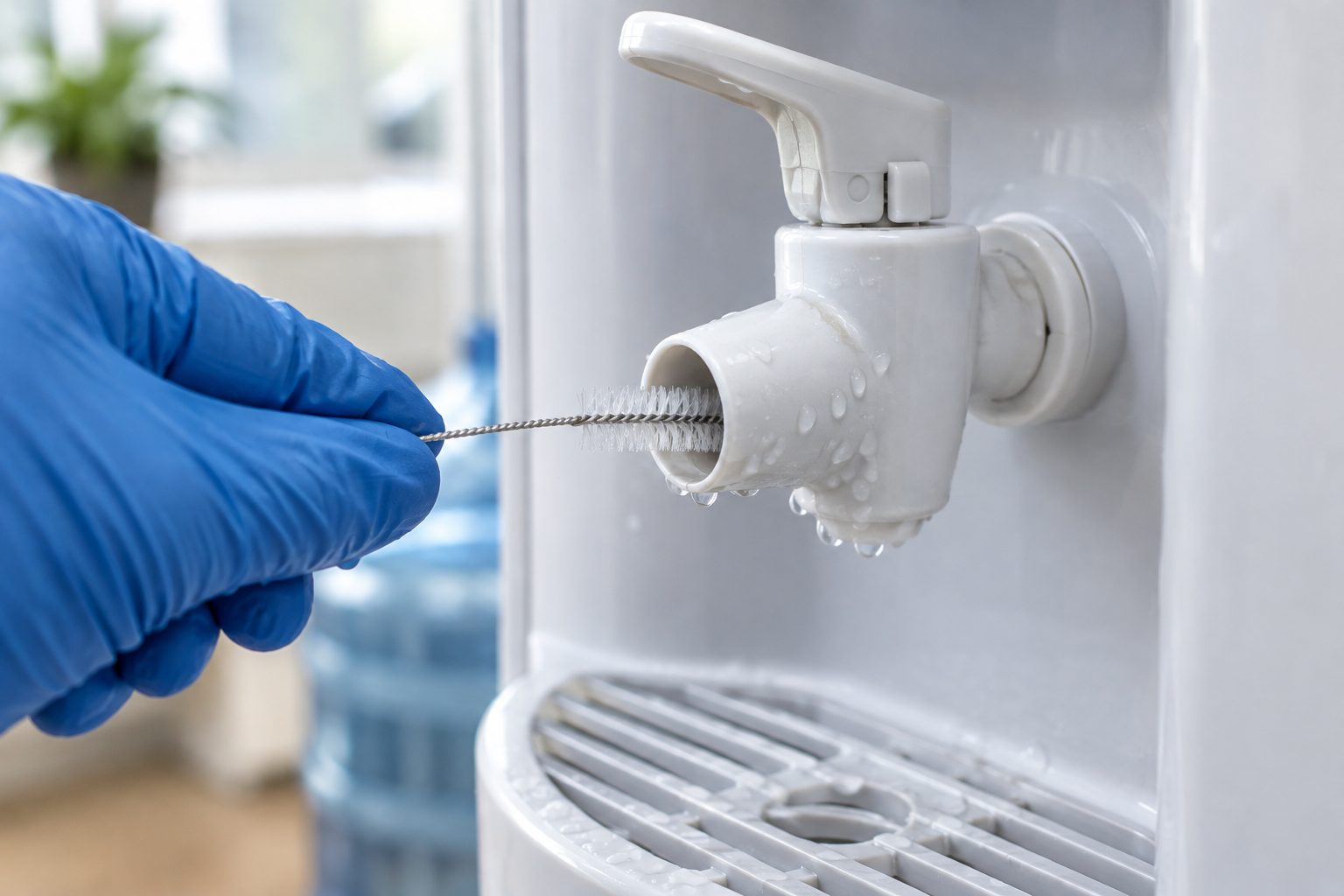
- Wipe the cold reservoir, baffle and drip tray with that solution, and scrub inside the spigots with a small tube brush.
- Fill the reservoir with the solution, wait 3 to 5 minutes, then drain it through the tap.
- Fill with clean water and drain, three times.
- Remove the hot tank plug, rinse, put a fresh bottle on and plug the cooler back in.
That is the method in Lawrence Berkeley National Laboratory’s environment, health and safety manual, which its facilities staff use on the lab’s bottled water dispensers. We like it because it is specific where most guides are vague.
Can you clean a water cooler with bleach?
Yes, at the right strength and never in the hot tank. The Berkeley Lab procedure calls for “5 ml of bleach with 4 liters of tap water (½ teaspoon of bleach to 1 gallon of water)” and says plainly: “DO NOT use a stronger sanitizing solution.” It also requires “a minimum contact time of three minutes and a maximum contact time of five minutes,” followed by filling the reservoir with tap water and draining it “at least three times.”
Two rules we would add from that same procedure: plug the inlet to the hot tank first (“DO NOT allow the sanitizing solution to enter the hot water tank”), and use a sponge and a 1/2 inch test-tube brush, not paper towels, so you can reach inside the spigots where slime collects.
Check your manual before you start. Some makers allow bleach and some do not. Primo’s bottom-load manual says to clean the cabinet, controls, bottle probe and spouts with “food grade sanitizer or bleach,” but other brands ask you to use only their own cleaner or citric acid.
Can you run vinegar through a water cooler?
Yes, and it is the better tool for mineral scale, while bleach is for germs. Brio, a cooler maker, publishes this bottom-load routine, which takes about 30 minutes:
- Switch the hot and cold switches off and unplug the cooler.
- Remove the bottle and drain the hot and cold reservoirs through the taps.
- In a spare empty 5-gallon bottle, mix 2 gallons of hot tap water with 200 grams (about 2 cups) of citric acid, or 2 cups of distilled white vinegar.
- Put the cleaning bottle on, insert the probe, plug in and let the solution fill the reservoirs. Run a little from every tap.
- Wait 20 minutes, then drain the reservoirs again.
- Rinse the bottle, fill it with plain hot tap water, run it through and drain.
Brio recommends doing this every three to four months, and repeating it with vinegar if a smell or taste remains after citric acid. Our preference is citric acid because it leaves less smell behind, but either works.
Never mix bleach and vinegar. The Skokie, Illinois fire department lists “Bleach + Vinegar = Chlorine gas,” which “can cause coughing, trouble breathing, burning, and watery eyes.” Do the bleach sanitize and the vinegar descale on different days, or rinse completely between them.
How do you clean a bottom load water cooler?
The same way, with one extra part: the probe. In a bottom-load cooler, a probe goes into the bottle and pumps water up to the reservoirs. Primo’s manual says to clean the bottle probe and spouts regularly, and to rest the probe on its hanger inside the door while you change bottles so it stays clean. We wipe the probe and its tube with the bleach solution, rinse it in clean water, and never set it down on the floor.
Some newer bottom-load models also sanitize themselves. Primo’s manual for one model says a sanitization cycle of the warm water reservoir runs automatically every 12 hours, boiling the water in that reservoir. That covers the warm tank, not the cold reservoir, the probe or the spigots, so we still clean those by hand.
How often should a water cooler be cleaned?
The published advice ranges widely:
- Berkeley Lab: “at least every 6 months, though low usage may require a more frequent cleaning schedule.”
- University of California, Irvine: its guidance notes the manufacturer suggests routine cleaning “twice a year.”
- Brio: descale every three to four months.
- The 2025 review of dispenser studies: internal lines and dispensing outlets “should be disinfected every two to four weeks, depending on unit usage,” and weekly in high-use locations.
Our schedule for a home or small office cooler: wipe the taps and empty the drip tray every week, wipe the bottle neck and probe at every bottle change, and do the full bleach sanitize plus descale every three months. Low use is not a reason to wait longer. Berkeley Lab notes it can mean cleaning more often, because water that sits still grows more.
What we would buy for this job
- CiaraQ 10-piece tube brush set, 2 to 24 mm: small enough for inside the spigots, which is where Berkeley Lab says to use a test-tube brush.
- Spicy World food-grade citric acid, 2 lb: enough for several descales at Brio’s 200 grams per cleaning.
As an Amazon Associate, Complete Water Guide earns from qualifying purchases. Prices change, so check the listing.
How do you clean a water cooler that has been sitting?
Start over rather than drink from it. The University of California, Irvine guidance for coolers left unused for a long time says to discard the partially used, opened bottle, then drain the reservoir and clean the unit thoroughly following the manufacturer’s instructions before using it again. We would do the full bleach sanitize, the vinegar or citric acid descale, and only then put on a fresh, sealed bottle.
Why does my water cooler water taste or smell bad?
Usually because of algae, bacteria or scale inside the unit, not the water. Berkeley Lab says coolers that are not cleaned can grow significant algae and undesirable levels of bacteria, and that while “this is not typically a health hazard,” it causes “poor taste, odor problems, and an undesirable appearance.” Sunlight makes it worse: the lab says bottles “should be stored in a cool, dark place.” If the bottled water itself is old, see our guide on whether water expires, and for odors that remain after cleaning, our guide on removing bad smells from drinking water.
If you are moving or lifting full bottles to clean around the cooler, our guide to how much a 5 gallon water jug weighs is worth a look first, since a full jug is heavier than most people expect. And if you rent your cooler from a delivery service, check whether cleaning is included before you do it yourself; our Primo water cost breakdown covers what those plans charge.
Frequently asked questions
What is the best way to clean a water cooler?
Sanitize the cold reservoir with 1/2 teaspoon of bleach per gallon of water for 3 to 5 minutes, rinse three times, and keep bleach out of the hot tank. Descale with citric acid or vinegar every three to four months. Never mix the two products.
Can you put vinegar in a water cooler?
Yes. Brio’s routine runs 2 cups of distilled white vinegar, or 200 grams of citric acid, in 2 gallons of hot water through the cooler from an empty bottle, waits 20 minutes, drains it and rinses with plain water.
How often should a water cooler be cleaned?
At least every six months, per Berkeley Lab, and more often with low use. We clean home coolers every three months and wipe the taps weekly. A 2025 review of studies suggests every two to four weeks for the internal lines and outlets.
How much bleach do I use to clean a water cooler?
Half a teaspoon of plain household bleach per gallon of water, which is 5 ml in 4 liters. Berkeley Lab’s procedure warns not to use a stronger solution.
Do water coolers need to be cleaned if they look clean?
Yes. Biofilm forms inside the reservoir and lines where you cannot see it, and studies found cooler water often carried more bacteria than the tap water feeding the cooler.
Can bacteria grow in a water cooler?
Yes. A 2025 review of water dispenser studies identified fecal coliform and Pseudomonas aeruginosa as recurring contaminants and found routine disinfection significantly reduced bacterial contamination.
Sources
- Lawrence Berkeley National Laboratory, ES&H Manual Chapter 42, Work Process E: Water Dispensers (Bottled Water).
- Brio, Bottom Load Cooler Cleaning Instructions.
- Primo, bottom loading water dispenser manual, model 601272.
- University of California, Irvine Environmental Health & Safety, Bottled Water Dispenser and Drinking Water System Units Cleaning Reference Guide, November 5, 2020.
- Microbiological quality of drinking water from water dispensers, review, accepted December 2025.
- Village of Skokie Fire Department, Dangers of Mixing Household Chemical Cleaners.