Not sure how hard your water is? Use our free Water Quality Checker Tool to find your grains per gallon first.
Disclosure: As an Amazon Associate we earn from qualifying purchases. If you buy through links on this page, we may earn a small commission at no extra cost to you — it never changes which products we recommend.
⚡ Top 3 Quick Picks — ranked by filtration media, jump to full picks & prices →
AquaHomeGroup 20-Stage
KDF-55 + calcium sulfite + carbon. Spare cartridge included.
Check Price
Aquabliss SF100
6-month cartridge, targets dry skin and dandruff.
Check Price
weAQUA 2-Pack
Two filters, a full year of coverage. Lowest cost per shower.
Check Price
What Is a Shower Filter for Hard Water?
A shower filter for hard water is an inline cartridge that fits between your shower arm and shower head, using media such as KDF-55, calcium sulfite and activated carbon to reduce chlorine, chloramine, heavy metals and sediment from the water before it reaches your skin. Installation takes about two minutes and requires no tools.
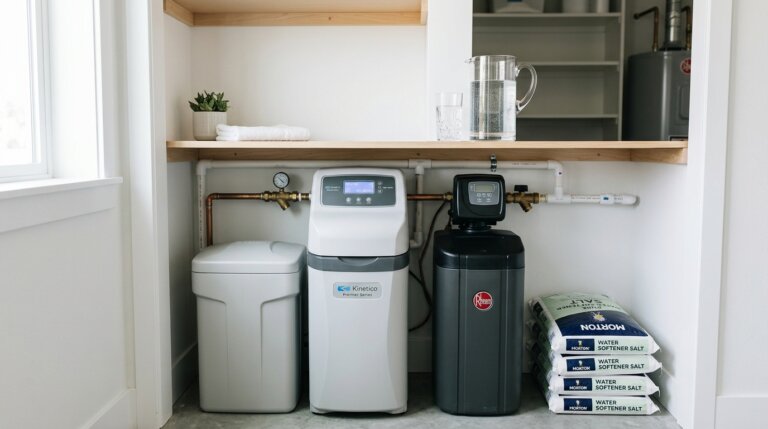
What it does not do is remove hardness. Calcium and magnesium ions — the minerals that define hard water — are not captured by carbon or KDF media. Removing them requires ion exchange, which needs a resin bed and a brine tank, neither of which fits inside a device the size of a fist.
The Three Media That Actually Work
Ignore the stage count on the box — “20-stage” and “15-stage” are marketing arithmetic. What matters is which media are inside.
| Media | What It Removes | Verdict |
|---|---|---|
| KDF-55 | Chlorine, lead, mercury, copper, chromium; works in hot water | A+ Essential |
| Calcium sulfite | Chlorine and chloramine, effective at high temperatures | A Essential |
| Activated carbon | Chlorine taste, odour, some organics | B+ Useful, weaker hot |
| Vitamin C | Neutralises chlorine and chloramine on contact | B Works, depletes fast |
| Ceramic / “energy” beads | Nothing demonstrable | D Filler |
| Any of the above for hardness | Does not remove calcium or magnesium | F Needs a softener |
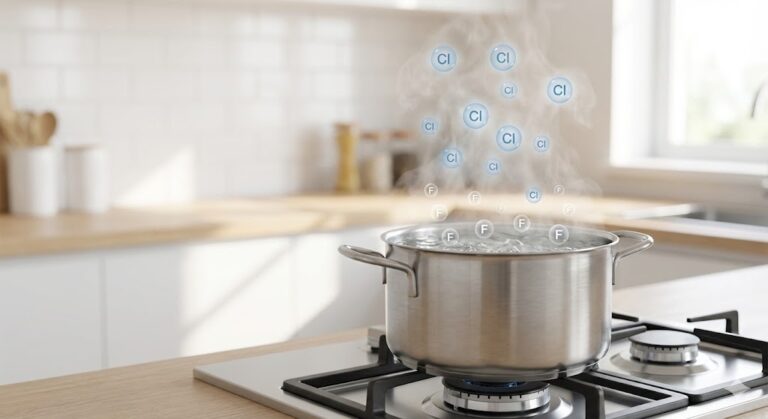
One technical point that explains a lot: activated carbon works poorly in hot water. Adsorption weakens as temperature rises, which is why the best shower filter for hard water leads with KDF-55 and calcium sulfite rather than carbon alone. A filter that is mostly carbon will underperform in an actual hot shower even if it tests well on paper.
Best Shower Filter for Hard Water: 5 Ranked (2026)
Ranked by filtration media, cartridge life and value. Prices are indicative and change on Amazon.
| Filter | Key Media | Cartridge Life | Price | Rating |
|---|---|---|---|---|
| AquaHomeGroup 20-Stage | KDF-55, calcium sulfite, carbon, vitamin C+E | 4–6 months | ~$30 | A+ |
| weAQUA Heavy Duty (2-pack) | KDF, calcium sulfite, carbon, sediment | 6 months | ~$40 | A |
| Aquabliss SF100 | KDF, calcium sulfite, carbon, ceramic | 6 months | ~$37 | A- |
| MyHalos Filtered Shower Head | KDF-55, calcium sulfite, charcoal | ~90 days | ~$80 | B+ |
| SR Sun Rise Handheld | KDF, maifan stone, VC beads | Varies | ~$22 | B |
An honest caveat about this whole category: no shower filter for hard water is NSF-certified the way drinking water filters are. There is no NSF/ANSI standard for shower filtration equivalent to NSF 53 for lead in drinking water. Manufacturer claims of “99% chlorine removal” come from their own commissioned testing, not from an auditable certification. We rank by media composition because that is the one thing you can verify from the specification.
Where to Buy: Our Shower Filter Picks
Three picks covering the realistic use cases. Prices and availability update on Amazon.

AquaHomeGroup 20-Stage Shower Filter
Uses all three media that matter — KDF-55, calcium sulfite and activated coconut carbon — plus vitamin C and E. Ships with a spare cartridge, which few competitors do.
- KDF-55 + calcium sulfite core
- 2 cartridges included
- No flow reduction claimed

Aquabliss SF100 Revitalizing Filter
The most established name in the category. Multi-stage with KDF, calcium sulfite and carbon. Cartridges last 6 months at roughly 9 cents a day.
- 6-month cartridge life
- Fits fixed, rain, combo, handheld
- Targets dry skin and dandruff
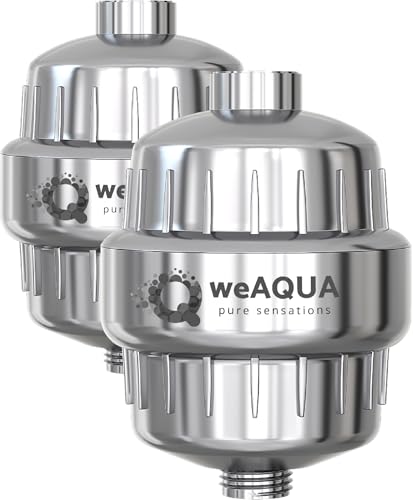
weAQUA Heavy Duty Filter (2-Pack)
Two filters for the price most brands charge for one. Refreshingly blunt marketing — the brand explicitly calls out ceramic bead gimmicks in its own listing.
- 2 units — best cost per shower
- Sediment, carbon, KDF, calcium sulfite
- 6-month cartridge life
None of these products carry NSF certification for shower filtration, because no such standard exists. Reduction percentages come from manufacturer-commissioned testing.
Which Shower Filter Fits Your Situation
The right choice depends on what is actually bothering you. Here is the honest pick for each:
Pick: Aquabliss SF100 or AquaHomeGroup. Chlorine strips skin oils more than hardness does, and both lead with KDF-55 plus calcium sulfite.
Pick: AquaHomeGroup with vitamin C. Chlorine damage is the usual culprit. See our guide on hard water and hair.
Pick: A softener, not a filter. Scale is calcium and magnesium, which no shower filter for hard water removes. This is the one problem this category cannot solve.
Pick: MyHalos or SR Sun Rise filtered shower heads. An inline filter adds a restriction point; an integrated head is designed around the flow.
Pick: weAQUA 2-pack. Two units at roughly $40 gives you a year of coverage, the lowest cost per shower here.
Pick: Softener plus whole-house filter. If every tap is affected, treating one shower is a patch rather than a fix.
Do Shower Filters Actually Work for Hard Water?
Partly, and the honest answer depends on which symptom you are trying to fix.
What They Genuinely Do
- Reduce chlorine and chloramine, the main cause of dry skin
- Reduce heavy metals including lead, mercury and copper
- Filter sediment and rust particles
- Reduce chlorine smell in the bathroom
- Cost $20–80 and install in two minutes
What They Do Not Do
- Remove calcium and magnesium hardness
- Stop limescale on doors, tiles or fixtures
- Change your water’s grains per gallon
- Carry NSF certification (no standard exists)
- Last indefinitely — cartridges need replacing every 4–6 months
Cartridge Replacement: The Part People Skip
A saturated cartridge does not just stop working — KDF and carbon media can release accumulated contaminants back into the water once exhausted.
- Replace every 4–6 months, or sooner in hard water areas where sediment clogs faster
- Watch for pressure drop — the most reliable real-world signal that a cartridge is spent
- Hand-tighten only — most brands warn that tools crack the housing and cause permanent leaks
- Factor in running cost — at roughly $15–20 per cartridge twice a year, that is $30–40 annually on top of the unit
Frequently Asked Questions
Do shower filters work for hard water?
Only partly. A shower filter for hard water reduces chlorine, chloramine, heavy metals and sediment effectively, and that is what usually causes dry skin and dull hair. They do not remove calcium and magnesium, which is what hardness actually is. If your problem is limescale on the shower door, you need a water softener; if it is skin and hair, a filter genuinely helps.
Can a shower filter soften water?
No. Softening requires ion exchange with a resin bed and brine tank, which cannot fit in an inline cartridge. Products marketed as “shower head water softeners” with ceramic or energy beads have no ion-exchange capacity. One manufacturer in the category states this plainly, describing such beads as “just clay with no real function.”
What is the best shower filter for hard water?
The AquaHomeGroup 20-Stage at around $30 is our pick, because it contains all three media that matter — KDF-55, calcium sulfite and activated carbon — plus vitamin C, and ships with a spare cartridge. For skin and hair specifically, the Aquabliss SF100 is the most established option. For value, the weAQUA 2-pack works out cheapest per shower.
Will a shower filter help my hair?
Likely yes, but for chlorine rather than hardness. Chlorine binds to hair keratin and strips natural oils, which is the main cause of straw-like texture after showering. A filter removes that. It will not stop the soap-residue effect that hard water causes. See our guide on hard water and hair damage.
Are shower filters NSF certified?
No, and this is worth knowing before you buy. There is no NSF/ANSI standard for shower filtration equivalent to NSF 53 for lead in drinking water. Every “99% chlorine removal” claim in this category comes from manufacturer-commissioned testing rather than an auditable certification. Judge by filtration media instead, since that is verifiable from the specification.
How often should I replace a shower filter cartridge?
Every 4 to 6 months for most brands, sooner in very hard water where sediment clogs the media faster. A noticeable pressure drop is the most reliable signal. Do not run a cartridge past its life: saturated KDF and carbon can release accumulated contaminants back into the water.
Does a shower filter reduce water pressure?
An inline filter adds a restriction point, so a small drop is normal, and it worsens as the cartridge clogs. If you already have low pressure, an integrated filtered shower head like the MyHalos or SR Sun Rise is designed around the flow path and is a better choice than adding an inline unit to an existing head.
Shower filter vs water softener: which do I need?
They solve different problems. A shower filter for hard water removes chlorine and metals at one fixture for $20–80. A softener removes hardness minerals for the whole house at $500–2,000 installed. If scale on fixtures and appliances is your issue, only the softener helps. If it is skin and hair at one shower, the filter is far better value. Our shower filter vs water softener comparison covers the decision in detail.
Do shower filters remove chlorine from hot water?
The good ones do. This is where media choice matters most: activated carbon loses effectiveness as temperature rises, while KDF-55 and calcium sulfite continue working in hot water. A filter that relies mainly on carbon will underperform in an actual hot shower, which is why we rank KDF and calcium sulfite content above stage count.
Do shower filters help with eczema?
Some people report improvement, and the mechanism is plausible: chlorine disrupts the skin’s lipid barrier, which is already compromised in eczema. Manufacturers make this claim frequently. However, no shower filter is a medical device and none has clinical trial evidence for eczema treatment. Treat it as a reasonable thing to try alongside, not instead of, medical advice.
Are expensive shower filters better?
Not necessarily. Our top pick is around $30 while the priciest here is $80. Price in this category tracks the housing and shower head design more than the filtration media. Check the media list first — a $30 filter with KDF-55 and calcium sulfite outperforms an $80 one that leans on carbon and ceramic beads.
How do I know if I have hard water?
Look for white scale on fixtures, spotting on glass, and soap that will not lather. For a number rather than a guess, check your utility’s annual water quality report or use a home test kit. Anything above 7 grains per gallon is hard; above 10 is very hard. Our 7 signs you need a water softener guide covers the symptoms.
Hard Water Deep Dives
We have published dedicated guides on the questions that come up most often from this page:
- Do Shower Filters Actually Work? — claim by claim, what the filtration chemistry supports
- Shower Filter vs Water Softener — which device fixes which symptom
- Hard Water and Hair Loss — what the evidence actually shows about hair damage
- Why Is My Water Making My Skin Dry? — separating chlorine effects from hardness effects
- 7 Signs You Need a Water Softener — when a filter is not enough
- Hard Water vs Soft Water — the underlying chemistry explained
References & Sources
- EPA — Drinking Water Regulations
- NSF — Water Treatment Device Certification Standards
- USGS Water Science School — Hardness of Water
- CDC — Water Disinfection with Chlorine and Chloramine
- EPA — National Primary Drinking Water Regulations
The Bottom Line
A shower filter for hard water is worth buying for the right reason and a waste of money for the wrong one. These filters genuinely reduce chlorine, chloramine and heavy metals — and chlorine, not hardness, is what causes most of the dry skin and straw-like hair people blame on hard water. Our pick is the AquaHomeGroup 20-Stage at around $30 because it contains KDF-55, calcium sulfite and activated carbon rather than filler media, and includes a spare cartridge. Where this category oversells is softening: no inline filter removes calcium and magnesium, ceramic beads do nothing, and if limescale on your shower door is the problem you need a softener costing twenty times more. Judge any shower filter for hard water by its media list rather than its stage count or its marketing, replace the cartridge every four to six months, and treat the whole category as a chlorine solution that happens to be sold as a hard water one.