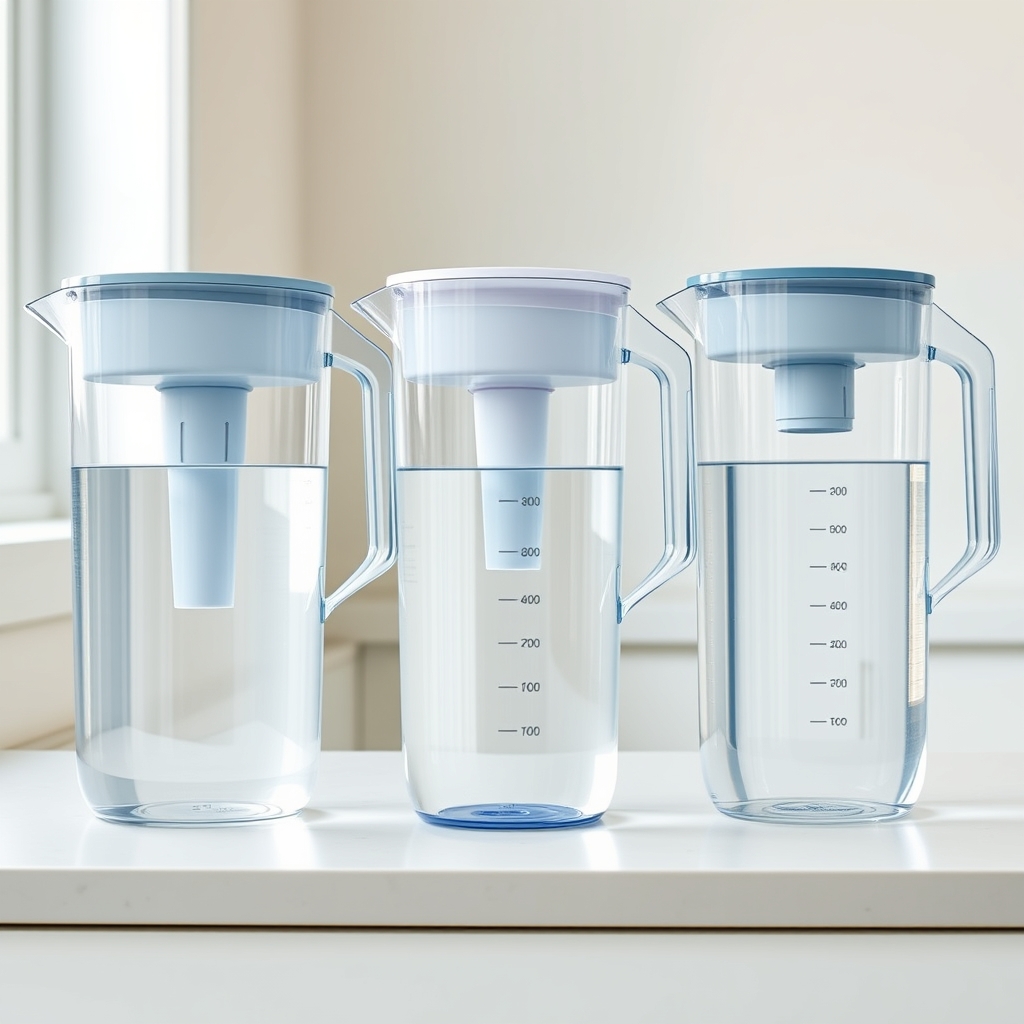
- PUR’s own documents contradict each other. Its marketing page claims lead and microplastics reduction for the Basic pitcher. Its own performance data sheet marks that same filter “Not Certified” for lead.
- Certification attaches to a system, not a pitcher. Brita’s broadest claims are restricted by footnote to nine named pitcher models. A third-party “compatible” cartridge carries no certification at all, including for lead.
- TDS removal is a marketing metric, not a certified claim. It measures bulk conductivity, counting harmless calcium equally with anything toxic.
Why compare certified claims instead of features?
Because the marketing bullet points and the certified claim list are different documents, and only one of them has been tested.
As we covered in our guide to what the NSF/ANSI standards actually mean, certification is granted per individual claim, not per standard. A filter “certified to NSF/ANSI 53” might be certified for one contaminant under it. So the only way to compare these pitchers honestly is claim by claim.
Doing that produces a different picture from every roundup we checked.
What is each pitcher actually certified for?
| Claim | Brita Elite | Brita Original | ZeroWater | PUR PLUS | PUR Basic |
|---|---|---|---|---|---|
| Lead | Yes (WQA) | No | Yes (IAPMO) | Yes (WQA) | Not certified |
| PFOA / PFOS | Yes (IAPMO) | No | Yes (IAPMO) | No | No |
| Hexavalent chromium | No | No | Yes | No | No |
| Mercury | Yes | Yes | Yes | Yes | Partial |
| Cadmium | Yes | Yes | No | Yes | Partial |
| NSF/ANSI 401 compounds | 16 claims | None | None | 8 claims | 2 of 8 |
| Microplastics | Yes, 99.6% | No | No | No | No |
| Chlorine taste and odour | Yes | Yes | Yes | Yes | Yes |
| Rated capacity | 120 gal | 40 gal | 15 gal rated* | 40 gal | 40 gal |
Three things in that table are worth pulling out, because they are the opposite of what the category’s reputation suggests.
Which pitcher is certified for PFAS?
ZeroWater and Brita Elite. PUR has no PFAS claim on either of its filters.
This surprised us, because PUR markets heavily on health contaminants and ZeroWater is usually discussed as a taste-and-purity product rather than a contaminant one.
ZeroWater’s certified figure is 99.8 percent PFOA/PFOS reduction under NSF/ANSI 53, certified by IAPMO. Brita Elite’s is 98.1 percent, also under 53 and also via IAPMO.
Note the wording carefully, because it is the same trap we described in the certifications guide. Both hold a PFOA/PFOS claim, which covers two specific compounds. Neither holds a Total PFAS Reduction claim, which is the broader certification. PFAS is a family of thousands of compounds, and a filter verified against two of them is not verified against the family.
What is ZeroWater actually certified for?
Four things under the health standard, and the list is narrower and sharper than its reputation implies.
Under NSF/ANSI 53: hexavalent chromium, lead, mercury, and PFOA/PFOS. Under NSF/ANSI 42: chlorine. That is the complete list.
Hexavalent chromium is genuinely differentiating. None of the other pitchers here carry it, and it is a real contaminant of concern in parts of the US. If that is your specific problem, ZeroWater is the only pitcher in this comparison certified against it.
But note two absences. ZeroWater holds no NSF/ANSI 401 certification whatsoever, so no pharmaceutical residues, no BPA, no microplastics claim. And its certified rated service life is 15 gallons, against 120 for Brita Elite.
*On capacity, ZeroWater’s own materials give more than one figure. The IAPMO-certified sheet states a rated service life of 15 gallons, while the company’s consumer guidance describes 25 to 40 gallons for typical US water, falling below 8 gallons in hard water. We use the certified figure in the table above because that is the tested number, and we cover the real-world variation in our cost per gallon guide. Either way it is the shortest-lived cartridge here by a wide margin.
Where does marketing diverge from the certified list?
In three documented places, and the first is the clearest.
PUR’s Basic pitcher. PUR’s marketing page claims lead and microplastics reduction for the Basic filter. PUR’s own performance data sheet marks that same filter “Not Certified” for lead, along with particulate Class I, carbon tetrachloride, simazine, and six of the eight emerging compounds the PLUS version covers. That is a contradiction inside one company’s own materials, and it matters, because someone buying Basic to address lead is buying the wrong product.
PUR’s lead certification is held by WQA, not NSF. PUR does not appear in NSF’s certified lead-reduction database at all, and NSF’s listing for PUR pitchers omits lead from its Standard 53 claims. The lead claim is real; it is simply certified by a different body. But retail copy that places “NSF Certified” next to lead reduction for a PUR pitcher is attributing the claim to the wrong certifier.
One unresolved disagreement. Brita’s own data sheet for the Original OB03 filter asserts WQA certification under Standard 53 for cadmium, copper and mercury. WQA’s own Gold Seal database lists that product under Standard 42 only. We could not resolve which is current from the sources available to us, and we are not going to guess. If the Standard 53 claims on the Original matter to your decision, ask Brita or WQA directly. For what it is worth, this does not affect the Elite, whose broader certification we verified from multiple directions.
Does the cartridge model matter?
More than almost anyone realises, and this is the most practically useful finding here.
Certification attaches to a tested system, not to a cartridge or a pitcher alone. The listings pair them: a specific cartridge in a specific housing.
Brita takes this further than most. Its Elite cartridge’s NSF/ANSI 401 claims and several of its 53 claims, including cadmium, endrin, carbon tetrachloride and PFOA/PFOS, carry a footnote restricting them to nine specifically named pitcher systems. The same cartridge in a Brita pitcher outside that list does not carry those claims.
Which leads to the consequence worth acting on:
Which certifier is on the box?
All three, sometimes on the same product, and it does not indicate quality.
Brita Elite alone carries claims certified by WQA (its 42, most 53 and all 401 claims), IAPMO (PFOA/PFOS) and NSF (lead, on one pitcher model). ZeroWater is certified by IAPMO only. PUR uses WQA for lead and NSF for other claims.
As covered in the standards guide, these three bodies are accredited to certify against the same NSF/ANSI standards, and NSF co-signed a joint 2023 letter affirming their equivalence. A WQA Gold Seal for lead reduction under NSF/ANSI 53 means the same testing as an NSF mark for the same claim.
What varies is not rigour but which certifier a manufacturer chose to pay. Do not read anything into the logo. Read the claim list.
So which should you buy?
It depends entirely on what is in your water, which is why we keep saying to test first.
- For the broadest coverage, Brita Elite. It is the only pitcher here with a substantial 401 list, a microplastics claim, lead, and PFOA/PFOS, and at 120 gallons it is also among the cheapest per gallon.
- For hexavalent chromium specifically, ZeroWater is the only option in this group.
- For PFAS, ZeroWater (99.8%) or Brita Elite (98.1%). Not PUR.
- Avoid PUR Basic if lead is your concern. PUR’s own sheet says it is not certified for it, whatever the marketing page says.
- Avoid Brita Original if you want health claims. Its verified coverage is aesthetic plus a short metals list, and the 53 portion is currently in question.
- Buy the manufacturer’s own cartridge if any of these claims are the reason you bought the pitcher.
And one honest caveat that applies to all of them: a pitcher is a point-of-use device treating drinking water only. None of these does anything about what comes out of your shower, your washing machine or your kitchen tap when the pitcher is empty.
Frequently asked questions
Does Brita Elite remove PFAS?
It holds a certified PFOA/PFOS reduction claim of 98.1 percent under NSF/ANSI 53, certified by IAPMO. That covers two specific PFAS compounds rather than the broader Total PFAS Reduction claim, so it is verified against two members of a family of thousands.
Does ZeroWater remove PFAS?
Yes, with a certified PFOA/PFOS reduction claim of 99.8 percent under NSF/ANSI 53 via IAPMO. Like Brita Elite, this is the narrower two-compound claim rather than Total PFAS Reduction.
Does PUR remove PFAS?
No. Neither PUR PLUS nor PUR Basic carries any PFAS claim on PUR’s own certified performance data sheets. If PFAS is your reason for buying a pitcher, PUR is not the one.
Is ZeroWater’s 99.6% TDS removal a certified claim?
No. TDS reduction is not a claim under any NSF/ANSI standard and does not appear on ZeroWater’s own certified performance sheet. It is a marketing metric measured by the included meter. TDS counts harmless calcium and magnesium the same as anything toxic, so a zero reading is not a safety result.
What is ZeroWater actually certified to remove?
Four contaminants under NSF/ANSI 53: hexavalent chromium, lead, mercury and PFOA/PFOS, plus chlorine under NSF/ANSI 42. It holds no NSF/ANSI 401 certification, so no pharmaceutical residues, BPA or microplastics claims.
Does PUR Basic remove lead?
PUR’s marketing page says yes; PUR’s own performance data sheet marks the Basic filter “Not Certified” for lead. The two documents contradict each other. PUR PLUS does hold a certified lead claim, via WQA. If lead is your concern, do not buy Basic.
Which pitcher filter removes microplastics?
Of these, only Brita Elite, with a certified 99.6 percent microplastics claim under NSF/ANSI 401. Note that this claim covers particles from 0.5 to 1 micron and says nothing about nanoplastics, which are far smaller.
Can I use a generic replacement cartridge in a Brita or PUR?
You can, but it carries no certification. Claims are certified to a tested system pairing a specific cartridge with a specific housing, so a third-party cartridge has never been tested in that system. Every claim, including lead and PFAS, no longer applies.
Is an NSF mark better than a WQA one?
No. NSF, WQA and IAPMO are all accredited to certify against the same NSF/ANSI standards, and NSF co-signed a 2023 statement affirming their equivalence. Brita Elite carries claims from all three certifiers on one product. Read the claim list rather than the logo.
Which pitcher is certified for hexavalent chromium?
ZeroWater, and it is the only one in this comparison that is. Hexavalent chromium is a genuine concern in parts of the United States, and this is ZeroWater’s clearest differentiating certification.
Is Brita Original certified for anything besides taste?
Brita’s own sheet claims NSF/ANSI 53 certification for cadmium, copper and mercury alongside its chlorine and zinc claims. However, WQA’s own database currently lists that product under Standard 42 only. We could not resolve the discrepancy and suggest asking the manufacturer directly if those claims matter to you.
Which water filter pitcher is best overall?
By certified coverage, Brita Elite: lead, twelve other health contaminants, sixteen NSF/ANSI 401 compounds, microplastics and PFOA/PFOS, at 120 gallons per cartridge. The exception is hexavalent chromium, where ZeroWater is the only certified option here. Test your water first, since the right answer depends on what you actually have.
Related reading
- NSF/ANSI 42 vs 53 vs 58 vs 401: what each certification covers
- What a water filter actually costs per gallon
- Home water test kit vs lab test
- The bottled water microplastics brand lists are made up
Sources
- NSF certified drinking water treatment unit listings, queried by manufacturer, trade name, and standard, September 2026.
- WQA Gold Seal product listings. The parameterised search returned results only partially.
- Brita official performance data sheets for the Elite (OB06) and Original (OB03) filters, manufacturer-hosted.
- ZeroWater official performance data sheet for the 5-stage filter, manufacturer-hosted, naming IAPMO R&T as certifier.
- PUR official performance data sheets for PPF951K (PLUS) and PPF900Z (Basic), manufacturer-hosted, alongside PUR’s consumer marketing pages for the same products.
- Joint statement on certification programme equivalence issued by NSF, the Water Quality Association and IAPMO R&T, July 2023.
- IAPMO R&T’s own product listing database was not queried directly; the IAPMO-certified claims above are taken from the manufacturers’ official data sheets naming IAPMO as the certifying body.