Not sure which problem you have? Use our free Water Quality Checker Tool to check your hardness first.
Shower Filter vs Water Softener: The Core Difference
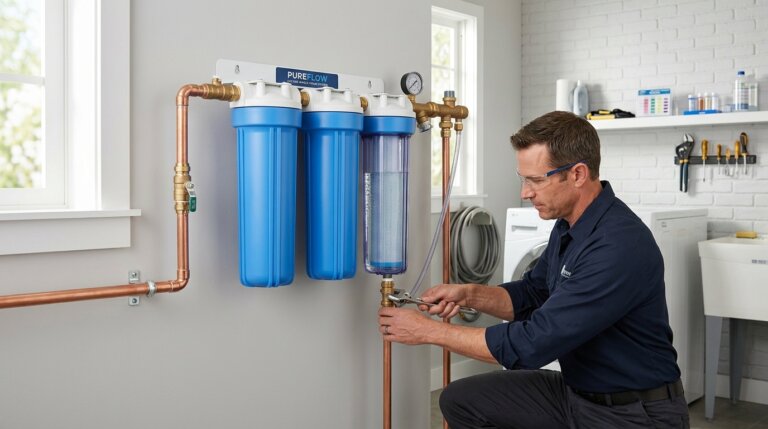
A water softener removes dissolved calcium and magnesium from all the water entering your home using ion exchange across a resin bed, while a shower filter removes chlorine, chloramine and heavy metals from a single fixture using KDF-55 and calcium sulfite media. Different chemistry, different scope, different problems.
| Water Softener | Shower Filter | |
|---|---|---|
| Removes | Calcium, magnesium (hardness) | Chlorine, chloramine, heavy metals |
| Method | Ion exchange (resin + brine) | Redox and adsorption (KDF, carbon) |
| Scope | Whole house, every tap | One fixture |
| Upfront cost | $500–$2,000 installed | $20–$80 |
| Running cost | Salt, ~$50–100/year | Cartridges, ~$30–40/year |
| Installation | Plumbing required | 2 minutes, no tools |
| Stops limescale? | A+ Yes | F No |
| Removes chlorine? | F No | A+ Yes |
| Certification | NSF/ANSI 44 available | D No standard exists |
Look at the last three rows. Each device scores an A+ where the other scores an F, which is the whole point of the shower filter vs water softener comparison. They are not competing products in the way a Brita and a PUR pitcher compete.
Do You Need a Shower Filter If You Have a Water Softener?
This is the question people ask most often, and the answer surprises them.
There is also a practical reason softener owners specifically benefit from a shower filter: chlorine damages softener resin. Free chlorine oxidises the polystyrene resin bead structure over time, shortening the bed’s life. Homes with high chlorine often install a carbon pre-filter ahead of the softener for exactly this reason.
The one case where a shower filter adds little: if you are on a private well with no chlorination. Well water has hardness and often iron, but no chlorine residual — so the filter’s main job is already done for you.
Shower Filter vs Water Softener: Match the Symptom
Your symptoms point clearly at one device or the other. This is the fastest way to decide:
| Symptom | Cause | What Fixes It |
|---|---|---|
| White scale on fixtures and kettle | Calcium carbonate | Softener |
| Spots on glassware after washing | Hardness minerals | Softener |
| Soap will not lather | Calcium reacting with surfactants | Softener |
| Skin feels tight and dry | Chlorine stripping lipid barrier | Shower filter |
| Chlorine smell in bathroom | Chlorine residual | Shower filter |
| Hair feels stripped and brittle | Chlorine binding to keratin | Shower filter |
| Skin feels filmy, soap will not rinse | Soap scum from hardness | Softener |
| Water heater losing efficiency | Scale on heating element | Softener |
| Both dry skin and scale | Chlorine + hardness | Both |
The Cost Comparison Over Five Years
The upfront gap looks enormous, but running costs narrow it less than people expect.
| Item | Water Softener | Shower Filter |
|---|---|---|
| Unit | $500–$2,000 installed | $20–$80 |
| Consumables, 5 years | $250–$500 (salt) | $150–$200 (cartridges) |
| Resin/media replacement | Resin lasts 10–15 years | Cartridge every 4–6 months |
| 5-year total | $750–$2,500 | $170–$280 |
On pure cost the shower filter vs water softener gap is four to ten times over five years. But a softener also protects a water heater that costs $1,000 to $2,500 to replace, and scale is a leading cause of premature heater failure. If you have genuinely hard water above 10 grains per gallon, the softener frequently pays for itself in appliance life alone.
What About Salt-Free “Conditioners”?
A third category sits between these two and deserves a clear explanation, because the naming is misleading.
Salt-free conditioners do not remove hardness minerals. They use template-assisted crystallisation to convert dissolved calcium into microscopic crystals that are less likely to stick to surfaces. The minerals are still in the water — your grains per gallon does not change — but scale adheres less readily.
Our hard water treatment options guide compares all three approaches on installed cost.
Which Setup Fits Your Home
Six common situations and the honest recommendation for each:
Pick: Shower filter only. You cannot plumb in a softener, and most landlords will not. A $30 filter is the entire realistic option.
Pick: Both. Softener for the scale and appliances, shower filter for the chlorine the softener leaves behind.
Pick: Add a shower filter. Your softener removes zero chlorine, and that is what causes dry skin post-shower.
Pick: Softener, skip the filter. No chlorine residual means the filter’s main job is unnecessary. See our well water softener guide.
Pick: Filter first. It costs 3% of a softener and fixes the symptom you feel daily. Save for the softener separately.
Pick: Shower filter. If your fixtures are scale-free, hardness is not your issue and a softener would be a $1,500 answer to the wrong question.
Three Claims to Ignore
The shower filter vs water softener comparison attracts a lot of marketing that does not survive scrutiny:
- “Shower head water softener” — no inline device performs ion exchange. Ceramic and “energy” beads have no softening capacity. One manufacturer, weAQUA, calls them “just clay with no real function” in its own listing.
- “A softener filters your water” — it does not. Ion exchange resin targets hardness ions specifically. Chlorine, sediment and most contaminants pass straight through.
- “99% chlorine removal, certified” — there is no NSF standard for shower filtration. Softeners can be certified to NSF/ANSI 44; shower filters cannot be certified to anything, so all percentages are manufacturer-tested.
Frequently Asked Questions
What is the difference between a shower filter and a water softener?
A water softener removes calcium and magnesium from the whole house using ion exchange, costing $500–$2,000 installed. A shower filter removes chlorine and heavy metals at one fixture for $20–$80 using KDF-55 and calcium sulfite. Neither does the other’s job: a softener removes zero chlorine, and a filter removes zero hardness.
Do you need a shower filter if you have a water softener?
Usually yes. A water softener does not remove chlorine — ion exchange resin only swaps hardness ions for sodium. Municipal water carries a chlorine residual of 0.2 to 4.0 mg/L, and that is what causes dry, tight skin after showering. The exception is private well water, which has no chlorination.
Can a shower filter soften water?
No. Softening requires ion exchange across a resin bed regenerated with brine — a process needing two tanks. Nothing that fits inline behind a shower head can do it. Products sold as “shower head water softeners” rely on ceramic or energy beads with no ion-exchange capacity, and your grains per gallon will be unchanged.
Which is better for hair, a shower filter or a softener?
They help with different problems. A filter removes chlorine, which binds to hair keratin and causes the stripped, brittle feeling. A softener stops calcium reacting with shampoo to leave a coating that will not rinse out. If your hair feels dry and straw-like, start with the filter; if it feels heavy and coated, the softener.
Does a water softener remove chlorine?
No. Softener resin is engineered specifically for calcium and magnesium ions and has no effect on chlorine or chloramine. In fact chlorine works against you here — free chlorine oxidises softener resin over time, which is why homes with high chlorine often add a carbon pre-filter ahead of the softener to protect the resin bed.
Is a shower filter or water softener cheaper?
A shower filter, by a wide margin. Over five years a filter runs roughly $170–$280 including cartridges, while a softener runs $750–$2,500 including salt. However, the softener protects a water heater costing $1,000–$2,500 to replace, and scale is a leading cause of premature failure, so in genuinely hard water it often pays for itself.
What about salt-free water conditioners?
They sit between the two and are widely misunderstood. A conditioner uses template-assisted crystallisation to make calcium less likely to stick to surfaces, but it does not remove the minerals. Your grains per gallon stays the same. It reduces scale in pipes and heaters, but soap still will not lather and glassware still spots.
Can I use both a shower filter and a water softener?
Yes, and for many homes on chlorinated municipal water that is the right answer. The softener handles hardness across the whole house; the filter handles the chlorine the softener leaves behind at your shower. They operate on different contaminants and do not interfere with each other.
Which should I buy first?
If money is tight, buy the shower filter first. It costs about 3% of a softener and addresses the symptom you feel daily. Then save for the softener if scale is damaging appliances. If your water heater is already scaling badly, reverse that order — heater replacement costs far more than either device.
Do I need a softener if my water is only slightly hard?
Probably not. Below about 7 grains per gallon most households see little scale and soap lathers acceptably. Between 7 and 10 it becomes a judgement call based on how much scale bothers you. Above 10 grains per gallon a softener is usually worth it for appliance protection alone. Check our 7 signs you need a water softener.
Is a whole-house filter the same as a softener?
No. A whole-house filter typically uses carbon or sediment media to remove chlorine, taste and particles from every tap — essentially a shower filter scaled up. It does not soften. A softener does not filter. Our whole-house vs under-sink guide covers the filtration side.
How do I know how hard my water is?
Check your utility’s annual water quality report, which publishes hardness in mg/L or grains per gallon, or use a home test kit for your specific tap. Above 7 grains per gallon is hard, above 10 is very hard. Municipal reports give a citywide figure, which can differ from your address if the city blends multiple sources.
Hard Water Deep Dives
We have published dedicated guides on the questions that come up most often from this page:
- Best Shower Filter for Hard Water — five models ranked by filtration media
- Do Shower Filters Actually Work? — claim by claim, what the chemistry supports
- What Size Water Softener Do I Need? — sizing by grains per gallon and household
- Hard Water Treatment Options — salt-based, salt-free and whole-house compared on cost
- 7 Signs You Need a Water Softener — the symptoms that justify the spend
- Hard Water vs Soft Water — the underlying chemistry explained
References & Sources
- USGS Water Science School — Hardness of Water
- NSF — Water Treatment Device Certification Standards
- CDC — Water Disinfection with Chlorine and Chloramine
- EPA — Drinking Water Regulations
- US Department of Energy — Water Heating Efficiency
The Bottom Line
Shower filter vs water softener is the wrong framing, because these devices do not overlap. A softener uses ion exchange to strip calcium and magnesium from every tap and removes exactly zero chlorine. A shower filter uses KDF-55 to strip chlorine at one fixture and removes exactly zero hardness. Match the device to the symptom: scale on fixtures, spotted glasses and soap that will not lather mean a softener; tight dry skin, chlorine smell and brittle hair mean a filter. If you already own a softener and your skin still feels dry after showering, that is chlorine, and a $30 filter is the missing piece. And ignore anything sold as a “shower head water softener” — ion exchange needs two tanks and a brine cycle, not a cartridge full of ceramic beads.