When you decide to filter your home’s water, the first big fork in the road is this: do you treat the water for the whole house, or just at the kitchen tap?
Whole-house and under-sink filters solve different problems at very different price points, and choosing the wrong one means either overspending or under-protecting. This guide compares the two head to head so you can match the system to what your water actually needs.
What a Whole-House Filter Does
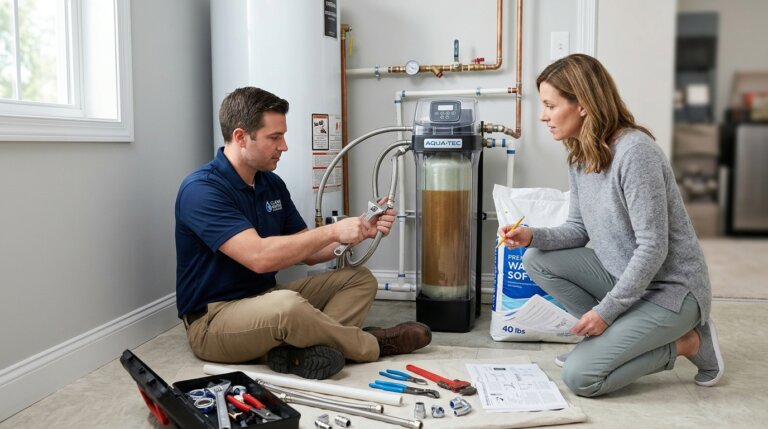
A whole-house filter, also called a point-of-entry (POE) system, is installed on the main water line where it enters your home. Every tap, shower, and appliance then receives filtered water.
This is the right approach when your water issue affects more than just drinking. Common examples include sediment that clogs fixtures, chlorine taste and smell throughout the house, or hard water leaving limescale on everything.
Because it protects plumbing and appliances as well as the water you drink, a whole-house system delivers broad, whole-home benefits. The trade-off is that the filtration is usually more general — it improves all your water rather than polishing one tap to drinking-water perfection.
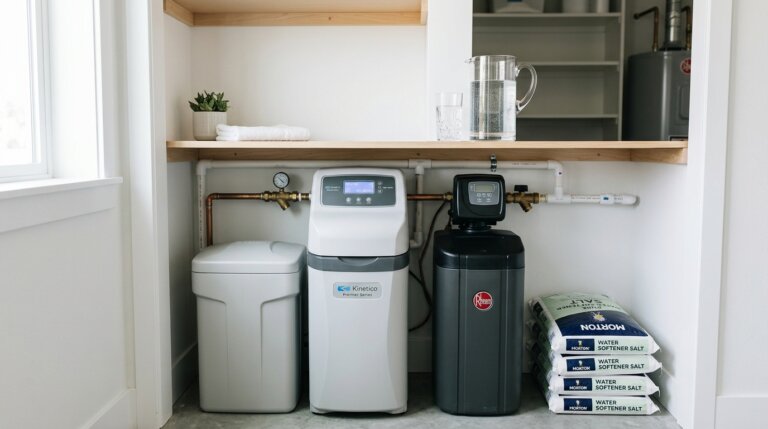
If hardness is your main complaint, note that a softener is a specific type of whole-house treatment. Our guide to the best water softeners covers that route, and how to fix hard water problems at home covers the wider options.
What’s Inside a Whole-House System
Most whole-house filters use a multi-stage approach matched to the home’s water. A typical setup begins with a sediment pre-filter that captures sand, rust, and grit, protecting the stages that follow.
After that comes the main media — often activated carbon to reduce chlorine, taste, and odor — and sometimes a specialised stage for iron, manganese, or hardness. The exact configuration depends on what your water test reveals.
Because these systems handle your entire water supply, they are sized to your home’s flow rate so that running several taps at once does not cause a pressure drop. This sizing is part of why professional installation is common.
What an Under-Sink Filter Does
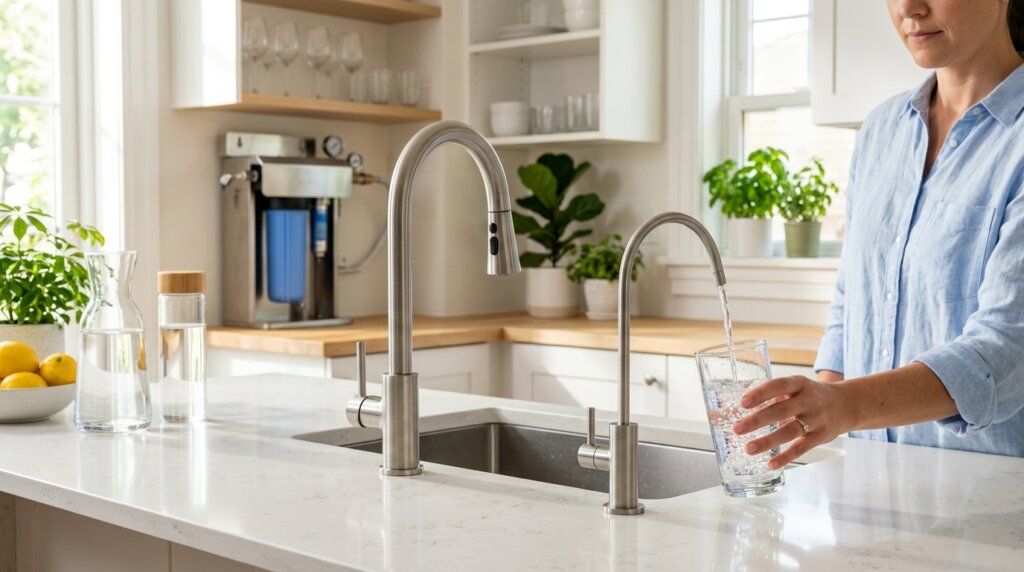
An under-sink filter, a point-of-use (POU) system, is installed under one sink — usually the kitchen — and filters only the water from that tap.
Because it only has to treat the water you drink and cook with, it can use higher-grade filtration without the cost of treating your entire supply. This is where reverse osmosis shines, removing a very wide range of contaminants for genuinely high-purity drinking water.
The limitation is scope. An under-sink unit does nothing for your shower, laundry, or other taps, so it will not stop limescale on your bathroom fixtures or chlorine smell in the shower. It is a focused tool for one job: excellent drinking water.
If high-purity drinking water is your goal, our roundup of the best reverse osmosis systems compares leading under-sink options, and our guide to the best water filters for home puts every type in context.
Under-Sink Types: Simple Filters vs Reverse Osmosis
Not all under-sink systems are equal. The simplest are single- or dual-stage carbon filters that improve taste and reduce chlorine and some contaminants, at a low price and with easy installation.
At the higher end sit reverse osmosis systems, which force water through a semi-permeable membrane to remove a very broad range of dissolved contaminants. They produce the purest drinking water available at home, but cost more, work more slowly, and produce some waste water.
Choosing between them comes down to what is in your water and how pure you want it. For taste and chlorine, a carbon filter may be enough; for the widest contaminant removal, reverse osmosis is the stronger choice.
Whole-House vs Under-Sink: Side by Side
| Factor | Whole-House (POE) | Under-Sink (POU) |
|---|---|---|
| Coverage | Every tap & appliance | One tap only |
| Best for | Sediment, chlorine, hardness home-wide | High-purity drinking & cooking water |
| Filtration grade | Broad, general-purpose | High (incl. reverse osmosis) |
| Protects appliances | Yes | No |
| Upfront cost | Higher | Lower |
| Installation | Main line, often a plumber | Under one sink, often DIY |
| Maintenance | Periodic cartridge changes | Periodic filter/membrane changes |
Which Filter for Which Problem
The clearest way to decide is to match the system to the specific problem your water test reveals. Different issues point naturally to one type or the other.
| Water Problem | Best Fit |
|---|---|
| Sediment / rust home-wide | Whole-house |
| Chlorine taste/smell at every tap | Whole-house |
| Hard water / limescale | Whole-house softener |
| Lead, dissolved solids in drinking water | Under-sink RO |
| Bad taste in drinking water only | Under-sink carbon |
| Both home-wide & drinking issues | Both combined |
This is why a water test comes first: it turns a vague “I want cleaner water” into a precise shopping list, so you buy exactly the system your situation calls for and nothing you do not need.
Which One Should You Choose?
The decision comes down to what problem you are solving. Start by identifying whether your issue is home-wide or limited to the water you drink.
Choose a Whole-House Filter If…
Your water problem affects the whole home — sediment damaging appliances, chlorine taste and smell at every tap, or hard water leaving scale across bathrooms and kitchen. You also want to protect plumbing and extend appliance lifespan.
In short, choose POE when the symptoms show up in more than one room.
Choose an Under-Sink Filter If…
Your main concern is the quality of water you drink and cook with, your home-wide water is otherwise fine, and you want high-grade filtration like reverse osmosis without a large budget.
Choose POU when the problem is essentially “I want better drinking water,” not “my whole supply needs work.”
When to Use Both
For many homes, the ideal setup is not either/or — it is both. A whole-house filter handles broad issues like sediment and chlorine across every tap, while an under-sink reverse osmosis unit polishes the kitchen water to drinking-grade purity.
This combination also has a practical benefit: the whole-house filter removes sediment and chlorine before they reach the under-sink RO membrane, which extends the life of the more expensive RO filters.
If budget allows and your water has both home-wide and drinking-specific issues, layering the two gives you complete coverage — broad protection everywhere, plus the purest possible water where you actually drink it.
Cost and Installation Realities
Budget often drives the decision, so it helps to be clear about the practical differences beyond the sticker price.
Whole-house systems cost more upfront and usually need professional installation on the main line, since the work involves cutting into your incoming supply. Their cartridges are larger and less frequent to change, but each replacement costs more.
Under-sink systems are far cheaper to buy and many are genuinely DIY-friendly, fitting under a standard sink with basic tools. Reverse osmosis units add a membrane that needs occasional replacement, and they produce some waste water, which is worth knowing if efficiency matters to you.
Maintenance and Running Costs Compared
The purchase price is only part of the story. Over years of ownership, maintenance is where the real cost difference shows up, and the two systems behave differently.
A whole-house system has larger cartridges that you change less often — often every six to twelve months depending on water quality and usage — but each cartridge costs more and there can be several stages to replace. The upside is infrequent attention; the downside is a bigger bill each time.
An under-sink system, especially reverse osmosis, has smaller and cheaper filters, but they may need changing more often, and the RO membrane itself is replaced every few years. Because it only treats one tap, the volume of water is small, which helps the filters last.
Neither is dramatically cheaper to run in every case; it depends on your water and usage. The key point is to budget for ongoing filter changes from the start, because a neglected filter performs worse than no filter at all once it clogs or saturates.
Start With a Water Test
Everything in this comparison points back to one first step: testing your water. Without knowing what is actually in it, you are guessing — and guessing leads to overspending or buying a system that does not target your real problem.
A test tells you whether your issues are aesthetic (taste, smell, staining) or involve specific contaminants like lead, nitrate, or bacteria, and whether they affect all your water or just what you drink. That single piece of information usually makes the whole-house-versus-under-sink choice obvious.
If you are on a private well, testing is even more important, since well water is unregulated and more variable. Either way, an inexpensive test or your utility’s published water quality report is the cheapest, smartest first purchase you can make.
Renters and Apartments: A Special Case
If you rent or live in an apartment, the whole-house-versus-under-sink choice is partly made for you. Installing a whole-house system means modifying the main water line, which usually is not possible — or permitted — in a rental.
For renters, point-of-use options are the practical answer. An under-sink filter can sometimes be fitted with a landlord’s permission, but even simpler are countertop filters, faucet-mounted filters, and filter pitchers that require no plumbing changes at all and move with you when you go.
These portable options will not match a full reverse osmosis system for purity, but they meaningfully improve taste and reduce chlorine and some contaminants in your drinking water. For most renters concerned mainly with what they drink, that is a sensible, low-commitment solution.
If your building has hard water or other home-wide issues, those are the landlord’s domain — but your drinking water is something you can improve yourself with a point-of-use filter, no installation drama required.
How Long Each System Lasts
Beyond the filters themselves, the systems have an overall lifespan worth factoring into the decision, since it affects long-term value.
A quality whole-house system’s housing and main components can last many years — often a decade or more — with only the internal cartridges needing regular replacement. Because it is plumbed into your main line, it becomes a semi-permanent part of the home’s infrastructure.
Under-sink systems, including reverse osmosis, also last for years, with the membrane being the longest-lived consumable and the carbon pre- and post-filters changed more often. Their smaller scale makes them easy to replace entirely if a newer model suits you better.
In both cases, the system lasts far longer than any single filter inside it, so the ongoing cost is dominated by consumables rather than replacing the unit. Buying a well-made system upfront tends to pay off over its long service life.
Common Mistakes to Avoid
A few recurring errors lead people to waste money or end up disappointed with their filtration. They are easy to sidestep once you know them.
- Buying before testing. Choosing a system without knowing your water’s problems often means paying for filtration you do not need or missing the issue you do have.
- Expecting an under-sink filter to fix home-wide problems. It will not stop limescale in your shower or chlorine smell at other taps — that needs whole-house treatment.
- Expecting a whole-house filter to match RO purity. General whole-house filtration improves all your water but does not polish drinking water the way an under-sink RO does.
- Undersizing a whole-house system. A unit too small for your flow rate causes pressure drops when several taps run at once.
- Neglecting maintenance. A clogged or saturated filter performs worse than none; skipping changes undermines the whole investment.
Avoid these and you will get filtration that actually matches your home and keeps performing for years.
Frequently Asked Questions
Is a whole-house filter better than an under-sink filter?
Neither is universally better — they solve different problems. A whole-house filter treats all your water for home-wide issues like sediment and chlorine, while an under-sink filter gives higher-purity drinking water at one tap. The best choice depends on whether your concern is home-wide or just drinking water.
Can I have both a whole-house and under-sink filter?
Yes, and it is often the ideal setup. The whole-house unit handles broad issues across every tap while an under-sink reverse osmosis system polishes drinking water. The whole-house filter also protects the under-sink membrane, extending its life.
Does an under-sink filter remove more than a whole-house filter?
For the single tap it serves, yes — under-sink systems, especially reverse osmosis, typically remove a wider range of contaminants than a general whole-house filter. The trade-off is that they only treat that one tap, not your whole supply.
Which is cheaper to install?
Under-sink filters are cheaper to buy and often DIY-friendly, fitting under a standard sink. Whole-house systems cost more and usually need professional installation on the main water line, since the work involves your incoming supply.
Do I need a whole-house filter if I have a water softener?
A water softener is itself a whole-house treatment for hardness. You may still want additional whole-house filtration for sediment or chlorine, or an under-sink filter for drinking water, depending on what else is in your supply. A water test clarifies what you need.
How do I know which one my home needs?
Start with a water test to identify your specific issues. If problems affect multiple rooms — scale, sediment, chlorine smell — lean whole-house. If your only goal is better drinking and cooking water, an under-sink filter is the more cost-effective fix.
Does a whole-house filter reduce water pressure?
A properly sized whole-house filter should not noticeably reduce pressure. Problems arise when a unit is too small for the home’s flow rate or its cartridges are clogged from missed maintenance. Sizing it to your household and changing filters on schedule prevents pressure drops.
Can I install an under-sink filter myself?
Many under-sink filters are designed for DIY installation and connect to the existing cold water line under the sink with basic tools. Reverse osmosis systems are a little more involved because of the membrane, tank, and drain connection, but are still within reach for a confident DIYer.
Related Guides
- Best Reverse Osmosis Systems for Home 2026
- Best Water Filters for Home in 2026
- How to Fix Hard Water Problems at Home
- How to Remove Hardness from Drinking Water
References & Sources
The Bottom Line
Choose a whole-house filter when your water problem affects the whole home — sediment, chlorine, or hardness across every tap — and you want to protect plumbing and appliances too. Choose an under-sink filter when your goal is high-purity drinking and cooking water at a lower cost.
For homes with both kinds of issue, combining the two gives complete coverage — and the whole-house unit even extends the life of your under-sink filters. Whichever way you go, start with a water test so you treat the right problem at the right point.