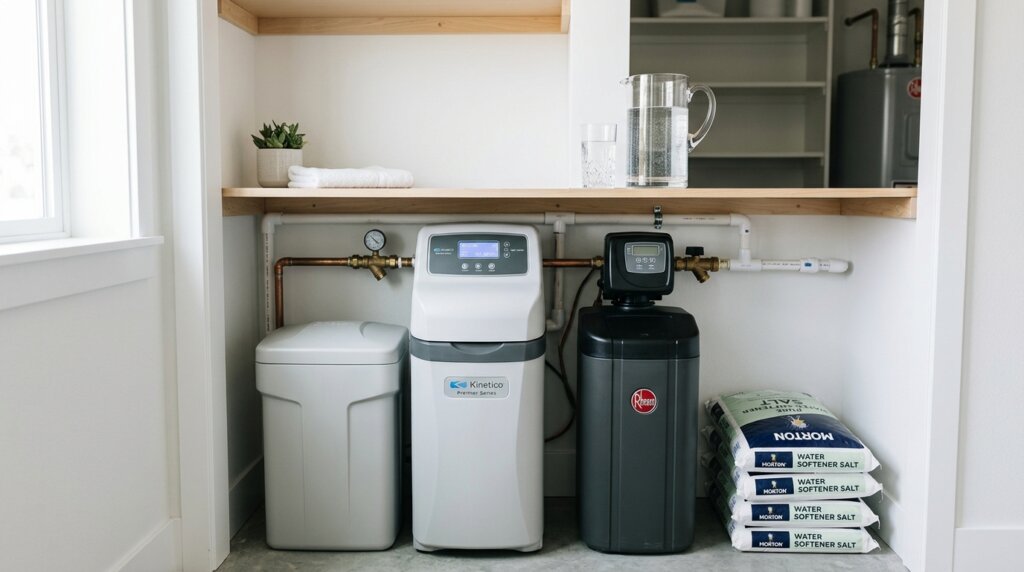
The best water softener for most homes is the Whirlpool WHES48: it is certified to NSF/ANSI 44 for both hardness reduction and salt efficiency, handles water up to 160 grains per gallon and 12 ppm of iron, and gets 5,107 grains of softening from each pound of salt. For a mid-size home the GE GXSH40V is our second pick, and the Morton M34 uses the least water per grain of any model we checked. All six picks below come from NSF’s public certification listing, and every number comes from the maker’s own manual.
We ranked these differently from most “best softener” lists. We did not start from brand popularity. We started from the one test that tells you a softener does what its box says, then read each certified model’s specification sheet line by line. Popular brands that we could not find in that listing are covered further down, with what to ask the seller before you buy.
Disclosure: some links below are Amazon affiliate links. If you buy through them we may earn a small commission at no extra cost to you. It does not change the ranking, which is based on the certified specs.
Get an installed price, yearly salt cost and payback estimate for your household size and water hardness.
Why we ranked by NSF/ANSI 44 first
NSF/ANSI 44 is the American standard for household cation exchange water softeners, the salt-based kind that actually removes calcium and magnesium. A softener can be certified for hardness reduction alone, or also carry the “Efficiency Rated” claim, which is much harder to earn. The Pacific Northwest National Laboratory’s Building America guide spells out what the efficiency rating requires. The softener must:
- “Be a demand-initiated regeneration system”, meaning it uses a flow meter or a hardness sensor to decide when to clean itself. The guide adds that “devices that use time clock-initiated regeneration (fixed time schedule) do not qualify for the efficiency rating.”
- “Have a rated salt efficiency of not less than 3,350 grains of total hardness exchange per pound of salt.”
- “Not generate more than 5.0 gallons of water per 1,000 grains of hardness removed during the service cycle.”
Those three lines are the reason we put certification first. A timer-only softener regenerates on schedule whether you used water or not, so it burns salt and sends water down the drain on days you were away. An efficiency-rated softener has been tested to prove it does not. Every model in our ranking is listed by NSF as both “Hardness Reduction” and “Efficiency Rated.” We checked NSF’s public NSF/ANSI 44 listing on October 29, 2026.
If you are still deciding whether you need one at all, start with the signs you need a water softener and our explainer on hard water vs soft water.
The best water softeners of 2026, ranked
All figures below are from each maker’s installation manual, except the flow rate, which is the figure printed in NSF’s certification listing. “Salt efficiency” is the rated efficiency at the minimum salt dose, the number the efficiency rating is tested at.
| Rank | Model | Max capacity | Salt efficiency | Water per 1,000 grains | Max hardness | Max clear-water iron | Flow (NSF) |
|---|---|---|---|---|---|---|---|
| 1 | Whirlpool WHES48, best overall | 48,000 grains | 5,107 grains/lb | 3.0 gal | 160 gpg | 12 ppm | 12 gpm |
| 2 | GE GXSH40V, best for a mid-size home | 40,000 grains | 5,100 grains/lb | 2.7 gal | 110 gpg | 8 ppm | 9.5 gpm |
| 3 | Morton M34, least water used | 34,900 grains | 5,060 grains/lb | 2.3 gal | 110 gpg | 9 ppm | 7.8 gpm |
| 4 | Whirlpool WHES40E, easiest to buy online | 40,000 grains (model name) | Efficiency Rated (NSF) | See manual | See manual | See manual | 7.6 gpm |
| 5 | Whirlpool WHES30, best for 1 to 2 people | 30,100 grains | 5,000 grains/lb | 2.3 gal | 95 gpg | 8 ppm | 7.6 gpm |
| 6 | Rheem RHS32, extra radium claim | See manual | Efficiency Rated (NSF) | See manual | See manual | See manual | 8 gpm |
Gpg means grains per gallon, the unit softeners use for hardness. Flow is the most water the softener can pass while still softening it, which matters when two showers and a washing machine run at once. If you are not sure which capacity your home needs, our water softener sizing guide walks through the math, and there is a worked example further down this page.
1. Whirlpool WHES48: best water softener overall
The WHES48 is the model we would buy for a family home with hard water. Its manual rates it at 48,000 grains at the maximum salt dose and 5,107 grains per pound of salt at the minimum dose. It is the only softener in our group rated for water up to 160 gpg and clear-water iron up to 12 ppm, and NSF lists it at 12 gpm, the highest flow of the six. That headroom is why it ranks first: it suits a busy household on city water and a lot of private wells.
Its control chooses the salt dose for you. In Whirlpool’s words: “The salt dose is selected by the electronic controls at regeneration time based on the amount needed.” The brine tank holds 200 lb of salt, so at about a pound a day (see the worked example below) a full tank lasts for months. Two honest drawbacks: it uses 3.0 gallons per 1,000 grains at the minimum dose, a little more than the Morton and GE units, and the manual notes that “State of Wisconsin requires additional treatment if water supply contains clear water iron exceeding 5 ppm.”
Best for: households of three or more, very hard water, or a well with some iron.
2. GE GXSH40V: best for a mid-size home
The GXSH40V is the efficient middle choice. GE rates it at 40,000 grains at 15.1 lb of salt, and 5,100 grains per pound at its 2.3 lb minimum dose. It uses 2.7 gallons per 1,000 grains during regeneration, less than the WHES48, and NSF lists it at 9.5 gpm. It handles hardness up to 110 gpg and 8 ppm of iron. GE also lists it for barium and radium 226/228 reduction in the NSF listing.
GE’s warranty is the clearest of the group: one year on any part, with GE covering labor in that year; three years on the electronic monitor; and ten years on the resin tank. If your water is harder than 110 gpg, the larger GXSH45V is rated for 160 gpg and 10 ppm iron.
Best for: two to four people on moderately hard to hard water who want lower salt and water use than a bigger unit.
3. Morton M34: uses the least water
Morton’s M34 uses 2.3 gallons of water per 1,000 grains removed at its minimum salt dose, the lowest figure we found among the certified models. Its salt efficiency is 5,060 grains per pound, its maximum hardness is 110 gpg, and its iron limit is 9 ppm, the highest in Morton’s M20 to M34 range. The trade-off is size: 34,900 grains at most and 7.8 gpm, so a large family with two bathrooms in use at once will feel the limit before they would with the WHES48.
If you are on a septic system or in a drought area where every gallon down the drain counts, this is the one we would look at first. Morton’s manual recommends its own System Saver pellets; our water softener salt guide covers pellets vs crystals for any brand.
Best for: smaller homes, septic systems and anyone who wants the least wastewater.
4. Whirlpool WHES40E: easiest to buy online
NSF lists the WHES40 as Hardness Reduction and Efficiency Rated, at 7.6 gpm. We could not download the WHES40E manual from Whirlpool’s site, so we are not quoting capacity or iron figures we have not read ourselves. Read the specification page in the box before installing, and check the rating decal, which Whirlpool places on the rim below the salt lid hinges. We include it because it is sold on Amazon and at big-box stores, which makes it the simplest certified softener to order and return.
Best for: an average city-water home that wants a certified unit with easy delivery.
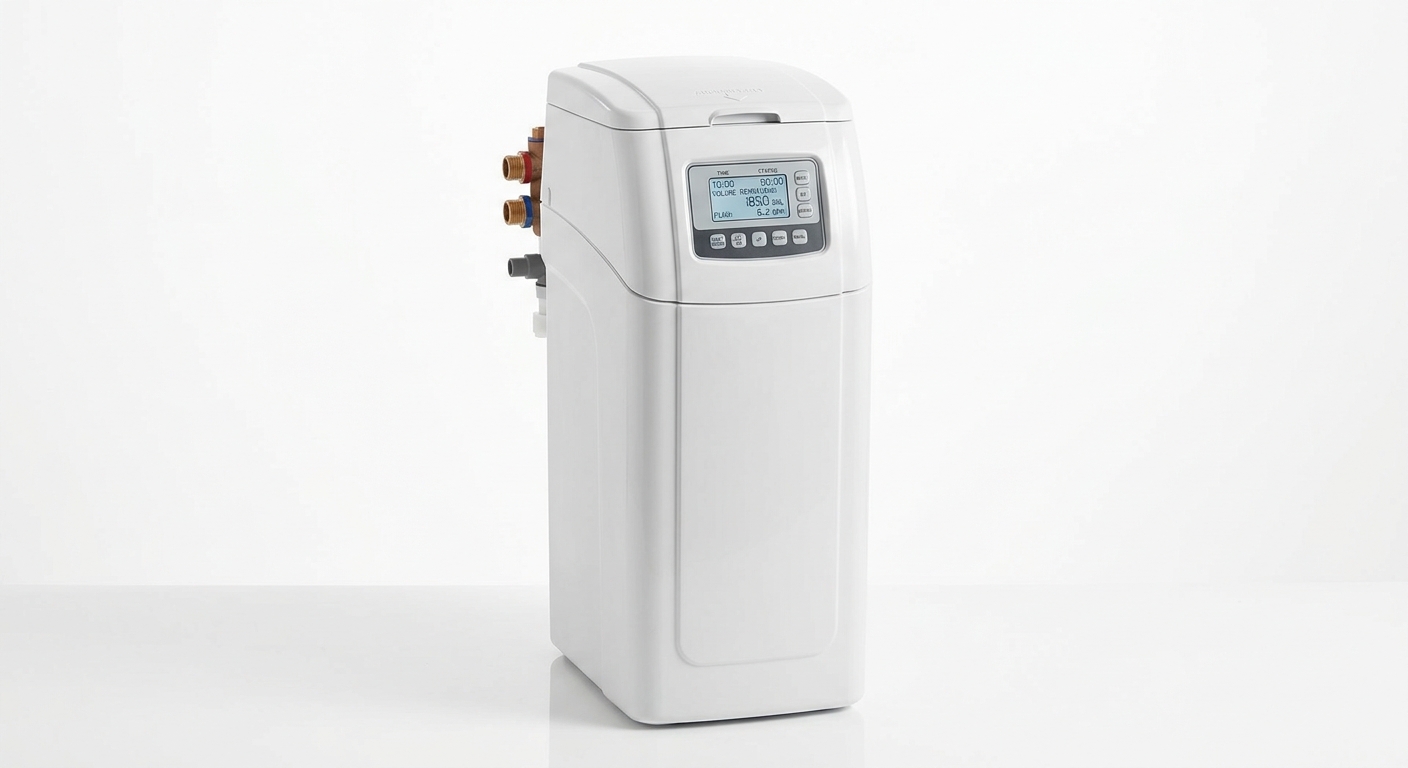
Whirlpool WHES40E 40,000 Grain
Listed by NSF (as WHES40) for hardness reduction and efficiency. Resin and salt in one cabinet, with demand-initiated regeneration. Check your water’s hardness against the manual’s limits before you order.
5. Whirlpool WHES30: best for one or two people
The WHES30 is the small, efficient unit. Its manual rates it at 30,100 grains at 13.1 lb of salt and 5,000 grains per pound at a 2.9 lb minimum dose, and it ties the Morton M34 on water use at 2.3 gallons per 1,000 grains. It is rated for 95 gpg and 8 ppm iron. For a couple or a single person on moderately hard city water, a bigger tank buys you little except a larger box in the garage.
Best for: apartments with a laundry hookup, condos, and small homes.
6. Rheem RHS32: if radium is on your water report
NSF lists the Rheem RHS32 as Efficiency Rated and Hardness Reduction at 8 gpm, and also for barium and radium 226/228 reduction. That last claim matters for some private wells, where radium shows up in groundwater. If your well test shows radium, a certified softener is one of the treatments worth pricing. Ask the seller for the manual’s specification page so you can check its hardness and iron limits against your test.
Best for: well owners whose test shows radium or barium along with hardness. Read our guide on what a well water test costs before you buy anything for a well.
The capacity on the box costs the most salt
This is the part most buyers miss. The big number in a softener’s name, such as 40,000 or 48,000 grains, is its capacity at the maximum salt dose. The efficiency rating is tested at the minimum dose. Whirlpool’s WHES48 manual says it plainly: “The efficiency rating is valid only at the minimum salt dose.” Here is what that means in salt, using each maker’s own capacity tables:
| Model | Low salt dose | Medium dose | Maximum dose |
|---|---|---|---|
| Whirlpool WHES48 | 14,300 grains @ 2.8 lb = 5,107 per lb | 37,900 @ 10.5 lb = 3,610 per lb | 48,000 @ 18.1 lb = 2,652 per lb |
| GE GXSH40V | 11,700 @ 2.3 lb = 5,087 per lb | 31,500 @ 8.7 lb = 3,621 per lb | 40,000 @ 15.1 lb = 2,649 per lb |
| Morton M34 | 13,700 @ 2.7 lb = 5,074 per lb | 29,200 @ 8.6 lb = 3,395 per lb | 34,900 @ 14.5 lb = 2,407 per lb |
| Whirlpool WHES30 | 14,700 @ 2.9 lb = 5,069 per lb | 25,400 @ 8.0 lb = 3,175 per lb | 30,100 @ 13.1 lb = 2,298 per lb |
At the low dose these softeners get roughly twice as much softening from each pound of salt as at the maximum. To remove one million grains of hardness, about 196 lb of salt does the job at 5,100 grains per pound, against about 377 lb at 2,650 grains per pound. That is why we prefer a demand-controlled softener with enough resin that it rarely needs the top dose, and why we would not pick a model just because its headline capacity is bigger.
How to size a water softener: a worked example
You need two numbers: your hardness in grains per gallon and how much water your household uses. The U.S. Geological Survey classes water by hardness in milligrams per liter: 0 to 60 is soft, 61 to 120 moderately hard, 121 to 180 hard, and over 180 very hard. Divide mg/L by 17.1 to get grains per gallon. Our free water quality checker shows what your utility reports, and a well needs its own test.
For water use, the EPA’s WaterSense program puts the average at 82 gallons per person per day at home. Here is the math for a family of four on 15 gpg water (about 257 mg/L, very hard):
- 4 people x 82 gallons = 328 gallons a day.
- 328 gallons x 15 grains = 4,920 grains of hardness to remove each day.
- At 5,107 grains per pound (the WHES48 at its low dose), that is about 0.96 lb of salt a day, or roughly 350 lb a year: about nine 40 lb bags.
- At 2,652 grains per pound (the same softener at its maximum dose), it is about 1.86 lb a day, or roughly 680 lb a year: about seventeen bags.
Our rule of thumb: pick a softener whose low-dose capacity covers at least two to three days of your household’s grains. In this example that is about 10,000 to 15,000 grains, which the WHES48 (14,300) and Morton M34 (13,700) both meet. Your own salt use will land between the two figures above, because the control picks the dose. For the yearly cost of that salt, try our water softener cost estimator.
Popular brands we could not find in the NSF listing
Many “best water softener” lists lead with SpringWell, SoftPro and Fleck. We searched NSF’s public NSF/ANSI 44 listing for each and did not find them. That does not prove they perform badly. Some companies certify through other bodies such as the Water Quality Association, and a valve brand like Fleck sells the control head that dealers build into their own systems. But it does mean the claims you read about them come from the seller, not from a certification report we could check. Before buying any of these, ask the seller for the certificate number and the standard it was tested to.
SpringWell SS1 and SoftPro Elite
Both are sold direct from their own websites and are popular in online reviews. Both use demand-initiated control. The figures you will see quoted for them, such as large salt savings, come from the sellers. If either one can show you an NSF/ANSI 44 Efficiency Rated certificate, or an equivalent one, it belongs on a list like ours. Until then we cannot rank it above a model whose numbers we checked.
Fleck 5600SXT
The Fleck 5600SXT is a metered control valve, and the systems sold under that name are usually built by a dealer around it: their tank, their resin, their brine tank. That is why it is a favorite of DIY installers who want parts they can service themselves. Quality depends on who assembled the kit, so read the listing for the resin type and the tank size, and set the valve to meter-based (demand) regeneration rather than a timer.
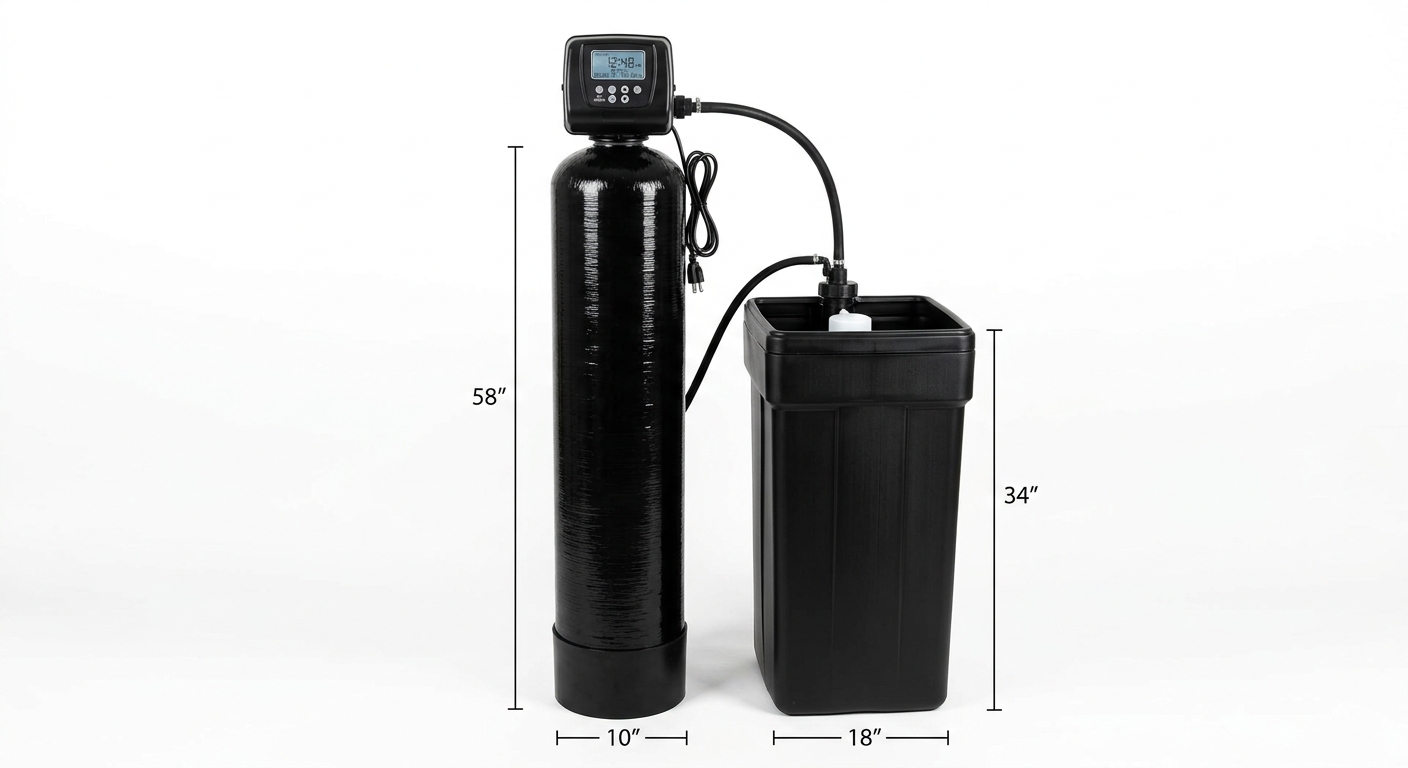
Fleck 5600SXT 48,000 Grain (Loaded)
A dealer-built kit around the Fleck metered valve, with brine tank and bypass. Not found in NSF’s NSF/ANSI 44 listing, so ask the seller for any certification before you buy.
Salt-free systems such as SpringWell FutureSoft
NSF/ANSI 44 covers cation exchange softeners, so a salt-free conditioner is outside its scope. Salt-free units do not remove calcium and magnesium; they aim to stop it forming scale. They can make sense for mild hardness or if you cannot add sodium, but you will not get the slippery soft-water feel. Our comparison of a water softener vs filter vs conditioner explains which problem each one solves.
Portable softeners for RVs and renters
For an RV, a boat or a rental where you cannot cut into the plumbing, a portable unit that connects to a hose is the practical choice. These are small, regenerate with table salt by hand, and are not efficiency rated, so think of them as a stopgap rather than a whole-house solution.
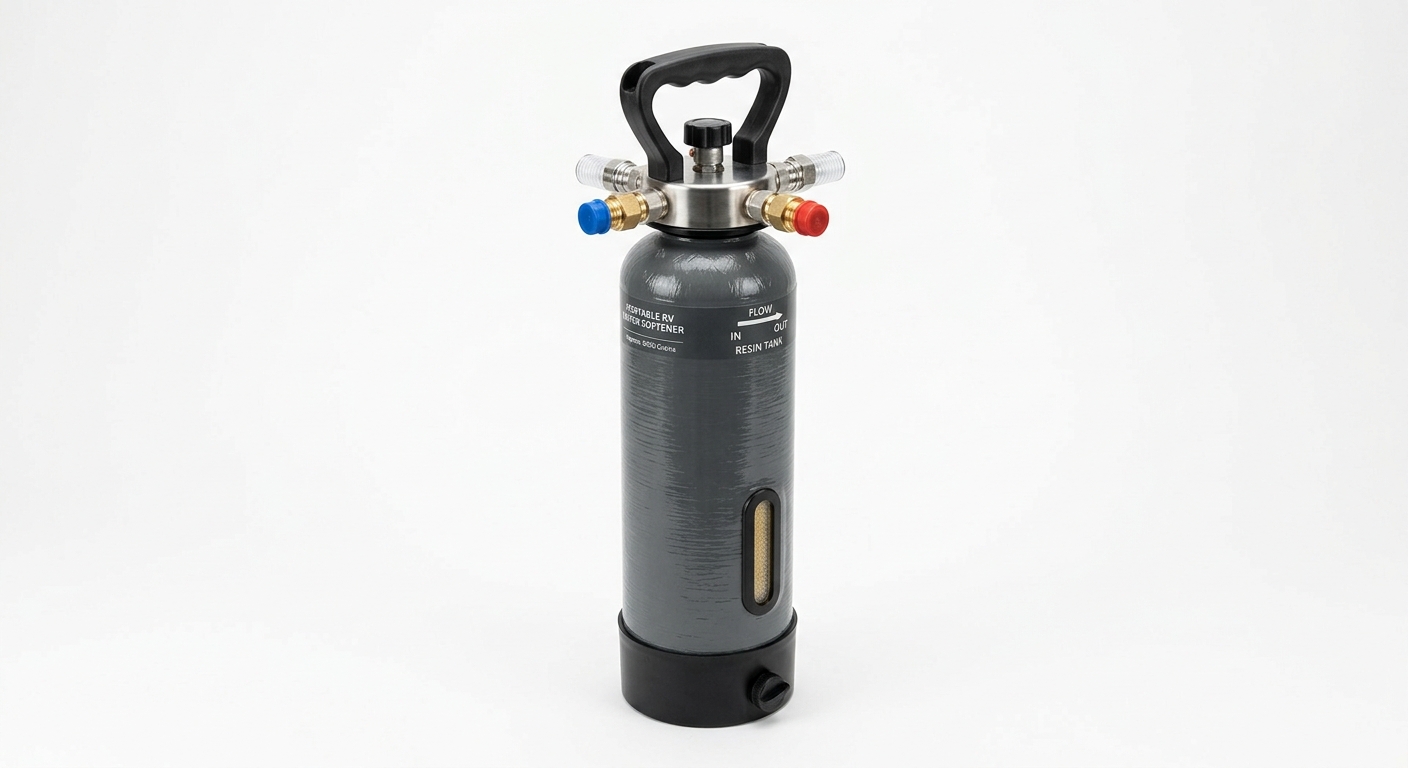
On The Go OTG4 16,000 Grain Portable
A hose-connected portable softener that you regenerate with ordinary table salt. No installation, so it suits RVs, boats and rentals. Not a whole-house system.
Which water softener is best for your home?
- City water, family of three or more: Whirlpool WHES48, or the GE GXSH40V if your hardness is under 110 gpg. Our guide to the best water softener for city water goes deeper on chlorine and chloramine.
- Well water with iron: the WHES48 is rated for 12 ppm, but above about 5 ppm (the level where Wisconsin requires extra treatment) we would put an iron filter in front. See iron in well water, how to remove iron from well water and our best softener for well water with iron. If you see orange slime, read about iron bacteria first, because a softener will not fix it.
- Private well, no iron problem: start with our best water softener for well water picks and a fresh well test.
- Septic system or water restrictions: Morton M34, at 2.3 gallons per 1,000 grains.
- One or two people: Whirlpool WHES30.
- Only bothered by dry skin and hair: a shower filter may be enough. Compare a shower filter vs a water softener before you buy a whole-house system.
A softener does not filter lead, PFAS or chlorine taste. If those are on your water report, you need a filter as well; our whole house water filter guide explains how the two fit together.
What a water softener costs to buy and run
The unit is only part of the cost. You also pay for installation, unless you do it yourself, and for salt every year. Using the worked example above, a family of four on 15 gpg water should budget for somewhere between nine and seventeen 40 lb bags a year, depending on how the softener doses. For full price ranges see our guide to how much a water softener costs, and for the plumbing side, water softener installation cost, DIY vs professional. Our overview of hard water treatment options compares softeners with the alternatives.
Once it is installed
Set the hardness on the control to your tested number, not a guess, and keep the salt level above the water in the brine tank. If the water starts feeling hard again or you hear odd noises during regeneration, our guides to a water softener that is not working and a water softener making a loud noise cover the usual causes. Scale left behind from before the softener can be cleaned off with the methods in how to remove hard water stains, and our guide to fixing hard water problems at home covers the rest of the house.
Frequently asked questions
What is the best water softener?
For most homes we rank the Whirlpool WHES48 first. It is NSF/ANSI 44 certified for hardness reduction and efficiency, rated for 160 gpg hardness and 12 ppm iron, and gets 5,107 grains of softening per pound of salt at its minimum dose.
What is the best water softener for a family of four?
The Whirlpool WHES48 or the GE GXSH40V. In our worked example, a family of four on 15 gpg water needs about 4,920 grains of softening a day, and both models cover two to three days of that at their most salt-efficient dose.
Which water softener uses the least salt?
Among the certified models we checked, the Whirlpool WHES48 (5,107 grains per pound), GE GXSH40V (5,100) and Morton M34 (5,060) are the most salt-efficient at their minimum dose. All demand-initiated, efficiency-rated softeners must reach at least 3,350 grains per pound.
What does NSF 44 certification mean on a water softener?
NSF/ANSI 44 is the standard for household cation exchange softeners. “Efficiency Rated” means the softener uses demand-initiated regeneration, gets at least 3,350 grains of hardness exchange per pound of salt, and uses no more than 5.0 gallons of water per 1,000 grains removed.
Is a 40,000 grain water softener enough?
For many homes, yes. But 40,000 grains is the capacity at the maximum salt dose. At the most efficient dose a 40,000-grain model such as the GE GXSH40V delivers about 11,700 grains, so size it against your daily grains, not the number in the name.
Are SpringWell and SoftPro softeners NSF certified?
We did not find either brand in NSF’s public NSF/ANSI 44 listing when we checked in October 2026. Some brands certify through other bodies, so ask the seller for the certificate number before you buy.
What is the best water softener for well water?
For a well with hard water and some iron, the Whirlpool WHES48 is rated for 12 ppm clear-water iron. Above about 5 ppm, put an iron filter in front of the softener, and test the well first.
Are salt-free water softeners worth it?
Only for mild hardness or if you cannot add sodium. Salt-free conditioners do not remove calcium and magnesium and are outside the NSF/ANSI 44 standard, so you will not get the soft-water feel of an ion exchange softener.
Sources
- NSF International, NSF/ANSI 44 certified residential water softener listings, checked October 29, 2026.
- Pacific Northwest National Laboratory, Building America Solution Center, Water Softeners.
- U.S. Geological Survey, Hardness of Water.
- U.S. EPA WaterSense, Statistics and Facts.
- U.S. EPA, Private Drinking Water Wells.
- Manufacturer installation and operation manuals: Whirlpool WHES48, Whirlpool WHES20/WHES30, Morton M20/M27/M30/M34, GE GXSH40V/GXSH45V (specifications, performance claims and warranty pages).