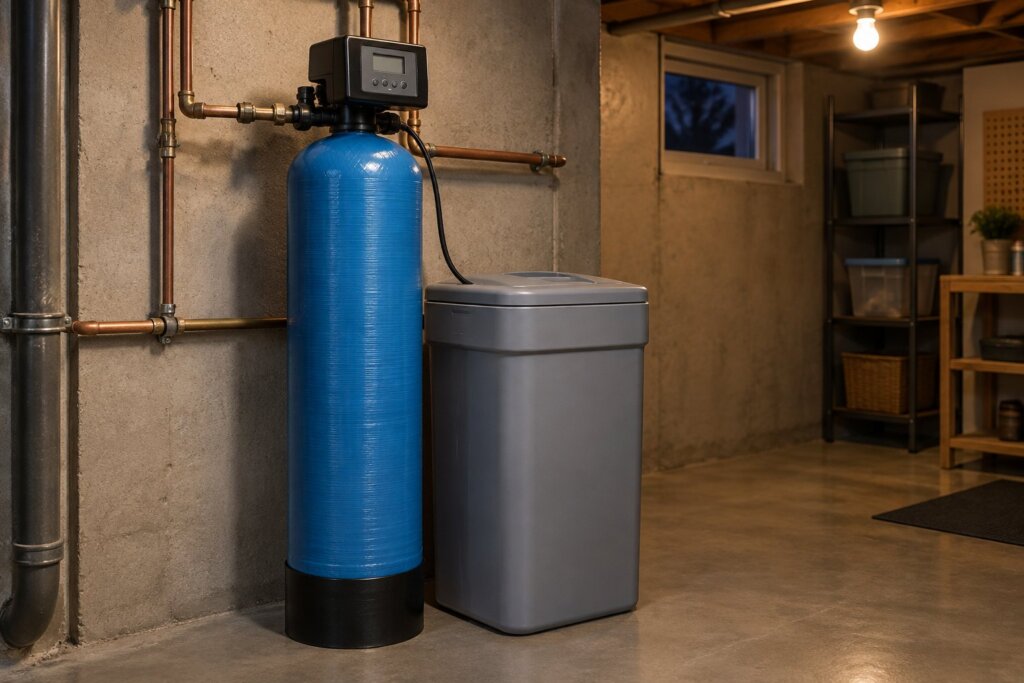
A water softener making loud noise is usually doing exactly what it should: regenerating. Most units start at 2 a.m., run for about one to two hours, and send water rushing to the drain while a small motor turns the valve. That sounds alarming from a bedroom above the utility room, but it is normal. The noises that are not normal are water running to the drain all day, a motor that never stops, and pipes that bang.
We read the owner’s and service manuals for Fleck, Clack, Culligan, Whirlpool, GE, Morton, Rheem, Kinetico and WaterBoss, plus University of Nebraska Extension and two plumbing sources on water hammer. Here is how to tell the normal sounds from the faults, and what the manuals say to do about each.
Is it normal for a water softener to make a loud noise?
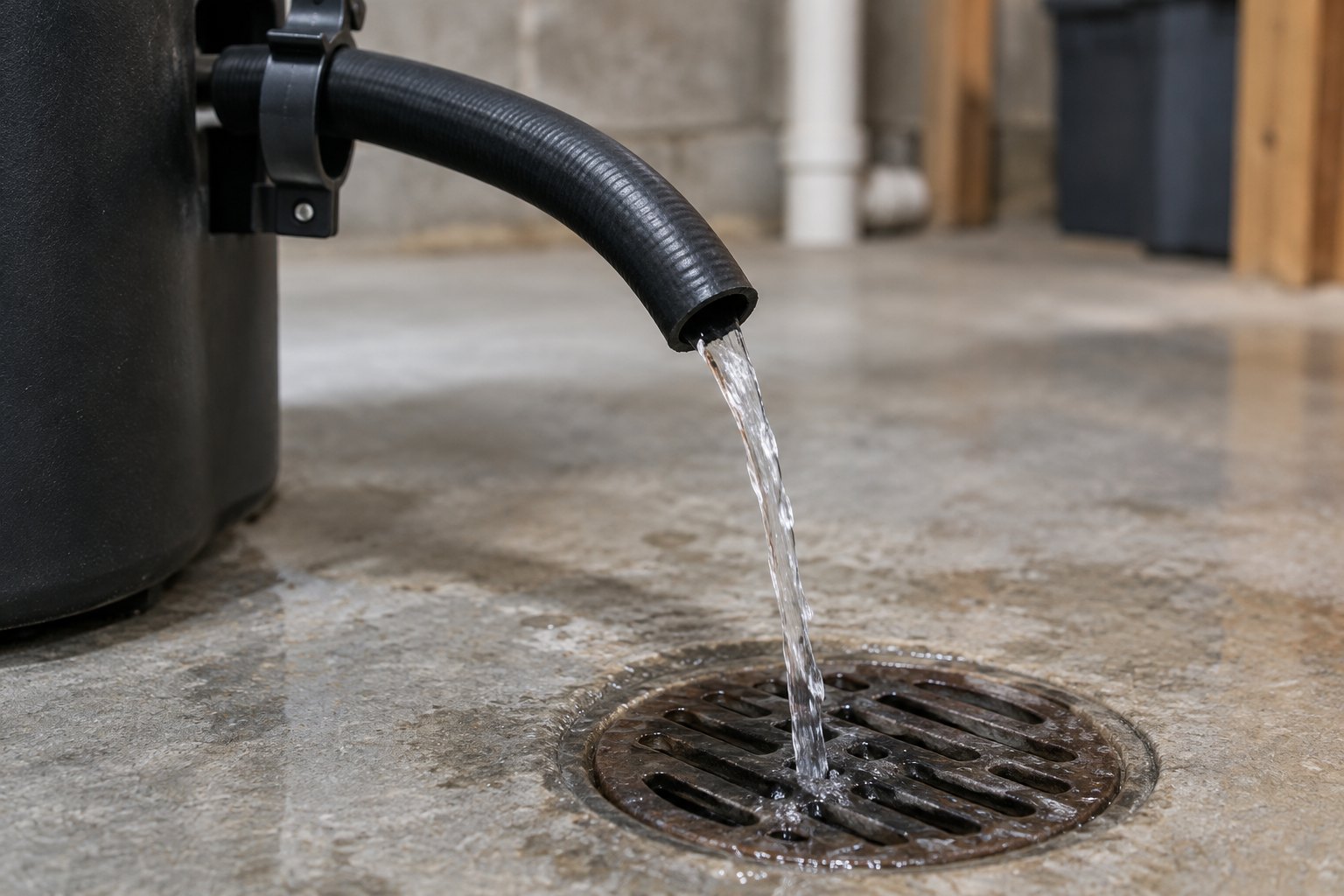
During regeneration, yes. GE’s manual explains that recharge “is started at 2:00 AM (factory setting)” and “consists of five stages or cycles. These are FILL, BRINING, BRINE RINSE, BACKWASH and FAST RINSE.” Several of those stages push water hard through the valve and out the drain line, and that is the rushing sound you hear.
How long it lasts depends on the unit:
- GE, Morton, Rheem: about 2 hours.
- Culligan HE: 62 to 78 minutes on average, depending on the model.
- WaterBoss: “typically complete in about 30 minutes.”
- University of Nebraska Extension: “Sixty to 120 minutes generally are required for the brine to pass through the unit and flush the tank before soft water is available again.”
Nebraska Extension also says regeneration uses “approximately 50 gallons of water,” which explains why it is not a quiet trickle.
What does it sound like when a water softener is regenerating?
Whirlpool’s manual walks through a manual regeneration and tells you what to look for at each stage. Matched to what you hear:
| Stage | What the manual says | What you hear |
|---|---|---|
| Backwash | “Look for a fast flow of water from the drain hose.” | Loud rushing water at the drain |
| Brine draw | “A slow flow of water to the drain will begin.” | A quieter, steady flow |
| Fast rinse | “Again look for a fast drain flow.” | Rushing water again |
| Between stages | The “valve gear and motor area, which rotates during regenerations.” | A short motor whir or click |
One more source of noise is easy to fix. Whirlpool tells installers to “secure drain hose. This will prevent ‘whip-ping’ during regenerations.” A loose drain hose can slap against a wall or the floor drain every time the fast flow starts. A couple of hose clips usually end it.
We did not find any manual that describes a steady hiss as normal. If you hear one outside a regeneration, treat it as a leak to check.
Water softener making loud noise at night: can you change it?
Yes. The 2 a.m. start is a default, not a requirement. Whirlpool explains it: “This is a good time in most households because water is not being used.” Kinetico gives the other reason: “Single tank, electric water softeners tend to be set to regenerate at night because of the unavailability of soft water during the regeneration process.” GE notes that “HARD WATER is bypassed to house faucets during recharge.”
So you can move the start time on most units, as long as you pick a time when nobody showers or runs the dishwasher. If the softener sits under a bedroom, we would try a time when the house is empty, such as late morning on a workday, rather than the middle of the night. Nebraska Extension suggests a low-use window “between midnight and 4 a.m.”
Twin-tank and demand units work differently. Kinetico’s manual answers the owner who asks why the softener now runs during the day: it “regenerates whenever necessary, at any time of day.” On those systems, daytime noise is normal too.
Water softener noises that are not normal
Water running to the drain all the time
This is the most common real fault. Fleck’s service manual lists “Drain flows continuously” with three causes: the “valve is not programming correctly,” “foreign material in control,” or an “internal control leak,” whose fix is “Replace seals and piston assembly.” Clack’s manual adds “power outage during regeneration,” a “damaged seal/stack assembly,” “piston assembly failure,” and a “drive cap assembly not tightened in properly.” Beyond the noise, this one wastes a lot of water, so we would not wait on it.
A motor that keeps running, buzzing or cycling
Fleck lists “Control cycles continuously” and blames a “misadjusted, broken, or shorted switch.” Its error 0 means “the valve drive took longer than 6 minutes to advance to the next regeneration position,” and the manual says to check the motor and drive train and “verify that the piston travels freely.” Clack’s E2 error is the same family: the motor “was unable to find the next cycle position and stalled,” from “foreign material” or “mechanical binding.” WaterBoss lists a unit that “stays in regeneration” with the motor running and says to “repair the drive end cap.” Any of these is a service call unless you are comfortable pulling the valve apart.
Banging pipes (water hammer)
A loud bang or knock in the pipes is water hammer. A State Water Heaters technical bulletin defines it as “the destructive forces, pounding noises and vibration in a piping system when water flowing through a pipeline is stopped abruptly,” and says the common causes are “single lever faucets” and “automatic solenoid valves (dishwashers, washing machines, etc.).” Watts, which makes water hammer arrestors, names “fast closing shutoff valves, dishwashers, and clothes washers.”
We found no manual or plumbing source that blames the softener itself, so note when the bang happens. If it comes when the washer or dishwasher shuts off, the fix belongs at that appliance. The bulletin says “arrestors should be located as close as possible to the source of the shock wave.” Minnesota’s plumbing board notes that arrestors “are not required unless water hammering has been identified,” so this is a fix for a problem you actually hear.
Sputtering, air and cloudy water
Right after an install, GE lists water with air bubbles that looks cloudy and says it goes away once the system has run for a while. On a well, Fleck lists “air in water system” and says to make sure the well has a “proper air eliminator control” and to check for a “dry well condition.”
Is your water pressure causing the problem?
Pressure that is too low or too high causes several of these symptoms. Almost every manual we read gives the same range:
- 20 to 125 psi: Fleck, Clack, Whirlpool, GE, Morton, Rheem and Culligan HE.
- 15 to 125 psi: Kinetico.
- 20 to 120 psi: WaterBoss, which recommends a pressure regulator above 70 psi.
High pressure wears out parts. Rheem says “high pressure may cause inner valve parts failure” and to add a pressure reducing valve “if daytime pressure is over 100 psi.” Whirlpool warns that “if daytime pressure is over 80 psi, nighttime pressure may exceed the maximum.” Low pressure stops the brine draw: Whirlpool says a drain hose that is too long or runs too high “may cause back pressure, stopping brine draw,” and Clack says pressure “must remain at minimum of 25 psi.” A cheap gauge on a hose spigot tells you where you stand.
What we would buy for this job
- CARBO 0 to 200 psi water pressure test gauge, 3/4 inch hose thread: tells you in a minute whether you are inside the 20 to 125 psi range the manuals give. The red max pointer catches overnight spikes.
- Sioux Chief 660-HB hose-thread water hammer arrestor, 3/4 inch: fits a washing machine supply valve, the most common source of banging pipes.
As an Amazon Associate, Complete Water Guide earns from qualifying purchases. Prices change, so check the listing.
Check the drain line
A drain line that is too long, too high or blocked makes the valve work harder and can stop regeneration from finishing. The manuals agree on the basics:
- Length and height: GE, Morton, Rheem and Whirlpool all say to avoid drain hose runs longer than 30 feet and to keep the hose no more than 8 feet above the floor.
- Air gap: Fleck requires “a 2x the drain line pipe diameter air gap” with “a minimum 1″ air gap,” and Whirlpool, Morton and Rheem say 1-1/2 inches. Clack says, “Never insert a drain line directly into a drain, sewer line, or trap.”
- Size: Fleck says a residential drain line should be at least 1/2 inch, and runs over 20 feet need 3/4 inch.
- Flow control: Fleck’s fix for a softener that “fails to draw brine” is “Clean drain line flow control.”
How to stop the noise while you troubleshoot
Use the bypass valve. GE and Morton say, “Bypass valves allow you to turn off water to the softener for maintenance if needed, but still have water in house pipes.” WaterBoss says it “can isolate the appliance should the appliance malfunction or leak.” On a Culligan Gold, “turn the blue knob clockwise” to bypass and counterclockwise to return to service. Your house gets hard water while it is bypassed, so treat this as a pause, not a fix.
What are signs that your water softener is going bad?
Noise is one sign; hard water is the bigger one. If you see scale again, soap that will not lather, or salt that never goes down, start with our list of signs a water softener needs repair. One common cause is a salt bridge, a hard crust that forms over empty space in the brine tank. WaterBoss says to “push the handle into the salt to dislodge the salt bridge, or use hot water around the inside perimeter to loosen salt.” The wrong salt makes bridges more likely; our guide to water softener salt pellets vs crystals covers which to buy.
If the unit is old, undersized or failing often, it may be time to replace it. Our guides on what size water softener you need and how much a water softener costs cover the next step.
Frequently asked questions
Why is my water softener so loud at night?
Because most softeners regenerate at 2 a.m. by default, when nobody is using water. Regeneration takes about 30 minutes to 2 hours depending on the model and sends fast-flowing water to the drain. You can move the start time on most units.
How long does a water softener regeneration take?
About 2 hours on GE, Morton and Rheem units, 62 to 78 minutes on Culligan HE models and about 30 minutes on WaterBoss. University of Nebraska Extension says 60 to 120 minutes in general.
Why does my water softener sound like water is running all the time?
Continuous flow to the drain is a fault. Fleck and Clack manuals blame a valve that is not positioning correctly, debris in the control, worn seals or a failed piston. Bypass the softener and call for service, because it wastes water.
Can a water softener cause water hammer?
We found no manual or plumbing source that says so. Water hammer usually comes from fast-closing valves such as washing machine and dishwasher valves or single-lever faucets. A water hammer arrestor near that appliance is the standard fix.
What water pressure does a water softener need?
Most manuals say 20 to 125 psi. Kinetico allows 15 psi minimum, and WaterBoss caps it at 120 psi and recommends a regulator above 70 psi.
How long does a water softener last?
None of the 11 manuals we read gives a lifespan in years. Dealer blogs often say 10 to 15 years, which we treat as a sales estimate. Keeping pressure in range, using clean salt and fixing leaks early all help.
Sources
- Pentair Fleck, 5600SXT Downflow Service Manual, and 5600 SXT User Guide.
- Clack, WS1 and WS1.25 Drawings and Service Manual; WS1.5/2 service manual.
- Culligan, HE Water Softener Owner’s Guide and Gold Series Owner’s Guide.
- Whirlpool WHES48, GE GXSH40V/45V, Morton M20 to M34, Rheem RHS32, Kinetico Signature Series and WaterBoss 700/900/950 owner’s manuals.
- University of Nebraska-Lincoln Extension, publication G1491 on water softening.
- State Water Heaters, Technical Bulletin 11: Water Hammer.
- Minnesota Department of Labor and Industry, Plumbing Board ruling PB0157.
- Watts, water hammer arrestors product page.