Quick answer: For most homes, the best water softener salt is high-purity evaporated salt pellets (99.8%+ sodium chloride) — they dissolve cleanly and resist bridging and mushing. Diamond Crystal and Morton are the leading NSF-certified brands. Solar salt crystals are a cheaper, eco-friendly option for light-to-moderate hardness. If your water has iron, use an iron-fighting salt (green-bag “Rust Buster” type). For low-sodium diets, potassium chloride works in any standard softener. Avoid rock salt, which has impurities that clog the brine tank.
The salt you put in your water softener matters more than most people think. Choose the wrong type and you can quietly wreck your softener’s efficiency, clog the brine tank, or end up fighting a stubborn salt bridge that lets hard water slip right back into your home. The good news: once you understand the four main salt types and how to dose them, buying the right bag becomes simple. This guide walks through every option, names the specific brands worth buying, and shows you how to avoid the two problems — bridging and mushing — that cause most softener headaches.
The four types of water softener salt
Almost every bag on the shelf falls into one of four categories. They differ in how they’re made, how pure they are, and how much maintenance they create.
1. Evaporated salt pellets (the gold standard)
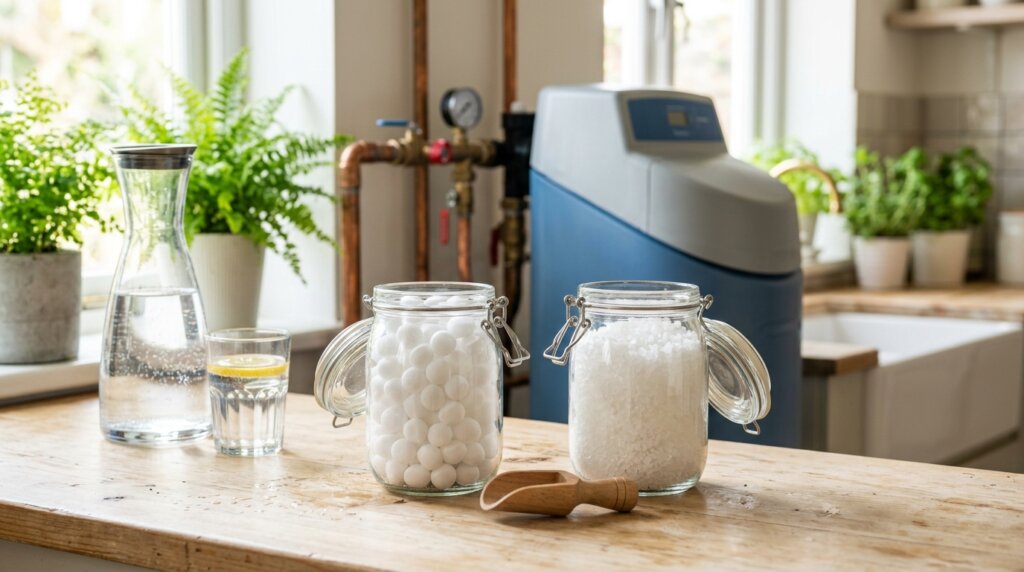
Evaporated pellets are made by boiling brine until only crystallized sodium chloride remains, then compressing it into pellets. This process produces the purest salt available — typically 99.6% to 99.8%+ sodium chloride. That high purity is why pellets are the recommended choice for most residential softeners: they dissolve cleanly, leave almost no residue in the brine tank, and strongly resist both bridging and mushing. They’re the best pick for very hard water (15+ grains per gallon) and for compact all-in-one (single-tank cabinet) softeners, which can clog if you use crystals.
2. Solar salt crystals (the budget pick)
Solar salt is made by evaporating seawater or brine using sun and wind, leaving behind salt crystals. It’s high purity (around 99.5%) but slightly less pure than premium pellets, and it contains more water-insoluble residue that gradually builds up as sludge in the tank. Solar crystals are budget-friendly and eco-conscious, and they work well for light-to-moderate hardness — provided you clean the tank periodically. They’re more prone to mushing in humid conditions, so they’re a weaker choice for basement installs.
3. Rock salt (avoid it)
Rock salt is mined directly from underground deposits. It’s the cheapest option, but it’s also full of impurities like dirt and calcium sulfate that don’t dissolve. Those impurities settle into the brine tank as muck, clog the system, and force more frequent cleaning. The small upfront saving isn’t worth the maintenance and reduced efficiency. Skip it.
4. Potassium chloride (the sodium-free alternative)
Potassium chloride replaces sodium chloride entirely for people on low-sodium diets, those with sodium-restricted septic or greywater systems, or anyone wanting to reduce salt discharge into the environment. It works in any standard ion-exchange softener with no hardware changes. The trade-offs: it costs three to four times as much, and it’s slightly less efficient, so you should set your softener’s hardness level about 10% higher to compensate.
Pellets vs crystals: which should you buy?
This is the most common question, and the answer for most homes is pellets. Here’s the practical difference. Pellets dissolve more predictably, cause fewer salt bridges, and produce far less tank residue. In real-world use, people who switch from crystals to pellets often report using fewer bags per year despite the higher per-bag price — one long-time softener owner went from roughly 15 bags of crystals a year to about 7 bags of pellets with no change in water quality, simply because pellets waste less.
Crystals still have their place: they’re fine in smaller or lower-use systems where bridging is unlikely, and they cost less per bag. But they’re more prone to mushing (a sludge layer at the bottom of the tank) in humid conditions. One hard rule regardless of which you choose: never mix pellets and crystals in the same tank. Their different dissolution rates create uneven brine and unpredictable regeneration.
Best water softener salt brands compared
Two brands dominate the U.S. market — Diamond Crystal and Morton — along with premium dealer-only cube salts. Here’s how the main options compare.
| Salt / Brand | Purity | Best for | Notes |
|---|---|---|---|
| Diamond Crystal Bright & Soft (pellets) | ~99.8% | Most homes, very hard water | Highly water-soluble; minimal bridging/mushing |
| Morton Clean & Protect (pellets) | ~99.6% | Most homes | Additives that help keep the system clean during regeneration |
| Iron-fighting pellets (Rust Defense / Iron Fighter) | ~99.6% | Water with iron/staining | Green bags; additive cleans iron from resin |
| Solar salt crystals | ~99.5% | Light-moderate hardness, budget | More residue; clean tank periodically |
| Dura-Cube / Hardi-Cube (dealer cube salt) | 99.8%+ | High iron, premium | Sold by water-treatment dealers; very low residue |
| Potassium chloride | ~99%+ KCl | Low-sodium homes | 3-4× the price; set hardness ~10% higher |
| Rock salt | ~95-98% | Not recommended | Impurities clog the tank |
The honest takeaway from years of head-to-head comparisons: Diamond Crystal and Morton are both excellent, NSF-certified, and reliable. Diamond Crystal edges ahead marginally on purity and low residue; Morton’s Clean & Protect line adds cleaning additives and often has slightly sturdier packaging. For most people the deciding factors are price and what’s stocked at your local store — either will serve you well.
Our pick for most homes: high-purity evaporated pellets (99.8%+) from an NSF-certified brand like Diamond Crystal Bright & Soft or Morton Clean & Protect. Switch to iron-fighting pellets if you have rust staining, or potassium chloride for a low-sodium home.
Special situations: iron, low-sodium, and humidity
- Iron in your water: If you see orange/brown staining on fixtures or laundry, use an iron-fighting salt (green-bag “Rust Buster,” “Iron Fighter,” or “Rust Defense”). These pellets include an additive — usually citric acid or sodium bisulfate — that cleans iron and manganese off the softening resin so your softener keeps working. Note this is only a supplement; heavy iron needs a dedicated iron filter (see below).
- Low-sodium diet or septic concerns: Potassium chloride adds no sodium to your water or wastewater. Set your hardness about 10% higher to make up for its lower efficiency, and expect to pay more per bag.
- High humidity (basement installs): Stick with evaporated pellets, which resist moisture-driven bridging far better than crystals. Keep the tank no more than three-quarters full.
How much salt does your softener actually need?
Using the right amount of salt matters as much as the type. Too little and your water stays hard; too much and you invite salt bridges and waste money. Your softener uses salt to “regenerate” — flushing accumulated hardness minerals off the resin and recharging it with sodium.
A typical residential softener uses roughly 6 to 10 lbs of salt per regeneration, and most homes regenerate every few days, which works out to about 40 to 50 lbs (one bag) every 4 to 8 weeks for an average family. Your actual usage depends on three things: your water hardness (grains per gallon), your household’s water consumption, and how efficiently your softener is programmed. Harder water and more people mean more frequent regeneration and more salt.
The practical routine: check the brine tank about once a month and refill when the salt drops below the halfway mark. Never fill it to the very top — keep the salt level around knee height (roughly three-quarters full at most). Overfilling is one of the leading causes of salt bridges.
Avoiding salt bridges and mushing
These are the two failures that quietly ruin softener performance. Knowing how to spot and prevent them saves you money and hard-water headaches.
Salt bridges
A salt bridge is a hard crust that forms across the tank, leaving an empty air gap underneath. When this happens, the softener draws brine from below the bridge but the salt never actually dissolves into the water — so the resin doesn’t recharge, and hard water returns even though the tank looks full of salt. Bridges are caused by high humidity, overfilling, low-quality salt, or temperature swings. To break one, gently push a broom handle down through the crust. To prevent them: use high-purity pellets, don’t overfill, and occasionally loosen the top layer.
Salt mushing
A salt mush is the opposite problem — dissolved salt recrystallizes into a sludgy layer at the bottom of the tank that blocks the brine pickup. Mushing is more common with crystals and lower-purity salt. It usually requires scooping out the tank and cleaning it. Prevention is the same: buy high-purity pellets and clean the tank once or twice a year.
Quick troubleshooting
- Salt level never drops: Likely a salt bridge, or the softener isn’t regenerating — check power, the timer/valve settings, and the brine line.
- Water suddenly feels hard again: Check for a bridge; verify the salt setting; confirm the unit is regenerating on schedule.
- Brown residue or sludge in tank: Low-purity salt or iron — switch to high-purity pellets or iron-fighting salt and clean the tank.
- Going through salt very fast: Very hard water, high water use, or a softener set to over-regenerate — consider a metered (demand-based) valve.
What softener salt costs
Typical U.S. retail prices per 40-lb bag: rock salt $5–8, solar salt crystals $6–12, evaporated pellets $10–18, and potassium chloride $25–35. Buying in bulk (multiple bags, or by the pallet from farm/hardware stores) lowers the per-pound cost. When comparing, look for at least 99.6% purity and NSF/ANSI 60 certification, which confirms the salt is safe for drinking-water treatment. Remember that a slightly pricier high-purity pellet often costs less over a year because you use fewer bags and clean the tank less often.
The bottom line
For the vast majority of homes, buy high-purity evaporated pellets from Diamond Crystal or Morton, keep the tank around half to three-quarters full, and check it monthly. Choose iron-fighting pellets if you have staining, potassium chloride if you need a sodium-free option, and skip rock salt entirely. Do that, and your softener will run efficiently for years with minimal maintenance.
New to softeners or shopping for a system? See our guides on water softener cost and the best water softeners, learn the signs you need a water softener, and read up on iron in well water if you have staining.
Frequently asked questions
What is the best type of water softener salt?
For most homes, evaporated salt pellets are the best choice: they’re the purest (99.6–99.8%+ sodium chloride), dissolve cleanly, and resist salt bridging and mushing. Diamond Crystal and Morton are the leading NSF-certified brands. Solar salt crystals are a cheaper, eco-friendly option for light-to-moderate hardness. Avoid rock salt, which has impurities that clog the brine tank.
Are salt pellets or crystals better?
Pellets are better for most systems. They dissolve more evenly, cause fewer salt bridges, produce less tank residue, and work in both large and small tanks — many people actually use fewer bags per year with pellets. Crystals work in smaller or lower-use systems but are more prone to bridging in humid conditions. Don’t mix the two in the same tank.
What salt should I use if my water has iron?
Use an iron-fighting salt (often sold as “Rust Buster,” “Iron Fighter,” or “Rust Defense” in green bags). These pellets include an additive like citric acid or sodium bisulfate that helps clean iron and manganese from the softening resin. For heavy iron, pair it with a dedicated iron filter.
Is potassium chloride better than salt?
Potassium chloride is a sodium-free alternative for people on low-sodium diets or who want to reduce brine discharge. It works in any standard softener but costs more ($25–35 per bag vs $6–18 for salt) and is slightly less efficient, so set your hardness about 10% higher.
How often should I add salt to my softener?
Check the salt level about once a month and refill when it drops below half full. Keep the tank no more than about three-quarters full (roughly knee height) to help prevent salt bridges. An average household uses about one 40-lb bag every 4 to 8 weeks.
Which is better, Diamond Crystal or Morton?
Both are excellent, NSF-certified brands. Diamond Crystal edges ahead slightly on purity and low residue; Morton’s Clean & Protect line adds cleaning additives and sturdier packaging. For most people the choice comes down to price and local availability — either performs well.
Reviewed by the Complete Water Guide team. This article is for general information and is not a substitute for professional water-quality or medical advice. We may earn a commission from some links on this page.