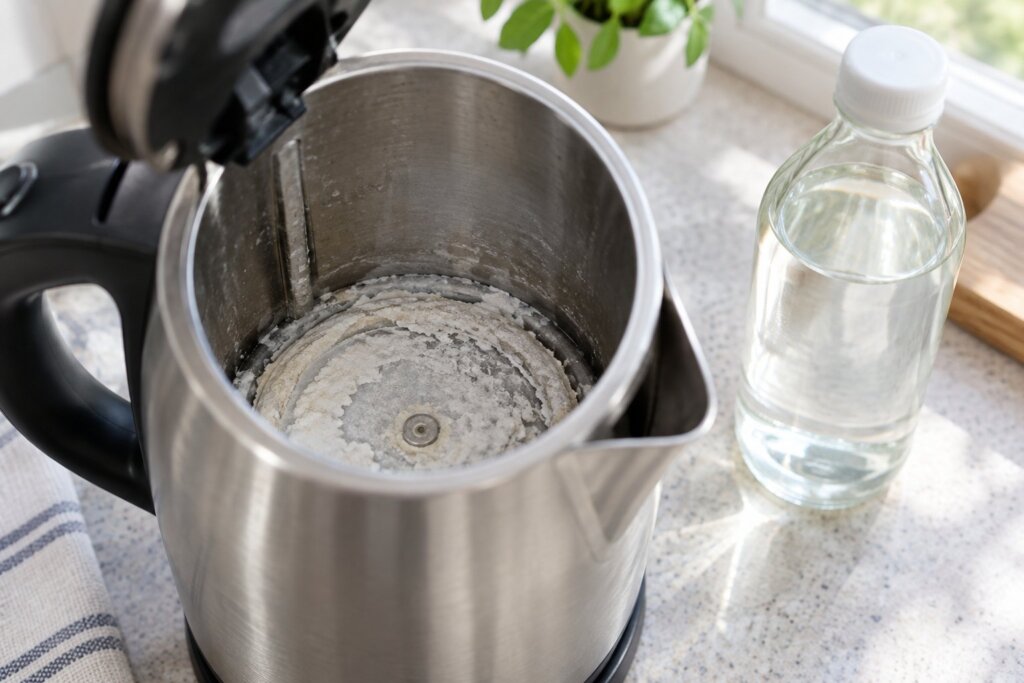
Here is how to descale a kettle the way most kettle makers tell you to: fill it with a mix of white vinegar and water, bring it to a boil, let it stand for at least 30 minutes or overnight, pour it out, then boil and throw away clean water twice. That is the method in the Breville, KitchenAid and Fellow instructions, with small differences in the ratio. If you would rather not use vinegar, citric acid, cream of tartar or a kettle descaler all work too.
We read the descaling instructions from Breville, Fellow, KitchenAid, Smeg, Hamilton Beach, Cuisinart and Russell Hobbs, plus Le Creuset’s stovetop care notes and what UK water authorities and WHO say about limescale. Below are the exact ratios, what not to do, and why one popular home remedy goes against a maker’s own manual.
How to descale a kettle, step by step
- Empty the kettle and unplug it from the base.
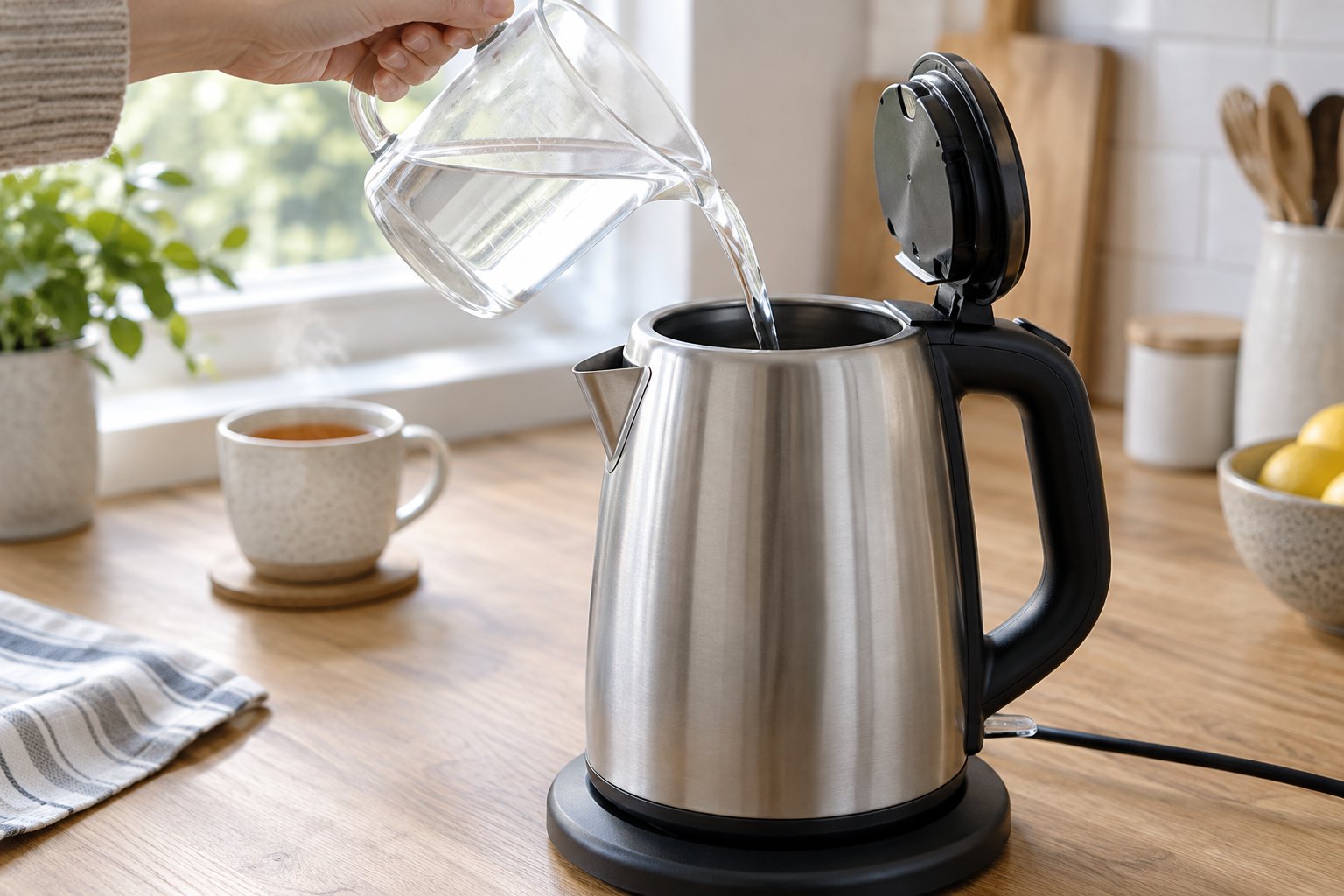
- Add vinegar and water. Breville uses “1 part vinegar and 2 parts water,” filled to 2/3 full. KitchenAid and Fellow use about half vinegar and half water.
- Boil it. Breville says to “boil and allow to stand overnight.” Fellow says to let it “sit for at least a half-hour before dumping it out.” For light scale, 30 minutes is enough; for a thick crust, we leave it overnight.
- Pour it out and wipe any loose flakes with a soft cloth.
- Boil and discard clean water. Breville says to “fill the kettle with clean water, bring to boil and discard the water,” then repeat. KitchenAid also does this twice. This gets rid of the vinegar taste.
Keep the window open. Smeg says, “Don’t breathe the fumes coming from the kettle while it’s being descaled,” and Cuisinart says, “Take care not to inhale fumes.”
How much vinegar do you use to descale a kettle?
Every maker gives a slightly different recipe. Here is what each one says:
| Maker | Mix | Time | After |
|---|---|---|---|
| Breville | 1 part vinegar, 2 parts water, kettle 2/3 full | Boil, stand overnight | Boil and discard clean water, twice |
| KitchenAid | Vinegar to the 0.5 L mark, water to 1 L (about half and half) | Boil, stand overnight | Boil and drain clean water twice |
| Fellow | Half vinegar, half water | Boil, at least 30 minutes | Rinse |
| Smeg UK | Boil 1 L of water, then add 100 to 500 ml vinegar while hot | 8 to 10 hours | Fill, boil and empty at least twice |
| Cuisinart (glass kettle) | Enough vinegar to cover the bottom by about 2 cm | Boil; repeat if needed | Rinse several times |
| Le Creuset (stovetop) | Equal parts water and white vinegar, filled to the maximum | Simmer gently for 20 minutes | Rinse and dry |
Our take: half and half is the safe middle. If your kettle’s manual gives a recipe, use that one, because it is the one the warranty assumes you followed.
How do you descale a kettle without vinegar?
Three options the makers themselves give:
- Citric acid. Fellow says to heat “a solution of 500mL of water and 2 spoonfuls of citric acid,” bring it to a boil, and let it sit for at least half an hour. It has no vinegar smell, which is why we use it.
- Cream of tartar. Hamilton Beach’s manual says to “place 1/2 teaspoon cream of tartar … into the kettle. Then fill the kettle 1/2 full with water,” bring it to a boil, let it cool and “rinse several times with clean tap water.”
- A kettle descaler. KitchenAid says, “A commercial descaler is recommended,” and Russell Hobbs says to “descale the appliance with a proprietary descaler.” Breville’s own Kettle Cleaner is 125 ml in 2 liters of water, boiled and left for 30 minutes. Fellow points owners to Urnex Dezcal.
Do you use baking soda or vinegar to descale a kettle?
Vinegar, or another acid. Limescale is mostly calcium carbonate, as Fellow puts it, and every method the kettle makers give is an acid: vinegar, citric acid, cream of tartar or a descaler. Baking soda is the opposite, an alkaline powder, and Breville’s manual says plainly, “do not use chemicals, alkaline cleaning agents, steel wool or abrasive cleaners to clean the inside or outside of the kettle.” We found no kettle maker that recommends baking soda for descaling.
Never mix the two in the kettle either. Vinegar and baking soda cancel each other out, so the fizz you see is the descaler being used up.
What should you never do when descaling a kettle?
- No steel wool or scouring pads. Fellow warns that “scrubbing the bottom of your kettle with steel wool or an abrasive brush will ultimately make limescale worse.” Hamilton Beach says abrasive pads “may scratch the smooth surface,” and Cuisinart rules out “scouring agents of any kind.”
- No hard tools. Bosch says, “Never use hard objects to remove limescale residue as this will damage the seal.”
- Never put the base in water. Breville says, “Never immerse the kettle base, power base, power cord or power plug in water,” and Hamilton Beach says the same.
- Do not ignore it for years. Russell Hobbs says, “Products returned under guarantee with faults due to scale will be subject to a repair charge.”
What we would buy for this job
- Urnex Dezcal liquid descaler, 33.6 oz: the descaler brand Fellow points its kettle owners to. Rinse and boil clean water afterward, the same as with vinegar.
- Spicy World food-grade citric acid, 2 lb: the no-smell option. Fellow uses 2 spoonfuls in 500 ml of water.
As an Amazon Associate, Complete Water Guide earns from qualifying purchases. Prices change, so check the listing.
How often should you descale a kettle?
It depends on your water. Russell Hobbs says to “descale regularly, (at least monthly).” Smeg’s South Africa page says, “In hard water areas, it’s recommended to descale the kettle every 2-3 months,” while Smeg UK says to do it “whenever scale appears.” KitchenAid and Cuisinart both say the interval depends on how hard your water is.
Hamilton Beach gives a useful warning sign: “If the kettle heats but does not boil, it might need descaling.” Our rule is simpler: descale as soon as you see a white crust on the base or flakes in your cup. In very hard water, that can be every few weeks. Our guide to hard water vs soft water explains how to find out how hard yours is.
Is limescale in a kettle harmful?
No, by every source we checked. Virginia Cooperative Extension says, “While consuming hard water does not present a health risk,” hard water “is considered safe for drinking, cooking, and other household uses.” Thames Water says, “It’s not considered harmful.” WHO did not set a health guideline for hardness: “There are insufficient data to suggest either minimum or maximum concentrations of minerals at this time.” Fellow calls it “a harmless and common buildup of minerals called limescale.”
It does affect taste and how well the kettle works, which is the real reason to remove it. Two things that look worrying are also normal: Breville says brown stains on the element “are the result of mineral deposits and are not rust,” and Hamilton Beach says, “It is normal for stainless steel heating elements to discolor.”
Why does my kettle get limescale so fast?
Hard water. United Utilities, a UK water company, explains that hard water forms when water passes over limestone or chalk and picks up calcium and magnesium, and that “when water is boiled, calcium carbonate scale can form, which can deposit on things like kettle elements.” The UK Drinking Water Inspectorate says, “Hard water causes scaling in hot water systems, kettles, electric irons and domestic appliances.”
Three ways to slow it down:
- Use filtered or softer water. Cuisinart recommends “only filtered or low-calcium water” for its glass kettles. Our guide to the best water for coffee and tea covers which waters keep kettles clean and still taste good.
- Do not leave water sitting in it. Le Creuset’s care notes say, “Do not leave water in the kettle when not in use,” and to dry it thoroughly after cleaning.
- Treat the water for the whole house. If the same crust shows up on your shower glass and faucets, the kettle is a symptom. Our guides on hard water soap scum and water softeners vs filters vs conditioners cover the bigger fix.
Frequently asked questions
What is the easiest way to descale a kettle?
Fill it with half white vinegar and half water, boil it, leave it for at least 30 minutes, pour it out, then boil and discard clean water twice. That is close to what Fellow, KitchenAid and Breville all recommend.
What is the best natural descaler for a kettle?
Citric acid is our pick because it does not smell. Fellow uses 2 spoonfuls in 500 ml of water, boiled and left for at least half an hour. White vinegar and cream of tartar also work.
Can you descale a kettle with baking soda?
We would not. Limescale is mostly calcium carbonate, which needs an acid, and baking soda is alkaline. Breville’s manual says not to use alkaline cleaning agents in its kettles, and we found no maker that recommends baking soda.
How long should vinegar sit in a kettle to descale it?
At least 30 minutes after boiling, according to Fellow. Breville and KitchenAid leave it overnight, and Smeg UK says 8 to 10 hours. Thick scale needs the longer soak.
Is it safe to drink from a kettle after descaling?
Yes, once you have rinsed it. Breville and KitchenAid both say to fill the kettle with clean water, boil it and throw it away, twice. That removes the vinegar taste.
Why is there white stuff in my kettle?
Limescale, mostly calcium carbonate, left behind when hard water is boiled. It is not harmful according to Virginia Cooperative Extension and Thames Water, but it affects taste and heating, so descale when you see it.
Sources
- Breville, Smart Kettle Pure BKE830 instruction booklet.
- Fellow, Stagg EKG gear guide.
- KitchenAid, Descaling an Electric Kettle.
- Smeg UK, Kettle Maintenance, and Smeg South Africa, Kettle FAQ.
- Hamilton Beach, electric kettle Use and Care guide.
- Cuisinart, GK15 glass kettle instruction booklet (UK).
- Russell Hobbs, 24360 kettle instructions.
- Bosch, TWK3A014 kettle instruction manual.
- Le Creuset, traditional stovetop kettle care notes (as published by a retailer).
- United Utilities, Water Hardness factsheet.
- UK Drinking Water Inspectorate, Water hardness.
- WHO, Hardness in Drinking-water, 2011.
- Virginia Cooperative Extension, Hardness in Household Water, publication 442-664.
- Thames Water, Hardness.