Here is how to clean water line in fridge systems, the short version: turn off the water to the fridge, run 3 to 4 cups of distilled white vinegar through the line, then flush with plain water until no vinegar taste is left, and put in a fresh filter. That vinegar method comes from Bosch, the only fridge maker we found that publishes one. Most other makers tell you something simpler: flush 1 to 4 gallons of water through the dispenser every time you change the filter, and change the filter every 6 months.
We read the support pages and manuals from Whirlpool, GE, Samsung, LG, Frigidaire, Bosch and Sub-Zero, plus the CDC and two published studies on fridge dispensers. Below is the method, how much to flush for your brand, and how to tell a dirty line from a clogged or frozen one.
How to clean water line in fridge, step by step
Check your manual first. Whirlpool, for one, says damage from “using non-recommended cleaning products is not covered under the warranty.” If your manual allows vinegar, or says nothing, this is the routine we would follow, built on Bosch’s instructions:
- Do it on filter-change day. The vinegar passes through the filter, so we let the old filter take it and put the new one in at the end.
- Turn off the water. Bosch starts by “switching off the water supply connected to the dispenser.” The valve is usually under the sink or behind the fridge.
- Disconnect the supply tube at the back of the fridge. Keep a towel under it.
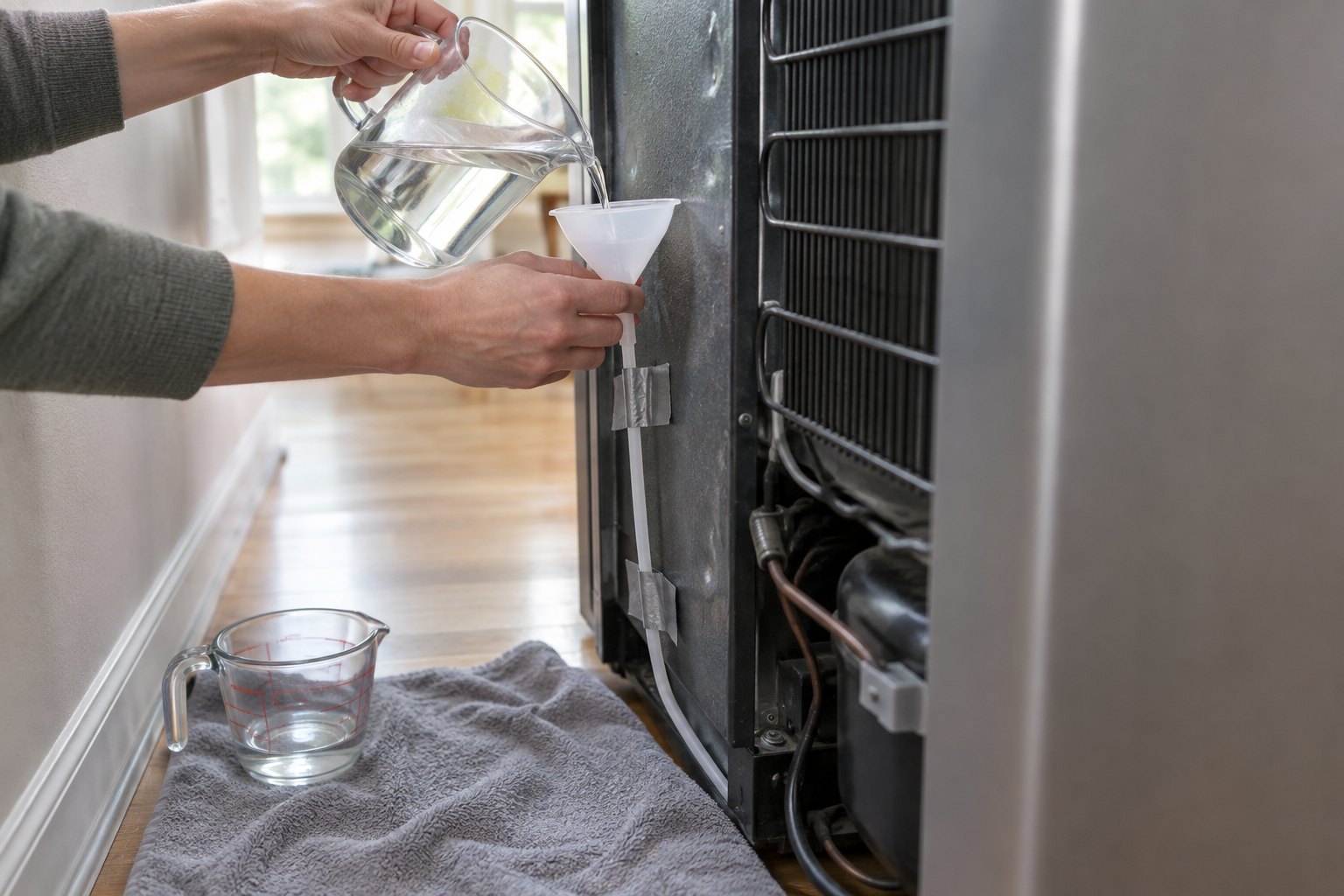
- Pour in the vinegar. Bosch uses “three to four cups of distilled vinegar.” Tape the tube upright to the back of the fridge and pour slowly through a small funnel so it drains into the fridge’s line.
- Reconnect and run the dispenser until there is no vinegar taste or smell, as Bosch says. Bosch uses the same method for the ice dispenser, so throw out the ice made in the next few batches.
- Install the new filter and flush it with the amount your maker gives in the table below.
If you find mold or slime you cannot flush out, stop there. Sub-Zero says that “if mold or other residue develops in the internal water lines or ice chute,” you should contact its Factory Certified Service. We agree. A line that grows mold after a vinegar flush needs replacing, not more vinegar.
How much water should you flush through a fridge water line?
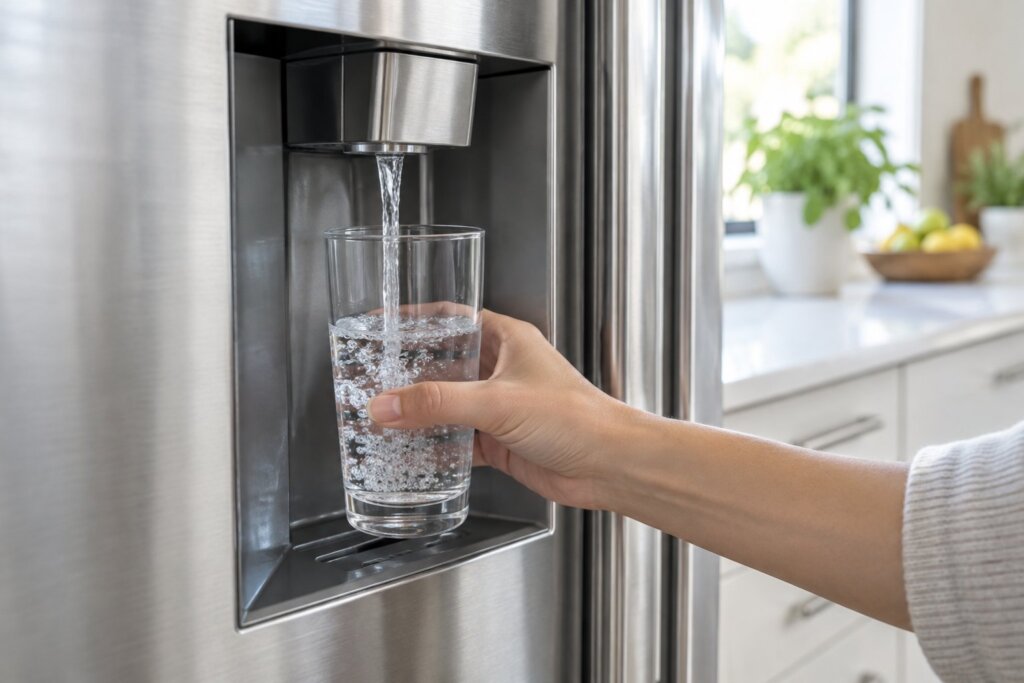
This is the part every maker agrees on: flush after every filter change. Whirlpool says, “It’s important to flush the water system as often as you change the water filter.” The amounts differ by brand:
| Brand | Flush after a new filter |
|---|---|
| Whirlpool, KitchenAid, Maytag | At least 1 to 4 gallons, 5 seconds on and 5 seconds off. The filter label gives the exact amount. |
| GE | 2 gallons, about 5 minutes (XWFE filter). Other GE pages say 1 to 2 gallons. |
| Samsung | 10 liters, or 6 to 7 minutes of dispensing |
| LG | About 2.5 gallons (9.5 liters) |
| Frigidaire | 3 to 5 tall glasses for a new filter; at least 1 gallon for a new fridge |
Expect some mess. GE says, “It is normal for water to appear discolored during the initial system flush,” and LG warns that “fine carbon particles from inside the filter may be released with the water.” Whirlpool says that skipping the flush leaves air in the system, which can cause “dripping at the dispenser, small/hollow ice cubes, or a cloudy appearance.” After flushing, Whirlpool says to “allow 24 hours for the refrigerator to cool and chill the water.”
For a fridge with an ice maker but no dispenser, Whirlpool says to “fill and discard three full containers of ice,” and GE says to “discard the first bin of ice to allow air to purge from the system.”
Is it necessary to clean a fridge water line?
Yes, in our view, and the main reason is the filter. The CDC says, “The germs that grow in pipe slime can also live and multiply in water filters,” and that “this can happen when you do not properly maintain and replace the filters.” Its list of filters to replace on schedule includes “Refrigerator and icemaker filters.”
Fridge dispensers have been studied directly. A 2024 paper in the American Journal of Infection Control found that “passage through these systems resulted in significant microbial growth in the water,” with two groups of germs that can cause infections, Mycobacterium and Pseudomonas, increasing “by 8,053- and 221-fold.” There is also a 2022 case report from Madrid of a heart infection the authors linked to a home fridge’s water dispenser. That is one patient, not a pattern, but it is a reminder the line is not sterile.
Every maker we checked gives the same filter schedule: about every 6 months. Whirlpool, Maytag, KitchenAid, Samsung, LG, Frigidaire and Bosch all say so, and GE says “every six (6) months or usually after every 170-200 gallons of dispensed water.” Our routine: a new filter and full flush every 6 months, a vinegar clean of the line once or twice a year, and Bosch’s advice to clean the dispenser “at least once every two months.” Whirlpool adds one more habit we like: “dispense enough water every week to maintain a fresh supply.”
How do you know if your refrigerator water line is clogged?
Slow or no water usually has one of four causes, and only one of them is a dirty line. Check them in this order:
- The filter. GE says, “A clogged or partially clogged filter will result in no water or slow running water from dispenser.” If the filter is more than 6 months old, replace it first.
- A kink. Whirlpool says to “check to make sure there are no kinks in the water supply line,” and Samsung says the tube “should not be kinked or crushed.” Pushing the fridge back against the wall is the usual cause.
- A frozen line or tank. GE says, “The water reservoir tank or tubing could be frozen,” usually because the fridge is set colder than recommended. Its fix is to set the temperature warmer and wait 24 to 48 hours. GE also notes that the fill tube going into the ice maker can freeze, “causing no water to get to the icemaker.”
- Low water pressure. LG says, “Slow water dispensing is usually the result of low water pressure from the main water supply.” Time how long a glass takes to fill: LG says “anything over 8 seconds may indicate possible low water pressure.” Samsung’s version of the test is to dispense for 10 seconds and check you get at least about 2/3 of a cup.
Here is the pressure each maker asks for:
- GE: “between 40 and 120 PSI on models with a water filter,” and 20 to 120 PSI without one. GE notes that normal household pressure is “approximately 40 to 45 PSI.”
- Whirlpool and Maytag: 30 to 120 psi, with performance “typically optimal between 40-80 psi,” and 40 to 60 psi if the fridge is fed by a reverse osmosis system.
- LG: “between 20 and 120 psi for optimal performance.”
If an under-sink RO system feeds your fridge, its tank pressure can be the bottleneck. Our guide to reverse osmosis membrane replacement covers keeping that system healthy.
How can I remove calcification from my refrigerator water line?
Most of the white crust people see is on the dispenser, not inside the line. LG says the white buildup is “minerals such as calcium and magnesium” left as the water evaporates, and it wipes off with a clean cloth. For heavier scale, the makers use vinegar on the parts you can reach:
- Drip tray (spill shelf): GE says to “wipe the area with undiluted vinegar, letting some vinegar remain on the surface,” and that “usually 30 minutes time is enough.” Then wipe it dry.
- Ice chute: Sub-Zero says calcium buildup “may be cleaned with a 1:1 vinegar and water solution.”
- Stainless dispensers: GE offers citric acid as another option but warns, “This should NOT be used on stainless steel dispensers.”
- What not to use: Samsung says, “Do not use benzene, thinner or Clorox for cleaning as it may damage the surface of the appliance.”
For scale inside the line, the vinegar flush above is the tool. If your water leaves this much crust, the water itself is the real problem; our guide on water softeners vs filters vs conditioners explains which one deals with hardness. And if the water tastes off rather than looking off, start with why your water tastes funny.
What we would buy for this job
- Whirlpool 8212547RP refrigerator water line kit, 5 ft: the supply line Whirlpool itself recommends, for when the old line is cheaper to replace than to clean.
- CARBO 0 to 200 psi water pressure test gauge, 3/4 inch hose thread: screws onto a hose spigot or washer valve so you can check you are inside the 40 to 120 psi most fridges need.
As an Amazon Associate, Complete Water Guide earns from qualifying purchases. Prices change, so check the listing.
Should you replace the fridge water line instead of cleaning it?
Often, yes. A new line is cheap, and the wrong kind of old line is a leak risk. GE says, “Copper tubing is recommended, if not using the GE SmartConnect water line,” and warns that “certain types of plastic will crack or rupture with age and cause water damage to your home.” Whirlpool recommends “copper tubing or Whirlpool supply line, Part Number 8212547RP,” and says other lines “could cause odd or off-tasting ice.” Sub-Zero says the line is “either copper or PEX.”
Our rule: if the supply line is thin, cloudy plastic, is discolored inside, or you cannot remember when it went in, we replace it rather than clean it. While you are at it, check that your filter is certified for what you want removed; our guide to NSF/ANSI water filter standards explains the labels.
Frequently asked questions
Can you run vinegar through a refrigerator water line?
Yes, if your manual does not forbid it. Bosch’s method uses three to four cups of distilled vinegar poured into the disconnected supply tube, then runs the dispenser until no vinegar taste or smell remains. Do it on filter-change day and flush the new filter afterward.
How often should you clean the water line in a fridge?
Flush it with every filter change, which makers set at about every 6 months. We add a vinegar clean once or twice a year. Bosch says to clean the dispenser at least once every two months.
Can I use bleach to clean my fridge water line?
We would not. None of the makers we checked gives a bleach method for the line, and Samsung says not to use Clorox on the appliance. Sub-Zero says to call its service team if mold develops in the internal lines.
How long should I run water after changing my fridge filter?
It depends on the brand: 1 to 4 gallons for Whirlpool, 2 gallons or about 5 minutes for GE, 10 liters or 6 to 7 minutes for Samsung, and about 2.5 gallons for LG. Discolored water at first is normal.
Why is my fridge water coming out slow?
Usually a clogged filter, a kinked supply line, a frozen tank or tube, or low household water pressure. GE and Whirlpool both list a clogged filter first. LG says a glass taking over 8 seconds to fill may point to low pressure.
Why does the water from my fridge taste bad?
An old filter, water sitting unused in the line, or the wrong supply line. Whirlpool says a non-recommended supply line could cause off-tasting ice, and suggests dispensing water every week to keep it fresh. For smells, see our guide on removing bad smells from drinking water.
Sources
- Whirlpool, How to Flush the Water System in a Refrigerator; water pressure, supply line, dispenser cleaning and not-dispensing pages. Same wording on KitchenAid and Maytag product help.
- GE Appliances, XWFE filter installation instructions and support articles on flushing, water pressure, frozen tanks, supply lines and dispenser cleaning.
- Samsung, filter change and dispenser support pages (UK, US, New Zealand, Hong Kong).
- LG, Refrigerator Water Dispensing Slowly and filter replacement pages.
- Frigidaire, Refrigerator Prime and Purge Guide.
- Bosch UK, Cleaning the Water Dispenser.
- Sub-Zero, How to Clean an Ice and Water Dispenser.
- CDC, Preventing Waterborne Germs at Home.
- Swanson and He, American Journal of Infection Control, 2024;52(7):857-859, doi:10.1016/j.ajic.2024.03.001.
- De Villarreal Soto et al., International Journal of Infectious Diseases, 2022;122:8-9, case report.