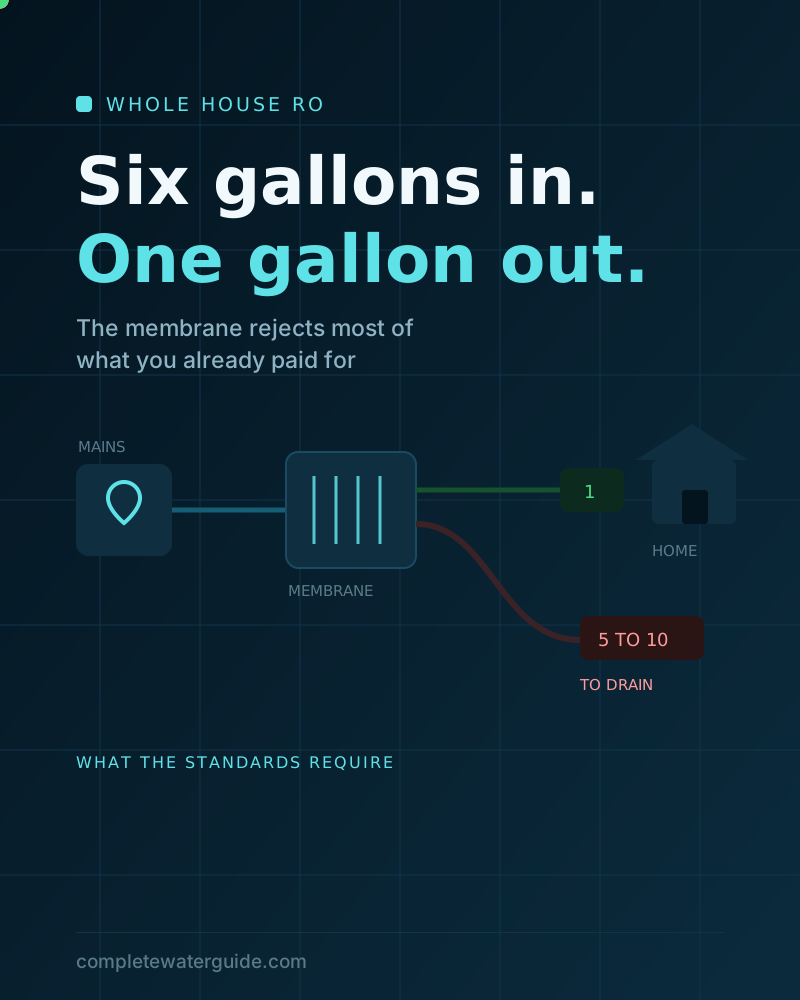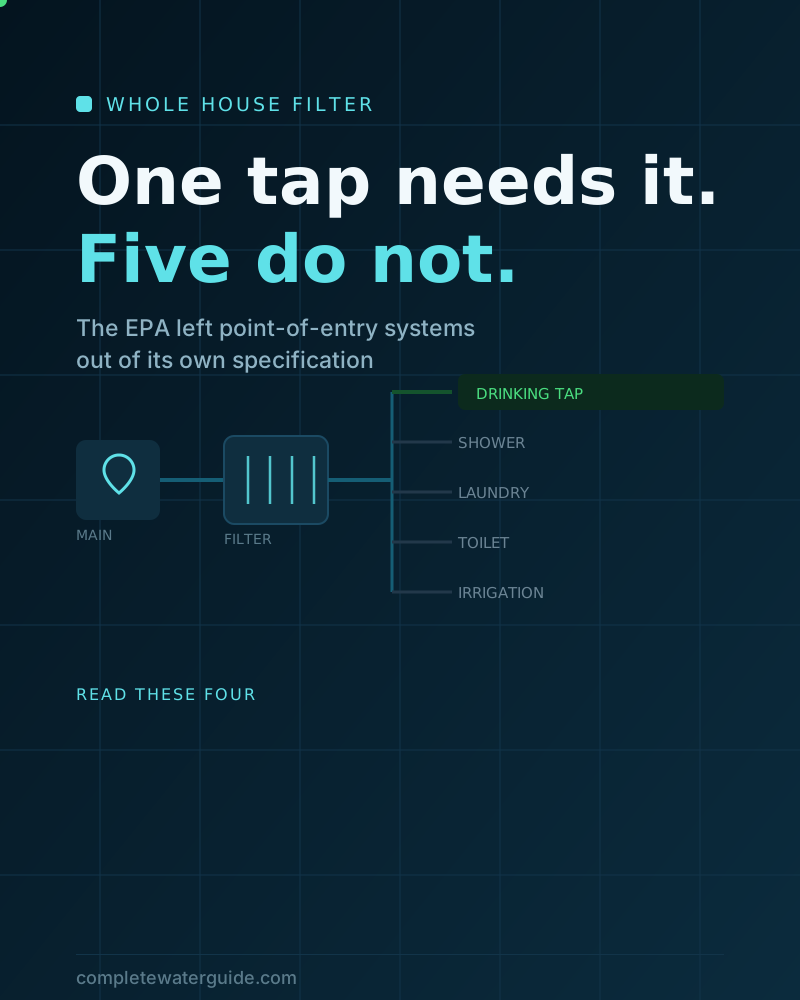
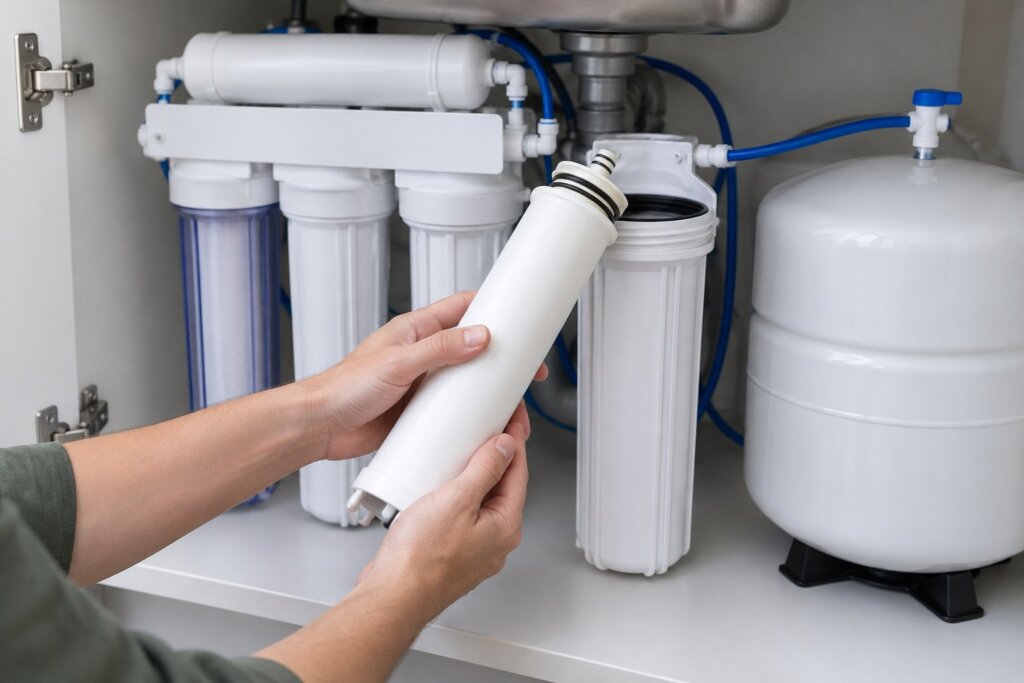
Reverse osmosis membrane replacement is due every 1 to 5 years depending on the brand, with 2 to 3 years the most common figure, or sooner if a TDS meter shows the membrane is removing less than 75% of what is in your tap water. The swap is a short job with no plumbing changes. The two mistakes we see most are putting the membrane in backward and drinking the first tank from a membrane that was packed in preservative.
We read the owner’s manuals from APEC, Watts, Culligan, Vitapur, A.O. Smith and Whirlpool, a FilmTec membrane data sheet and EPA’s WaterSense specification for RO systems. Below is what they say, where they disagree, and the order we would follow.
How often should you replace a reverse osmosis membrane?
Here is what each maker says, in its own manual or product page:
| Brand | Membrane | Pre-filters |
|---|---|---|
| APEC Essence | 2 to 3 years on city water, 2 years on well water | 6 to 12 months |
| APEC standard series | 3 to 5 years on city water, 2 to 3 years on well water | 12 months |
| Watts | 2 to 3 years (life expectancy 2 to 5 years) | 6 months |
| Culligan Aqua-Cleer | 3 to 5 years | At least once a year |
| iSpring MC7 membrane | 2 to 3 years | About 6 months |
| Whirlpool | Every 2 years (a warranty condition) | Every 6 months |
| Vitapur | 12 to 18 months | 6 to 12 months |
| A.O. Smith | 12 months rated capacity | See your model’s manual |
Our take: treat your manual’s number as the outer limit, not a date to wait for. Well water, hard water and late pre-filter changes all shorten it. APEC is direct about the pre-filters: “If they are not changed timely and become over-depleted, the membrane will be damaged.” The TDS test in the next section tells you whether your membrane is done early or still has life left.
How do you know when an RO membrane needs replacing?
Test it with a TDS meter. Watts gives the clearest rule we found: “if at any time you notice a reduction in water production or an unpleasant taste in the reverse osmosis water, it could be time to replace the membrane. Watts recommends replacing the membrane when TDS reduction falls below 75%.”
- Measure the TDS of your tap water (the feed) in ppm.
- Measure the TDS of water from the RO faucet.
- Work out the rejection rate: (tap TDS minus RO TDS) divided by tap TDS, times 100.
Example: tap water at 300 ppm and RO water at 30 ppm is a 90% rejection rate, which is healthy. Tap at 300 ppm and RO at 90 ppm is 70%, below the Watts line, so we would replace the membrane. Culligan builds this test into its annual service: “Test and record feed TDS, and then calculate rejection percentage.” For what the numbers mean for drinking water, see our guide to the ideal TDS level for drinking water.
For comparison, a new membrane does far better than 75%. FilmTec’s data sheet lists a stabilized salt rejection of 98% and a minimum of 96%, iSpring says its MC7 rejects up to 97% under NSF/ANSI 58 test conditions, and Vitapur lists 92% to 99%. The 75% figure is the floor for certification: EPA’s WaterSense spec says a system “shall reduce the influent challenge level of TDS by at least 75 percent” and must be certified to NSF/ANSI 58. Frizzlife, an RO seller, calls roughly 80% to 85% a warning sign on its blog, but says that figure is not a universal replacement specification.
One caution before you buy a membrane: slow production alone does not prove it is bad. Watts’ troubleshooting chart lists low water pressure and clogged pre-filters as causes of slow production, alongside a fouled membrane. If your rejection rate is still good, change the pre-filters first.
Reverse osmosis membrane replacement, step by step
This follows APEC’s Essence manual, with notes where Watts and Vitapur do it differently. Check your own manual for the details of your housing.
- Shut off the water. Turn off the cold water supply to the RO system and close the tank valve.
- Release the pressure. APEC says to “lift up RO faucet lever briefly to relief the built-up pressure.” Watts instead has you open the faucet and drain the tank “until it is completely empty.”
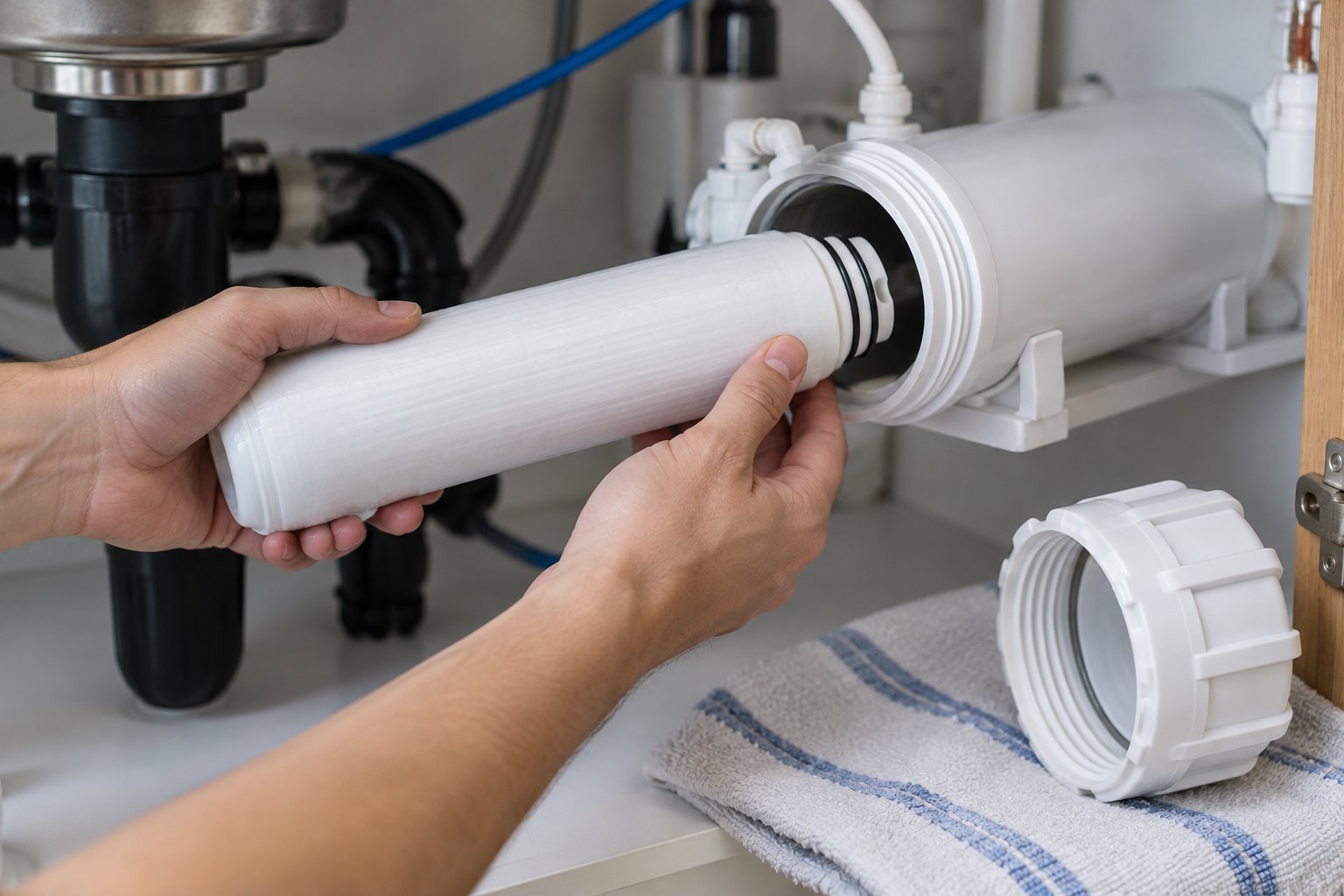
- Open the membrane housing. Disconnect the tubing from the housing cap by pushing in the collet ring and pulling the tube, then turn the cap counterclockwise. A housing wrench helps if it is stuck.
- Pull out the old membrane. Watts says, “Using a pair of pliers, grip the PVC tube of the RO membrane and pull firmly.”
- Handle the new one carefully. APEC says, “Avoid touching the Membrane with your hands to prevent contamination!” We wash our hands and open the bag only at the housing.
- Lubricate the O-rings the way your manual says. Watts says to use “a water soluble lubricant such as KY Jelly.” Vitapur says to lubricate them “with water only.” The manuals disagree, so follow yours.
- Insert it the right way round. The end with the two black O-rings goes in first. APEC warns, “The membrane cannot filter water if it’s inserted in the WRONG direction!” Give it a firm push so it seats.
- Replace the flow restrictor if your manual asks. Vitapur says, “The drain flow restrictor must be replaced each time you change the membrane,” and A.O. Smith’s kit replaces it too.
- Close up and check for leaks. Screw the cap back on, reconnect the tubing, open the supply and the tank valve, and watch the fittings for a few minutes.
- Let the tank refill and flush it. APEC says refilling “takes about 2-3 hours.” Then flush, as below.
Do you need to flush a new RO membrane?
Yes, and the manuals disagree on how much. Many membranes ship wet with a preservative. Vitapur says its membrane “contains a preservative solution to prevent microbiological growth and freezing which, if ingested may cause irritation of the gastrointestinal tract,” and tells you to “discard 3 full tanks of product water.”
- APEC: drain the first tank; “The 2nd tank of water is ready for use.”
- Watts: drain three tanks; “The fourth tank can be used for drinking.”
- Vitapur: discard 3 full tanks.
- Culligan: “Minimum 24 hour flush to remove preservative solution.”
- A.O. Smith: let water run through the faucet for 24 hours, and “Do not drink flushed water.”
- FilmTec: “The first full tank of permeate must be discarded.”
- iSpring MC7: the exception. It ships dry and does “not contain preservation solution that needs to be washed off before usage.”
Our rule: follow the instructions that came with the membrane, not the ones for the system. If a generic replacement membrane arrives with no instructions, we dump at least three full tanks before anyone drinks from it.
How much does a reverse osmosis membrane replacement cost?
The membrane itself runs about $35 to $45 for a standard home size. When we checked on October 26, 2026, iSpring sold its MC7 75 GPD membrane for $42.99 on its own store, and APEC sold its MEM-ES-50 membrane for the Essence series at $39.95, with the retailer Abt listing the same part at $36.87. Generic 11.75 by 1.75 inch membranes sell for less. If you buy one, match the size to your housing and look for NSF/ANSI 58 certification.
Doing it yourself costs the membrane plus any flow restrictor your manual calls for. APEC says its final carbon filter is best replaced together with the membrane, so budget for that as well. If you would rather hire it out, our RO installation cost guide covers what plumbers charge, and our water filter cost per gallon breakdown shows what the membrane adds to each gallon.
What we would buy for this job
- iSpring MC7 75 GPD RO membrane, 11.75 x 1.75 inch: the standard size that fits most under-sink housings. It ships dry, so there is no preservative to flush out.
- HM Digital TDS-3 handheld TDS meter: for the rejection test that tells you when the membrane is actually done.
- RO membrane housing wrench, 2 pack: for a stuck housing cap. Made for 3 inch APEC-style membrane housings, so measure yours first.
As an Amazon Associate, Complete Water Guide earns from qualifying purchases. Prices change, so check the listing.
What shortens the life of an RO membrane?
- Chlorine. FilmTec lists a free chlorine tolerance of under 0.1 ppm and says chlorine and other oxidizers “will cause premature membrane failure.” APEC says not to apply chlorine or bleach to the membrane “in any way.” The carbon pre-filter is what removes chlorine before the membrane, so a late carbon filter change is the fastest way we know to ruin a membrane.
- Hard water. Culligan says “Hardness is the most common membrane foulant.” Watts recommends hardness under 10 grains per gallon (170 ppm) and says “Addition of a water softener may lengthen the membrane life.”
- Iron and sediment. Culligan calls iron “another common membrane foulant,” and APEC says well water users may need to change pre-filters sooner because of heavy sediment.
- Low water pressure. Watts lists a minimum of 40 psi and a maximum of 100 psi, and says “A booster pump is needed for incomming water pressure under 40psi.” Culligan says its units are not certified below 40 psi.
- High TDS. Culligan says osmotic pressure “becomes significant at TDS levels above 500 mg/L (ppm).” iSpring asks owners with TDS above 750 ppm to contact it before buying.
Should you change the filters when you replace the membrane?
We do. A new membrane behind an old carbon filter gets the chlorine the filter was supposed to catch. APEC says of its final carbon filter, “It’s best to replace this filter when replacing the stage-4 membrane,” and Watts’ fix for a fouled membrane is to “Replace membrane and flow restrictor” together. Doing all of it on the same day also resets the schedule, so you only have one date to remember.
If your system is old enough that you are thinking about a new one instead, two numbers from EPA’s WaterSense spec are worth knowing: a labeled system must have an efficiency of at least 30 percent and an automatic shut-off. Our picks for the best reverse osmosis systems cover that, and if you are wondering about the water itself, see whether RO water is safe to drink.
Frequently asked questions
How long does a reverse osmosis membrane last?
Between 12 months and 5 years, depending on the brand and your water. A.O. Smith rates its membrane at 12 months, Watts and iSpring say 2 to 3 years, and Culligan says 3 to 5 years. Well water, hardness and chlorine shorten it.
How do I know if my RO membrane is bad?
Compare the TDS of your tap water and your RO water with a meter. If the membrane is removing less than 75% of the tap water’s TDS, Watts recommends replacing it. A drop in output or a change in taste is another sign.
Can I replace an RO membrane myself?
Yes. It needs no plumbing changes: shut off the water, release the pressure, open the membrane housing, swap the membrane and flush the system. A housing wrench helps if the cap is tight.
Which way does an RO membrane go in?
The end with the two black O-rings goes into the housing first. APEC warns that a membrane inserted the wrong way cannot filter water.
Is the first tank of water safe to drink after a membrane change?
Not from most membranes. Many ship with a preservative, and APEC, Watts, Vitapur and FilmTec all say to discard at least the first tank. iSpring’s MC7 ships dry, without preservative.
Do I need to replace the flow restrictor with the membrane?
Some makers say yes. Vitapur says the drain flow restrictor must be replaced each time you change the membrane, and A.O. Smith’s replacement kit includes one. Check your own manual.
Sources
- APEC Water, ESSENCE series owner’s manual and filter change instructions; APEC standard RO system manual.
- Watts, FMRO4G reverse osmosis installation, operation and maintenance manual.
- Culligan, Aqua-Cleer Advanced Drinking Water System Owner’s Guide.
- Vitapur, VRO under-sink reverse osmosis system manual.
- A.O. Smith, AO-US-RO-MEM replacement membrane instructions.
- Whirlpool, reverse osmosis system warranty.
- Dow FilmTec, TW30-1812 home drinking water membrane product data sheet.
- U.S. EPA, WaterSense Specification for Point-of-Use Reverse Osmosis Systems, version 1.0, November 2024.
- iSpring, MC7 membrane product page.
- Frizzlife, blog post on calculating RO membrane rejection rate. A seller’s blog, not a specification.