A whole house water softener does one job: it exchanges the calcium and magnesium that make water hard for sodium or potassium. The standard that certifies it, NSF/ANSI 44, backs a very short list of claims, and counting the live listings in the NSF register shows exactly how short.
The Department of Energy adds a second thing no product page mentions. Its guidance on water-intensive processes says plainly: “Softeners with timers should be avoided.” That single sentence rules out a large share of what is sold.
What does a water softener actually remove?
Hardness, and depending on the model, two or three other things. Softening is ion exchange rather than filtration: hard water passes through a resin bed, calcium and magnesium bind to the resin, and sodium or potassium is released in their place. Nothing is strained out, so a softener does not behave like a filter at all.
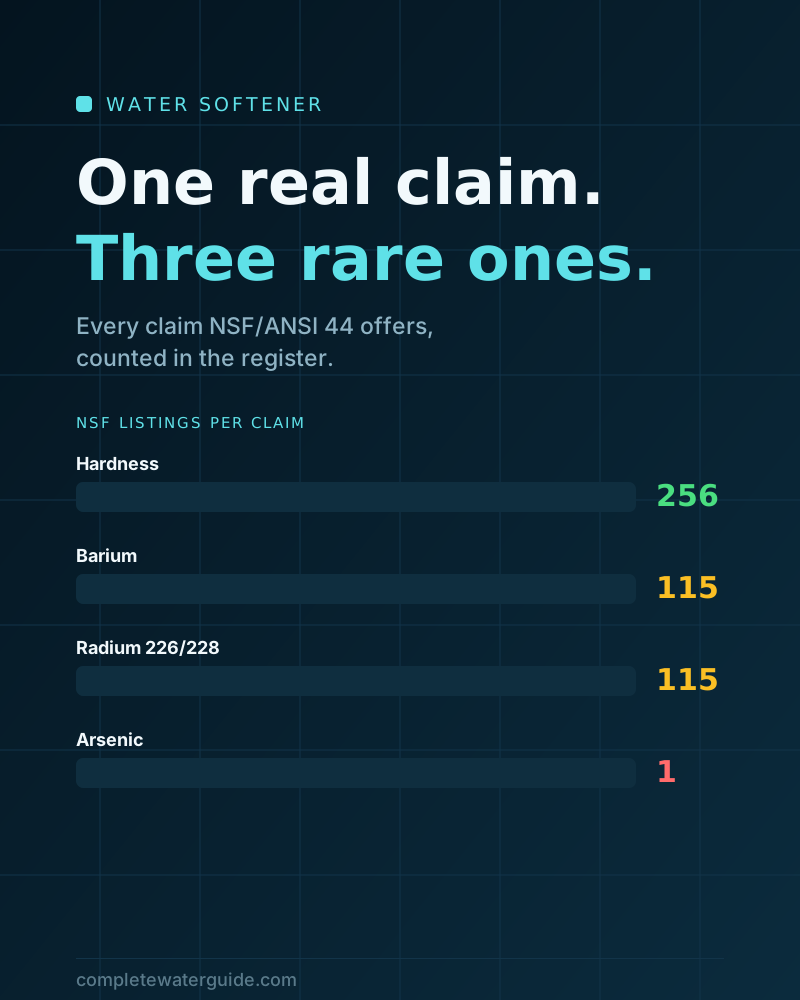
The certification register makes the boundary visible. Reading the NSF listings under Standard 44 in September 2026, the claims attached to certified softeners break down like this.
| Claim under NSF/ANSI 44 | Listings carrying it | What that tells you |
|---|---|---|
| Hardness reduction | 256 | The base claim. Every certified softener holds it. |
| Barium reduction | 115 | Under half. Not a given. |
| Radium 226/228 reduction | 115 | Same subset. Relevant on some well supplies. |
| Arsenic (pentavalent) reduction | 1 | Effectively absent. Do not buy a softener for arsenic. |
That is the whole list. A softener is not certified for lead, PFAS, nitrate, chlorine, taste or odour, because those are not claims Standard 44 offers. Certification is granted per claim, not per standard, exactly as it is in the filtration standards, and a softener carrying the badge has proved hardness reduction and nothing more unless the listing says otherwise.
Why does the Department of Energy say to avoid timer softeners?
Because a timer regenerates on a schedule whether the resin needs it or not, and every regeneration cycle costs water and salt. The DOE’s operation and maintenance guidance is direct: “Set the controls to start softening and regeneration processes only when needed. Softeners with timers should be avoided.”
Its replacement guidance says the same thing from the other side: “Install new water softening equipment that regenerates based on the hardness of the water supply and water consumption demand.”
This is the single most useful buying filter on the whole category, and it is a yes-or-no question rather than a judgement call. A demand-initiated regeneration system meters actual water use and regenerates when the resin is genuinely exhausted. A timer model regenerates every third night regardless, discharging salt brine to your septic or sewer for no benefit on the weeks you were away.
What size water softener do you need?
Sizing is arithmetic, not a product tier. Three numbers produce it.
- Your hardness, in grains per gallon. This comes off a test, and on a private well it comes off a state-certified laboratory test rather than a strip.
- Your household water use. Multiply people by daily gallons. This is where guessing goes wrong most often, because a softener sized for the average day fails on the heavy one.
- Days between regenerations. Multiply the first two, then multiply by how many days of capacity you want before the unit regenerates.
Grains of hardness per gallon, times gallons used per day, times days between regenerations, gives the grain capacity the unit has to hold. Everything else on the spec sheet is secondary to that figure matching your actual water.
One correction worth making, because it is repeated constantly: buying a much larger unit than the arithmetic gives is not a safety margin. An oversized softener regenerates less often, which means the resin bed sits saturated for longer, and salt efficiency drops rather than improves.
Does a water softener remove iron?
Some do, up to a point, and relying on it is how softeners get destroyed. Iron fouls resin. A softener handling iron at the edge of its tolerance will lose capacity, then lose it faster, and the fix is a dedicated iron removal stage ahead of it rather than a bigger softener.
The staging order is the same one that applies to any well water treatment train: sediment first, then oxidation and iron removal, then softening. Put the softener first and you are running your most expensive resin as a crude iron filter.
Is softened water safe to drink?
Ion exchange adds sodium in proportion to the hardness it removes, so the harder the incoming water, the more sodium ends up in the softened water. Households watching sodium intake usually keep one unsoftened tap at the kitchen sink for drinking and cooking, or run a point-of-use system on that line.
Potassium chloride can be used in place of sodium chloride in the brine tank, at higher cost. That is a decision about the salt, not about the machine.
What does a whole house softener cost to run?
The running cost is salt plus regeneration water, and both are driven by the same thing: how often the unit regenerates. That is precisely why the DOE’s demand-initiated point matters more than the purchase price. A timer model on a household that travels regenerates through empty weeks, and every one of those cycles is salt bought and water discharged for nothing.
No federal body publishes a benchmark price for softener salt or for the units themselves, so any single figure is a vendor estimate. What can be compared without a price list is the mechanism: demand-initiated versus timer, and grain capacity versus your actual arithmetic.
Softener or filter, which do you need?
They solve different problems and neither substitutes for the other.
| Your symptom | What it is | What treats it |
|---|---|---|
| Scale on kettles, spotted glassware, stiff laundry | Hardness | Ion exchange softener |
| Chlorine taste and smell | Aesthetic, from the utility | Carbon, under NSF/ANSI 42 |
| Lead, PFAS, VOCs | Health contaminants | Carbon block or RO, under NSF/ANSI 53 or 58 |
| Orange staining, metallic taste | Iron | Oxidising filter ahead of the softener |
| Rotten egg odour | Hydrogen sulfide | Oxidation, not softening |
| Sand and grit | Sediment | Sediment pre-filter |
Our comparison of softeners, filters, conditioners and descalers covers the one distinction that catches most buyers: a salt-free conditioner changes how minerals behave without removing them, so a hardness test taken after it reads the same as before.
What this page could not verify
The DOE guidance quoted here comes from its Federal Energy Management Program best-practice material on water-intensive processes, which is written for facility managers rather than households. The advice about demand-initiated regeneration applies identically at domestic scale, but it is worth knowing the context it was written in.
The claim counts come from reading the NSF listing register in September 2026. WQA and IAPMO R&T maintain their own registers of products certified to the same standard, and those were not counted here, so the totals describe the NSF register rather than the whole market.
The bottom line
Buy a whole house softener for hardness, because that is what NSF/ANSI 44 certifies and, on 256 listings against a single arsenic claim, essentially all it certifies. Insist on demand-initiated regeneration, because the Department of Energy says timer models should be avoided and it is the only spec that changes your running cost every week. Size it from your own hardness and water use rather than from a product tier.
Then treat everything else in your water with the stage built for it, ahead of the softener where iron is involved.
Frequently asked questions
What does NSF/ANSI 44 certify a water softener for?
Hardness reduction, and on some models barium and radium 226/228. Reading the NSF register in September 2026, 256 listings carry hardness reduction, 115 carry barium, 115 carry radium and just one carries arsenic. Standard 44 does not offer claims for lead, PFAS, nitrate, chlorine or taste and odour.
Should I buy a timer or demand water softener?
Demand. The Department of Energy’s guidance states that softeners with timers should be avoided, and recommends equipment that “regenerates based on the hardness of the water supply and water consumption demand.” A timer regenerates on a schedule regardless of use, spending salt and water on weeks when nobody was home.
What size water softener do I need?
Multiply your hardness in grains per gallon by your household’s daily water use, then by the days of capacity you want between regenerations. That product is the grain capacity to buy. Oversizing is not a safety margin, because a unit that regenerates rarely runs at lower salt efficiency.
Does a water softener remove iron?
Some models tolerate low levels, but iron fouls softener resin and shortens its life. Where a test shows iron, the correct answer is a dedicated oxidising or iron removal stage installed ahead of the softener, not a larger softener.
Is softened water safe to drink?
Ion exchange adds sodium in proportion to the hardness removed, so harder incoming water means more sodium in the result. Households managing sodium intake commonly leave one kitchen tap unsoftened for drinking and cooking, or fit a point-of-use system on that line. Potassium chloride can replace sodium chloride in the brine tank at higher cost.
Does a water softener remove lead or PFAS?
No. Neither is a claim available under NSF/ANSI 44. Lead and PFAS are certified under NSF/ANSI 53 for filtration systems and NSF/ANSI 58 for reverse osmosis, which are different standards on different equipment.
Do I need a softener and a filter, or just one?
It depends on what your water test found. Hardness needs a softener, chlorine needs carbon, lead or PFAS needs a certified filtration or RO system, and iron needs oxidation. Each is a separate stage, and where both a softener and iron removal are needed, the iron stage goes first.