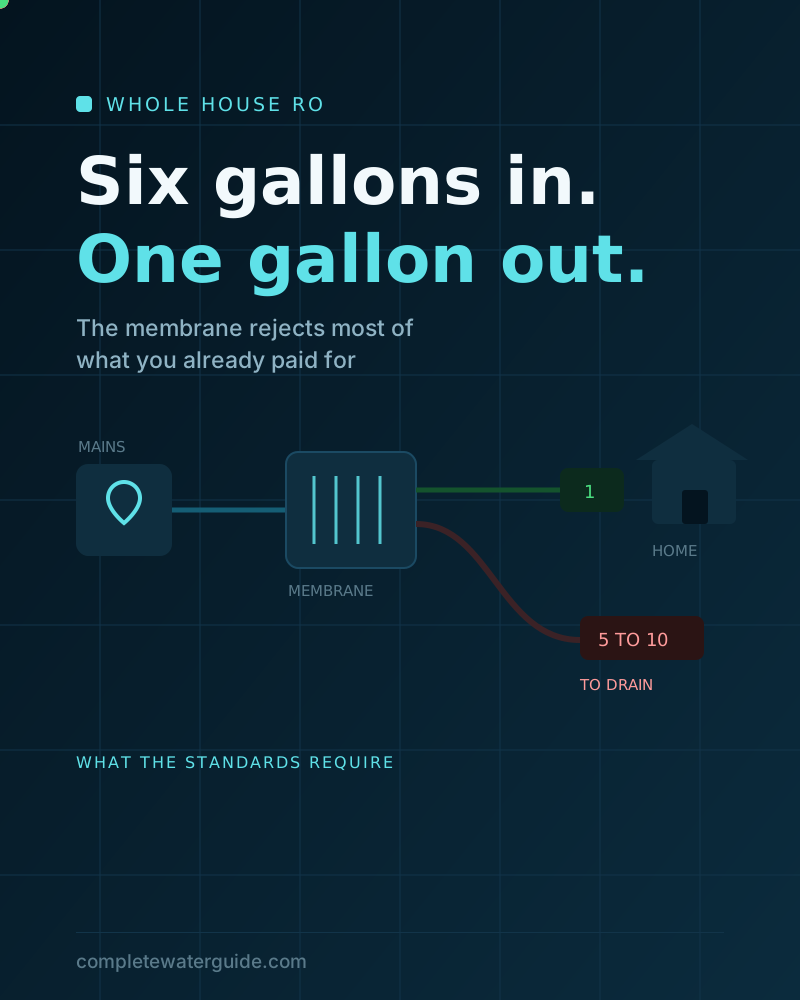
A whole-house reverse osmosis system treats every tap in the building, and it sends most of your water to the drain to do it. The EPA puts a typical point-of-use RO system at five gallons or more of reject water for every gallon it produces, and inefficient units at up to ten. Scaled to a whole house, that ratio is what decides whether this is the right purchase or an expensive mistake.
This page covers what the certification floors actually guarantee, what the water loss adds up to across a year, and the three questions that tell you whether you need whole-house RO at all. Every figure here comes from EPA WaterSense documentation or the standards it references. Where a figure does not exist, that is said rather than filled in.
What is a whole-house reverse osmosis system?
It is a point-of-entry system that pushes your entire incoming water supply through a semi-permeable membrane before it reaches any fixture. The EPA describes the process plainly: pressure forces water through the membrane, creating a stream of treated water called permeate and a stream of reject water called concentrate or brine.
The difference from an under-sink unit is scale, not method. A point-of-use system treats the water at one tap. A point-of-entry system treats all of it, which means bathing, laundry, toilets and irrigation all run on RO water that cost five to ten gallons each to make.
How much water does whole-house RO waste?
A typical system sends five gallons or more down the drain for every gallon of treated water, and the EPA notes some inefficient units reach ten gallons. In efficiency terms, a conventional point-of-use RO system has an efficiency rating between 10 and 20 percent, meaning 80 to 90 percent of the water entering it never reaches a tap.
The EPA defines efficiency rating as the percentage of the water going into the system that becomes available to the user as treated water. The related figure on a product label is the waste-to-treated water ratio, written as a number like 5.0:1.
| Efficiency rating | Waste per gallon produced | What this is |
|---|---|---|
| 10 to 20 percent | 5 to 10 gallons | A conventional system, the EPA’s typical case |
| 30 percent | About 2.3 gallons | The ASSE 1086 average recovery floor |
| 30 percent or better | 2.3 gallons or less | What earns the WaterSense label |
Here is the part that changes the maths for a whole house. A point-of-use system only treats drinking and cooking water. A point-of-entry system treats everything, and the EPA states that the average American family uses more than 300 gallons of water per day at home, with roughly 70 percent of that use occurring indoors.
Run those EPA figures through a 5:1 ratio and the volume is large.
| What is treated | Water used | Sent to drain at 5:1 | Per year |
|---|---|---|---|
| Indoor use only (70% of 300) | 210 gallons a day | 1,050 gallons a day | 383,250 gallons |
| The whole supply | 300 gallons a day | 1,500 gallons a day | 547,500 gallons |
| Indoor use, WaterSense unit at 2.3:1 | 210 gallons a day | 483 gallons a day | 176,295 gallons |
Those are volumes, not bills. Water rates differ enough between US utilities that a national average would mislead you, so take the right row and multiply by your own rate per thousand gallons, which is printed on your bill. That number is the running cost the sticker price does not mention, and on a whole-house system it is usually larger than the cartridge cost.
What does NSF/ANSI 58 certification actually guarantee?
Less than most people assume. NSF/ANSI 58 sets a TDS reduction baseline of 75 percent, and that is the performance floor a system must clear to be certified under the standard. It is not a promise of near-pure water.
Total dissolved solids covers minerals, salts, metals and organic matter as a single bulk measurement. A system certified to NSF/ANSI 58 has demonstrated it removes at least three quarters of that bulk figure. Anything beyond 75 percent is the manufacturer’s own tested claim, and it should appear as a specific percentage on the performance data sheet.
Individual contaminants are separate claims. The EPA’s own label template lists them one by one, with a column asking whether the system is verified to remove each listed contaminant, and a blank where the answer is no. Arsenic, hexavalent and trivalent chromium, lead, nitrate and nitrite, and total PFAS each get their own line. A system certified to Standard 58 for TDS has told you nothing about whether it is certified for lead.
The EPA states the consequence directly on that template: a system without verified reduction claims for a listed contaminant has not been verified to remove that contaminant under NSF/ANSI 58.
This is the same trap covered in our guide to what NSF/ANSI 42, 53, 58 and 401 each cover: certification is granted per claim, not per standard.
What is ASSE 1086 and why does it matter here?
ASSE 1086 is the standard governing RO water efficiency and membrane life, and it sets the recovery floor a system must hold. The requirement is an average minimum of 30 percent recovery, with no individual sample reading below 23 percent, and a final percent recovery measurement of at least 30 percent.
The membrane life test behind that figure runs a minimum of 20 days and produces at least 1,000 gallons of treated water, using a challenge water deliberately harder on the membrane than typical tap water. The EPA describes it as representative of a year of treatment under challenging conditions.
This matters because efficiency degrades as a membrane ages. A system quoting an efficiency figure from a new membrane is quoting its best day. The ASSE 1086 test exists to confirm the system still holds 30 percent after the equivalent of a hard year.
Do you actually need whole-house reverse osmosis?
In most homes, no. Whole-house RO is the correct answer to one problem: a contaminant that must be removed from every tap in the building, confirmed by a test. For the two problems people usually buy it for, a different device does the job with a fraction of the water loss.
Work through it in order.
- If the concern is only drinking and cooking water, a point-of-use system under the sink treats the few gallons a day that go in your body, not the 210 that go through the house indoors. Same membrane technology, a small fraction of the waste.
- If the concern is scale, spotted glassware, dry skin or appliance wear, that is hardness, and hardness is not contamination. An ion-exchange softener removes the calcium and magnesium causing it. Our comparison of softeners, filters and conditioners covers which one moves a hardness reading and which one does not.
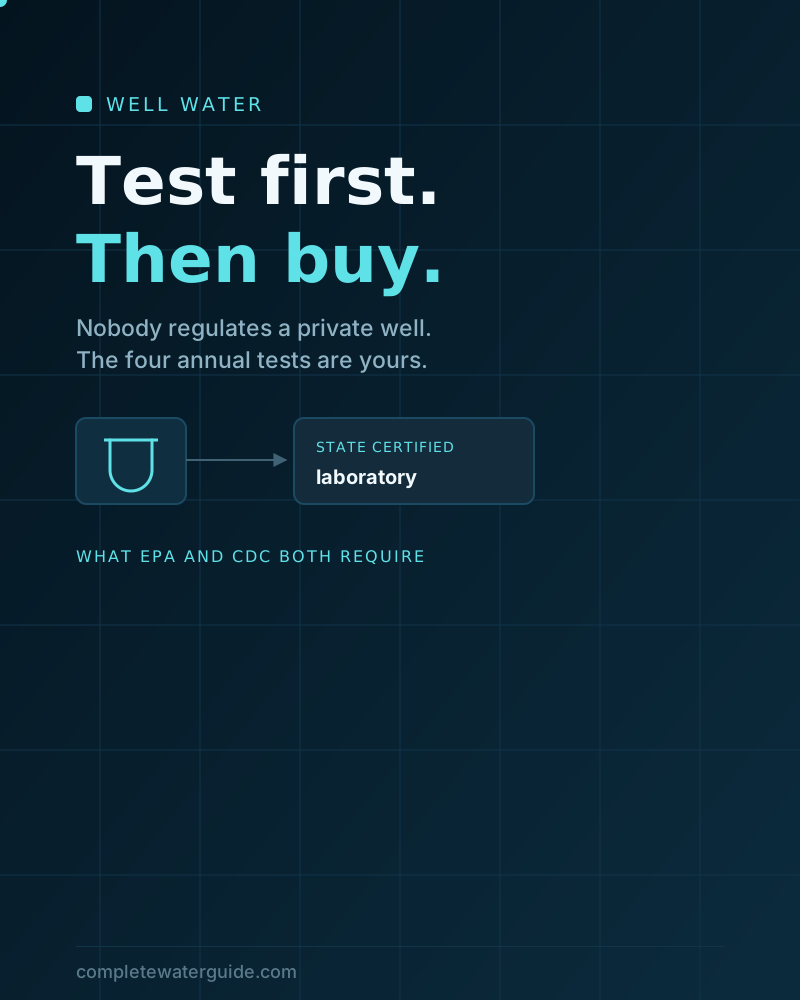
- If a tested contaminant must genuinely be removed from every outlet, including showers and laundry, whole-house RO becomes the right tool. Arsenic and nitrate in well water are the common real cases. Test first, then size the system to what the test found.
The order matters because each step costs less than the one below it, and most households stop at the first or second. If you have not tested yet, our guide to home test kits versus lab testing explains which contaminants a strip can actually detect.
What does a whole-house RO system cost to buy?
Published figures disagree widely, and no regulator or standards body publishes a price, so treat every number below as a vendor or contractor estimate rather than a verified figure.
Across home-services sites and manufacturer guides in 2026, installed whole-house RO quotes commonly land somewhere between roughly $4,500 and $8,000, with larger or more complex installations quoted well above that. The spread is wide because the systems are not comparable to each other: a point-of-entry setup includes a storage tank, typically 150 to 500 gallons, plus a delivery pump, and labour changes a great deal depending on whether the equipment goes in an open basement or a crawl space.
What is missing from that picture, and worth saying plainly, is any independent price benchmark. There is no equivalent of the certification registers for cost. What you can compare independently is the running side: the efficiency rating and the waste ratio are both published on a compliant performance data sheet, and those are the numbers that keep costing you money after installation.
How do you check a system before buying it?
Ask for the performance data sheet, then read four things on it.
- The efficiency rating and waste-to-treated water ratio. The EPA’s label format states both, in the form of a percent efficiency rating alongside a ratio like 5.0:1. If a seller cannot produce this, that is your answer.
- The daily production rate. Measured in gallons per day, and it needs to exceed your household’s peak demand, not its average, or the tank runs dry mid-shower.
- The contaminant reduction table. Not the standard number. The list of specific contaminants with verified reduction percentages beside them. Blanks mean not verified.
- Which certifier tested it. NSF, WQA and IAPMO R&T all certify to the same standards and each keeps its own separate register. A product missing from the NSF database is not automatically uncertified, so search all three.
The gap nobody mentions: there is no EPA efficiency spec for whole-house RO
The WaterSense specification for reverse osmosis, released in November 2024, covers point-of-use systems. It does not cover point-of-entry systems, and no equivalent federal efficiency specification for whole-house RO exists.
That has a practical consequence. Every efficiency figure in this article, including the 10 to 20 percent typical range and the 5:1 ratio, comes from point-of-use testing. When a whole-house system quotes an efficiency rating, it is quoting a number derived from test methods written for a smaller class of equipment. It is the best available comparison, and it is not a like-for-like one.
Ask the manufacturer which standard their efficiency figure was measured against. A straight answer names ASSE 1086 or NSF/ANSI 58. A vague answer tells you the figure came from somewhere else.
The bottom line
Whole-house reverse osmosis is the right purchase when a test has found something that has to leave every tap in the building. It is the wrong purchase when the real problem is drinking water, which a point-of-use unit handles, or hardness, which a softener handles. The certification floors sit lower than the marketing implies, at 75 percent TDS reduction under NSF/ANSI 58 and 30 percent average recovery under ASSE 1086. And the water you buy and pour away is a permanent line on the bill, not a one-time cost.
Test your water first. Buy for what the test found.
Frequently asked questions
How much water does a whole-house reverse osmosis system waste?
A typical RO system sends five gallons or more to the drain for every gallon of treated water it produces, and the EPA notes that some inefficient units reach ten gallons. Applied to an average American household using more than 300 gallons a day, treating indoor use alone at a 5:1 ratio means roughly 1,050 gallons sent to the drain daily.
Is NSF/ANSI 58 certification enough to prove a system removes lead?
No. NSF/ANSI 58 sets a TDS reduction baseline of 75 percent, and individual contaminants are certified as separate claims. The EPA’s label template lists arsenic, chromium, lead, nitrate and nitrite, and total PFAS on their own lines, with a blank where a system is not verified. A system certified for TDS has told you nothing about lead.
What is a good efficiency rating for a reverse osmosis system?
ASSE 1086 requires an average minimum of 30 percent recovery, with no sample below 23 percent, and the EPA’s WaterSense label goes to systems sending 2.3 gallons or less to the drain per gallon produced. A conventional system sits at 10 to 20 percent, so 30 percent or better is the threshold worth paying for.
Is whole-house RO better than a water softener for hard water?
No, a softener is the correct tool for hardness. Scale, spotted glassware and dry skin are caused by calcium and magnesium, which an ion-exchange softener removes directly. Whole-house RO will also reduce hardness, but it is the most expensive way to solve a problem a softener solves without the drain loss.
Does the EPA certify whole-house reverse osmosis systems for efficiency?
No. The WaterSense specification for reverse osmosis systems, released in November 2024, covers point-of-use systems only. No federal efficiency specification exists for point-of-entry whole-house RO, so any efficiency figure quoted for one is derived from point-of-use test methods.
How long does a reverse osmosis membrane last?
The ASSE 1086 membrane life test is designed to represent a year of treatment under challenging conditions, running a minimum of 20 days and producing at least 1,000 gallons using a challenge water harder on the membrane than typical tap water. A system passing it has demonstrated it still holds at least 30 percent recovery after that equivalent year.