Quick answer: Nitrates in drinking water become dangerous above the EPA limit of 10 mg/L, especially for infants under six months (risk of “blue baby syndrome”) and pregnant women. Nitrates come mainly from fertilizer runoff and septic systems, so private wells near farmland are most at risk. Remove nitrates with reverse osmosis, ion exchange, or distillation — carbon filters and boiling do NOT work, and boiling actually concentrates them. Test wells at least yearly.
Nitrates are one of the most common contaminants in private well water, and unlike many others, they carry a genuine health risk at high levels — particularly for infants. They’re also invisible: no taste, no color, no smell, so the only way to know is to test. This guide explains what nitrates are, who’s most at risk, where they come from, and exactly which removal methods work (and which don’t), with a cost comparison to help you choose.
What are nitrates and why they matter
Nitrate is a compound of nitrogen and oxygen that dissolves readily in water. The U.S. Environmental Protection Agency sets the maximum contaminant level at 10 mg/L (10 ppm) measured as nitrate-nitrogen. Below that, water is considered safe; above it, action is needed.
The most serious concern is infants under six months of age. In a baby’s body, nitrate converts to nitrite, which interferes with the blood’s ability to carry oxygen — a condition called methemoglobinemia, better known as “blue baby syndrome.” It can be life-threatening. Pregnant women are also advised to avoid water over the limit. For healthy older children and adults, low-to-moderate levels aren’t acutely harmful, but the 10 mg/L limit exists to protect the most vulnerable, and some research is examining links between long-term nitrate exposure and other health outcomes.
Where nitrates come from
Nitrate contamination is overwhelmingly a groundwater and well-water problem, driven by human activity on the land above:
- Fertilizer runoff from farms and even residential lawns — the single biggest source.
- Animal waste from livestock and manure application.
- Septic systems that leak or are poorly maintained.
Because of this, the highest-risk situations are shallow private wells in agricultural regions — think the Corn Belt, the Central Valley, and other intensive-farming areas across the Midwest and Great Plains, along with parts of California and the Mid-Atlantic. Rainfall and flooding accelerate the problem by washing nitrates down into the water table. If your well is shallow, old, or near cropland or feedlots, assume you’re at elevated risk until a test proves otherwise.
How to remove nitrates (and what fails)
This is the most important section, because the most common home filters do nothing for nitrates. Here’s what fails and what works:
What does NOT remove nitrates:
- Carbon / pitcher filters (Brita, most fridge and faucet filters) — nitrate ions pass straight through.
- Boiling — this actively makes it worse. As water evaporates, the nitrate concentration rises. Never boil water to address nitrates.
- Standard sediment filters and softeners (a standard softener doesn’t target nitrate, though a special nitrate-selective resin exists).
What DOES remove nitrates:
| Method | How it works | Best for | Typical cost |
|---|---|---|---|
| Reverse osmosis (RO) | Forces water through a membrane that rejects nitrate + many other contaminants | Drinking & cooking water at one tap | $200–$600 installed |
| Ion exchange (anion) | Nitrate-selective resin swaps nitrate for chloride | Whole-house nitrate removal | $1,000–$3,000+ |
| Distillation | Boils and condenses water, leaving nitrate behind | Small volumes; very thorough | $100–$400 (countertop) |
For most households, an under-sink reverse osmosis system is the practical answer: it handles the water you actually drink and cook with, at a reasonable price, and removes far more than just nitrate. Whole-house anion exchange makes sense if you need every tap treated or have very high levels.
If your well tests above 10 mg/L nitrate, an under-sink reverse osmosis system is the most practical fix for drinking and cooking water. For whole-house nitrate removal, a nitrate-selective anion-exchange system is the standard approach.
How to test your water for nitrates
Because nitrate is undetectable by sight, smell, or taste, testing is the only way to know your level. You have three options:
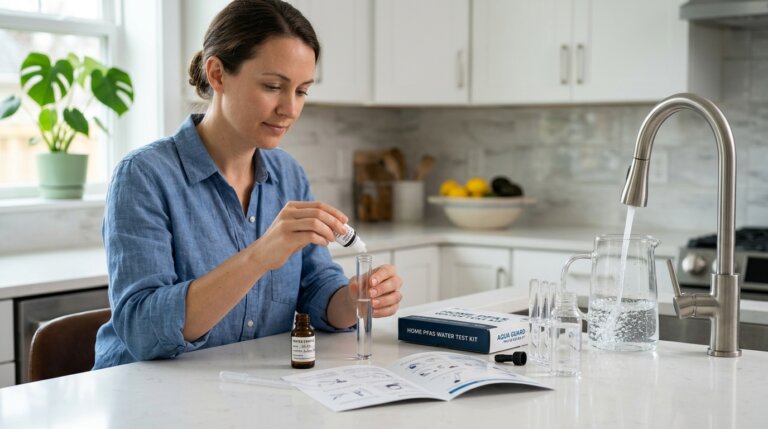
- Home test strips — cheap ($10–20) and instant; good for a quick screen but less precise.
- Mail-in lab kit — the gold standard for accuracy ($30–100); you collect a sample and mail it to a certified lab that reports exact levels.
- Local health department — many county health departments offer free or low-cost nitrate testing, especially for households with an infant.
If a strip shows anything near the limit, confirm with a certified lab test before deciding on treatment.
When to test
Test private wells for nitrates at least once a year. Test immediately if:
- A pregnant woman or an infant under six months will drink the water or have formula mixed with it.
- You’ve had heavy rain or flooding near agricultural land.
- You’ve never tested the well, or you just moved in.
Never mix infant formula with untested well water. If you’re waiting on results and have an infant, use bottled or distilled water in the meantime.
The bottom line
Nitrates are a real, invisible risk in well water — especially for babies and pregnant women — but they’re straightforward to manage once you know your level. Test at least yearly, treat anything over 10 mg/L with reverse osmosis, ion exchange, or distillation (never carbon filters or boiling), and protect infants by never using untested well water for formula.
See how home water testing works, our guide to the best testing kits, and our roundup of reverse osmosis systems. Concerned about your well overall? Read about common drinking water contaminants and the best water for baby formula.
Frequently asked questions
Are nitrates in drinking water dangerous?
Nitrates are a serious concern above the EPA limit of 10 mg/L, especially for infants under six months, who can develop “blue baby syndrome” (methemoglobinemia). For most adults, low levels are not acutely harmful, but pregnant women and infants should avoid water above the limit. Test if you’re on a well near farmland.
How do nitrates get into water?
Nitrates mainly come from agricultural fertilizer runoff, animal waste, and septic systems. Private wells in farming areas — especially shallow ones — are most at risk. Rainfall carries nitrates down into groundwater, so shallow wells near fields often show higher levels.
How do I remove nitrates from water?
The proven methods are reverse osmosis, ion exchange (nitrate-selective anion exchange), and distillation. Standard carbon filters and boiling do NOT remove nitrates — boiling actually concentrates them. A reverse osmosis system at the tap is the most common home solution.
Does boiling water remove nitrates?
No. Boiling water does not remove nitrates and actually increases their concentration as water evaporates. Use reverse osmosis, ion exchange, or distillation instead.
How often should I test my well for nitrates?
Test private wells for nitrates at least once a year, and immediately if a pregnant woman or infant will drink the water, or after heavy rain or flooding near agricultural land.
How much does it cost to remove nitrates?
An under-sink reverse osmosis system runs about $200–$600 installed and handles drinking and cooking water. Whole-house nitrate-selective ion exchange costs $1,000–$3,000+. Countertop distillers run $100–$400. Home nitrate test strips cost $10–20; certified lab tests $30–100.
Reviewed by the Complete Water Guide team. This article is for general information and is not a substitute for professional water-quality or medical advice. We may earn a commission from some links on this page.