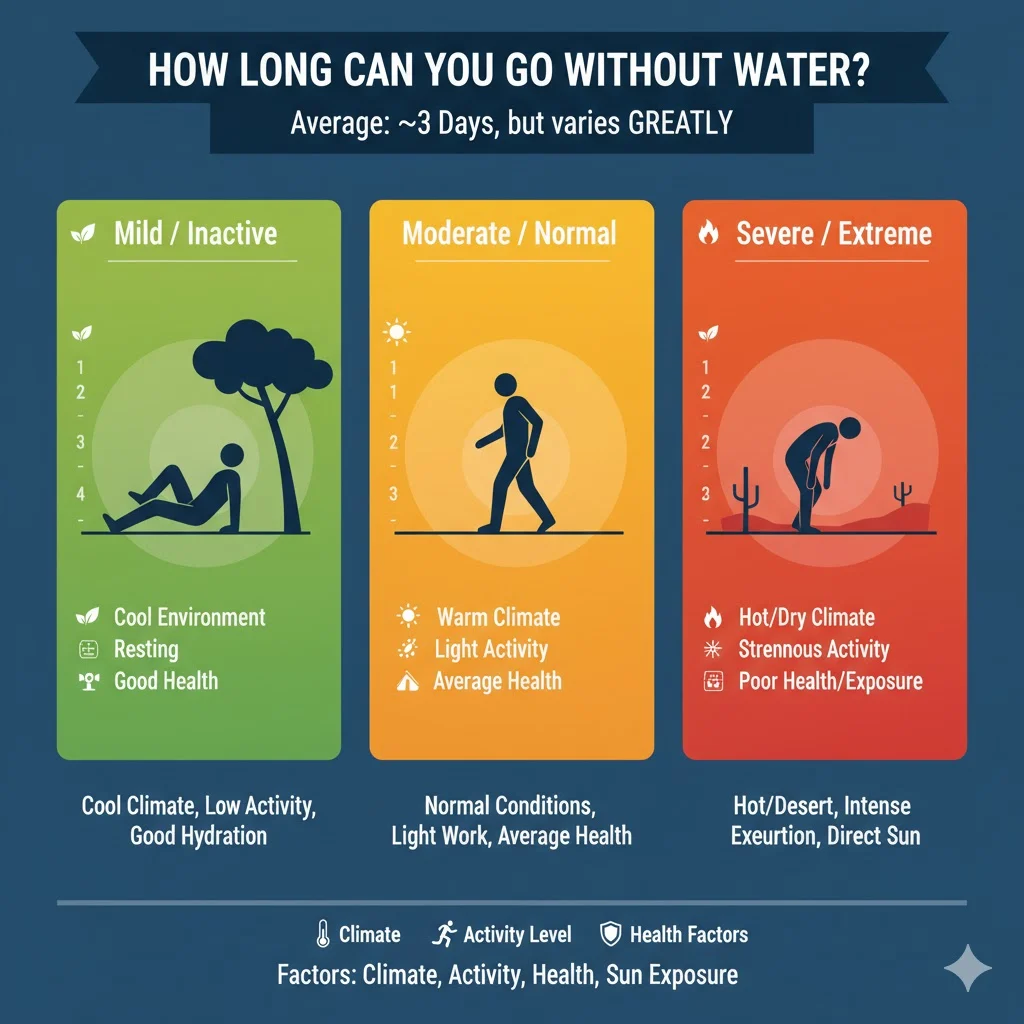
How long can you go without water? Only a few days. A major review of water and health in the journal Nutrition Reviews puts it plainly: “Without water, humans can survive only for days,” and its absence “will be lethal within days.” The rule of thumb you will often see is about three days, but the real limit depends heavily on heat, activity and health. In a hot car, a desert or a heat wave, it can be far shorter.
Below is why water runs out so much faster than food, what changes the timeline, the early signs of dehydration, and when it becomes an emergency.
Why can you survive longer without food than without water?
Your body stores energy as fat and can live off it for weeks. It has no real reserve of water. You lose water all day through breath, sweat and urine, and those losses do not stop just because you stop drinking.
The same review notes that water loss through the skin alone can be about 0.3 liters an hour in sedentary conditions, and that adults normally need “2.5 to just over 3 L/d” under normal conditions. Without drinking, the body cannot replace that, and blood volume falls.
How much water do you normally need?
The U.S. Institute of Medicine (now the National Academies) set adequate intakes for total water, from drinks and food combined, of 3.7 liters a day for men and 2.7 liters a day for women aged 19 to 30. Part of that comes from food rather than drinks. Our guide on how much water you should drink per day breaks this down by age, weight and activity.
What shortens or lengthens the time without water?
| Shortens it | Lengthens it |
|---|---|
| Heat and direct sun | Cool, shaded surroundings |
| Physical work or exercise | Resting |
| Vomiting, diarrhea or fever | Being healthy |
| Young children and older adults | Eating water-rich food, if any is available |
| Alcohol and some medicines |
Sweat is the big variable. Athletes in hard conditions can lose a lot of fluid fast; the Nutrition Reviews paper says “it is not uncommon for athletes to lose 6–10% of body weight in sweat loss,” and that performance drops at dehydration “as little as 2%.” In extreme heat, the survival window can shrink from days to hours.
What are the signs of dehydration?
The NHS lists these early symptoms in adults and children:
- Feeling thirsty
- Dark yellow, strong-smelling pee
- Headache, dizziness or feeling lightheaded
- Tiredness
- Dry mouth
- Sunken eyes
The NHS advice for mild dehydration is simple: drink fluids, starting with small sips if you feel sick. If you have been vomiting or have diarrhea, a pharmacist can recommend oral rehydration solution, a powder mixed with water.
When is dehydration an emergency?
The NHS says to get urgent medical help if you feel unusually tired, are dizzy when standing up and it does not pass, or are peeing much less than normal, because these “can be signs of serious dehydration that need urgent treatment.”
Call emergency services for blue, gray or pale skin, lips or tongue, cold skin, difficulty breathing, confusion, or unusual sleepiness. The NHS warns these “could be signs of shock.” Babies, young children and older adults can become dehydrated faster, so act sooner with them.
How long can you go without food and water?
Without water, the limit is the water, not the food: a matter of days. Going without both is no longer than going without water alone, and food actually supplies some of your daily water, so losing it shortens the timeline a little further.
How to avoid running short
- In hot weather or when hiking, carry more water than you think you need and drink before you feel thirsty.
- Store emergency water at home. Our guide on how long you can store drinking water covers containers and shelf life.
- If your only water source is questionable, the CDC says boiling for 1 minute (3 minutes above 6,500 feet) kills germs; our guide on how boiling makes water safe explains when that is enough.
Frequently asked questions
Can you survive a week without water?
It is very unlikely. A Nutrition Reviews research review says humans can survive only for days without water. The commonly quoted figure is about three days, and less in heat.
How long can you go without water in the heat?
Much less than in cool conditions, possibly hours with heavy sweating in extreme heat. Sweat losses can be large, and they continue whether or not you drink.
What happens to your body without water?
You lose water through breath, sweat and urine. Blood volume falls, you feel thirsty, tired and dizzy, urine darkens, and in severe cases the body goes into shock.
Does food count toward water intake?
Yes. A share of your daily water comes from food, especially fruit and vegetables. The National Academies’ intake figures include water from food and drinks combined.
What are the first signs of dehydration?
Thirst, dark yellow strong-smelling urine, dry mouth, headache, dizziness and tiredness, according to the NHS.
This article is general information, not medical advice. If you or someone else shows signs of severe dehydration, get emergency help.
Sources
- Popkin BM, D’Anci KE, Rosenberg IH. Water, Hydration and Health. Nutrition Reviews, 2010.
- NHS, Dehydration.
- U.S. Centers for Disease Control and Prevention, Water Disinfection for Travelers.