Updated on
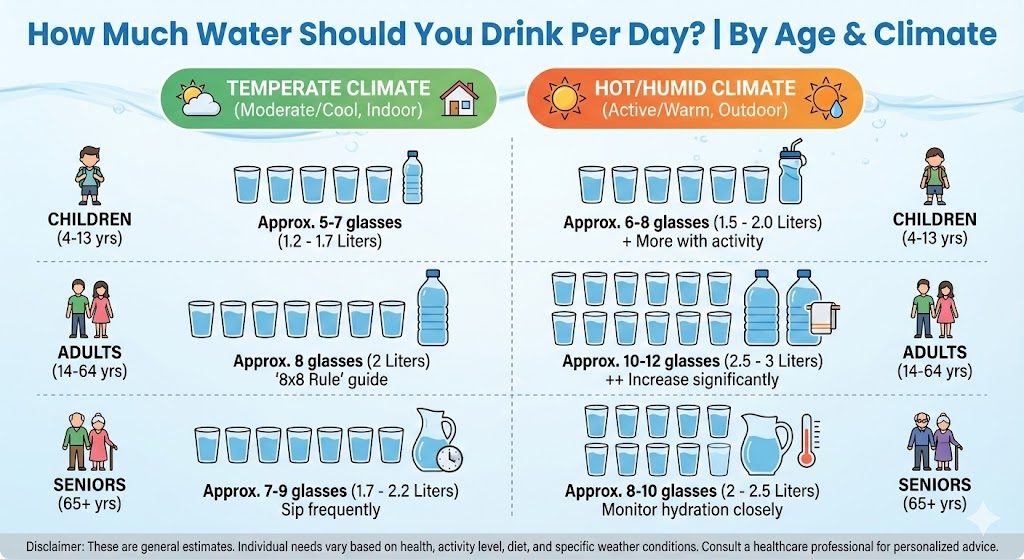
Quick Answer: Most adults need about 2.7–3.7 liters (91–125 oz, or roughly 11–15 cups) of total water per day from all sources, including food and other beverages. The U.S. National Academies set the benchmark at about 3.7 liters for men and 2.7 liters for women. Your real number rises with heat, exercise, pregnancy, and body size.
- Men: ~3.7 liters (125 oz) total water per day
- Women: ~2.7 liters (91 oz) total water per day
- Hot climate or active: add 0.5–1 liter or more
- Pregnant / breastfeeding: higher needs (see below)
Enter your weight, activity level and climate to get a personal daily target in litres and cups.
“How much water should I drink per day?” is one of the most searched health questions — and one of the most misunderstood. The famous “8 glasses a day” rule is a rough simplification that does not account for your body size, climate, activity, or life stage. This guide breaks down what the science actually says, gives you a simple formula to find your personal number, and clears up the most common hydration myths.
Where Do the Daily Water Intake Numbers Come From?
The most cited figures come from the U.S. National Academies of Sciences, Engineering, and Medicine. They recommend a total daily water intake of about 3.7 liters (125 oz) for men and 2.7 liters (91 oz) for women. The key word is total — this includes plain water, other drinks like milk, tea, and coffee, and the moisture in food. Roughly 20% of most people’s water intake comes from food alone, especially fruits, vegetables, soups, and yogurt.
That is why “drink 8 glasses of plain water” overstates how much you need to actively sip. If you eat a normal diet, you are already getting a meaningful share of your fluids from food and other beverages.
Is the “8×8 Rule” Actually Real?
The 8×8 rule — eight 8-ounce glasses, or 64 oz a day — is the single best-known piece of hydration advice, and it is an easy, reasonable target to remember. But it is not a strict scientific requirement, and it does not match the official totals. The Mayo Clinic and other health bodies put total daily fluid needs higher, at roughly 3.7 liters for men and 2.7 liters for women, counting fluid from food and every beverage rather than plain water alone.
So the two numbers are not in conflict — they measure different things. 64 oz is a sensible floor for plain water you actively drink; 2.7–3.7 liters is your total intake from everything combined. Many people meet their needs with somewhat more or less than either figure.
A Simple Formula to Find Your Personal Number
A widely used starting point is to drink half to two-thirds of your body weight (in pounds) in ounces of water per day. For example, a 150-pound person would aim for roughly 75–100 ounces (2.2–3 liters) before accounting for exercise or heat. Our free daily water intake calculator does this maths for you and adjusts for activity and climate. For a body-weight-based breakdown, see our guide on water intake by body weight, or use the metric version in our daily water intake in liters guide.
Some guides stretch the upper end of that range to a full 1.0 fluid ounce per pound for very active people in hot conditions. If you prefer metric, the same guidance is usually written as 30–35 ml per kg of body weight — the ranges are broadly equivalent, so use whichever unit is easier for you to track.
Then adjust up for these factors: add about 12 oz (350 ml) for every 30 minutes of exercise, drink more in hot or humid weather, and increase intake if you are at high altitude or recovering from illness with fever or vomiting.
Daily Targets by Body Weight (in Ounces)
If you track hydration in ounces rather than liters, this table applies the per-pound formula directly. Ounces map neatly onto common US bottle sizes (12, 16.9, 20, 24, 32 fl oz), which makes daily targets easy to hit — just divide your goal by your bottle size. A 96-oz goal is three 32-oz fills.
| Body Weight | 0.5 fl oz/lb (Lower) | 0.7 fl oz/lb (Middle) | 1.0 fl oz/lb (Upper) | 500-ml Bottles (Middle) |
|---|---|---|---|---|
| 120 lb | 60 fl oz | 84 fl oz | 120 fl oz | ≈5 (84 fl oz ≈ 2.5 L) |
| 140 lb | 70 fl oz | 98 fl oz | 140 fl oz | ≈6 (98 fl oz ≈ 2.9 L) |
| 160 lb | 80 fl oz | 112 fl oz | 160 fl oz | ≈7 (112 fl oz ≈ 3.3 L) |
| 180 lb | 90 fl oz | 126 fl oz | 180 fl oz | ≈8 (126 fl oz ≈ 3.7 L) |
| 200 lb | 100 fl oz | 140 fl oz | 200 fl oz | ≈9 (140 fl oz ≈ 4.1 L) |
500-ml ≈ 16.9 fl oz. Counts include water, unsweetened drinks, and water-rich foods.
Daily Water Intake by Age and Gender
| Group | Approx. Total Daily Water |
|---|---|
| Adult men | 3.7 L (125 oz / ~13 cups) |
| Adult women | 2.7 L (91 oz / ~9 cups) |
| Pregnant women | ~3.0 L (101 oz) |
| Breastfeeding women | ~3.8 L (128 oz) |
| Children 4–8 | ~1.7 L (57 oz) |
| Children 9–13 | 2.1–2.4 L (71–81 oz) |
| Older adults (65+) | Same targets, but need reminders due to reduced thirst |
How Climate and Activity Change Your Needs
Hot or dry climates increase fluid loss through sweat and breathing, and physical activity — especially outdoors — pushes it higher still. Sweat losses commonly range from about 0.5 to 2+ liters per hour depending on intensity, heat, humidity, clothing, and your individual sweat rate. Endurance athletes and people doing heavy manual work in summer sit at the top of that range. If you live somewhere warm or train regularly, treat the standard numbers as a floor, not a ceiling. A practical check: if you are sweating visibly, you need to be replacing those fluids actively, not just when you feel thirsty.
Altitude matters too. Dry air and faster breathing at elevation increase fluid losses, so plan for extra when you travel somewhere high.
For workouts specifically, a simple before/during/after structure works well:
- Before: sip 10–17 fl oz over the hour before exercise so you start hydrated.
- During: about 12–17 fl oz per 30 minutes of vigorous activity — roughly 24–34 fl oz across a full hour. Heavy sweaters may need more.
- After: if you can, weigh yourself before and after. For each 1 lb lost, drink about 16–24 fl oz over the next few hours, which replaces around 150% of what you lost.
- Electrolytes: long or hot sessions call for sodium and potassium alongside water. For short, easy sessions, plain water is usually fine.
Signs You Are Not Drinking Enough
- Dark yellow urine — pale straw color is the goal
- Fatigue, headaches, or trouble concentrating
- Dry mouth, lips, or skin
- Feeling dizzy or lightheaded
- Infrequent urination (fewer than 4–6 times a day)
The simplest at-home hydration check is urine color: pale yellow means you are well hydrated, dark amber means drink up. Bathroom breaks roughly every 3–4 hours are another good sign you are on track. Worth knowing: crystal-clear urine all day is not the target either — consistently clear can mean you are overdoing it, and pale straw is ideal. If symptoms persist despite drinking enough, see a healthcare professional.
Can You Drink Too Much Water?
Yes, though it is rare. Drinking a very large volume in a short time can dilute blood sodium — a dangerous condition called hyponatremia. It mostly affects endurance athletes who overdrink during long events. For everyday life, spreading your intake across the day and listening to thirst keeps you safely on track. Your kidneys can process roughly 0.8–1 liter per hour, so there is no benefit to chugging huge amounts at once.
This is also why you should not force an extreme target just because you saw it online. If you are smaller or sedentary, a “gallon a day” goal is more than you need, and drinking heavily without any sodium during long sweaty efforts is exactly the pattern that causes problems.
Rehydrating Safely After Heavy Sweating
After heavy sweating your gut absorbs fluids better when there is some sodium alongside the water, so pair rehydration with food or an electrolyte drink rather than chugging plain water all at once.
- Lightly dehydrated: water plus a salty snack, or a low-sugar oral rehydration option.
- Moderate symptoms: add electrolytes and cool down. Seek care if you cannot keep fluids down.
- Emergency signs: confusion, fainting, no urine for 8+ hours, or a rapid pulse and breathing — call emergency services.
Do Coffee, Tea, and Sparkling Water Count?
Yes to all three. Despite a mild diuretic effect, coffee and tea still provide net hydration. Plain sparkling water hydrates exactly like still water, so if carbonation helps you drink more, it counts fully toward your daily total. If you are choosing a daily sparkling option, our guide to the healthiest sparkling water for daily drinking compares the leading brands. What does not count well are sugary sodas and alcohol — alcohol is a true diuretic and works against hydration.
Habits That Make the Target Stick
- Use a marked bottle: 24, 32, or 40 fl oz bottles simplify the math and let you count fills instead of sips.
- Chunk the day: for a 112-oz goal, aim for 28 oz by 10am, 56 oz by 1pm, 84 oz by 4pm, and finish by 8pm.
- Flavor, not sugar: lemon, cucumber, or mint, or plain sparkling water with a citrus twist.
- Front-load: drink more earlier in the day and taper at night to protect your sleep.
- Build anchors: pair a few ounces with things you already do — waking up, meetings, the commute, the gym.
- Eat your water: cucumber, watermelon, and oranges all add meaningfully to your daily total.
Frequently Asked Questions
Is 8 glasses of water a day enough?
For a smaller, less active person in a mild climate, eight 8-oz glasses (about 1.9 liters) of plain water plus the water in food can be enough. Larger or more active people, and anyone in heat, generally need more.
Is the 8×8 rule a real scientific rule?
No. The 8×8 rule (eight 8-ounce glasses, 64 oz) is an easy target to remember, not a strict requirement. Official total-fluid guidance is higher at 2.7–3.7 liters, but that counts food and all beverages, not just plain water.
How many ounces should I drink at 150 lb?
Start between 75–150 fl oz a day. Many people feel best near the middle of that range, around 105 fl oz, then adjust upward for heat and activity.
How much water should I drink to lose weight?
Drinking water before meals can reduce appetite and support weight goals. Aim for your normal daily target and consider a glass 30 minutes before meals. See our guide on whether drinking water helps you lose weight for the evidence.
Does drinking water at specific times matter?
Timing has minor benefits — a glass on waking and before meals helps — but total daily intake matters far more than exact timing. Spreading water through the day beats drinking it all at once.
Should I track in liters or ounces?
Whichever you will actually stick with. The per-pound ounce ranges line up with the 30–35 ml per kg guidance used in metric, so both routes land in the same place.
How much water should older adults drink?
Older adults need the same targets as other adults but often feel less thirst, so dehydration is more common. Setting reminders and keeping water visible helps maintain intake.
Do other drinks really count toward hydration?
Yes. Milk, tea, coffee, juice, and plain sparkling water all contribute. Only alcohol meaningfully works against hydration. About 20% of your daily water also comes from food.
Free Hydration Tools
- Daily Water Intake Calculator — your personal target from weight, activity and climate.
- Body Water Percentage Calculator — estimate total body water using the Watson equations.