By Jessica Miller · Brand Reviews Lead · Reviewed by Emily Carter, Hydration & Nutrition Editor · Updated
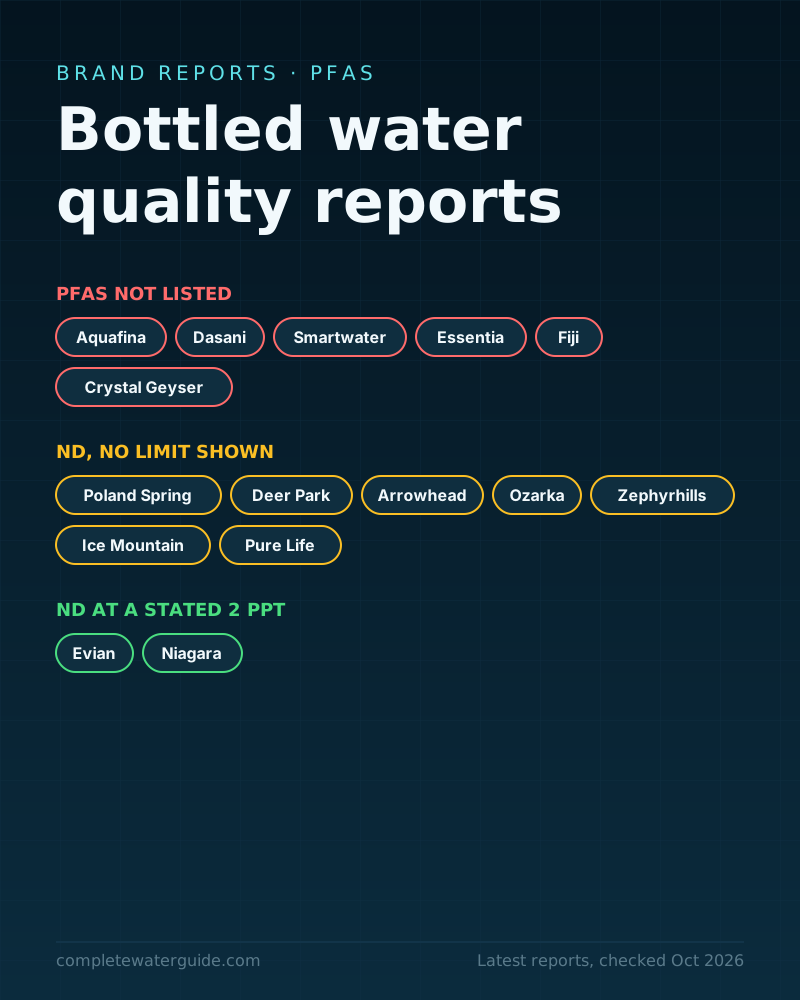
Most big bottled water brands post an annual water quality report, but six of the 15 we read leave PFAS out entirely, and seven more list it as “not detected” without saying how low the lab can see. Only Evian and Niagara state a 2 ppt reporting limit. Below are direct links to every major brand’s latest report, the numbers each one actually gives, and the three things to check before you trust one.
Where can you find each brand’s water quality report?
On the brand’s own website, almost always as a PDF. The table links straight to each one, with the figures it gives for total dissolved solids (TDS), pH and PFAS. Ranges mean the brand bottles from more than one source and reports the lowest and highest.
| Brand | Latest report | TDS (mg/L) | pH | PFAS line |
|---|---|---|---|---|
| Aquafina | 2025 (June 2025) | not given | not given | Not listed |
| Dasani | 2025 | PASS (no number) | not given | Not listed |
| Smartwater | 2025 | PASS (no number) | not given | Not listed |
| Essentia | 2025 (updated Apr 2026) | 61.33 (average) | 9.92 | Not listed |
| Pure Life | 2025 | 13 to 44 | 6 to 7.2 | ND, limit not stated |
| Poland Spring | 2025 | 27 to 84 | 6.2 to 7.5 | ND, limit not stated |
| Deer Park | 2025 | ND to 240 | 4.8 to 8.3 | ND, limit not stated |
| Arrowhead | 2025 | 31 to 240 | 6.9 to 8.1 | ND, limit not stated |
| Ozarka | 2025 | 38 to 150 | 5.5 to 6.9 | ND, limit not stated |
| Zephyrhills | 2025 | 220 to 240 | 7.6 to 8.3 | ND, limit not stated |
| Ice Mountain | 2025 | 53 to 330 | 6 to 8.4 | ND, limit not stated |
| Fiji | March 2026 | 210 | 7.91 | Not listed |
| Evian | 2025 (posted Mar 2026) | 340 | 7.95 | ND at 2 ppt |
| Crystal Geyser | 2026, one per plant | 160 (Olancha, CA) | 6.8 | Not listed |
| Niagara | 2025 analysis | ND (purified) | not given | ND at 2 ppt |
Links checked 5 October 2026. Several Primo Brands sites (Poland Spring, Deer Park, Arrowhead, Zephyrhills, Pure Life) block automated requests but open normally in a browser. Costco does not post a report for Kirkland Signature; Niagara, which is reported to bottle it, posts its own. Crystal Geyser now publishes a separate report for each plant.
Do bottled water companies have to publish a report?
Only California requires it. Its Health and Safety Code section 111071 says each bottled water plant “shall annually prepare a bottled water report and shall, upon request, make that report available to each customer.” Section 111170 adds that labels must carry the bottler’s contact details and tell buyers how to get the report. Because national brands sell in California, most of them post the report for everyone.
There is no federal publishing rule. The FDA does require testing: under 21 CFR 129.35 source water is analysed for chemical contaminants at least once a year, and under 21 CFR 129.80 the finished product gets a chemical, physical and radiological analysis at least annually and a total coliform test at least weekly. Those results stay with the company unless it chooses to share them.
Which reports actually list PFAS?
Nine of the 15 we read, and they do it in two very different ways. The seven Primo Brands reports, from Poland Spring to Pure Life, list PFAS compounds such as PFOA as ND with a 5 next to each one. A footnote explains that the 5 is the limit set by the International Bottled Water Association. The lab’s own reporting limit is never printed.
Evian and Niagara do it properly. Evian’s report shows PFOA tested by EPA Method 537.1 with a 2 ng/L (2 ppt) reporting limit and a result of ND, and Niagara’s shows the same 2 ppt floor. Aquafina, Dasani, Smartwater, Essentia, Fiji and Crystal Geyser have no PFAS line at all, so for those brands the only independent data is Consumer Reports’ 2020 test.
What should you look for in a bottled water report?
Three things. First, the year: a 2025 or 2026 report is current, anything older is a sign the brand has stopped updating. Second, numbers: Dasani and Smartwater print PASS for TDS rather than a value, which tells you the water met the limit but not where it sits. Third, a PFAS line with a stated reporting limit, which only Evian and Niagara gave.
Then compare what is there against the legal limits. The EPA’s PFAS rule sets 4 ppt each for PFOA and PFOS; arsenic is limited to 0.01 mg/L. Fiji, for example, reports arsenic detected at 0.001 mg/L, a tenth of the limit, which is the kind of honest detail a thin report leaves out. Our water quality checker explains what each TDS and pH range means.
Which brands publish the most complete reports?
Evian, by a wide margin among the big brands. Its report includes a dated NSF lab analysis, calcium 81 mg/L, magnesium 26 mg/L, sodium 7.1 mg/L, TDS 340 mg/L, pH 7.95 and PFAS by EPA Method 537.1. Our Evian PFAS page covers the lawsuits around the brand.
The thinnest are Aquafina and Dasani. Aquafina’s 2025 report lists regulated contaminants such as arsenic and nitrate but no pH, no minerals and no PFAS. Dasani reports mostly PASS or ND with no values. Both were still in Consumer Reports’ under-1-ppt group in 2020 (see our Aquafina and Dasani pages), so the gap is in what they choose to publish, not in the water.
Can you test bottled water yourself?
Yes, through a certified lab, though PFAS testing is not cheap. Mail-in kits send a sample to an accredited lab that runs the same EPA methods the brands use. A PFAS kit that reports to below 2 ppt costs around $300 to $340, so it only makes sense if you drink one brand every day and its report leaves PFAS out.
A cheaper general kit covers metals, bacteria, hardness and pH but not PFAS. For a side-by-side of two brands that both publish full reports, see our Deer Park vs Poland Spring comparison.
Tap Score PFAS Test for Drinking Water (mail-in lab kit)
Tests 18 PFAS compounds including PFOA and PFOS by EPA Method 537.1, which the listing says detects below 2 ppt. Prepaid shipping to a certified lab included. $339.95 when checked on 5 October 2026.
As an Amazon Associate we earn from qualifying purchases.
Safe Home Complete Drinking Water Combo Test Kit
A budget screen: DIY strips for 12 parameters plus lead and bacteria tests, with optional paid lab analysis. It does not test PFAS. $29.99 when checked on 5 October 2026.
As an Amazon Associate we earn from qualifying purchases.
Frequently Asked Questions
Where can I find the Aquafina water quality report?
PepsiCo posts it as a PDF on its contact site. The current version is a 2025 analysis, updated to the website in June 2025. It shows arsenic not detected and nitrate from not detected to 0.05 mg/L, but it gives no pH, no minerals and no PFAS line.
Where is the Arrowhead water quality report?
On arrowheadwater.com, as a 2025 water analysis report. Its Mountain Spring Water column shows total dissolved solids of 31 to 240 mg/L, pH 6.9 to 8.1 and calcium 3.4 to 52 mg/L. PFAS compounds are listed as not detected, set against the industry’s 5 ppt limit.
Where is the Dasani water quality report?
Coca-Cola publishes the 2025 Dasani Purified Water Annual Analysis on coca-cola.com. It reports most items as ND or PASS rather than a number, does not list PFAS, and gives 1-800-788-5047 for questions.
Do bottled water companies have to publish a water quality report?
In California, yes: each bottled water plant must prepare an annual report and make it available to customers on request, and labels must say how to get it. There is no matching federal rule. The FDA requires bottlers to test, including a chemical analysis of the finished product at least once a year, but not to publish the results.
Which bottled water reports include PFAS?
Of the 15 reports we read, nine list PFAS. Evian and Niagara show PFOA as not detected at a stated 2 ppt reporting limit. Seven Primo Brands reports, including Poland Spring and Pure Life, show not detected without stating the limit. Aquafina, Dasani, Smartwater, Essentia, Fiji and Crystal Geyser do not list PFAS.
What does ND mean in a bottled water report?
ND means not detected: the lab found less than its reporting limit. That limit matters. A report that prints ND next to the industry’s 5 ppt limit, without its own reporting limit, tells you less than one that says ND at 2 ppt.
Does Fiji publish a water quality report?
Yes. Its March 2026 report, linked from the Fiji FAQ page, shows total dissolved solids of 210 mg/L, silica of 86 mg/L and pH 7.91. Arsenic was detected at 0.001 mg/L, a tenth of the 0.01 mg/L limit. It has no PFAS line.
The bottom line
Almost every major brand posts a report, because California makes them, but the reports are not equal. Use them for the basics: TDS, pH, sodium and whether regulated contaminants were detected. Do not read a missing PFAS line, or an ND with no reporting limit, as proof of zero. For PFAS, Evian and Niagara give the clearest answers in their own reports, and for everyone else Consumer Reports’ independent 2020 test is still the reference point.
Sources: Each brand’s own report, linked in the table above (accessed 5 October 2026); California Health and Safety Code 111071; California Health and Safety Code 111170; 21 CFR 129.35 and 21 CFR 129.80; FDA bottled water PFAS results (April 2025); EPA PFAS drinking water regulation.
Affiliate disclosure: as an Amazon Associate we earn from qualifying purchases; commissions never affect our assessments.