
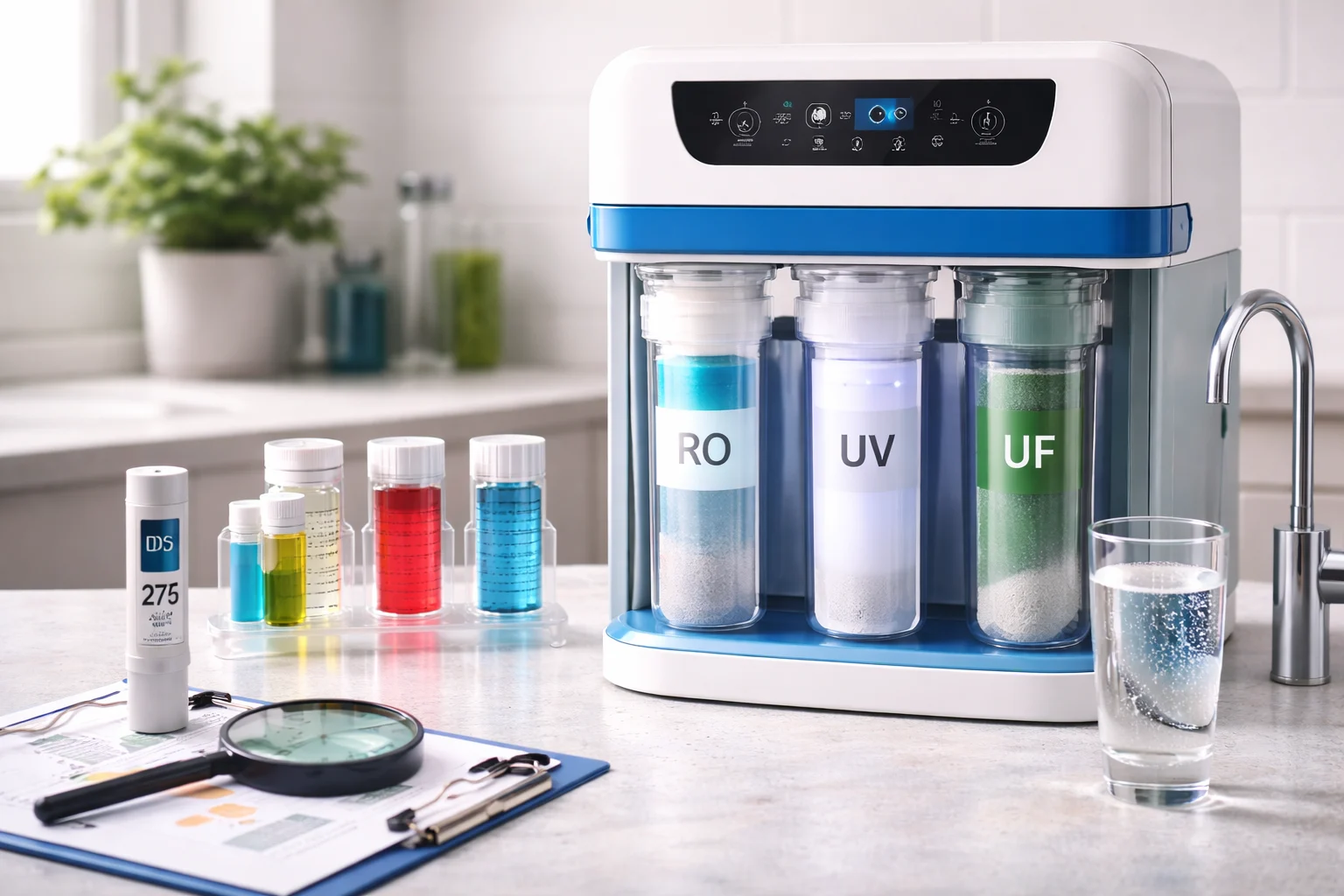

Choosing the right water purifier for your home is essential for safe and healthy drinking water. With multiple technologies like RO, UV, and UF available, selecting the best one depends on your water quality, source, and specific needs.
Step 1: Check Your Water Quality
Before buying a purifier, test your water for TDS (Total Dissolved Solids), hardness, and contaminants. Drinking water is generally considered acceptable below around 500 mg/L TDS for taste and quality. :contentReference[oaicite:0]{index=0}
- Low TDS (below 300 ppm): Municipal water
- High TDS (above 300 ppm): Borewell or groundwater
- Biological contamination: Bacteria, viruses
Step 2: Understand Types of Water Purifiers
1. RO (Reverse Osmosis)
RO purifiers remove dissolved salts, heavy metals, and impurities using a semi-permeable membrane. :contentReference[oaicite:1]{index=1} ✔ Best for high TDS water and borewell supply
2. UV (Ultraviolet)
UV purifiers use ultraviolet light to kill bacteria and viruses without changing taste. :contentReference[oaicite:2]{index=2} ✔ Best for low TDS water with microbial contamination
3. UF (Ultrafiltration)
UF filters remove suspended particles and microorganisms but not dissolved salts. :contentReference[oaicite:3]{index=3} ✔ Best for basic filtration and areas with low TDS
4. RO + UV + UF Combination
Advanced purifiers combine multiple technologies for complete purification and better safety. :contentReference[oaicite:4]{index=4} ✔ Best for mixed contamination
Step 3: Choose Based on Water Source
| Water Source | Recommended Purifier |
|---|---|
| Municipal Supply | UV / UF |
| Borewell Water | RO |
| Mixed Source | RO + UV + UF |
Step 4: Important Factors to Consider
- Storage Capacity: Choose based on family size
- Maintenance Cost: Check filter replacement cost
- Electricity Usage: RO & UV need power, UF doesn’t
- Water Wastage: RO systems waste some water
- Additional Features: Mineralizer, TDS controller, smart alerts
Step 5: Quick Selection Guide
| Condition | Best Choice |
|---|---|
| High TDS water | RO purifier |
| Bacteria/virus concern | UV purifier |
| Low TDS, basic filtration | UF purifier |
| All-in-one protection | RO + UV + UF |
FAQs
Which water purifier is best for home?
It depends on your water quality—RO for high TDS, UV/UF for low TDS.
Is RO water safe to drink daily?
Yes, especially when it includes a mineralizer.
Do I need a water test before buying?
Yes, it helps you choose the correct purifier type.
Which purifier needs less maintenance?
UF and UV systems generally require less maintenance than RO.
Conclusion
Choosing the right water purifier depends on your water source, TDS level, and type of contamination. By understanding these factors and selecting the right technology, you can ensure safe, clean, and healthy drinking water for your home.
