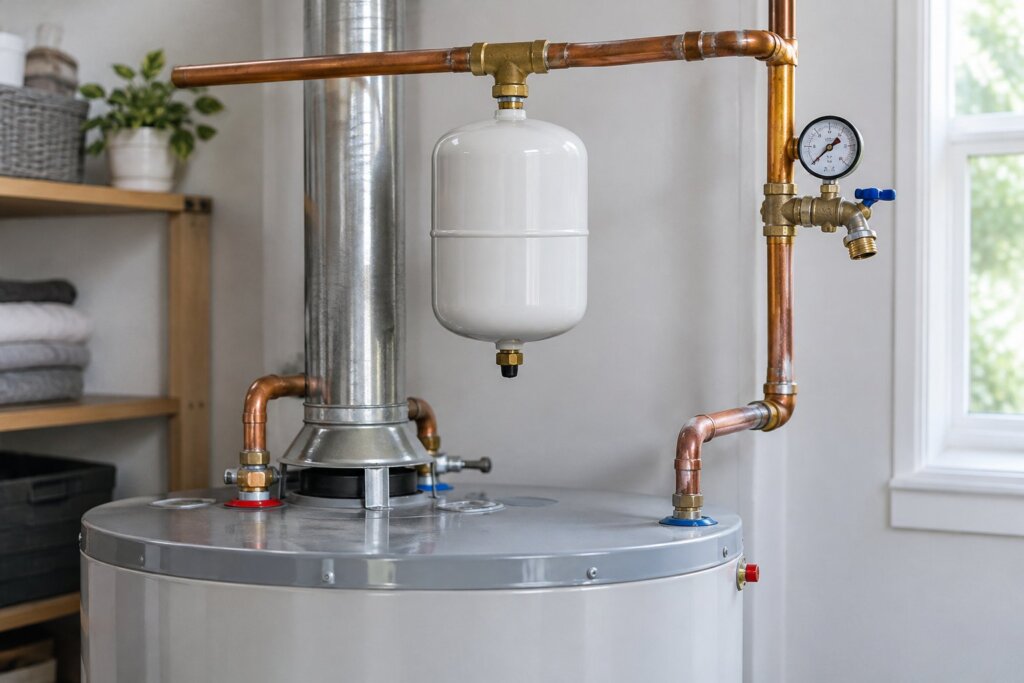
In a water heater expansion tank installation, the tank goes on the cold water supply line, between the water heater and the nearest check valve, backflow preventer or pressure-reducing valve, with its air pre-charge set to match your home’s water pressure before it is filled. For a 40- or 50-gallon heater at normal household pressure, Amtrol’s sizing chart calls for its smallest residential model, the ST-5, which holds 2 gallons.
Below is when you need one, how to size it, the exact installation order from the manufacturer’s instructions, and what it costs.
Do you need an expansion tank on your water heater?
You need one if your plumbing is a “closed system,” which means a check valve, pressure-reducing valve or backflow preventer sits on the water line coming into the house. Ogden City, Utah explains it plainly in its homeowner handout: “when a check valve, pressure-reducing valve or backflow preventer is installed in the service pipe a ‘closed system’ is created. Provisions must be made for thermal expansion in these cases.”
Water expands as it heats. In an open system, the extra volume can push back toward the city main. In a closed system it has nowhere to go, so the pressure climbs every time the heater runs.
Manufacturers treat this as a warranty issue. The Lochinvar residential gas water heater manual, from an A. O. Smith company, says thermal expansion “can cause premature tank failure (leakage)” and that this type of failure “is not covered under the limited warranty.” It adds that “a properly sized thermal expansion tank must be installed on all closed systems.”
The International Residential Code covers the same ground in section P2903.4, which requires a means of controlling thermal expansion where a backflow preventer, check valve or similar device creates a closed system. Your local code is the version that applies, so check with your building department if you are unsure.
What are the signs you need one?
The clearest sign is a temperature-pressure relief valve that drips or discharges now and then. The Lochinvar manual says thermal expansion “can also cause intermittent temperature-pressure relief valve operation,” and that the valve “is not intended for the constant relief of thermal expansion.”
Other signs to check:
- A new water meter or a dual check valve was recently installed at the street. Ogden City’s handout shows one in the meter box on the customer side.
- Your home has a pressure-reducing valve on the main line.
- Static water pressure reads high on a gauge. The 2021 International Residential Code, section P2903.3.2, caps static pressure at 80 psi and requires a pressure-reducing valve above that, which in turn closes the system.
If you see water around the base of the heater, read our guide on whether a leaking water heater is dangerous first, because a relief valve drip and a tank leak need very different fixes.
What size expansion tank do you need?
Size depends on three things: the heater’s capacity, your static water pressure and the heater’s temperature setting. Amtrol’s Therm-X-Trol quick sizing chart, built on 40°F incoming water, a 150 psi relief valve and a pre-charge equal to supply pressure, gives these picks for a heater set at up to 160°F:
| Water heater size | 40 psi supply | 60 psi supply | 80 psi supply |
|---|---|---|---|
| 40 gallons | ST-5 | ST-5 | ST-8 |
| 50 gallons | ST-5 | ST-8 | ST-8 |
| 60 gallons | ST-8 | ST-8 | ST-12 |
| 80 gallons | ST-8 | ST-12 | ST-25V |
| 120 gallons | ST-12 | ST-25V | ST-25V |
Two details on the same chart change the answer. A heater set hotter, up to 180°F, needs a larger tank: a 50-gallon heater at 60 psi moves from the ST-5 to the ST-8. A heater kept at 140°F or below can use the ST-5 for 40 and 50 gallons at any of the three pressures.
For reference, Amtrol’s specifications list the ST-5 at 2.0 gallons of tank volume with 0.9 gallons of maximum acceptance, the ST-8 at 3.2 gallons and 1.9 gallons, and the ST-12 at 4.4 gallons and 3.2 gallons. All three have a 3/4 inch NPT male connection, a maximum working pressure of 150 psig and a factory pre-charge of 50 psig.
Parts and tools for this job
- Amtrol ST-5 thermal expansion tank, 2 gallon: the model Amtrol’s chart points to for many 40 and 50 gallon heaters. Check the chart against your own pressure first.
- CARBO water pressure test gauge, 0 to 200 psi, 3/4 inch hose thread: reads your static pressure at a hose bib, the number the pre-charge must match.
As an Amazon Associate, Complete Water Guide earns from qualifying purchases. Prices change, so check the listing.
How do you install a water heater expansion tank?
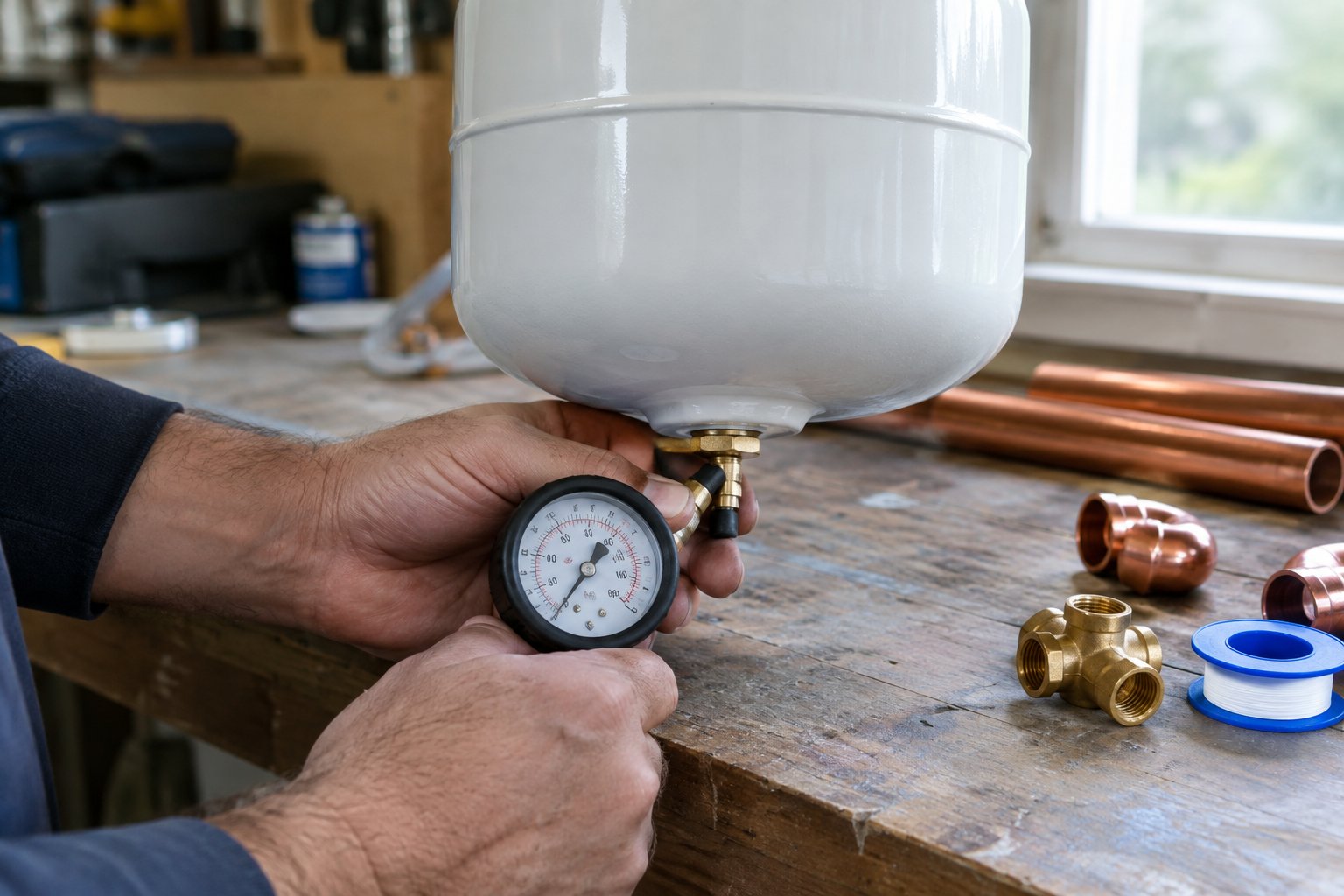
Amtrol’s installation instructions for the Therm-X-Trol ST-5C through ST-210VC give this order. Note the first line of those instructions: “THIS PRODUCT MUST BE INSTALLED BY A LICENSED PROFESSIONAL.”
- Measure your water pressure. Thread a pressure gauge onto a hose bib or the heater drain valve with no water running. That reading is your static supply pressure.
- Set the pre-charge on the empty tank. “With tank empty of water, adjust pre-charge to match cold water supply pressure.” Amtrol’s ST-5, ST-8 and ST-12 ship at 50 psig, so add or release air at the valve with a tire gauge until it matches your reading. Amtrol says adjustments “must be done at ambient temperature only.”
- Cap the air valve. Amtrol warns that failing to seal the valve cap “will result in loss of precharge causing product to fail.”
- Install it on the cold line, “between the water heater and backflow preventer, check valve or pressure reducing valve.” Mount it vertically only, and support it so the piping does not carry the weight of a tank full of water.
- Check for leaks along the supply line once water is back on.
- Purge the air before the heater fires: open a hot water fixture and draw water until all air is out.
- Bleed the first heat-up. Amtrol says to slightly open a hot faucet until the heater reaches temperature. After that, no further bleeding is needed.
The manual for the Lochinvar heater recommends dielectric unions or couplings where the heater connects to copper pipe, to protect fittings from corrosion. That applies to the new tee and fittings too.
How do you check the pre-charge later?
Shut off the cold supply, relieve pressure at a hot faucet, then read the air valve with a tire gauge. It should match your static water pressure. A licensed professional should check the whole system, including the expansion tank, “yearly and more frequently as the system ages,” per Amtrol.
Newer Amtrol tanks carry an InSight indicator cap on the air valve that changes color when the tank needs replacing, according to the company’s brochure. Amtrol’s instructions also say not to re-pressure a tank that is corroded, damaged or has “diminished integrity”. Replace it instead.
How much does expansion tank installation cost?
The tank itself costs about $40 to $90, and installing and testing it takes about 45 to 60 minutes, according to ContractorPlus’s August 2026 cost estimator. We could not find a reliable published price for a plumber-installed tank. ContractorPlus lists labor at $0, so its totals are not a real installed price. Ask for a written quote that names the tank model.
For context, the Department of Energy puts a typical new gas tank water heater at $1,578 installed and an electric one at $1,855, in 2022 dollars. A small expansion tank that keeps pressure off the tank is cheap insurance against that bill, which our water heater replacement cost guide covers in detail.
If your home also has weak flow at the taps, the pressure-reducing valve may be part of the story. Our guide to low water pressure covers the causes, and the water heater troubleshooting guide covers the rest of the heater.
Frequently asked questions
Where does the expansion tank go on a water heater?
On the cold water supply line, between the water heater and the backflow preventer, check valve or pressure-reducing valve, per Amtrol’s instructions. Mount it vertically.
What size expansion tank for a 50-gallon water heater?
Amtrol’s chart calls for an ST-5 at 40 psi and an ST-8 at 60 or 80 psi, for a heater set at up to 160°F. At 180°F, every pressure needs at least an ST-8.
What should the expansion tank pressure be?
Set the air pre-charge to match your static cold water supply pressure, with the tank empty of water. Amtrol’s residential tanks ship at 50 psig, so adjust up or down to your reading.
Is an expansion tank required by code?
The International Residential Code, section P2903.4, requires thermal expansion control where a backflow preventer or check valve creates a closed system. Local adoptions vary, so confirm with your building department.
Why does my relief valve drip without an expansion tank?
In a closed system, heated water expands and raises the pressure until the relief valve opens. The Lochinvar manual says the valve is not meant for constant relief of thermal expansion and points to an expansion tank as the fix.
How long does an expansion tank last?
Amtrol gives the ST-5C through ST-210VC a three-year limited warranty, and recommends a yearly check by a licensed professional. Replace the tank if it shows corrosion or its indicator cap changes color.
Sources
- Amtrol, Therm-X-Trol Thermal Expansion Absorbers Installation and Operation Instructions, models ST-5C(DD) through ST-210VC, part 9017-091 (04/24).
- Amtrol, Water Heater Expansion Tanks brochure MC4090 (11/17): specifications and Quick Sizing Charts.
- Lochinvar (an A. O. Smith company), Residential Gas Water Heater Installation and Operation Manual, 2017: thermal expansion and closed systems.
- Ogden City, Utah, Thermal Expansion Danger homeowner handout, quoting 2021 International Residential Code section P2903.3.2.
- International Code Council, 2021 International Residential Code, sections P2903.3.2 and P2903.4.
- ContractorPlus, Replace Water Heater Expansion Tank cost estimator, August 2026. Estimator output, not quotes.
- U.S. Department of Energy, Consumer Water Heaters final rule, Federal Register, May 6, 2024.