
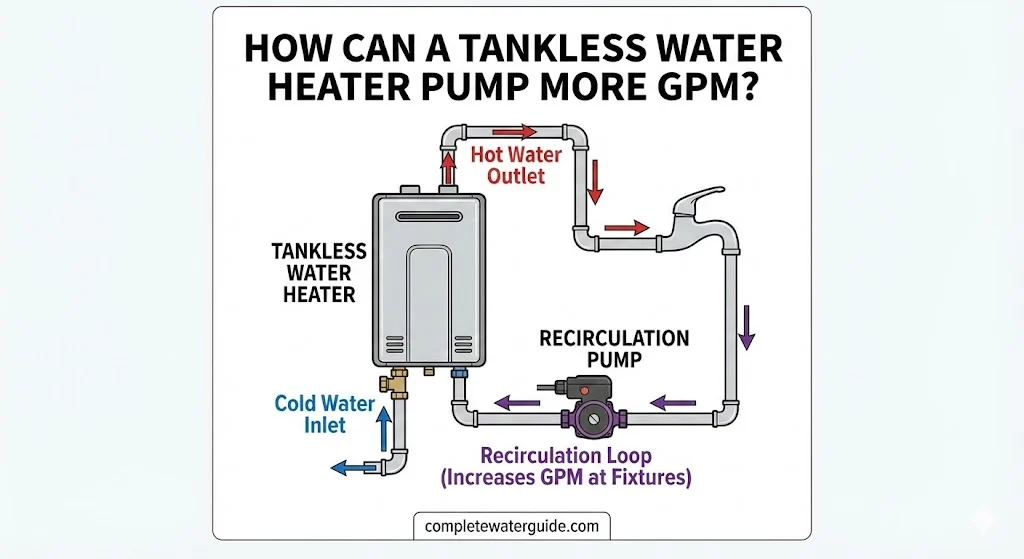

You bought a tankless water heater for endless hot water, but now you’re realizing “endless” doesn’t mean “infinite volume.” If your shower goes cold when the dishwasher starts, you are hitting your unit’s GPM (Gallons Per Minute) limit. Here’s an answer-first guide on how to squeeze more flow out of your system, covering temperature rise physics, parallel installation strategies, and simple maintenance hacks.
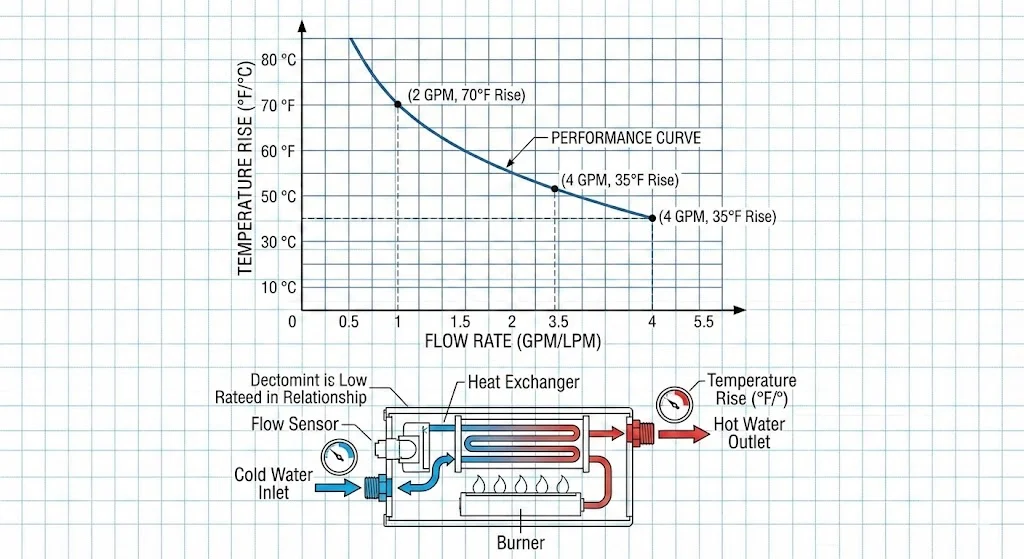
The Science: Why GPM Drops in Winter
Unlike a tank heater that stores hot water, a tankless unit heats water instantly. Its ability to pump water is strictly limited by math. It can only add a certain amount of heat (BTUs) per second.
The formula is: Max GPM = BTU Output ÷ (Temp Rise × 500)
- Summer: Groundwater is 70°F. To reach 120°F, the heater adds 50°. Result: High GPM.
- Winter: Groundwater drops to 40°F. To reach 120°F, the heater must add 80°. Result: Low GPM (The unit automatically slows the water down to ensure it gets hot enough).
Scenario: How Temperature Kills Flow Rate
| Groundwater Temp | Desired Output | Temp Rise Needed | Resulting GPM (Typical 199k BTU Unit) |
|---|---|---|---|
| 70°F (Warm) | 120°F | 50°F | ~7.5 GPM (3 showers) |
| 55°F (Mild) | 120°F | 65°F | ~5.8 GPM (2 showers) |
| 40°F (Cold) | 120°F | 80°F | ~4.7 GPM (1.5 showers) |
| 40°F (Cold) | 110°F (Optimized) | 70°F | ~5.4 GPM (Recovered ~0.7 GPM) |
Notice the last row: simply lowering your thermostat by 10°F can gain you nearly a gallon per minute of flow.
4 Ways to Increase Your GPM Output
If you are tired of weak pressure, try these solutions ranging from free adjustments to professional upgrades.
1. The “Turn Down” Trick
Most people set their heater to 120°F or 125°F but mix it with cold water at the tap to make it bearable. This is inefficient. Set your heater to 110°F or 112°F. This reduces the work the heater has to do (Temperature Rise), allowing the computer to open the flow valve wider. You get more volume, and you just use the hot tap fully open without mixing.
2. Clean the Inlet Filter & Descale
If your GPM used to be high but has dropped over time, your heat exchanger is likely clogged with scale (calcium) or debris. A tankless unit has a tiny inlet screen that catches sediment. If this is plugged, no amount of heating power will help.
Action: Flush your system with vinegar or a descaling solution. If you aren’t comfortable doing this yourself, you can book a professional maintenance visit via our services page to restore your unit to factory flow rates.
3. Install a Second Unit (Parallel)
For large families, one unit might never be enough. You can install a second tankless heater and link them with a “quick connect” cable. This allows them to “talk” to each other and split the load, effectively doubling your GPM. This is often better than buying one giant commercial unit.
4. Use Low-Flow Fixtures
If you can’t increase the supply, decrease the demand. Swap 2.5 GPM showerheads for 1.8 GPM high-efficiency models. This allows you to run two showers simultaneously on a flow budget that previously only supported one.
FAQs
Will adding a water pump increase GPM?
Generally, no. A pump increases pressure (PSI), not the heating capacity. If you force water through a tankless heater faster than it can heat it, the unit will simply shut down or deliver lukewarm water to protect itself.
Can I add a small tank to my tankless system?
Yes! This is called a “buffer tank” or “hybrid installation.” A small 6-10 gallon electric mini-tank installed after the tankless unit can provide a reservoir for short bursts of high demand, smoothing out flow issues.
Why does my flow rate drop when I turn the faucet on fully?
This is the “Flow Control Valve” inside the heater working. If the water is moving too fast to be heated to your set temperature, the unit deliberately restricts the flow to ensure the water comes out hot, not tepid.
How often should I flush my tankless heater?
In areas with hard water, every 6-12 months. Scale buildup acts as insulation, forcing the heater to work harder and restricting water flow paths.
References
- Department of Energy — Tankless Water Heaters
- Rinnai — Understanding Flow Rates
- Noritz — Sizing & GPM Calculations
What Readers Say (Verified)
Verified
Turning the temp down to 110 actually worked! We can finally run the shower and sink at the same time in winter.
Verified
We ended up installing a second unit in parallel. It was expensive but totally worth it for a family of 5.
Verified
Good explanation of the physics. I didn’t realize groundwater temperature had such a huge impact on GPM.
Verified
Cleaning the inlet filter fixed my low pressure instantly. It was completely blocked with grit.
