Quick Answer: Crystal Geyser has no published brand-specific PFAS test, so there is no verified number. Its main line is natural spring water with no reverse-osmosis step — the category that tends to test in the ~1 to 2 ppt range, above purified brands like Aquafina (~0.5) but under the 4 ppt EPA legal limit. Worth knowing separately: Crystal Geyser has a documented hazardous-waste regulatory history unrelated to PFAS, which is a fair reason some buyers approach the brand cautiously.
What We Actually Know About Crystal Geyser and PFAS
Let’s separate verified facts from guesswork:
- Crystal Geyser was not individually tested in the widely cited Consumer Reports analysis of 47 bottled waters. There is no published, brand-specific total-PFAS number for it the way there is for Poland Spring (1.66) or Fiji (~0.5).
- Its flagship is natural spring water, the “Alpine Spring Water” line, drawn from several spring sources across the US and bottled at the source. This line receives no reverse-osmosis treatment.
- It also sells a purified line in some markets, which — if reverse-osmosis treated — would be expected to test lower, in line with other purified brands.
The honest answer is inference, not measurement: Crystal Geyser’s spring line almost certainly carries trace PFAS in the same range as other spring waters — roughly 1 to 2 ppt — but no verified number exists. Anyone quoting a precise figure is extrapolating.
Why the Spring-Water Process Points to the Answer
When a brand-specific test is missing, the production method is the most reliable predictor — and it has been consistent across every water that has been tested.
Spring water like Crystal Geyser Alpine is drawn from underground springs, filtered for sediment, and disinfected with ozone or UV. None of those steps removes PFAS. The “minimal processing” spring brands advertise as a virtue is exactly why forever chemicals pass straight through into the bottle.
Purified brands, by contrast, use reverse osmosis — a membrane with pores around 0.0001 microns that physically excludes PFAS, removing 94-99%. That single step is why Aquafina (~0.5) and Dasani (~0.4) test at a fraction of what spring waters do. Crystal Geyser’s spring line skips it.
The Regulatory History Worth Knowing
Separate from PFAS, Crystal Geyser has a documented environmental-compliance history that is relevant to how much to trust the “natural” branding. In 2020, CG Roxane — the company behind Crystal Geyser — pleaded guilty to federal charges related to the illegal storage and unlawful transport of hazardous waste. The waste in question was arsenic-laden filter sludge from a bottling facility, generated while removing naturally occurring arsenic from spring water.
Two things to be clear about: first, this concerned waste handling, not the arsenic content of the bottled water sold to consumers, which the company stated met safety standards. Second, it is unrelated to PFAS. But it is a matter of public record, and it is a legitimate reason some buyers treat the brand’s environmental claims with extra scrutiny.
How Crystal Geyser Likely Fits the Rankings
| Brand | Total PFAS (ppt) | Type |
|---|---|---|
| Essentia | 0.2 | Purified (RO) |
| Dasani | ~0.4 | Purified (RO) |
| Aquafina | ~0.5 | Purified (RO) |
| Deer Park | ~1.2 | Spring |
| Crystal Geyser (Alpine) | No published data (likely ~1-2) | Spring |
| Arrowhead | No published data (likely ~1-2) | Spring |
| Poland Spring | 1.66 | Spring |
Full rankings: Best Bottled Water Without PFAS and our complete bottled water rankings.
Is the Likely Level Safe to Drink?
If Crystal Geyser’s spring line sits in the estimated 1-2 ppt range, it is legal and compliant — under the EPA’s 4 ppt limit for individual regulated compounds and the industry’s 5 ppt voluntary standard, though above the stricter 1 ppt threshold some scientists advocate. Occasional drinking carries no established PFAS risk.
The number matters for cumulative exposure. PFOA and PFOS have blood half-lives of 2 to 5 years, so if bottled water is your main daily source, a purified brand at 0.4-0.5 ppt roughly halves or thirds the contribution compared with a spring water. For an occasional drinker, the difference is negligible against larger sources.
Where Bottled Water Sits in Total Exposure
Even in the 1-2 ppt range, Crystal Geyser is rarely a person’s biggest PFAS source. The larger contributors:
- Food packaging — grease-resistant wrappers, microwave popcorn bags, takeout containers.
- Non-stick cookware — scratched or overheated pans above roughly 500°F / 260°C.
- Household dust — from treated carpets and textiles.
- Tap water — detectable in supplies serving more than 200 million Americans, per EWG estimates.
Lower-PFAS Alternatives to Crystal Geyser
If you want a lower, verified reading, switch from spring to purified:
- Dasani (~0.4) and Aquafina (~0.5) — reverse-osmosis purified, tested, roughly a third of the spring-water range.
- Essentia (0.2) — the lowest tested purified brand.
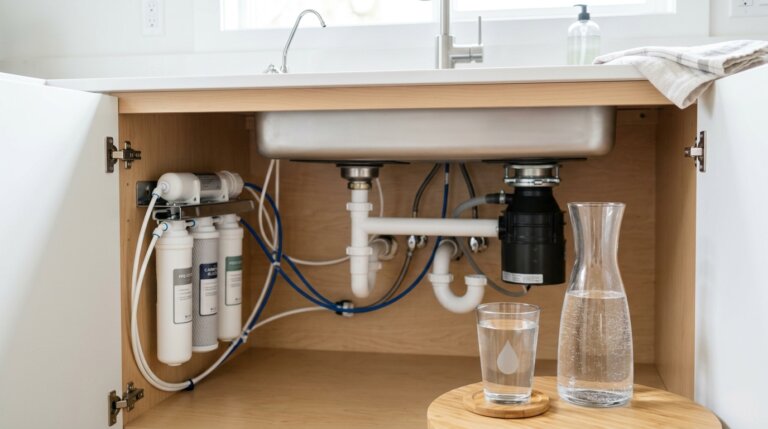
- Home filtration — a certified NSF 53/58 system beats every bottled brand and gives a number you can verify.
Want a Verified Number? Filter at Home
A certified filter gives you a testable result instead of an inferred range — and takes tap water below every bottled brand, for pennies per gallon. As an Amazon Associate we earn from qualifying purchases.
Clearly Filtered Pitcher
Tested against 365+ contaminants including PFOA and PFOS. A verifiable way to go below every bottled brand’s PFAS level.
For under-sink and RO options, see the best certified PFAS filters.
Frequently Asked Questions
Does Crystal Geyser water have PFAS?
Crystal Geyser has no published brand-specific PFAS test. Its Alpine Spring Water line, with no reverse-osmosis step, very likely carries trace PFAS in the same ~1-2 ppt range as other spring waters like Deer Park (~1.2) and Poland Spring (1.66) — above purified brands and under the 4 ppt EPA legal limit.
Is Crystal Geyser water safe to drink?
Yes, for PFAS it meets FDA and IBWA bottled water standards and its likely level sits under the legal limits. Note separately that the company had a 2020 hazardous-waste conviction related to arsenic filter sludge disposal — a waste-handling matter, not the water sold to consumers, and unrelated to PFAS.
Why did Crystal Geyser get in legal trouble?
In 2020, CG Roxane, the maker of Crystal Geyser, pleaded guilty to federal charges over illegally storing and transporting arsenic-laden filter waste generated while removing naturally occurring arsenic from spring water. It concerned waste disposal, not the bottled water’s safety, and is unrelated to PFAS.
Is Crystal Geyser spring or purified water?
Its flagship is Alpine Spring Water, a natural spring water bottled at the source with no reverse osmosis. It also sells a purified line in some markets, which — if RO-treated — would be expected to test lower on PFAS than the spring line.
What bottled water is better than Crystal Geyser for PFAS?
Purified reverse-osmosis brands like Dasani (~0.4), Aquafina (~0.5) and Essentia (0.2) are tested and sit well below the spring-water range, at similar prices.
Which bottled water has no PFAS at all?
Icelandic Glacial reported non-detect results, and Essentia tested lowest among purified brands at 0.2 ppt. See the full PFAS-free bottled water rankings.
The Bottom Line
Crystal Geyser’s spring line almost certainly contains trace PFAS, most likely in the 1-2 ppt range, but it has no verified public test — its likely level is inferred from its spring-water process and tested peers like Deer Park (~1.2) and Poland Spring (1.66). That would keep it under the EPA’s 4 ppt legal limit and 5 ppt industry standard, while above the stricter 1 ppt scientist-recommended threshold.
Two honest caveats set Crystal Geyser apart: its spring process leaves PFAS in place rather than removing it, and its 2020 hazardous-waste conviction — though unrelated to PFAS and to the water sold — is a matter of record. If PFAS is your priority, a tested purified brand like Dasani or Aquafina cuts the likely reading to roughly a third, and home filtration beats every bottle with a number you can verify yourself.
References
- Consumer Reports — Bottled Water PFAS Testing (47 products)
- EPA — PFAS National Primary Drinking Water Regulation (2024)
- FDA — PFAS in Food & Bottled Water
- Environmental Working Group — PFAS Contamination Map
- US Department of Justice — Environment & Natural Resources Division
Affiliate disclosure: as an Amazon Associate we earn from qualifying purchases. It never affects our rankings or the numbers we report.