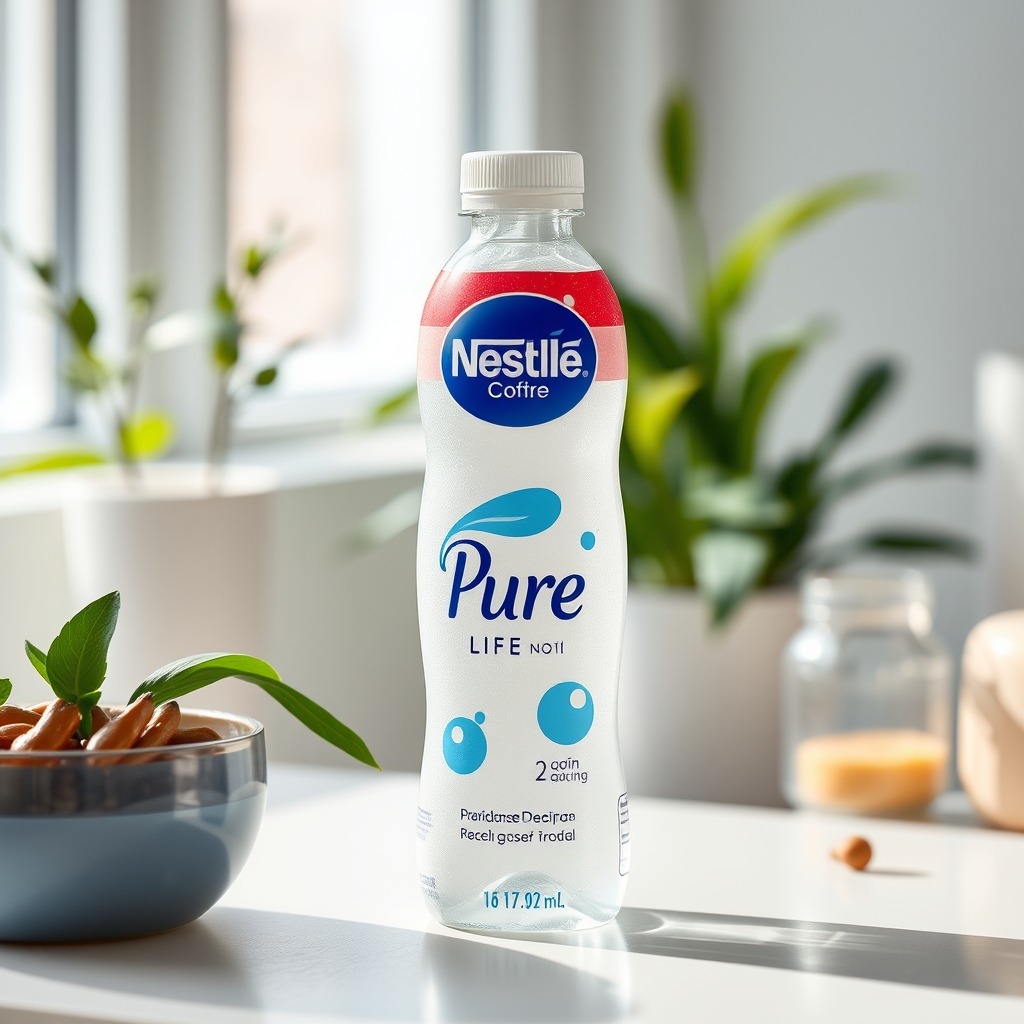
Quick Answer: Yes, and slightly more than most. Nestlé Pure Life measured around 1.0 ppt (parts per trillion) total PFAS in Consumer Reports’ bottled water testing — still under the 4 ppt EPA legal limit and the industry’s 5 ppt voluntary standard, but right at the 1 ppt threshold scientists recommended, and roughly twice the level of Aquafina (~0.5) or Dasani (~0.4). It is a purified water, but the result sits higher than most reverse-osmosis brands — a difference worth understanding before you buy it by the case.
What Testing Found in Nestlé Pure Life
In Consumer Reports’ analysis of 47 bottled waters for per- and polyfluoroalkyl substances (PFAS), Nestlé Pure Life came in at approximately 1.0 ppt total PFAS. That places it in an awkward middle spot: comfortably legal, but at the exact level the report’s scientists flagged as a precautionary ceiling.
- EPA legal limit (2024): 4 ppt each for PFOA and PFOS
- Industry voluntary standard: 5 ppt total
- Scientist-recommended limit: 1 ppt total PFAS
- Nestlé Pure Life: ~1.0 ppt — at the recommended threshold, under the legal ones
The nuance matters. Nestlé Pure Life is not unsafe by any regulatory measure — it clears the legal bar with a large margin. But among purified brands, which typically test at 0.2-0.5 ppt, a 1.0 ppt result stands out as roughly double, and that is the honest headline.
How Nestlé Pure Life Compares
| Brand | Total PFAS (ppt) | Type |
|---|---|---|
| Essentia | 0.2 | Purified (RO) |
| Dasani | ~0.4 | Purified (RO) |
| Aquafina | ~0.5 | Purified (RO) |
| Nestlé Pure Life | ~1.0 | Purified |
| Poland Spring | 1.66 | Spring |
| Tourmaline Spring | ~4.0 | Spring |
Nestlé Pure Life sits between the cleanest purified brands and the higher-testing spring waters — better than Poland Spring, but noticeably above its purified peers. Full rankings: Best Bottled Water Without PFAS and our complete bottled water rankings.
Why Does a Purified Water Test at 1.0 ppt?
This is the real question, because purification is supposed to keep the number low. A few factors likely explain why Nestlé Pure Life reads higher than Aquafina or Dasani:
- Purification method varies by plant. Nestlé Pure Life is bottled at multiple facilities, and not all use full reverse osmosis — some rely on a lighter purification (carbon filtration, microfiltration, ozonation) that reduces PFAS less completely than RO. Where RO is not the core step, more PFAS survives.
- Source water differs by region. Purified brands start from local municipal or well sources that vary in background PFAS. A plant drawing from a more contaminated supply, without aggressive RO, will finish higher.
- Single-sample testing. The 1.0 ppt figure is one sample at one time. Another bottle from another plant could read higher or lower — which is a limitation, but also means 1.0 is not a fixed brand constant.
The takeaway: unlike Aquafina and Dasani, whose central RO step reliably drives PFAS down, Nestlé Pure Life’s result suggests its purification is less uniformly aggressive. That is the most plausible reason for the gap.
Is 1.0 ppt Safe to Drink?
By regulation, yes — 1.0 ppt is one-quarter of the EPA’s 4 ppt legal limit for individual compounds and one-fifth of the industry’s 5 ppt standard. Nestlé Pure Life is a legal, compliant bottled water, and drinking it occasionally poses no established risk.
The reason to note the number is cumulative exposure. The compounds regulators track — PFOA and PFOS — have estimated half-lives in human blood of 2 to 5 years, so intake adds up over time. If bottled water is your primary daily source, choosing a 0.4 ppt brand over a 1.0 ppt one more than halves that particular input. For someone drinking several litres a day, that is a meaningful, easy swap; for an occasional drinker, it barely registers.
Where Bottled Water Ranks in Your Total Exposure
Even at 1.0 ppt, Nestlé Pure Life is rarely a person’s largest PFAS source. The bigger contributors for most people:
- Food packaging — grease-resistant wrappers, microwave popcorn bags, some takeout containers.
- Non-stick cookware — scratched or overheated pans (above roughly 500°F / 260°C).
- Household dust — from treated carpets and textiles, a notable route for children.
- Tap water — detectable PFAS in supplies serving more than 200 million Americans, per EWG estimates.
So while switching away from Nestlé Pure Life lowers one input, it is worth keeping the whole picture in view rather than treating a single brand as the decisive factor.
Better Alternatives If You Want a Lower Number
If you like the convenience of purified bottled water but want a lower PFAS reading than Nestlé Pure Life’s, the swaps are simple and same-priced:
- Dasani (~0.4 ppt) or Aquafina (~0.5 ppt) — both use central reverse osmosis and test at less than half Nestlé Pure Life’s level.
- Essentia (0.2 ppt) — the lowest tested purified brand, if you want the cleanest widely available option.
- Home filtration — a certified NSF 53/58 filter beats every bottled brand and gives a number you can verify yourself.
Want to Beat Every Bottle? Filter at Home
A certified filter takes tap water below what any bottled brand tests at — including the cleanest — for pennies per gallon. As an Amazon Associate we earn from qualifying purchases.
Clearly Filtered Pitcher
Tested against 365+ contaminants including PFOA and PFOS. A verifiable way to go below every bottled brand’s PFAS level.
For under-sink and RO options, see the best certified PFAS filters.
Frequently Asked Questions
Does Nestlé Pure Life have PFAS?
Yes. It measured approximately 1.0 ppt total PFAS in Consumer Reports’ testing — legal and under the 4 ppt EPA limit, but at the 1 ppt scientist-recommended threshold and about twice the level of purified brands like Aquafina and Dasani.
Is Nestlé Pure Life safe to drink?
Yes, by every regulatory standard. At 1.0 ppt it sits well under the 4 ppt EPA legal limit and 5 ppt industry standard. The reason to note the number is cumulative exposure, not any immediate safety risk.
Why does Nestlé Pure Life test higher than Aquafina or Dasani?
Most likely because its purification is less uniformly reverse-osmosis-based. Nestlé Pure Life is bottled at multiple plants, some using lighter purification than full RO, and source water varies by region — both of which leave more PFAS than a central RO step would.
Is Nestlé Pure Life purified or spring water?
It is a purified water, drawn from local municipal or well sources and treated before bottling. It is not marketed as a natural spring water, which makes its 1.0 ppt result notable, since purified brands usually test lower.
What bottled water is better than Nestlé Pure Life for PFAS?
Dasani (~0.4 ppt), Aquafina (~0.5 ppt) and Essentia (0.2 ppt) all use reverse osmosis and test at less than half Nestlé Pure Life’s level, at similar prices.
Which bottled water has no PFAS at all?
Icelandic Glacial reported non-detect results, and Essentia tested lowest among purified brands at 0.2 ppt. See the full PFAS-free bottled water rankings.
The Bottom Line
Nestlé Pure Life contains PFAS at roughly 1.0 ppt — legal and compliant, sitting under the EPA’s 4 ppt limit and the industry’s 5 ppt standard, but right at the stricter 1 ppt threshold some scientists advocate and about double the level of purified peers like Aquafina and Dasani. It is not unsafe, but among purified waters it is a middling performer rather than a leader.
The likely reason is that its purification is not as uniformly reverse-osmosis-driven as the cleaner brands, and its source water varies by bottling plant. If you drink purified water daily and want a lower number, switching to Dasani, Aquafina or Essentia more than halves the reading at the same price — and home filtration beats them all with a result you can verify yourself.
References
- Consumer Reports — Bottled Water PFAS Testing (47 products)
- EPA — PFAS National Primary Drinking Water Regulation (2024)
- FDA — PFAS in Food & Bottled Water
- Environmental Working Group — PFAS Contamination Map
- ATSDR/CDC — Health Effects of PFAS Exposure
Affiliate disclosure: as an Amazon Associate we earn from qualifying purchases. It never affects our rankings or the numbers we report.